
A fuel result is only as useful as the sample behind it. Reliable bunker sampling and analysis starts with a representative sample collected throughout delivery, not a bottle drawn at one moment. A MARPOL sample supports statutory fuel-compliance checks, while commercial samples help investigate fuel quality and contractual claims.
It’s easy to focus on the laboratory result, but the sampling method, identification, sealing and storage all affect how confidently you can use it. This article explains how shipboard sampling works, how MARPOL and commercial samples differ, and how careful handling preserves the evidence. You’ll also learn what analysis can reveal and why the findings matter for fuel decisions, machinery and contractual discussions.
Key Takeaways
- Match the sampling method to the decision: shipboard monitoring, statutory compliance and contractual quality investigations serve different purposes.
- For the retained fuel sample, the International Maritime Organization specifies at least 400 ml, with the container filled to 90% ± 5% of capacity.
- Protect sample integrity by mixing thoroughly before filling, preventing contamination and maintaining clear seal and custody records.
- Compare commercial sample results with the agreed fuel specification and machinery limits to guide decisions when fuel quality is in question.
Bunker fuel testing and shipboard operations
Reliable fuel oil results begin with representative sampling at the receiving ship’s bunker manifold. MARPOL samples support compliance checks, while contract samples help assess quality against the agreed ISO 8217 edition.
Fuel Analysis Reporting and Customer Support
A fuel analysis report records measured properties, test methods and the sample’s seal number. This information links laboratory findings to the fuel delivered and supports timely operational decisions.
Tests can include sulphur, water, viscosity, density and aluminium. ISO 8217 requirements depend on the edition named in the bunker supply contract or charterparty; Table 2 includes limits for sulphur, water and aluminium. Viscosity measures resistance to flow, helping crews assess fuel handling and atomization. The report gives the results, not a substitute for interpreting them against the applicable specification.
Interpreting Independent Test Results
Independent test results are laboratory findings used to assess fuel quality against a specification or investigate a contractual concern. Their meaning depends on the sample’s identity, collection point, seal and test method.
Compare each result with the contract’s ISO 8217 edition and relevant machinery limits. Under ISO 8217:2024 Clause 8, disputes and result interpretation follow ISO 4259-2 procedures, which account for test-method precision. A result near a limit therefore needs context, not a simple pass-or-fail reading. Independent results can inform a claim, but they do not replace designated samples used for formal MARPOL compliance determinations.
Density and Centrifuge Separation
Fuel density affects how effectively an onboard centrifuge separates water and contaminants, including catalytic fines. High-density fuel can reduce separation efficiency, leaving more contaminants in the fuel entering the engine.
Catalytic fines are hard aluminium and silicon oxide particles. Excessive amounts can rapidly wear fuel pumps, plungers, liners and piston rings, making effective onboard treatment important. Viscosity also affects fuel handling and atomization. Insufficient heating can impair atomization or delay burning; excessive heating can cause cracking and release gases. Together, these properties help crews interpret results and manage fuel treatment before combustion.
Onboard Test Kits and Laboratory Analysis
Onboard bunker fuel test kits support operational screening, while laboratory analysis provides measured results using specified test methods. A kit can help crews assess fuel during shipboard operations; laboratory findings are better suited to documenting properties against a contract specification or examining a dispute.
Choose the result that fits the decision. A MARPOL sample serves statutory verification, while commercial samples support quality and contractual investigations. In the United States, analysis cost depends on the tests requested, sample handling and delivery logistics, and is provided after a quote request. Preserve the sample’s identity and seal details to keep the findings linked to the fuel delivery.
MARPOL-delivered sample procedures and retention
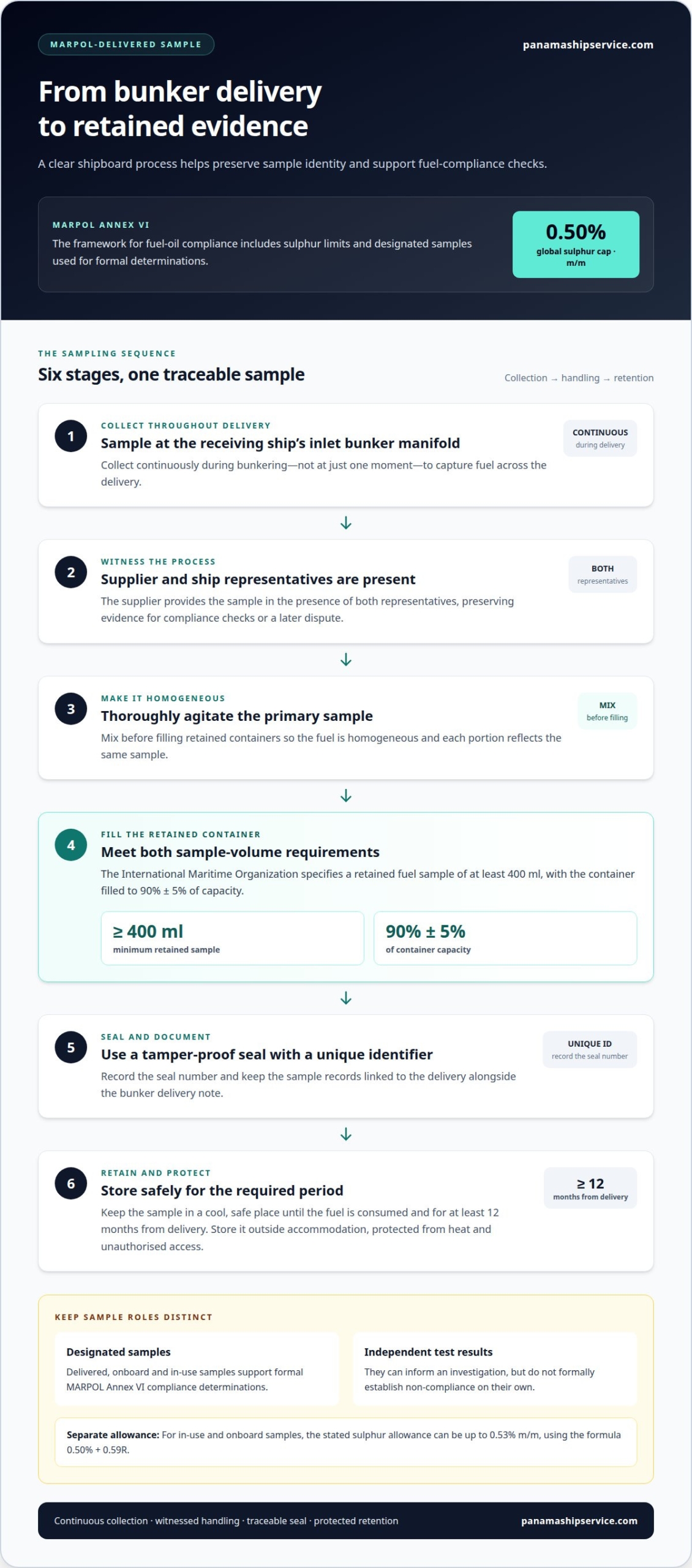
Standard vessel sampling draws fuel continuously at the receiving ship’s inlet bunker manifold throughout delivery. The supplier’s representative and the ship’s representative witness collection and sealing, preserving evidence for compliance checks or a later dispute.
Sampling Procedures on a Vessel
The MARPOL-delivered sample is collected during bunkering at the receiving ship’s inlet bunker manifold. Continuous collection captures fuel across the delivery, rather than at one moment, making the sample more representative of the fuel delivered.
The supplier provides the sample in the presence of both representatives. Before filling the retained container, thoroughly agitate the primary sample to make it homogeneous. Fit a tamper-proof seal with a unique identifier and record its number. This documented process helps link the sample to the delivery if fuel quality or sulphur compliance is disputed.
Annex VI Compliance and Sample Retention
MARPOL Annex VI sets the framework for fuel-oil compliance, including sulphur limits and designated samples used for formal determinations. The global sulphur cap for bunker fuel used by ships is 0.50% m/m. Under regulation 18.8.1, the delivered sample accompanies the bunker delivery note.
The International Maritime Organization states that the retained fuel sample must be at least 400 ml, with its container filled to 90% ± 5% capacity. Keep it in a cool, safe place until the fuel is consumed and for at least 12 months from delivery. Store it outside accommodation, protected from heat and unauthorised access.
In-use and onboard samples serve a different role from the delivered sample. They help assess fuel already in the ship’s system, while designated delivered, onboard and in-use samples support formal MARPOL Annex VI compliance determinations. Independent test results can inform an investigation, but don’t formally establish non-compliance on their own.
Preserve the seal number and sample records alongside the bunker delivery note. For in-use and onboard samples, the stated sulphur allowance can be up to 0.53% m/m, using the formula 0.50% + 0.59R. For vessel waste management beyond sample retention, consider MARPOL Disposal.
Sample mixing, division and contamination control
Improper sampling can introduce contamination or produce an unrepresentative result. Either can mislead fuel decisions and weaken evidence in a quality dispute.
Sample Mixing and Division
Mixing makes a collected fuel sample homogeneous before it is divided into separate containers. This ensures that each portion reflects the same bunker fuel, rather than uneven layers or settled material.
Thoroughly agitate the primary sample before filling retained containers. Then divide it carefully, keeping the sample identity and seal records linked to the delivery. If one portion is tested and another retained, inconsistent mixing can lead to different results. That weakens comparisons during later testing or a contractual investigation.
Water Contamination and Corrosion
Water contamination adds an unwanted component to marine fuel and can affect fuel treatment and engine operation. Water reduces fuel energy content, while excessive amounts can disrupt pretreatment and high-pressure fuel injection.
Seawater presents additional risks: it can corrode fuel apparatus, cause pumps and injectors to stick, and contribute to deposits in cylinders and turbochargers. Interpret a water result alongside the sample’s collection and handling history. Proper sampling helps distinguish fuel conditions from contamination introduced during collection.
Chemical Contamination Screening
Chemical contamination screening uses fuel testing to investigate whether measured properties indicate a quality concern. A single result may not explain how the fuel will behave in the ship’s system, so consider it in context.
Review results against the specification that applies to the bunker transaction, then consider machinery limits and operational context. For example, water, viscosity and aluminium results point to different fuel concerns and treatment needs. If an unusual result suggests contamination, preserve the sample and its records. This supports further analysis without treating one measurement as a complete diagnosis.
Contaminated Equipment and Sampling Risks
Contaminated sampling equipment can transfer residue into a new fuel sample. This can distort testing and make it harder to determine whether a result reflects the delivered fuel or the collection process.
Keep collection equipment clean and prevent contact with unrelated liquids or materials. Record sample identity, location and seal details so owners can trace each result to its source. A bottle taken at one moment may not represent an entire delivery; contamination or poor collection can therefore create misleading evidence. Consistent handling protects later comparisons and decisions.
Commercial and contractual bunker samples
Commercial samples help investigate fuel quality and contractual claims, rather than serving as the designated MARPOL compliance sample. Their value depends on representative sampling, clear records and comparison with the specification named in the bunker supply contract.
During a dispute, connect each sample to the delivery and vessel. Records should identify the sample, date, location and fuel grade, and include seal numbers, signatures and a link to the bunker delivery note. These details help establish which fuel was examined and provide a traceable basis for discussing results.
Send commercial samples promptly to a contracted laboratory. Review the report against the contract’s specified ISO 8217 edition and relevant machinery limits. ISO 8217 editions 2012 and 2017 are examples of versions that may appear in fuel contracts. Under ISO 8217:2024 Clause 8, ISO 4259-2 procedures guide dispute resolution and interpretation in light of test-method precision.
BIMCO Bunker Terms 2018 Clause 9(b)(ii) calls for marine fuel quality to be analysed by a mutually agreed, qualified and independent laboratory when a claim is raised. This makes agreement on the laboratory part of the contractual process, alongside the sample evidence. A result should be considered with its method and precision, not read as a standalone verdict.
If fuel is suspected to be non-compliant, preserve the sample and related records, notify relevant parties, and keep the fuel segregated where operationally possible. Technical assessment and contractual action can then proceed using evidence tied to the delivery. A vessel survey may help assess operational issues alongside fuel findings; plan the next vessel-side step.
Panama Ship Service
Panama Ship Service supports vessel operations when fuel findings point to a related technical or port-service need. Bunker sampling and analysis informs decisions, but it doesn’t replace action when inspections identify machinery concerns or other operational requirements.
When findings indicate a need to assess vessel condition, Marine Surveys can provide a relevant next step. Mechanical Ship Repairs and Underwater Hull Services address ship repair and hull-service needs, while MARPOL Disposal supports waste disposal requirements. These services complement operational planning but do not replace laboratory testing or contractual review of fuel results.
For support with vessel operations at the Panama Canal, contact Panama Ship Service.
Turn Fuel Findings Into a Clear Next Step
Reliable bunker sampling and analysis gives your team a stronger basis for operational decisions. The next step is to determine how the findings affect the vessel’s plans. Consider the technical issue, the timing of required work and the available evidence. A focused response helps connect fuel concerns with wider vessel operations.
Panama Ship Service supports shipping operations with services that address related needs, including Mechanical Ship Repairs, Underwater Hull Services and MARPOL Disposal. Turn to the appropriate service when fuel-related findings coincide with repair, hull-service or disposal requirements. Keep the operational issue and the required action clear when planning the vessel’s next move.
Contact Panama Ship Service to discuss support for your vessel’s operational needs. A clear next step helps your team move forward with confidence.
Frequently Asked Questions
Why does this matter?
Reliable fuel results help crews decide how to handle a delivery before it creates avoidable operational problems. For example, a result indicating excess water can prompt closer attention to fuel pretreatment and injection equipment. A well-documented sample also gives shipowners and suppliers a clearer basis for discussing a disputed delivery than recollection or an isolated observation.
Why is this important?
Fuel decisions affect both vessel operations and contractual accountability. A test result can guide whether fuel needs further assessment, while traceable records help establish which delivery it concerns. For example, matching the sample seal number to the bunker delivery note and sample register keeps the evidence connected to the correct transaction.
What is bunker fuel sampling and analysis?
Bunker fuel sampling and analysis is the collection and testing of marine fuel to assess its properties and suitability for a stated purpose. Sampling provides the material for testing; analysis measures characteristics such as sulphur, water, viscosity or density. Interpret the findings against the relevant contract specification or operational limits so the results can inform a specific fuel decision.
Where should bunker fuel samples be taken during delivery?
For a MARPOL-delivered sample, collection takes place at the receiving ship’s inlet bunker manifold during delivery. Continuous collection across the delivery period helps capture changes in fuel flow. This differs from drawing a single bottle at one moment, which may not reflect the full delivery. Make the collection point and method clear in the sample documentation.
How long do bunker fuel analysis results take?
Fuel analysis reports are sent to customers within 24 hours after the laboratory receives the fuel sample. That period begins on receipt, not necessarily when the sample is collected or dispatched. For operational planning, account for sample transit and handling before laboratory receipt. The report should identify test results and methods, and include the seal number of the retained sample tested.
How are bunker fuel samples sealed, labeled, and stored?
Use a tamper-proof security seal with a unique identifier, then record its number in the delivery documents and sample register. Labels and records should identify the fuel grade, date, location, signatures and bunker delivery note. Store retained samples in a cool, safe place, away from heat, direct sunlight, accommodation spaces and unauthorised access. Investigate any seal-number mismatch before custody is lost.