
The cost of marine fuel is one of the single largest expenses in vessel operation. At a high-traffic chokepoint like the Panama Canal, ensuring you receive the exact quantity of fuel you’ve paid for is not just a matter of good practice-it’s a critical financial control. An independent bunker survey is your most effective tool to protect your investment, prevent costly disputes, and ensure a smooth transit. This guide explains the entire process and demonstrates how a professional survey provides the proof you need to operate with confidence.
What is a Bunker Survey and Why is it Essential in Panama?
A bunker survey is a specialized inspection performed by a qualified, independent surveyor to accurately measure and verify the quantity of fuel oil delivered to a vessel. It is your primary defense against costly fuel shortages and quality discrepancies. In the time-sensitive environment of the Panama Canal, where tight schedules and complex logistics are the norm, preventing disputes before they arise is essential to avoid expensive delays. Our surveyors act as your expert, impartial witness on the ground, ensuring the entire process is transparent and accurately documented.
The Main Goal: Preventing Bunker Shortage Claims
Even small measurement discrepancies can result in significant financial losses over time. An independent survey precisely quantifies the amount of fuel delivered, comparing the supplier’s figures with the surveyor’s physical measurements. This provides irrefutable, third-party documentation that can be used to support any shortage claims, effectively eliminating “he said, she said” arguments and protecting your bottom line.
Key Terminology: BQS, MFM, and API Standards
To understand the process, it’s helpful to know the key terms. BQS simply stands for Bunker Quantity Survey. Many modern supply barges use a MFM (Mass Flow Meter) to measure delivery, but these systems still require independent verification. All reputable surveys are conducted according to strict international protocols, such as those set by the API (American Petroleum Institute), which ensures the procedures and calculations are standardized and recognized globally.
The Bunker Survey Process: A Step-by-Step Guide
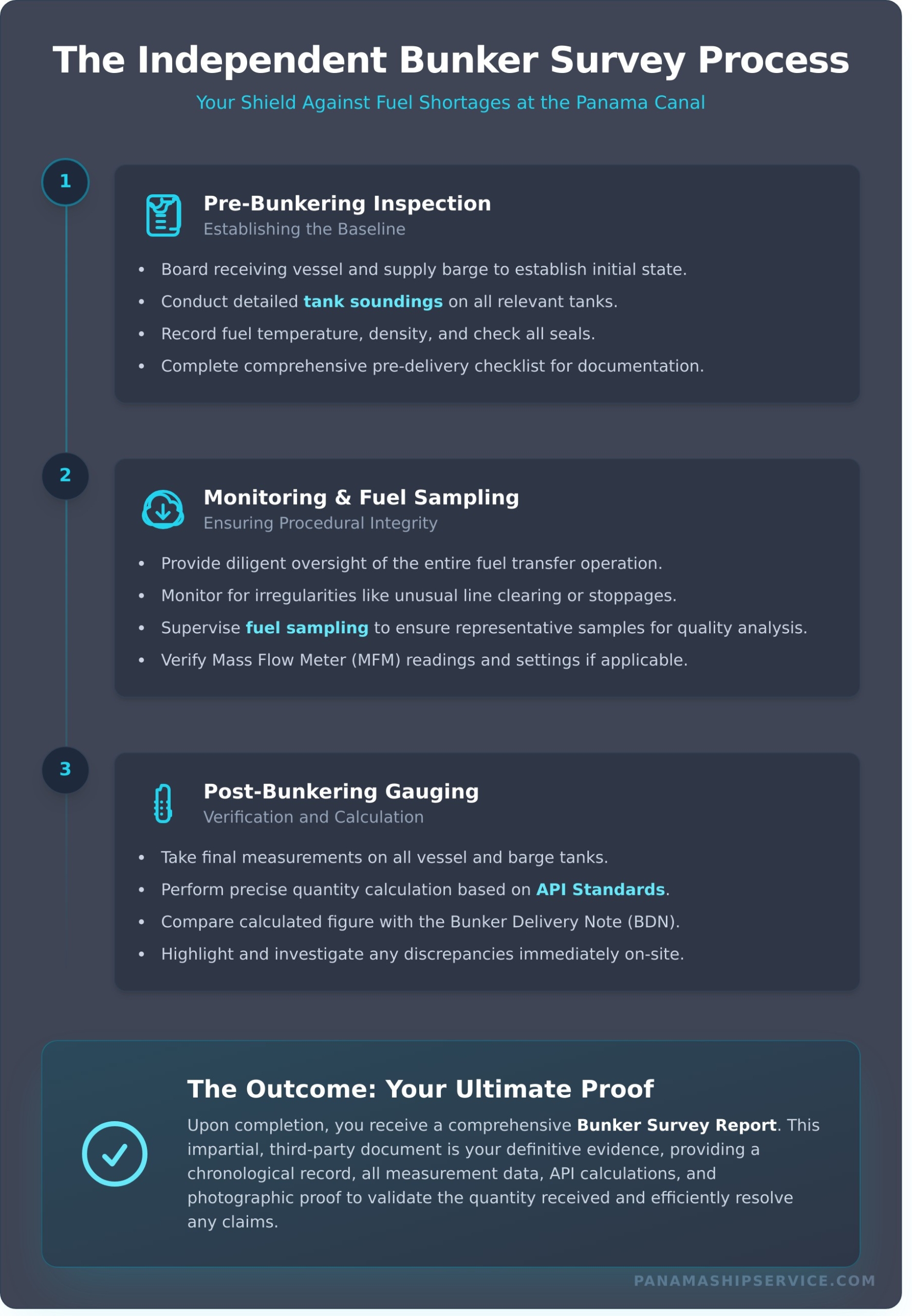
Our process is designed to ensure maximum accuracy and transparency from start to finish. By adhering strictly to American Petroleum Institute (API) protocols, we provide a clear and defensible record of the entire bunkering operation, maintaining constant communication between the receiving vessel’s crew and the fuel supplier.
Step 1: Pre-Bunkering Inspection and Measurement
Before any fuel is transferred, our surveyor boards both the receiving vessel and the supply barge or tanker. This initial phase is crucial for establishing a baseline. The surveyor takes detailed initial tank soundings on all relevant vessel and barge tanks, records the temperature and density of the fuel, and meticulously checks all seals. A comprehensive pre-delivery checklist is completed to ensure all conditions are documented before the operation begins.
Step 2: Monitoring Delivery and Fuel Sampling
During the transfer, the surveyor provides diligent oversight of the entire bunkering operation. This includes continuous monitoring for any irregularities, such as unusual line clearing or unexpected stoppages. A critical part of this stage is supervising the fuel sampling procedures. The surveyor ensures that samples are drawn correctly throughout the delivery, guaranteeing they are representative of the entire fuel batch and suitable for later analysis if a quality dispute arises.
Step 3: Post-Bunkering Gauging and Calculation
Once the delivery is complete, the surveyor takes final measurements on all tanks aboard both the vessel and the barge. This data, combined with the initial readings and fuel density, is used to perform a precise calculation of the delivered quantity according to API standards. The calculated figure is then immediately compared with the amount stated on the Bunker Delivery Note (BDN). Any discrepancy is highlighted on-site so it can be investigated and addressed with all parties present.
Your Bunker Survey Report: The Ultimate Proof
Upon completion of the survey, you receive a comprehensive and detailed report. This document is more than just a summary; it is your key evidence in the event of a dispute. It provides a clear, factual, and chronological record of the entire operation, compiled by an impartial third party. This report validates the quantity received and serves as the definitive proof needed to resolve any claims efficiently.
What’s Included in a Professional Survey Report?
A professional BQS report is meticulous and thorough. It includes a detailed timeline of the entire bunkering operation, all initial and final tank measurement data from both vessels, the complete calculations based on API standards, and the final determined quantity. To provide further evidence, the report is supported by photographic documentation and the surveyor’s official remarks on the conduct of the delivery.
How Our Expertise Protects You at the Panama Canal
Our qualified surveyors are not only technical experts but are also highly familiar with the specific operational protocols and regulations at the Panama Canal. We ensure the survey is conducted efficiently to avoid contributing to vessel downtime or transit delays. When you need impartial, accurate verification, trust Panama Ship Service to protect your interests. Request a quote for your next bunker survey in Panama.
FAQs about Bunker Surveys in Panama
What happens if the surveyor finds a shortage during the survey?
If a discrepancy is found, our surveyor immediately notifies the vessel’s Chief Engineer and the supplier’s representative. A Letter of Protest may be issued, and all findings are meticulously documented in the final report to provide you with the necessary evidence to support a claim.
How long does a typical bunker survey take in Panama?
The duration depends on the quantity of fuel being delivered and the specifics of the operation. However, a standard survey typically takes a few hours. Our team works with maximum efficiency to align with your vessel’s schedule and minimize any potential for delay.
Can you perform a bunker survey on both the Atlantic and Pacific sides?
Yes. We provide full bunker survey coverage for vessels at both ends of the Panama Canal, including the ports of Balboa on the Pacific side and Cristobal on the Atlantic side.
Is a bunker survey necessary if the barge uses a Mass Flow Meter (MFM)?
Absolutely. While MFMs are advanced tools, they are not infallible. An independent surveyor verifies the MFM’s calibration records, seal integrity, settings, and totalizer readings before and after delivery. This serves as a critical cross-check to confirm the meter’s accuracy and ensure you are not being billed for “air” in the lines or other system errors.
What information do I need to provide to book a bunker survey?
To schedule a survey, we typically require the vessel’s name and IMO number, its estimated time of arrival (ETA), the name of your port agent, and the details of the nominated bunker supplier.
Don’t leave your most significant operational expense to chance. An independent bunker survey is a small investment that delivers substantial protection and peace of mind. By verifying fuel quantity with an impartial expert, you ensure fairness, prevent losses, and maintain operational integrity at one of the world’s most critical maritime passages. Secure Your Fuel Delivery. Request a Bunker Survey Quote.