
For fleet managers, timing is everything, but efficiency is what protects the bottom line. With fuel costs rising and IMO decarbonization targets tightening, every fraction of a knot counts toward your operational success. While many view hull and propeller maintenance as a standard expense, calculating ROI on propeller polishing proves it is actually the highest-return investment a vessel can make. In the high-stakes environment of the Panama Canal, where delays are costly, understanding the precise financial impact of biofouling is essential for maintaining a competitive edge.
This guide provides you with a clear, actionable formula to quantify fuel savings and present a compelling business case to your stakeholders. We will demonstrate how immediate efficiency gains translate into long-term compliance and reduced vessel downtime. At Panama Ship Service, we are experts so you don’t have to be. We specialize in delivering these critical maintenance solutions with minimal disruption to your transit schedule, ensuring your fleet remains both cost-conscious and environmentally compliant without sacrificing speed or reliability.
Key Takeaways
- Understand how the “Roughness Penalty” creates significant fuel waste and why microscopic deposits impact your bottom line more than you realize.
- Discover why propeller efficiency yields higher returns than hull cleaning by leveraging the “Propeller Law” to compound energy savings over long distances.
- Master a precise four-variable framework for calculating ROI on propeller polishing to quantify your vessel’s exact payback period and financial gain.
- Learn how to achieve “Zero-Downtime” maintenance by turning mandatory Panama Canal transit waits into productive, high-return service windows.
- Identify the technical advantages of Grade A super-polishing and how expert underwater services restore peak hydrodynamic performance without off-hire time.
The Financial Impact of Propeller Roughness on Vessel Performance
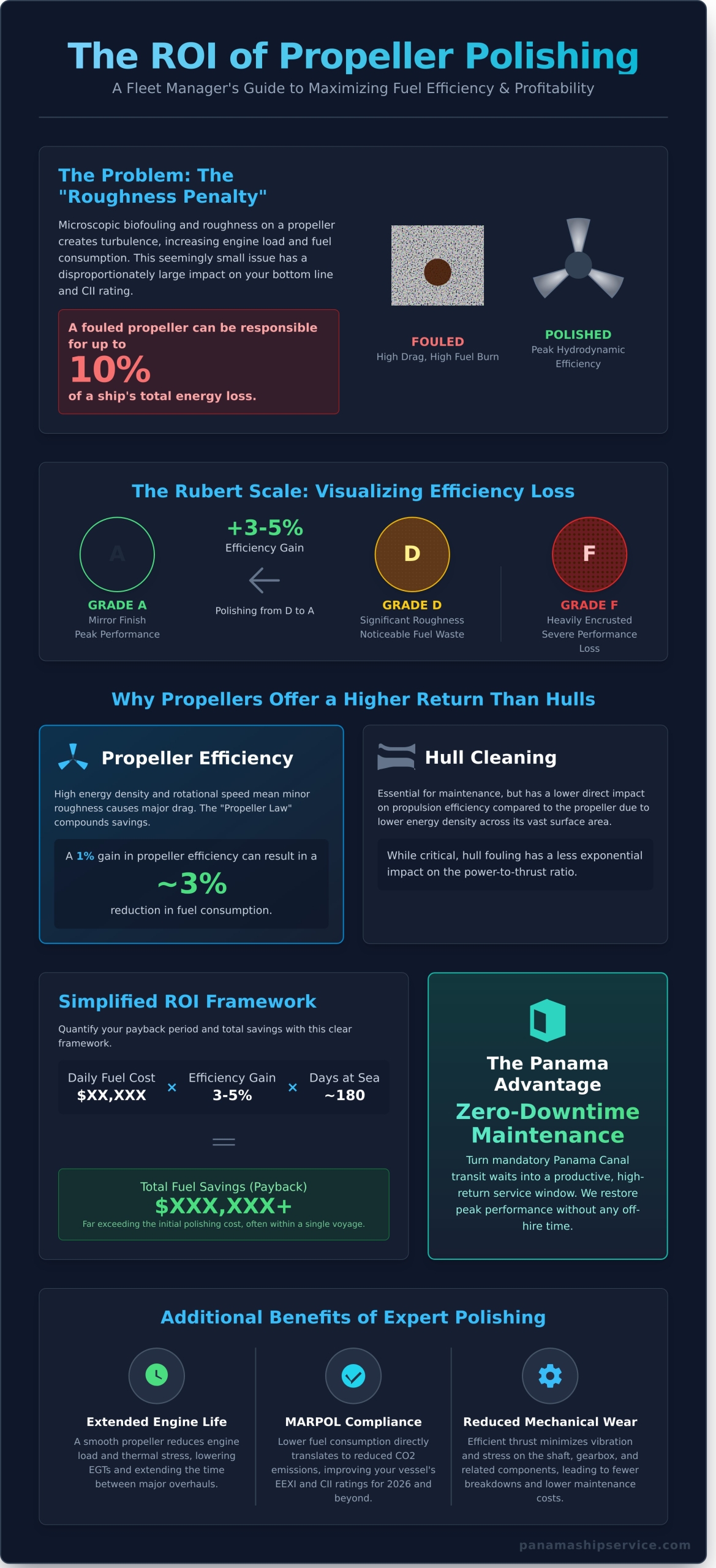
In the maritime industry, efficiency is the difference between profit and loss. Propeller polishing is the technical process of removing calcium deposits and organic growth to restore a blade’s hydrodynamic profile. While the propeller accounts for a small percentage of a vessel’s total wetted surface area, its condition is disproportionately critical; a fouled propeller can be responsible for up to 10% of a ship’s total energy loss.
This “Roughness Penalty” occurs when microscopic changes to the blade surface create turbulence, increasing torque requirements and forcing the engine to consume more fuel to maintain speed. Beyond immediate fuel waste, propeller condition is now a primary lever for managing Carbon Intensity Indicator (CII) ratings. With stricter 2026 requirements approaching, maintaining a smooth surface is a mandatory operational strategy. Understanding The Science of Biofouling is the first step in calculating ROI on propeller polishing and protecting your vessel’s commercial viability.
Understanding the Rubert Scale and Efficiency Loss
The Rubert Scale is the industry standard for measuring propeller surface finish. This comparator scales surface texture from Grade A (mirror-like) to Grade F (heavily encrusted). The efficiency gap between these grades is stark: shifting a propeller from a neglected Grade D back to a pristine Grade A can improve vessel efficiency by 3-5%. At Panama Ship Service, we prioritize reaching Grade A to ensure your engine operates at peak performance with minimal resistance.
Biofouling vs. Mechanical Roughness
It is vital for operators to distinguish between temporary biofouling-such as slime, algae, and barnacles-and permanent mechanical roughness caused by cavitation or impingement. While simple cleaning removes organic matter, true polishing addresses the underlying surface texture of the metal. Even a propeller that appears “clean” to the naked eye can be hydrodynamically inefficient due to microscopic pitting. There is a clear point of diminishing returns where the cost of increased fuel consumption far exceeds the cost of a dive. Identifying this threshold is the most effective way of calculating ROI on propeller polishing and ensuring a high-value transit through the Panama Canal.
The Science of Fuel Savings: Why Propellers Matter More Than Hulls
While hull cleaning is a standard maintenance practice, the propeller is the most critical component for vessel propulsion efficiency. The energy density on a propeller’s surface is significantly higher than that of the hull. Because the propeller operates at high rotational speeds, even minor surface imperfections create disproportionate drag. When calculating ROI on propeller polishing, owners must consider the “Propeller Law,” which dictates that the power required to drive a vessel is proportional to the cube of its speed. This means a 1% gain in propeller efficiency can result in a 3% reduction in fuel consumption at a constant speed.
Recent research on propeller roughness indicates that neglecting this surface can increase measured fuel consumption by 2% to 4%. Maintaining a Rupert Scale Grade A finish ensures that the energy you pay for is converted into thrust, rather than being wasted as heat and turbulence. We are experts so you don’t have to be; we focus on the technical precision that drives these savings.
Hydrodynamics and Thrust Efficiency
Surface roughness disrupts laminar flow, triggering premature turbulence and increasing the risk of cavitation. Cavitation does more than reduce thrust; it causes physical pitting and blade erosion, leading to permanent power loss. A professional multi-stage polish restores the hydrodynamic profile, optimizing the thrust-to-fuel ratio. By smoothing the surface, you reduce the torque required to maintain RPM, which is a fundamental metric when calculating ROI on propeller polishing.
Secondary Benefits: Emissions and Engine Life
The advantages of a polished propeller extend beyond the bunker bill. A smooth surface reduces engine load, leading to lower Exhaust Gas Temperatures (EGT) and less thermal stress on internal components. This directly extends the interval between major mechanical overhauls, saving significant capital expenditure over the vessel’s lifecycle.
- MARPOL Compliance: Lower fuel consumption translates directly to reduced CO2 emissions, assisting with EEXI and CII ratings.
- Reduced Mechanical Wear: Polishing eliminates hydrodynamic imbalances that cause vibration and long-term tailshaft and bearing wear.
- Cost-Effective Speed: As the saying goes in the industry, “A smooth propeller is the cheapest way to ‘buy’ knots.”
By prioritizing propeller maintenance, ship owners adopt a proactive and responsive strategy to rising operational costs. It is not just about cleaning; it is about restoring the mechanical integrity of your propulsion system to ensure a timely and cost-effective transit.
The ROI Calculation Framework: Quantifying the Payback Period
In the high-stakes maritime industry, efficiency is the difference between profit and loss. When calculating ROI on propeller polishing, we focus on a data-driven approach to prove the immediate financial benefits. To determine your return, you must track four key variables: the Cost of Service, current Fuel Price, Daily Fuel Oil Consumption (FOC), and projected Sea Days.
The standard ROI formula for this service is: (Daily Fuel Savings × Fuel Price × Days at Sea) / Cost of Polishing. Beyond the direct fuel savings, our technical team emphasizes “Avoided Costs.” A rough propeller increases torque and engine vibration, leading to mechanical fatigue. By maintaining a Rubert Grade A finish, you prevent premature shaft seal wear and avoid the operational delays often caused by severe biofouling.
Vessels deployed on long-haul trans-Pacific or trans-Atlantic routes see the highest ROI. Because these ships spend 20+ consecutive days at sea, the cumulative efficiency gains compound rapidly, often covering the entire service cost before the vessel reaches its next port of call.
A Sample Calculation for a Panamax Vessel
Consider a Panamax vessel operating at 14 knots with a daily FOC of 35 tons. By applying a conservative 4% efficiency gain from a professional polish, the vessel saves 1.4 tons of fuel per day. Based on projected 2026 VLSFO prices of approximately $650/mt, the vessel realizes a monthly saving of $27,300. We are experts so you don’t have to be; we provide the precision required to hit these targets.
Calculating the Break-Even Point
The “Payback Voyage” for a propeller polish is remarkably short, often achieved within 10 to 15 days of active steaming. Comparing the one-time cost of a precision polish in Panama against the cumulative cost of six months of inefficiency reveals a massive disparity in operational expenditure.
| Metric | Rough Propeller (Annual) | Polished Propeller (Annual) |
|---|---|---|
| Fuel Consumption (200 Sea Days) | 7,000 tons | 6,720 tons |
| Total Fuel Cost ($650/mt) | $4,550,000 | $4,368,000 |
| Net Annual Savings | – | $182,000 |
As your trusted partner at the Panama Canal, we ensure your vessel operates at peak performance, turning a routine maintenance task into a high-yield financial strategy. Calculating ROI on propeller polishing isn’t just about the next voyage; it is about protecting your long-term margins.
Strategic Advantage: Why Panama is the Optimal ROI Location
Timing is everything in the maritime industry. When calculating ROI on propeller polishing, many operators overlook the most significant variable: off-hire cost. In Panama, this cost is effectively neutralized. Because every vessel transiting the Canal faces a mandatory waiting period at anchorage, we turn idle time into a high-value maintenance window. This “Zero-Downtime” logic ensures that your maintenance investment does not conflict with your operational schedule.
Panama Ship Service provides a logistical stronghold at both Balboa and Cristobal. With deep-water anchorages and expert dive teams available 24/7, we provide the rapid response required to meet tight transit slots. We are experts so you don’t have to be; we manage the technical complexities while you focus on your cargo. By utilizing this strategic stop, you ensure your vessel operates at peak hydrodynamic efficiency without adding a single day to your voyage charter.
Maximizing the Transit Window
- Step 1: Coordinate polishing with your Canal agent immediately upon arrival at Balboa or Cristobal to ensure dive team readiness.
- Step 2: Utilize the mandatory 12-24 hour waiting period for underwater work, avoiding any interference with the Panama Canal Authority (ACP) schedule.
- Step 3: Receive a comprehensive post-service report and Rubert Grade confirmation before the transit begins, providing the data needed for calculating ROI on propeller polishing for your specific hull.
Environmental and Port Regulations in Panama
The Panama Canal Authority (ACP) maintains rigorous standards for vessel condition. Furthermore, local environmental regulations necessitate the use of professional, class-approved providers who utilize specialized debris capture systems. Panama’s warm tropical waters significantly accelerate biofouling rates; therefore, regular polishing is not just a fuel-saving measure-it is a regulatory necessity.
Partnering with Panama Ship Service ensures your vessel remains compliant with all local port requirements while reclaiming lost speed. Our systematic approach to underwater maintenance allows ship owners to minimize expenses and maximize performance in one of the world’s most critical maritime hubs. Put your transit in our hands to ensure a cost-effective, efficient service that protects your bottom line.
Panama Ship Service: Expert Propeller Polishing Solutions
With over 20 years of experience in the Panama Canal zone, Panama Ship Service understands that in the maritime industry, timing and precision are everything. We provide a comprehensive, multi-stage polishing process that goes far beyond basic cleaning. Our specialized teams transition from initial biofouling removal to “super-polishing,” achieving a Grade A finish on the Rubert scale. This level of smoothness is essential for reducing hydrodynamic drag and ensuring that your calculating ROI on propeller polishing results in the highest possible fuel savings.
Transparency and data are vital for modern fleet managers. Our service includes a robust reporting package featuring:
- High-resolution before and after photography.
- Detailed technical assessments of the propeller condition.
- Comprehensive reporting for class and owner records.
As a “One-Stop-Shop,” we offer the strategic advantage of combining propeller maintenance with other critical requirements, such as bunker surveys or MARPOL disposal. This integrated approach minimizes your vessel’s idle time and reduces overall port expenses.
Qualified Divers and Specialized Equipment
Our team of certified divers utilizes state-of-the-art hydraulic polishing heads and diamond-disc technology to achieve a mirror finish. Unlike standard brushes, our specialized equipment ensures a uniform surface without damaging the blade material. We operate with a sense of urgency, offering rapid response times and constant communication throughout the narrow transit window. Learn more about our Underwater Hull Services and how we maintain your vessel’s peak performance.
Secure Your ROI with a Trusted Partner
When calculating ROI on propeller polishing, the reliability of your service provider is the most critical variable. Global charterers and ship owners trust Panama Ship Service for time-critical repairs because we are experts so you don’t have to be. We focus on minimizing your vessel’s expenses by providing efficient, high-quality solutions that withstand the rigors of international shipping. Put your transit in our hands and ensure your maintenance budget delivers tangible results. Contact us today for a propeller polishing quote and secure your vessel’s efficiency.
For more information on our full range of maritime solutions, visit panamashipservice.com.
Maximizing Fleet Efficiency with Expert Propeller Maintenance
In the high-stakes maritime industry, every percentage of fuel saved directly impacts your bottom line. As we have explored, the science of vessel performance confirms that maintaining a smooth propeller surface is one of the most cost-effective ways to reduce drag and carbon emissions. By calculating ROI on propeller polishing, fleet managers can clearly see that the payback period is remarkably short, often yielding significant operational savings in just a single transit.
Panama Ship Service provides the technical expertise and reliability needed to turn these calculations into tangible results. With over 20 years of Canal experience, our class-approved underwater surveys and 24/7 rapid response teams ensure your vessel remains compliant and efficient without compromising your schedule. We are experts so you don’t have to be, providing the specialized solutions required to minimize expenses and maximize performance.
Ready to optimize your vessel’s fuel economy? Request an Expert Propeller Polishing Quote in Panama today. Put your transit in our hands and start seeing the immediate benefits of a more efficient fleet.
Frequently Asked Questions
How often should a vessel’s propeller be polished for maximum ROI?
For maximum ROI, most vessels should schedule propeller polishing every 6 to 12 months. The exact frequency depends on the vessel’s trade route and time spent in tropical waters where biofouling is aggressive. By maintaining a Rupert Scale Grade A or B finish, you prevent the drag associated with heavy marine growth, ensuring your fuel consumption remains optimized between scheduled dry dockings.
Can propeller polishing be performed while the vessel is at the Panama Canal anchorage?
Yes, propeller polishing can be performed while your vessel is at the Panama Canal anchorage, specifically at the Balboa (Pacific) or Cristobal (Atlantic) side. As your trusted partner at the Panama Canal, we coordinate with your transit schedule to perform the service without causing delays. This allows ship owners to utilize waiting periods effectively, turning idle time into a fuel-saving opportunity.
What is the typical fuel saving percentage after a professional propeller polish?
A professional propeller polish typically yields a fuel saving of 3% to 8%. When calculating ROI on propeller polishing, these savings often cover the cost of the service within the first few weeks of operation. By reducing the torque required to maintain speed, the vessel operates more efficiently, directly lowering the daily bunker consumption and overall voyage costs.
Is in-water propeller polishing as effective as polishing in a dry dock?
Modern in-water propeller polishing is just as effective as polishing in a dry dock. Using specialized hydraulic tools and multi-stage abrasive discs, our divers achieve a “mirror-like” finish that matches shipyard standards. We are experts so you don’t have to be; we ensure the surface roughness is minimized to improve hydrodynamic efficiency without the need for expensive and time-consuming dry docking.
How does propeller roughness affect the vessel’s CII rating and IMO compliance?
Propeller roughness significantly impacts a vessel’s Carbon Intensity Indicator (CII) rating. Increased drag leads to higher fuel consumption and greater CO2 emissions, which can lower your rating and jeopardize IMO compliance. Regular polishing is a proactive solution to maintain a favorable CII grade, helping ship owners avoid operational restrictions and demonstrate a commitment to environmental regulations.
What information do I need to provide for a propeller polishing quote in Panama?
To provide an accurate quote for services in Panama, we require the vessel name, current location (Atlantic or Pacific anchorage), propeller diameter, number of blades, and the date of the last polish. Providing photos of the propeller or a recent dive report helps us assess the degree of fouling. This information allows us to provide a competitive, fixed-price solution tailored to your specific operational needs.
Does propeller polishing damage the blade surface over time?
Professional polishing does not damage the blade surface; instead, it removes marine growth and oxidation that can lead to pitting. We use controlled abrasive techniques that only remove the “roughness” layer, preserving the integrity of the base metal. Frequent, gentle polishing is actually better for the propeller’s long-term health than infrequent, aggressive cleaning that must remove heavy calcareous deposits.
How long does a typical underwater propeller polishing service take?
A typical underwater propeller polishing service takes between 3 and 5 hours, depending on the propeller size and the severity of the fouling. Because we prioritize efficiency, this service is often completed during cargo operations or while awaiting transit. This rapid turnaround is a critical factor when calculating ROI on propeller polishing, as it ensures there is no loss of hire or operational downtime.