
With Neo-Panamax reservation fees now reaching $100,000 and auction premiums often exceeding $425,000, a single operational oversight at the Panama Canal is no longer just a minor delay; it’s a significant financial risk. You’re likely already feeling the pressure of unpredictable transit wait times and the increasing complexity of ACP regulations. It’s a high-stakes environment where technical readiness is just as critical as the transit itself. Managing fragmented vendor communication while trying to avoid $50,000 MARPOL fines can feel like an exhausting administrative burden for any fleet manager.
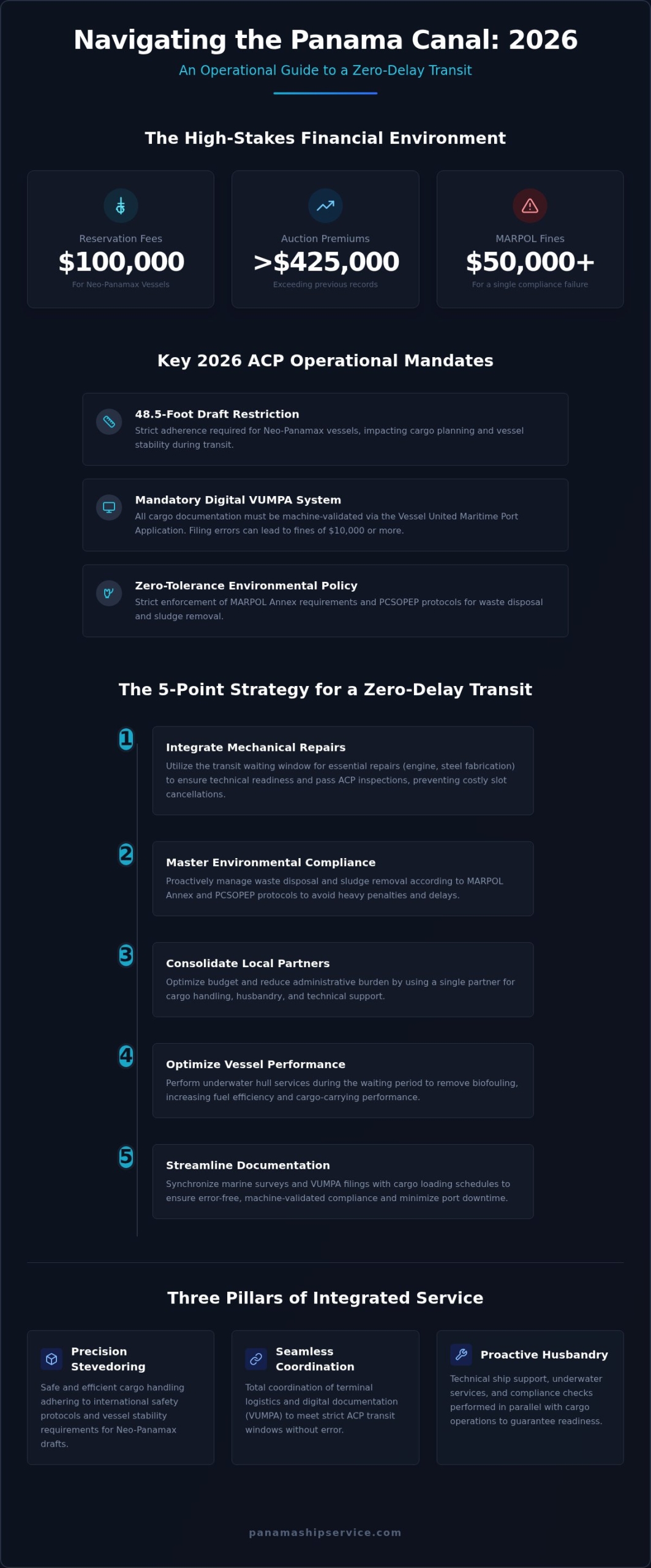
This 2026 operational guide provides the technical roadmap you need to secure efficient cargo handling services panama canal while maintaining full compliance with the newest standards. We’ll help you manage the 48.5-foot draft restrictions and the strict OP Notice N-01-2026 requirements to ensure your vessel moves through the locks without a hitch. By the end of this article, you’ll have a clear strategy for coordinating technical ship support and cargo transfers to achieve a zero-delay transit that protects your bottom line and ensures fiscal responsibility.
Key Takeaways
- Learn how to integrate mechanical ship repairs with transit schedules to prevent slot cancellations and ensure technical readiness for ACP inspections.
- Master the 2026 MARPOL Annex requirements and PCSOPEP protocols to manage waste disposal and sludge removal without incurring heavy penalties.
- Optimize your operational budget by consolidating cargo handling services panama canal with husbandry and technical support under a single local partner.
- Understand the impact of underwater hull services on vessel performance and fuel efficiency during the transit waiting window.
- Streamline your documentation process by synchronizing marine surveys and VUMPA filings with cargo loading schedules to minimize port downtime.
Defining Cargo Handling Services at the Panama Canal in 2026
In 2026, cargo handling services panama canal represent a complex intersection of manual labor, digital logistics, and technical compliance. It isn’t merely the movement of containers; it’s the total coordination of stevedoring, logistics, and technical readiness required for vessels to meet strict Panama Canal Authority (ACP) transit windows. For a comprehensive Panama Canal Overview, one must understand that the waterway operates as a precision-timed machine. If your cargo isn’t secured or your documentation isn’t validated, you don’t just lose time; you lose your transit slot. This environment demands more than just manual labor. It requires a strategic approach to technical readiness, ensuring every mechanical system is operational and every cargo manifest is digitally compliant before the pilot boards.
The 2026 landscape is defined by the digital VUMPA (Vessel United Maritime Port Application) system. Every piece of cargo documentation must be machine-validated before the vessel reaches the locks. This shift means that technical husbandry and cargo coordination are now inseparable. You can’t separate the physical act of loading from the digital act of compliance. Effective cargo handling requires a partner who understands that terminal coordination and technical ship repairs must happen simultaneously to avoid the massive surcharges currently being implemented by major carriers. With MSC and CMA CGM implementing $100 per TEU surcharges, the cost of a documentation error or a slow load is higher than ever. We focus on the three pillars of service: precision stevedoring, seamless terminal coordination, and proactive technical husbandry.
The Stevedoring and Unstevedoring Process
Securing cargo in 2026 requires adherence to evolved international safety protocols, particularly for Neo-Panamax vessels facing 48.5-foot draft restrictions. Our coordination includes organizing containers and breakbulk cargo to ensure stability and integrity during the transit. Specialized handling for refrigerated goods and hazardous materials is non-negotiable. We prioritize strict safety standards to prevent cargo shifts that could lead to ACP inspections or transit delays. This process is about maintaining vessel balance and cargo safety under the high-pressure timelines of the canal’s operational schedule.
ACP Regulatory Compliance for Cargo Vessels
Compliance now centers on the LoTSA 2.5 auction system and digital accuracy. Pre-arrival documents must be error-free to avoid significant penalties. Common VUMPA filing errors, such as incorrect Garbage Record Book entries for vessels over 100 GT, can trigger $10,000 fines. We act as your technical bridge, machine-validating all documents to ensure your cargo-heavy transit meets every ACP and MARPOL requirement. By delegating these complexities, you ensure your vessel remains compliant with the zero-tolerance policies for waste disposal and documentation accuracy that define the current canal administration.
Technical Readiness: Integrating Ship Repairs with Cargo Operations
Mechanical integrity is a non-negotiable prerequisite for any vessel transiting the locks. The Panama Canal Authority (ACP) maintains strict oversight, and any deficiency in steering, propulsion, or power can lead to immediate slot cancellation. In 2026, where reservation fees reach $100,000, technical failure is a catastrophic financial hit. Comprehensive cargo handling services panama canal must therefore include technical oversight to ensure your vessel meets all Panama Canal Authority Maritime Regulations before the pilot boards. If your vessel isn’t mechanically sound, your cargo isn’t moving.
The waiting period at the Balboa or Cristobal anchorages offers a strategic window to address these issues. Instead of allowing downtime to drain your budget, use this interval for essential mechanical ship repairs. Our team provides 24/7 technical support, addressing everything from engine diagnostics to steel fabrication at anchor. This proactive approach ensures that when your transit window opens, your vessel is ready to perform without the risk of an ACP-mandated tug assistance or a costly delay.
Underwater Hull Services for Cargo Optimization
A fouled hull is a direct drain on cargo-carrying efficiency. Biofouling increases drag, which forces engines to work harder and consume more fuel, especially when vessels are heavily laden at the current 48.5-foot draft limit. Our underwater hull services include class-approved hull cleaning and propeller polishing to restore hydrodynamic performance. We also perform UWILD surveys to verify structural integrity, providing the documentation required to prove your vessel is fit for transit. For operators looking to maximize fuel efficiency, scheduling a cleaning while waiting for a slot is a high-return investment.
Mechanical and Steel Fabrication Repairs
Operational readiness often hinges on the condition of cargo gear and structural components. We offer on-site welding and steel fabrication to repair damaged cranes, hatch covers, or lashing points that could compromise safety. Beyond the deck, our engineers handle critical engine and A/C repairs to maintain crew safety and vessel control during the intense heat of the transit. Addressing rudder and propeller issues at the anchorage prevents performance-related delays that could trigger heavy fines. If you’re managing a complex schedule, we recommend consulting with our technical team to synchronize these repairs with your cargo operations.
Environmental Compliance: MARPOL and Waste Management
Environmental risk at the Panama Canal has reached a critical threshold in 2026. With the implementation of OP Notice N-01-2026, the Panama Canal Authority (ACP) now enforces a zero-tolerance policy for the discharge of plastics and food waste within Canal waters. Operating cargo handling services panama canal now requires a rigorous approach to waste management to avoid the $15,000+ fines frequently issued for improper discharge at anchor. In fact, mismanagement of MARPOL Annex I documents can trigger penalties as high as $50,000. Navigating the PCSOPEP (Panama Canal Shipboard Oil Pollution Emergency Plan) Authorized Person requirements is no longer just a formality; it’s a vital component of your vessel’s technical readiness.
Efficiency depends on your ability to synchronize technical requirements with operational windows. Scheduling MARPOL disposal in Panama alongside your cargo operations is the most effective way to maintain compliance without extending your port stay. By coordinating the removal of sludge and bilge water during your cargo call at Balboa or Cristobal, you ensure that your vessel is ready for ACP environmental inspections. This proactive management protects your schedule and prevents the administrative nightmare of dealing with regulatory non-compliance during a transit.
Sludge and Ship Garbage Disposal
Safe removal of slops and sludge is a technical necessity at both the Pacific and Atlantic terminals. As of 2026, the threshold for maintaining a Garbage Record Book has been reduced to vessels of 100 gross tonnage (GT) and above. We manage the physical logistics of waste removal while providing the MARPOL-compliant documentation required for international regulatory proof. This includes the disposal of oily water and domestic waste under strict local sanitary standards, ensuring your vessel leaves Panama with a clean record and all necessary certifications in hand.
Sanitary Inspections and Pest Control
Cargo integrity often hinges on biological safety, particularly for vessels carrying sensitive food or forest products. We facilitate comprehensive sanitary inspections to ensure cargo spaces meet international health and quarantine standards. Our services include professional fumigation and the issuance of deratting and sanitary certificates for both crew and cargo. These steps are essential to prevent quarantine delays that could disrupt your entire 2026 schedule. It’s about protecting the commercial value of your cargo while meeting the rigorous health standards of the Panama Canal Authority.
Logistics, Husbandry, and Crew Support
One of the most significant advantages for operators in 2026 is the “Spares in Transit” regime. This allows for a 7% ITBMS tax exemption on critical technical stores delivered to vessels in canal waters. By sourcing high-quality ship supplies at the Panama Canal, you can ensure your deck and engine departments are fully equipped without the financial overhead of standard import duties. We prioritize fiscal responsibility by streamlining the movement of these spares from the airport directly to your vessel at the Balboa or Cristobal anchorages, ensuring your technical readiness isn’t compromised by customs delays.
Efficient Crew Change Management
Sourcing Provisions and Marine Spares
Reliable sourcing is the backbone of operational readiness. We coordinate the customs clearance of imported technical engine parts, utilizing our local expertise to navigate the regulatory landscape quickly. Fresh water delivery is monitored to ensure it meets strict quantity and quality standards, protecting your crew’s health and vessel systems. By selecting reputable ship chandlers for deck and engine stores, we guarantee that the provisions delivered to your vessel meet international maritime standards. If you need to streamline your vessel’s logistics, contact us today for comprehensive husbandry support.
Consolidating Services: Minimizing Downtime and Costs
The operational complexity of the 2026 maritime environment leaves no room for fragmented vendor management. When you coordinate your cargo handling services panama canal through a single technical partner, you eliminate the communication gaps that lead to transit delays. Fragmented management often results in conflicting schedules between stevedores, technical engineers, and husbandry agents. By consolidating these operations, you ensure that every service provider is aligned with the vessel’s primary objective: an on-time, compliant transit. This “One-Stop-Shop” approach reduces administrative overhead and minimizes the risk of costly errors that occur when multiple parties attempt to synchronize their work in a high-pressure environment.
A key component of this consolidation is synchronizing marine surveys in Panama with your cargo loading or discharge schedules. Conducting structural, technical, or bunker surveys while the vessel is already alongside or at anchor for cargo operations maximizes every hour of port time. This technical foresight allows for the immediate identification of deficiencies that might otherwise trigger an ACP slot cancellation. In an era where a lost slot can result in auction premiums exceeding $400,000, proactive consolidation isn’t just a convenience; it’s a financial necessity for ship managers.
The Panama Ship Service Strategy
Our approach is built on a 24/7 commitment to technical proficiency and regulatory excellence. We leverage our extensive local networks to ensure that spare parts and specialized technicians reach your vessel without the delays typical of global agencies that lack a local technical footprint. Our strategy focuses on proactive problem-solving. For example, we recently managed a scenario where a cargo vessel faced a hydraulic failure during loading. By integrating our mechanical repair team with the cargo coordination schedule, we performed the repairs alongside the stevedoring operations. This integrated strategy saved the operator 36 hours of potential downtime and preserved their scheduled transit slot.
Next Steps for Ship Operators
As you finalize your 2026 transit plans, it’s essential to review your schedule for potential technical or regulatory gaps. The combined pressure of draft restrictions and stricter MARPOL enforcement requires a partner who handles more than just paperwork. We recommend auditing your current vendor list to identify where communication breakdowns might occur. Requesting a comprehensive quote for consolidated support allows you to see the tangible cost-benefit of combining repairs, cargo, and agency services. Delegate the operational complexity to us to simplify your own operations and ensure a zero-delay transit. Contact Panama Ship Service for expert cargo handling and transit support.
Optimizing Your Panama Canal Transit Strategy for 2026
The 2026 maritime landscape at the Panama Canal demands a shift from reactive management to proactive technical integration. You’ve seen how digital VUMPA accuracy and strict MARPOL Annex compliance are now the primary drivers of transit success. Protecting your reservation from $100,000 slot losses requires more than just standard agency support; it requires a partner who understands the mechanical and regulatory nuances of the waterway. By consolidating your cargo handling services panama canal with technical husbandry and underwater services, you eliminate the communication errors that lead to costly downtime.
Panama Ship Service provides the 24/7 emergency technical response and full ACP & MARPOL regulatory expertise necessary to navigate these high-stakes operations. Our consolidated ‘one-stop-shop’ efficiency ensures your vessel remains compliant and operational throughout its stay. It’s time to delegate the operational complexity to a local veteran who prioritizes your schedule and fiscal responsibility. Request a Comprehensive Cargo Handling and Technical Support Quote today to secure your vessel’s performance. We’re ready to ensure your next transit is efficient, safe, and entirely delay-free.
Frequently Asked Questions
What are the essential cargo handling services for Panama Canal transit in 2026?
Essential services include professional stevedoring for containerized or breakbulk cargo, terminal coordination, and technical husbandry to ensure vessel readiness. These cargo handling services panama canal must align with strict ACP transit windows to avoid slot cancellations. Integration with digital VUMPA filings is now a mandatory component for operational success and regulatory compliance.
How can I ensure MARPOL compliance during cargo operations in Panama?
You can ensure compliance by strictly adhering to OP Notice N-01-2026, which mandates zero-tolerance for plastic and food waste discharge. Vessels over 100 GT must maintain an accurate Garbage Record Book to avoid $10,000 fines. Coordinating MARPOL-compliant sludge and bilge water disposal during your cargo call is the most efficient way to meet these environmental standards.
Are emergency ship repair services available at the Balboa and Cristobal anchorages?
Yes, 24/7 emergency mechanical and steel fabrication repairs are available at both the Balboa and Cristobal anchorages. Mobile technical teams can address rudder, engine, and structural issues while your vessel is at anchor. Resolving these deficiencies before the pilot boards is critical to preventing ACP-mandated tug assistance or costly transit delays.
What documentation is required for VUMPA filing for cargo vessels in 2026?
Required documentation includes machine-validated crew lists, comprehensive cargo manifests, and updated Garbage Record Books. In 2026, all pre-arrival documents must be submitted via the Vessel United Maritime Port Application (VUMPA) for machine validation. Errors in these digital filings often lead to administrative penalties and the rescheduling of your transit window.
Can hull cleaning be performed while a vessel is loading or unloading cargo?
Hull cleaning and propeller polishing can be performed at the anchorage while the vessel waits for its transit window or during specific cargo operations. This allows you to restore hydrodynamic performance and optimize fuel efficiency without adding extra time to your port stay. Class-approved underwater services are essential for vessels operating at the current 48.5-foot draft limit.
How do I coordinate crew changes during a Panama Canal cargo call?
Crew changes are coordinated through professional launch services that transport personnel between the vessel and shore. You must manage immigration requirements and logistics through Tocumen International Airport (PTY) to ensure timely arrivals and departures. Integrating these husbandry tasks with your cargo schedule reduces administrative overhead and ensures seafarer welfare isn’t compromised by transit pressures.
What is the role of a cargo surveyor at the Panama Canal?
A cargo surveyor performs draft surveys, verifies cargo integrity, and ensures that loading or unloading meets international safety standards. Their role is to provide independent documentation of the cargo’s condition and quantity before transit. Synchronizing these marine surveys with your cargo loading schedule is a vital part of a consolidated and efficient operational strategy.
How does the ACP auction system impact cargo handling schedules?
The ACP auction system creates high financial stakes, with reservation fees for Neo-Panamax vessels reaching $100,000 in 2026. Auction premiums for vessels without reservations have reached up to $425,000. These costs make technical readiness and efficient cargo handling services panama canal essential, as any delay can result in the loss of a multi-thousand dollar transit slot.