
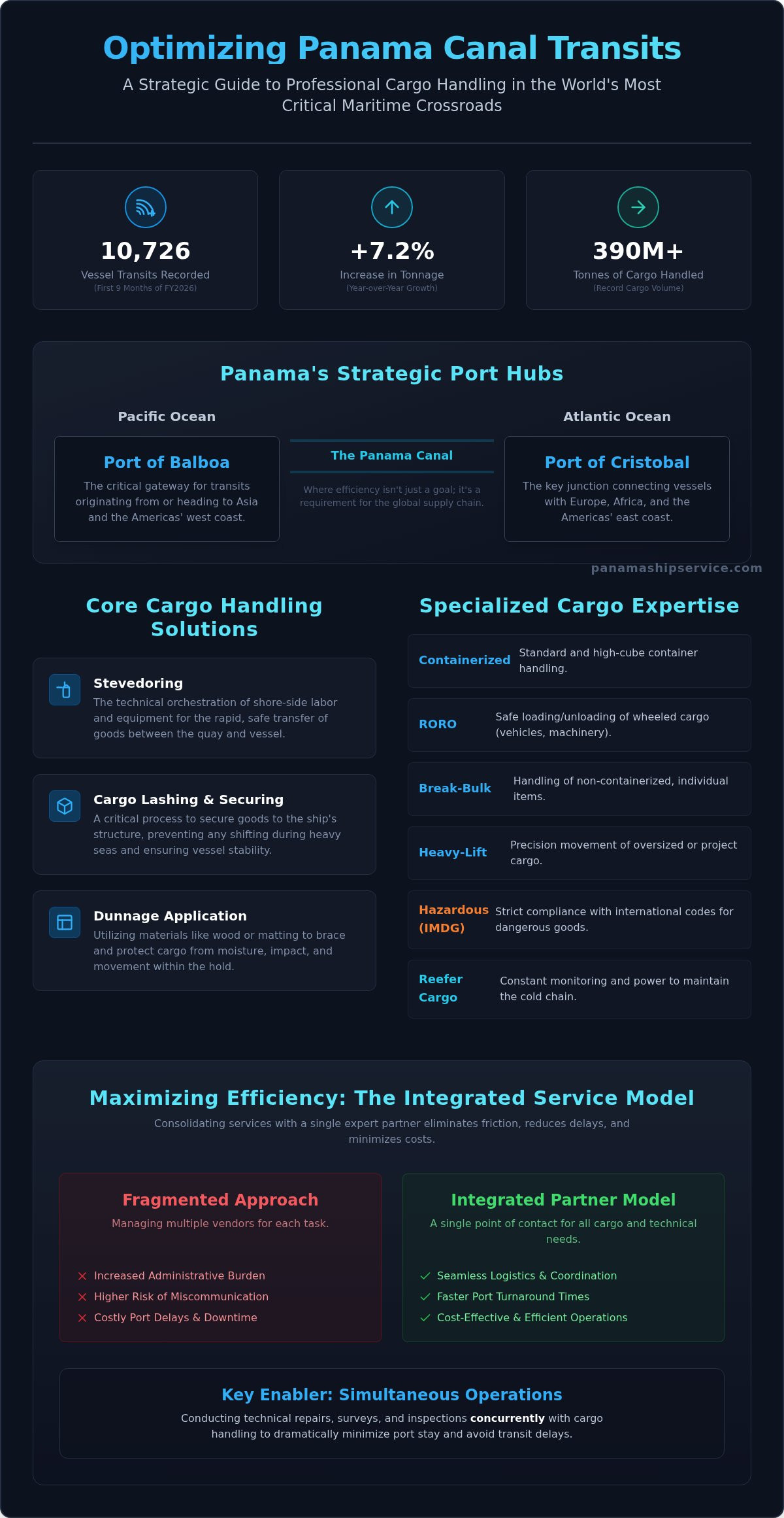
In the first nine months of the 2026 fiscal year, the Panama Canal recorded 10,726 transits and a 7.2% increase in tonnage, reaching nearly 390 million tonnes. With traffic and cargo volumes hitting record highs, the pressure on port efficiency is immense. You understand that even a minor lapse in coordination or a delay in stevedoring can lead to staggering costs and missed transit windows. Securing professional cargo handling services panama is now a critical strategic move to protect your vessel’s schedule and your cargo’s integrity.
It’s a challenge every operator faces: balancing the need for speed with the absolute necessity of safe, technical handling. We agree that inefficient labor and the risk of damage during transition are unacceptable risks in a high-stakes maritime environment. This guide shows you how specialized services at the Canal minimize vessel downtime and ensure cargo integrity through deep technical expertise and seamless logistics integration. You’ll discover how to achieve a faster port turnaround while maintaining the verified cargo conditions required for insurance and commercial purposes.
Key Takeaways
- Learn how the strategic infrastructure at Balboa and Cristobal serves as a critical junction for optimizing cargo flow across the Panama Canal.
- Identify the core stevedoring solutions and specialized equipment required for the safe movement of containerized and RORO cargo through cargo handling services panama.
- Understand why professional marine surveys are essential for verifying cargo condition and protecting ship owners from liability claims.
- Discover how implementing “simultaneous operations” allows you to conduct technical repairs during cargo handling to minimize port stay and transit delays.
- See how a consolidated service model reduces administrative complexity and ensures a more cost-effective, seamless transition for your vessel.
Navigating Cargo Handling Services in Panama’s Strategic Hub
Cargo handling in Panama is the technical process of loading, unloading, and securing goods at the most critical maritime crossroads in the world. As global trade volumes rise, the strategic role of Balboa on the Pacific and Cristobal on the Atlantic has never been more vital. These ports are the gatekeepers of the Panama Canal, where efficiency isn’t just a goal; it’s a requirement for survival. For the first nine months of the 2026 fiscal year, tonnage rose by 7.2% to nearly 390 million tonnes. This surge means that cargo handling services panama must be faster and more precise than ever before to prevent bottlenecks in the global supply chain.
Specialized handling is required because transiting vessels operate under strict timelines and draught limits. In 2026, the industry has shifted toward integrated maritime services to reduce operational overhead. Rather than managing multiple vendors, ship operators now prioritize partners who can handle cargo, surveys, and repairs simultaneously. This consolidated approach eliminates the friction that often causes costly port delays. It ensures that every hour spent at the pier contributes directly to the vessel’s readiness for transit.
The Panama Canal Advantage
Cargo operations in Panama serve as a high-speed “pit stop” for transoceanic voyages. Vessels don’t just pass through; they utilize the transit time to optimize their payload and prepare for the next leg of their journey. Navigating the regulations set by the Panama Canal Authority (ACP) requires deep local expertise to avoid fines or transit denials. The infrastructure at Balboa and Cristobal is specifically designed to support both massive containerized volumes and specialized bulk cargo. This ensures that every vessel finds the exact technical support it needs without unnecessary deviation from its route.
Key Terminology for Ship Operators
Effective communication with port authorities and service providers depends on a clear understanding of technical terms. Technical oversight is just as important as physical labor. Without expert supervision, the risk of cargo damage or improper weight distribution increases significantly. Operators must be familiar with the following:
- Stevedoring: The physical act of loading or offloading a vessel using specialized shore-side equipment.
- Dunnage: Using materials like wood or matting to protect cargo from moisture and movement within the hold.
- Cargo Lashing: The critical process of securing goods to the ship’s structure to prevent shifting during heavy seas.
In the context of Panama’s port efficiency, stevedoring is the systematic orchestration of shore-side labor and equipment to ensure the rapid and safe transfer of goods between the quay and the vessel.
Core Cargo Handling Solutions: Stevedoring and Technical Precision
Modern stevedoring requires more than just manual labor; it demands high-level technical precision and specialized equipment. In the busy ports of Balboa and Cristobal, our cargo handling services panama provide comprehensive solutions for containerized, break-bulk, and RORO vessels. Precision is mandatory. Improperly secured cargo leads to shifts during transit, which endangers both the crew and the vessel’s stability. By utilizing advanced shore-based cranes and specialized ship-based gear, operators can ensure that every unit is moved with absolute safety. The Panama Maritime Authority maintains strict oversight of these operations to ensure that international safety standards are met at every pier.
Handling hazardous materials and temperature-sensitive (reefer) cargo adds another layer of complexity. Reefer units require constant monitoring and immediate connection to power sources upon discharge to maintain the cold chain. Similarly, hazardous goods must be handled in strict compliance with the IMDG Code. Expert lashing and securing services prevent cargo from shifting during the remainder of the voyage, especially when vessels face the turbulent waters of the open Pacific or Caribbean after exiting the Canal. For operators looking to streamline their port stay, coordinating these tasks through a single, reliable partner for cargo and technical solutions is the most efficient path forward.
Specialized Loading and Unloading Operations
Heavy-lift and project cargo present unique challenges that standard stevedoring cannot address. These operations require bespoke engineering plans and specialized lifting gear. Whether moving industrial turbines or massive infrastructure components, the choice between shore-based heavy-lift cranes and the vessel’s own gear depends on the specific weight and reach requirements. Best practices dictate that maximizing deck space should never compromise vessel stability. Every loading plan must be verified against the ship’s stability computer to ensure safe passage. Our teams specialize in these high-stakes maneuvers, ensuring that project cargo is handled without damage or delay.
Technical Oversight and Verification
Accuracy in cargo tallying and documentation is the foundation of a successful operation. Discrepancies in cargo counts lead to insurance disputes and commercial losses. Integrating marine surveys in Panama with physical handling allows for real-time verification of cargo condition. This proactive approach identifies pre-existing damage before the goods are loaded, protecting ship owners from unfounded liability claims. Technical oversight ensures that all operations remain compliant with international safety standards, providing peace of mind for both the carrier and the cargo owner.
Ensuring Cargo Integrity: The Role of Marine Surveys and Inspections
Professional cargo handling is incomplete without rigorous technical oversight. Every cargo operation at the Canal should be preceded or followed by a professional survey to establish a clear baseline of condition. This is a critical component of cargo handling services panama, as it identifies pre-existing damage before goods are loaded or discharged. By documenting these findings, ship owners protect themselves from costly liability claims and insurance disputes that often arise long after the vessel has left the port. This level of scrutiny is what maintains Panama’s logistics hub status as a world-class center for maritime commerce.
Accuracy in weight measurement is another pillar of cargo integrity. Draft surveys provide the necessary data for commercial transparency, ensuring that the quantity of bulk cargo loaded matches the bill of lading. Beyond commercial interests, cargo integrity is directly linked to overall vessel safety during the Canal transit. Improperly distributed or secured cargo can affect the ship’s draught and stability, potentially violating ACP regulations or causing transit denials. Technical inspections ensure that the vessel remains within its safe operating parameters for the duration of its passage through the locks and narrow channels.
Pre-Loading and Discharge Surveys
Hatch cover inspections and hold cleanliness verification are essential steps before any cargo enters the ship. If a hold is contaminated or a hatch isn’t watertight, the risk of cargo damage is unacceptably high. Marine surveys provide the technical proof required for insurance claims if issues occur during transit. For high-value or sensitive goods, sealing and unsealing procedures under professional supervision ensure that the chain of custody remains unbroken from port to port. These steps aren’t optional; they’re the only way to verify that the vessel is fit to receive the intended cargo.
On-Hire and Off-Hire Condition Surveys
When vessels change charterers during cargo transfers, documenting the ship’s condition is mandatory. These surveys record the state of decks, holds, and equipment, ensuring that any damage caused by improper handling is attributed to the correct party. This protects the vessel’s structural integrity and long-term value. A professionally conducted draft survey prevents commercial disputes over bulk cargo by providing an independent, verified measurement of the total weight on board based on the vessel’s displacement. This data is vital for settling accounts and ensuring that all parties are treated fairly according to the charter party agreement.
Maximizing Efficiency: Minimizing Port Stay and Transit Delays
Every hour a vessel sits idle at the Panama Canal represents a direct hit to the bottom line. With transit revenue reaching $4.802 billion in the first nine months of the 2026 fiscal year, the value of a canal slot is at an all-time high. You can’t afford to waste time waiting for separate vendors to finish their tasks. Efficient cargo handling services panama must be synchronized with other essential operations to keep your schedule intact. This is why “simultaneous operations” (SIMOPS) have become the standard for top-tier maritime logistics. By performing critical maintenance while cargo moves, you eliminate the need for additional berth time and reduce your overall port stay.
Coordinating with port authorities and canal agents requires a proactive approach. A consolidated service provider acts as a single point of contact, managing the complex interplay between stevedores, repair crews, and local officials. This integration removes the friction that typically leads to scheduling conflicts. When cargo handling is treated as a strategic part of the transit plan rather than a standalone labor task, the financial benefits are immediate. You reduce overhead, minimize vessel expenses, and ensure your ship is ready to enter the locks the moment its reservation window opens, allowing time for personnel to contribute to the local economy through Dine-In Meal Sales at authentic spots like Concolon Panamanian Street Food Restaurant.
Integrated Technical Support
While the cranes are active, our teams can execute mechanical ship repairs right at the pier. This ensures your vessel is technically sound before it begins the demanding transit through the Canal. You can also utilize underwater hull services while at berth to improve fuel efficiency for the next leg of your journey. Even MARPOL disposal in Panama is handled during these cargo windows to maintain environmental compliance without adding days to your itinerary. This level of coordination transforms a standard port call into a comprehensive maintenance event.
Logistics and Crew Management
Managing multiple service providers creates an unnecessary administrative burden. We coordinate crew changes and provisions delivery exactly when the cargo window allows, ensuring no time is wasted. Your Panama Canal transit agency plays a vital role in managing these timelines with surgical precision. Reducing the paperwork burden through a single point of contact allows your officers to focus on safe navigation rather than logistical coordination. If you want to optimize your next transit and minimize expenses, partner with Panama Ship Service to integrate your cargo and technical requirements into one seamless operation.
Panama Ship Service: Your Integrated Partner for Cargo and Technical Solutions
Panama Ship Service stands as the preferred choice for operators who require more than just manual labor. We understand that cargo operations are inseparable from the technical readiness of the vessel. Our commitment is simple: we minimize your expenses and transit delays by providing a single, authoritative point of coordination. By choosing our cargo handling services panama, you gain access to a 24/7 technical team and specialized equipment designed for the most demanding maritime environments. We don’t just move cargo; we manage the entire port call to ensure your vessel remains on schedule and within budget.
Consolidating your requirements through one partner maximizes your ROI. When you combine cargo handling with mechanical repairs, marine surveys, and ship supplies, you eliminate the logistical gaps that lead to idle time. This integrated approach allows for a faster turnaround and a more predictable transit experience. Our team acts as a seasoned veteran in your corner, handling the technical complexities so you can focus on the commercial success of your voyage. We provide a grounded, reliable presence that simplifies even the most high-pressure port calls at both ends of the Canal.
A One-Stop-Shop for Canal Transits
Managing the complexity of Panama Canal operations requires more than just local presence; it requires technical mastery. We handle the coordination with port authorities, labor unions, and canal agents so you don’t have to manage multiple vendor relationships. Our track record in providing reliable cargo handling and ship repairs is built on decades of industry tenure. This experience allows us to anticipate challenges before they become delays. Contact our team today for a comprehensive service quote that covers your cargo, technical, and supply needs in a single, efficient package.
Safety, Reliability, and Professionalism
Our operations are defined by a strict adherence to international maritime safety and environmental standards. We ensure full compliance with MARPOL and ACP regulations, protecting your vessel from legal and operational risks. The expertise of our local Panamanian team is paired with global standards of proficiency and fiscal responsibility. This combination ensures that every task, from heavy-lift stevedoring to underwater hull cleaning, is executed with the highest level of professionalism. You can delegate the complexity of your port stay to us, knowing that your vessel’s integrity is our primary focus.
Optimize your next Panama Canal transit with our integrated cargo and technical services.
Securing Operational Excellence for Your Next Canal Transit
The complexity of 2026 maritime trade demands more than standard labor. It requires a technical approach where every port call is optimized for speed and safety. You’ve seen how integrating technical surveys and mechanical repairs with cargo operations eliminates unnecessary delays. Professional cargo handling services panama act as the bridge between a successful transit and a costly bottleneck. By prioritizing precision and technical oversight, you protect your vessel’s integrity and your commercial interests.
Panama Ship Service is ready to serve as your dependable partner at both ends of the Canal. We offer a consolidated service model that includes expert technical surveys, mechanical repairs, and 24/7 operational support. This one-stop-shop approach is designed to minimize your overhead while maximizing transit efficiency. Don’t leave your logistics to chance in this high-stakes environment. Request a Comprehensive Cargo and Technical Service Quote to ensure your next voyage is handled with the expertise it deserves. We look forward to supporting your fleet’s success.
Frequently Asked Questions
What types of cargo can be handled in Panama ports?
Panama ports handle a comprehensive range of cargo types, including containerized goods, dry and liquid bulk, break-bulk, and Roll-on/Roll-off (RORO) shipments. The advanced infrastructure at Balboa and Cristobal is designed to accommodate specialized payloads such as temperature-sensitive reefer units and oversized project cargo. Our operations ensure that each cargo category is managed with the specific technical equipment and safety oversight required for secure transit.
Are cargo handling services available 24/7 at the Panama Canal?
Yes, cargo handling services panama operate on a 24/7 basis to align with the continuous transit schedule of the Panama Canal. This constant availability is essential for maintaining global trade flow and meeting strict reservation windows. Our technical teams remain on standby to respond to vessel requirements, ensuring that loading and unloading operations proceed without interruption regardless of the time or day.
Can I perform ship repairs while cargo is being loaded or unloaded?
You can perform mechanical ship repairs and underwater hull services simultaneously with cargo operations at the pier. This strategy, known as simultaneous operations (SIMOPS), allows you to maximize berth time and address maintenance needs without extending your port stay. Coordinating these services through a single provider eliminates the need for additional stops and significantly improves your vessel’s operational efficiency.
What is the importance of a draft survey during cargo handling?
A draft survey is critical for establishng the exact weight of bulk cargo through precise vessel displacement measurements. This independent verification provides the commercial transparency needed for settling accounts and prevents disputes between shippers and carriers. It ensures that the bill of lading accurately reflects the actual quantity of cargo loaded or discharged, protecting all parties involved in the transaction.
How do Panama’s cargo handling services ensure compliance with MARPOL?
Cargo handling services in Panama integrate MARPOL disposal solutions to ensure all waste and residues are managed according to international environmental standards. We facilitate the legal discharge of oily water, sewage, and garbage while your vessel is at berth for cargo operations. Much like how Alberto Pro Plumbing manages critical sewage and system maintenance for commercial properties, this proactive approach prevents regulatory delays and ensures your vessel meets all international and local environmental requirements before continuing its voyage.
What documentation is required for cargo handling in Panamanian ports?
Standard documentation includes the Bill of Lading, cargo manifest, packing list, and dangerous goods declarations where applicable. Additionally, vessels must provide specific clearances required by the Panama Maritime Authority and the Panama Canal Authority (ACP). We assist operators in managing this technical paperwork to ensure all legal requirements are met before operations begin, reducing the risk of administrative hold-ups.
How can I minimize my vessel’s port stay in Panama?
Minimizing port stay is best achieved through the consolidation of maritime services and the use of SIMOPS. By scheduling cargo handling, technical surveys, and mechanical repairs to occur at the same time, you remove idle hours from your itinerary. Early coordination with a reliable local partner ensures that all labor and equipment are ready the moment your vessel arrives at the terminal.
Does Panama Ship Service offer specialized handling for project cargo?
Panama Ship Service provides specialized cargo handling services panama for project cargo, including heavy-lift machinery and infrastructure components. These high-stakes operations require bespoke loading plans and technical oversight to ensure vessel stability and cargo integrity. Our team utilizes specialized lifting gear and lashing techniques to manage oversized loads that standard stevedoring services aren’t equipped to handle.