
Could a cleaning rag or maintenance residue end up in the wrong garbage category simply because it was generated during routine work? Under MARPOL Annex V, category f garbage covers qualifying operational wastes, including some maintenance materials and cleaning supplies. The key is to assess the waste’s source and nature, then keep it separate from food waste, domestic garbage, and other streams while maintaining clear records.
That can be harder to manage when a Panama Canal call leaves little time for last-minute disposal planning. Accurate segregation and Garbage Record Book entries help document how waste was handled. Early coordination also gives the vessel time to confirm suitable shoreside reception and applicable requirements.
This article explains what may count as Category F, how to distinguish it from other garbage categories, and what to check when waste is transferred or otherwise handled. It also covers practical steps for planning disposal during a port call. Panama Ship Service provides MARPOL-compliant ship-garbage disposal at the Panama Canal; confirm specific waste acceptance and handling requirements in advance.
Key Takeaways
- Learn what category f garbage means under MARPOL Annex V and use the regulatory definition to guide classification.
- Compare operational waste with other garbage categories to help prevent incorrect segregation.
- Follow a clear onboard process to identify, separate, contain, and arrange disposal of Category F waste.
- Check Garbage Record Book details so entries accurately reflect each waste-handling event.
- Plan a Panama Canal handover by confirming accepted waste types, documentation, timing, and arrangements in advance.
What Is Category F Garbage Under MARPOL Annex V?
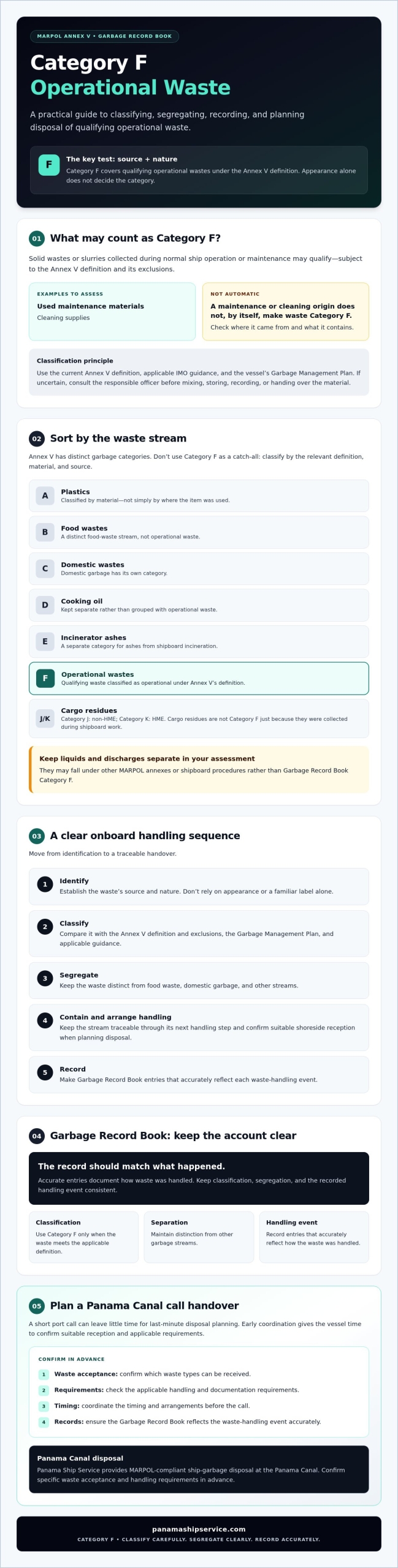
Under MARPOL Annex V, Category F is the Garbage Record Book category for operational wastes. It covers qualifying waste generated or collected during a ship’s normal operation and maintenance, subject to the Annex’s definition and exclusions. Appearance alone does not determine the category. Identify the waste’s source and nature before classifying it. The MARPOL Annex V overview gives broader context, but the current regulation and vessel procedures govern classification.
Category F is for operational waste that meets MARPOL Annex V’s definition, not every residue produced during maintenance. Consider the material’s source and nature, and whether another garbage category or MARPOL requirement applies. If the classification is unclear, don’t rely on appearance or a familiar label alone.
What wastes may fall within Category F?
Solid wastes or slurries collected during normal ship operation or maintenance may qualify as operational waste. Used maintenance materials and cleaning supplies are examples to assess, not automatic Category F items. Check where the material came from and what it contains against the current Annex V definition, applicable IMO guidance, and the vessel’s Garbage Management Plan before recording or disposing of it.
Keep operational waste distinct from other sources. Food waste, plastics, and cargo residues have their own Annex V categories. For example, a residue associated with cargo handling should not be classified as Category F simply because it was collected during routine work. Classification follows the relevant definition, not the place where the waste was found.
Which materials should not be classified as Category F by default?
Don’t use Category F as a catch-all for ship-generated garbage. Annex V has separate categories for plastics, food waste, domestic waste, cooking oil, incinerator ashes, and cargo residues. These distinctions support accurate segregation, recordkeeping, and disposal. A cleaning or maintenance task can produce waste that belongs in another category, depending on the material and its source.
Assess liquids and discharges separately as well. They may fall under other MARPOL annexes or shipboard procedures rather than the Garbage Record Book’s Category F. When uncertain, consult the vessel’s Garbage Management Plan and the responsible officer before mixing, storing, recording, or handing over the material. A clear classification onboard helps keep the waste stream traceable through its next handling step.
Category F Compared with Other MARPOL Garbage Categories
Annex V separates ship-generated garbage into categories so crews can classify, record, and manage each stream consistently. The MARPOL Annex V regulations provide the governing framework. Use this comparison as an orientation aid, not as a substitute for official definitions, the vessel’s Garbage Management Plan, or flag-state direction.
| Category | Garbage type | How it differs from Category F |
|---|---|---|
| A | Plastics | Classified by material as plastics, not simply by where the item was used. |
| B | Food wastes | A distinct food-waste stream, not operational waste. |
| C | Domestic wastes | Classified as domestic garbage under its own category. |
| D | Cooking oil | Kept separate as cooking oil rather than grouped with operational waste. |
| E | Incinerator ashes | A separate category for ashes from shipboard incineration. |
| F | Operational wastes | Waste classified as operational under Annex V’s definition. |
| J and K | Cargo residues, non-HME and HME | Separate categories for cargo residues, distinguished by whether they are harmful to the marine environment. |
How is Category F different from cargo residues and domestic waste?
Operational waste arises from ship operation or maintenance; cargo residue arises from the cargo and its handling. The activity and source help guide classification, but the applicable Annex V definition determines the category. Cargo residues are recorded under Category J or K as applicable, not Category F simply because they were collected during shipboard work. Domestic waste has its own category, Category C, and should not be folded into operational waste. Check the material’s source and nature against current guidance before assigning a category.
How do special-area rules affect garbage decisions?
Annex V discharge conditions depend on both the garbage type and the vessel’s location. A special area is a sea area designated under the Convention where environmental conditions call for specific discharge controls. Don’t assume that a rule for one waste category applies to another, or that a familiar route permits discharge. Confirm current charts, onboard procedures, and voyage-specific direction from competent authorities before deciding whether to discharge.
Correct classification is also the starting point for planning a shoreside handover. For vessels arranging disposal at the Panama Canal, MARPOL ship-garbage disposal can be included in port-call planning. Confirm accepted waste streams and applicable arrangements in advance.
How to Identify, Segregate, and Handle Category F Waste Onboard
A reliable process connects the waste’s source with its classification, segregation, records, and final handover. Follow the vessel’s Garbage Management Plan and assigned responsibilities at every stage. Don’t classify a material as Category F based only on its appearance or where it was temporarily collected.
- Identify the source. Note where and how the waste was generated, including the maintenance or operational task involved. Keep enough context for the responsible officer to assess it.
- Check the category. Compare the material and its source with current Annex V definitions and vessel procedures. Check whether another garbage category or MARPOL annex applies before assigning Category F.
- Segregate the stream. Keep the waste separate from other garbage while its classification is assessed. Once confirmed, continue separation from differently classified waste as required by vessel procedures.
- Contain and identify it. Follow the Garbage Management Plan for labeling, containment, and temporary storage. Confirm material-specific controls with the designated officer instead of assuming one method suits every waste stream.
- Arrange disposal and handover. Confirm the intended disposal route, acceptance requirements, and timing with the selected provider. Keep the waste identifiable through transfer so the handover details can be reconciled with onboard records.
What should the crew check before assigning Category F?
Start with the task that produced the waste, not just its physical form. A residue from maintenance may need a different classification from a similar-looking item that came from cargo operations or another source. Check the relevant Annex V category and consider whether a liquid or discharge is governed by another MARPOL annex. If the answer remains uncertain, keep the material identifiable and separate while the designated officer consults approved vessel procedures and determines the correct classification.
How should Category F be segregated and prepared for handover?
Use the vessel’s approved procedures for labels, containers, and temporary storage. Avoid mixing unconfirmed waste with established streams. Mixing can make classification harder, complicate records, and affect whether a disposal provider can accept the material. Before the port call, share the waste description and confirm acceptance and handling requirements with the provider. Don’t assume a particular container, treatment method, or reception arrangement applies without checking vessel procedures and applicable requirements.
This workflow keeps category f garbage traceable from its source through the planned handover. Clear onboard responsibility and timely confirmation can reduce sorting and documentation questions during port-call operations.
How to Record Category F in the Garbage Record Book
A clear Garbage Record Book (GRB) entry should match the waste stream handled onboard and the disposal event that took place. Ships of 100 gross tonnage and above must maintain a GRB under the requirements stated here. Confirm applicability and the latest entry instructions against current MARPOL requirements, flag-state direction, and the vessel’s approved procedures.
Before making an entry for category f garbage, verify that the waste is correctly classified and has remained identifiable through handling. The GRB does not replace proper segregation. Its details should agree with what the crew recorded onboard and what was transferred or otherwise disposed of.
What information belongs in a Category F entry?
Use the current GRB format and instructions rather than a generic template. Depending on the event and applicable requirements, check details such as the date, garbage category, estimated quantity, and disposal or handover information. For a shoreside transfer, confirm how the required entry should identify the location or reception arrangement. Keep entries legible and chronological, and follow flag-state, company, and vessel procedures if requirements differ.
Record the waste stream and handover that actually occurred, not what was planned or assumed. If a provider issues a receipt or other supporting document, reconcile it with the vessel’s records and retain it as required by applicable rules and company policy.
How can crews reduce recordkeeping errors?
Use a simple check before closing out an event:
- Match the recorded category and description to the onboard segregation and confirmed classification.
- Compare the recorded quantity and disposal details with the event information and any applicable handover documentation.
- Check that the entry is complete, legible, and in the sequence required by current GRB instructions.
- If an error is found, correct it using the prescribed procedure. Don’t obscure the original entry or silently replace it.
Resolve and document differences between onboard estimates and handover documents through vessel procedures rather than leaving them unexplained. Retain receipts and related records for the period required by applicable rules and company policy. This creates a clearer trail from segregation through shoreside disposal and supports a consistent account if records are reviewed.
For a Panama Canal garbage handover, Panama Ship Service’s MARPOL garbage disposal can be considered during planning. Confirm accepted waste types, documentation, and applicable arrangements in advance.
Plan Category F Garbage Disposal During a Panama Canal Call
A shoreside handover needs to fit the vessel’s schedule and the waste stream’s actual classification. Before arrival, confirm whether the selected provider can accept the specific material, what packaging or handling conditions apply, which documents are needed, and how timing will align with port-call operations. Don’t assume every operational residue is accepted simply because it falls under Category F.
For broader compliance context, review this MARPOL disposal guide for Panama. If maintenance is planned during the call, consider whether it may generate additional waste and coordinate classification and disposal alongside the work. Information about mechanical ship repairs in Panama may also help with planning the work.
What details should a vessel provide when arranging disposal?
Give the provider enough information to assess the waste stream and coordinate the handover. Prepare:
- The confirmed garbage category and a clear description of the material.
- An estimated quantity and details of its packaging or containment.
- The requested service timing and relevant port-call schedule information.
- Any handling considerations identified in the vessel’s procedures.
Ask the provider to confirm whether the material is accepted, any applicable handling conditions, and what documentation will be available after handover. Coordinate the plan with responsible onboard personnel so the waste description, segregation, records, and transfer details remain consistent.
How can Panama Ship Service support a compliant handover?
Panama Ship Service provides MARPOL-compliant ship-garbage disposal at the Panama Canal. Acceptance depends on the specific waste stream and applicable handling requirements, so confirm these details rather than assuming every Category F material can be received. Share the waste description, estimated quantity, packaging, requested timing, and relevant port-call requirements to support an informed service discussion.
Before the vessel arrives, Panama Ship Service can confirm the service scope, acceptance of the specific material, documentation, and operational coordination requirements. Early confirmation helps the vessel align the planned handover with onboard responsibilities and its port-call schedule.
Keep Category F Waste Traceable Through Handover
Sound management starts with the source. Classify each waste stream using the applicable MARPOL Annex V definition and the vessel’s procedures. Keep it segregated while its category is confirmed, then carry that classification through onboard handling and the Garbage Record Book. For a shoreside transfer, make sure the record reflects the waste and handover that actually occurred.
During a Panama Canal call, confirm the waste description, estimated quantity, packaging, timing, acceptance requirements, and available handover documents with the disposal provider in advance. Plan Category F garbage as a documented waste stream, not as a catch-all for maintenance residues.
Panama Ship Service provides MARPOL-compliant ship-garbage disposal and operational and technical services for vessels at the Panama Canal. Confirm specific waste acceptance and handling requirements before arrival. With clear classification and advance coordination, your crew can approach the handover with greater confidence. Contact Panama Ship Service to confirm Category F disposal requirements and discuss the port-call details.
Frequently Asked Questions
What are examples of Category F operational waste?
Some maintenance materials and cleaning supplies may qualify as Category F operational waste, but both the task that generated them and the material itself need assessment. A residue isn’t automatically Category F because it came from maintenance. Check whether it meets the Annex V definition or belongs to another garbage category or MARPOL annex. Use the vessel’s Garbage Management Plan and current guidance to confirm the classification.
Can Category F garbage be discharged into the sea?
Don’t assume Category F waste can be discharged at sea. MARPOL Annex V discharge conditions depend on the waste type and the vessel’s location, and some materials may also be subject to other MARPOL requirements. Check current rules, voyage-specific restrictions, vessel procedures, and competent-authority direction before any discharge. If the applicable conditions aren’t clear, keep the waste contained onboard and confirm the permitted disposal route.
How should Category F garbage be recorded in the Garbage Record Book?
Record the event using the current Garbage Record Book format and instructions. Check the date, category, quantity, and relevant disposal or handover details required for that event. Ships of 100 gross tonnage and above must maintain a Garbage Record Book under the requirements stated here. Confirm applicability and entry requirements against current regulations, flag-state direction, and vessel procedures. Reconcile shoreside handovers with supporting documents where applicable.
Is Category F the same as cargo residues?
No. Category F covers qualifying operational wastes, while cargo residues are recorded in separate Annex V categories: J for non-HME cargo residues and K for HME cargo residues. The source and activity help distinguish them. Waste doesn’t become operational waste simply because crew collected it during a routine task. Check current definitions and vessel procedures to classify cargo-related material correctly before segregation and recordkeeping.
How can a vessel arrange Category F garbage disposal in Panama?
Before the port call, provide a disposal provider with the confirmed category, waste description, estimated quantity, packaging, and requested timing. Ask the provider to confirm acceptance of that specific material, applicable handling requirements, and available handover documentation. Panama Ship Service provides MARPOL-compliant ship-garbage disposal at the Panama Canal, but acceptance of a particular Category F stream must be confirmed. Coordinate the plan with onboard personnel and the vessel schedule.
Who is responsible for classifying and recording ship garbage?
The vessel should follow its Garbage Management Plan, which sets out onboard responsibilities and procedures. Crew handling the waste should provide accurate information about its source and keep it segregated. The designated officer should resolve classification uncertainties and ensure records follow applicable Garbage Record Book instructions. Confirm oversight and correction procedures with the master, company, and flag-state requirements. Clear responsibility helps keep the waste description, category, and handover record aligned.