
A vessel operating in Panama may need more than canal transit support. Comprehensive maritime services in Panama can cover mechanical repairs, underwater hull work, marine surveys, waste disposal, ship supplies, cargo handling, and crew support. The right combination depends on the vessel’s operational needs and schedule.
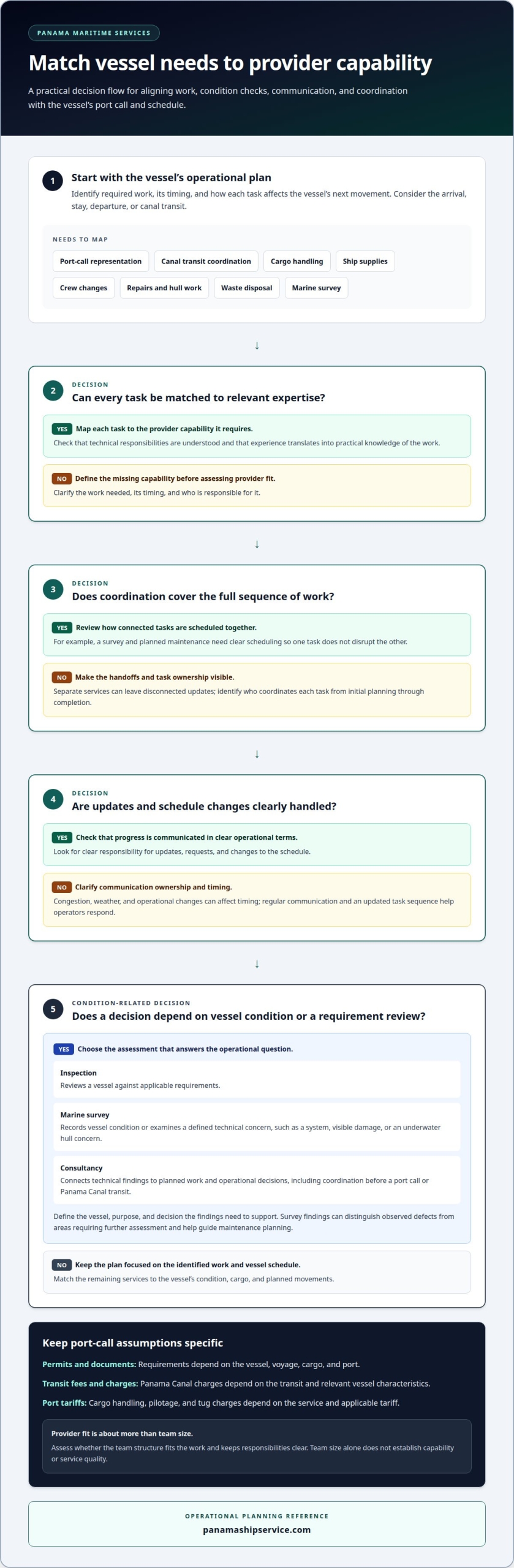
When time alongside or a transit window is limited, coordinating several needs through one provider can simplify communication and help reduce avoidable delays and expenses. Start by matching each service to the vessel’s condition, cargo, and planned movements.
This guide explains what maritime services in Panama can cover and how to assess a provider’s technical capability, communication, and coordination. It also explains how surveys support decisions about vessel condition, what to consider when seeking maritime consultancy, and how consolidating services can make planning easier. Use these points to identify support that fits your operation and keeps essential tasks organized.
Key Takeaways
- Map the vessel’s operational needs, from representation and transit coordination to technical work, before selecting support.
- Assess a provider’s fit by how its capabilities, communication, and service coordination align with your vessel’s schedule.
- Use surveys and inspections to clarify vessel condition and guide maintenance or operational decisions.
- Consider underwater hull services when hull condition needs attention, and see how coordinated support can simplify vessel operations.
What Are Maritime Services in Panama?
Maritime services support a vessel’s port call, canal transit, cargo movement, and technical needs. Panama’s strategic position connects more than 140 maritime routes and 1,700 ports worldwide.
Ship Agency and Owner Representation
A shipping agent represents the shipowner or operator during a port call. The role can include coordinating communications, organizing port-call arrangements, and aligning the vessel’s schedule with the services it needs. For example, an agency can coordinate a canal transit with cargo handling or a marine survey. Look for clear responsibility for updates, requests, and schedule changes.
Shipping, Logistics, and Port Services
Shipping and port services bring together tasks around a vessel’s arrival, stay, and departure. Depending on the call, these may include cargo handling, ship supplies, crew changes, repairs, waste disposal, or hull work. To decide what is needed, identify each task, its timing, and how it affects the vessel’s next movement.
Permits and documents for Panamanian port calls depend on the vessel, voyage, cargo, and port requirements. The agency coordinates applicable submissions and port-call paperwork based on those details.
Panama Canal transit fees and charges depend on the transit and the vessel’s relevant characteristics. Port tariffs for cargo handling, pilotage, and tug services depend on the service and applicable tariff, so no single amount covers every call.
Ship agency and marine services are centered on the Panama Canal and Panama’s ports. The right location for agency, bunkering, or other marine support depends on the vessel’s planned port call and required service.
Delays can disrupt a planned port call or canal schedule. Congestion, weather, and operational changes can affect timing, so regular communication and an updated sequence of tasks help operators respond.
Shipping-service capabilities vary by provider. Map each need, such as cargo handling or a marine survey, to the relevant capability and the vessel’s schedule. This helps bring separate tasks together in one operational plan.
Criteria for choosing a maritime services company
A maritime provider in Panama should connect its capabilities to the vessel’s operational priorities. Start with the port call: identify required work, timing, and handoffs, then assess whether coordination covers the full sequence. For example, a survey and planned maintenance need clear scheduling so one task does not disrupt the other.
Experience matters when it translates into practical knowledge of the work. Technical teams should understand their responsibilities and communicate progress in clear operational terms. A reliable partner also makes ownership of each task visible, from initial coordination through completion, instead of leaving shipowners to manage disconnected updates.
Mission and continuous improvement are best judged by operating practices, not slogans. A useful mission connects service delivery to vessel needs. Improvement means reviewing completed work, identifying coordination gaps, and applying those lessons to future calls. For example, a revised handoff process can clarify who shares schedule changes and when.
A company’s vision should support lasting client relationships across national and international operations. This calls for consistent communication, clear accountability, and service planning that reflects each vessel’s requirements. Worldwide operations can involve different time zones and stakeholders, so concise updates help owners, operators, and onboard teams stay aligned.
Team size offers context, but it doesn’t establish capability on its own. A provider dataset recorded a median employee-size category of 11-50 employees as of September 20, 2026. The same dataset listed 33 companies with 1-10 employees and 52 with 11-50 employees. These figures describe the dataset, not service quality. Assess whether the team structure fits the work and keeps responsibilities clear.
Use a practical selection sequence: define the vessel’s requirements, map each task to the responsible expertise, and review how updates and schedule changes are handled. Then assess whether the proposed coordination supports the intended port call. For hull-related planning, explore Panama maritime service capabilities as one part of your operational review.
Flag inspections, surveys, and consultancy
Flag inspections, marine surveys, and consultancy address different operational questions. An inspection reviews a vessel against applicable requirements, while a survey records its condition or examines a defined technical concern. In Panama’s maritime sector, providers should comply with Panama Maritime Authority regulations and international standards. A sound process begins by defining the vessel, the purpose of the inspection, and the decision the findings must support.
A marine survey gives owners and operators a structured view of vessel condition. Its scope may focus on a specific system, visible damage, or an underwater hull concern. Findings help identify what needs attention and support maintenance planning. For example, a survey report can distinguish observed defects from areas requiring further assessment, giving the operator a clearer basis for prioritizing follow-up work.
Consultancy turns technical findings into operational decisions. An adviser can organize the information, explain how a finding affects planned work, and identify issues that need coordination before a port call or Panama Canal transit. Linking survey findings with the vessel’s schedule and relevant agency arrangements helps the owner plan next steps without managing disconnected decisions.
Vessel registration under the Panama flag depends on the vessel’s particulars, ownership, and applicable registration process. Supporting documents therefore depend on those details. Handle registration according to the relevant requirements rather than relying on a general checklist.
For a practical review, define the survey or inspection scope, gather relevant vessel records, document findings, and connect each finding to an operational decision. The scope and records determine how useful the assessment will be. A specific hull concern calls for a focused examination, while a broader condition review requires a broader scope. This keeps consultancy tied to the vessel’s needs and gives the maritime team a clear basis for planning repairs, maintenance, or further assessment.
Benefits of hiring a maritime services provider
A maritime services provider can reduce coordination friction by organizing separate tasks around one vessel schedule. For example, an operator can align a planned inspection with port-call arrangements rather than treating each activity as a separate job. Teams can then see dependencies, sequence work, and respond to schedule changes using shared information.
Specialized support helps match technical work to the vessel’s condition and operational needs. If there is a hull concern, an underwater assessment can help define the issue before maintenance decisions are made. When cargo operations are planned, clear handling coordination connects vessel activities to the broader port call. The benefit is a more focused plan, not a promise that every delay will disappear.
Coordinating services can simplify communication between shipowners, vessel operators, technical teams, and port-side contacts. A clear coordination point helps establish who is responsible for each task and where updates should go. For example, if a survey affects the timing of planned work, the relevant parties can adjust the sequence instead of relying on disconnected instructions. This can reduce avoidable handoff problems.
Personalized planning matters because vessels differ in condition, schedule, cargo, and support needs. A useful provider maps those needs, then links each task to its timing and operational purpose. This helps owners focus their internal teams on decisions while specialists coordinate defined service requirements. In Panama, where port calls and canal movements shape operations, a joined-up service plan can make responsibilities easier to manage.
- Bring the vessel’s schedule and required tasks into one working plan.
- Match specialized technical support to the specific condition or operation.
- Set clear responsibility for updates, handoffs, and schedule changes.
For hull-related operational needs, discuss underwater hull services as part of your vessel’s maintenance planning.
Panama Ship Service: Underwater Hull Services
Panama Ship Service provides Underwater Hull Services for vessels requiring attention below the waterline. Use this service when a hull concern needs assessment or underwater work as part of maintenance planning. A Marine Survey can also document vessel condition and inform the next operational decision.
For broader vessel needs, Panama Ship Service also provides Mechanical Ship Repairs and MARPOL Disposal. Coordinating relevant work around a port call can keep tasks organized alongside the vessel’s schedule. The appropriate service depends on the vessel’s condition and operational requirements.
Share your vessel’s needs and schedule with Panama Ship Service to discuss the appropriate support. Contact Panama Ship Service to discuss your requirements.
Plan your vessel’s next move
Turn operational priorities into a clear work request by identifying the vessel, the issue requiring attention, and how the work fits its planned movements. This gives the discussion a practical starting point and keeps decisions focused on the vessel’s needs.
For comprehensive maritime services in Panama, Panama Ship Service supports vessel requirements through Mechanical Ship Repairs, Underwater Hull Services, and MARPOL Disposal. Choose the service that matches the task, whether you’re addressing a mechanical issue, an underwater hull concern, or disposal needs.
Share the relevant vessel details and your operational priorities with the team. A focused request can help establish which service applies and what information is needed to discuss the work. Contact Panama Ship Service to discuss your vessel’s requirements and take the next step with confidence.
Frequently Asked Questions
What maritime services are offered in Panama?
Comprehensive maritime services in Panama can include vessel agency, cargo handling, ship supplies, crew support, surveys, repairs, and underwater hull work. Panama Ship Service also provides MARPOL Disposal. For example, an operator planning maintenance can coordinate Mechanical Ship Repairs with a Marine Survey, while a vessel requiring hull attention can arrange Underwater Hull Services. The right combination depends on the vessel’s operational requirements.
How do ship agency and port-call services work in Panama?
A ship agency coordinates port-call requirements between the vessel, its owner or operator, and relevant service teams. The process starts with the vessel’s schedule and requested support, such as cargo handling or a crew change. The agency then coordinates arrangements and communicates updates as the call develops. Sharing the expected arrival, operational priorities, and service needs helps keep the plan focused.
What are the costs and availability of ship repair, dry dock, and maintenance services in Panama?
Repair and maintenance costs depend on the vessel’s condition, work scope, parts, and scheduling requirements. Request a quote to establish the applicable price. Panama Ship Service provides Mechanical Ship Repairs and preventive maintenance for marine engine and navigation components. For dry-dock planning, distinguish yard arrangements from the repair work being scoped. Coordinate the work around the vessel’s needs and planned schedule.
How can a shipowner choose and contact a maritime services provider in Panama?
When assessing comprehensive maritime services in Panama, match a provider’s technical capabilities to the vessel’s needs, then consider how it will coordinate work and communicate updates. A hull concern calls for underwater expertise, while a mechanical fault needs repair support. Contact Panama Ship Service with the vessel’s location, schedule, issue, and requested service to discuss the right operational support.