
An ROV may seem like the obvious choice for a large hull, but it isn’t automatically the right one. When choosing between ROV and diver hull cleaning, vessel operators need to consider more than coverage. Hull condition, fouling, access, environmental controls and the time available around a Panama Canal call all shape the decision.
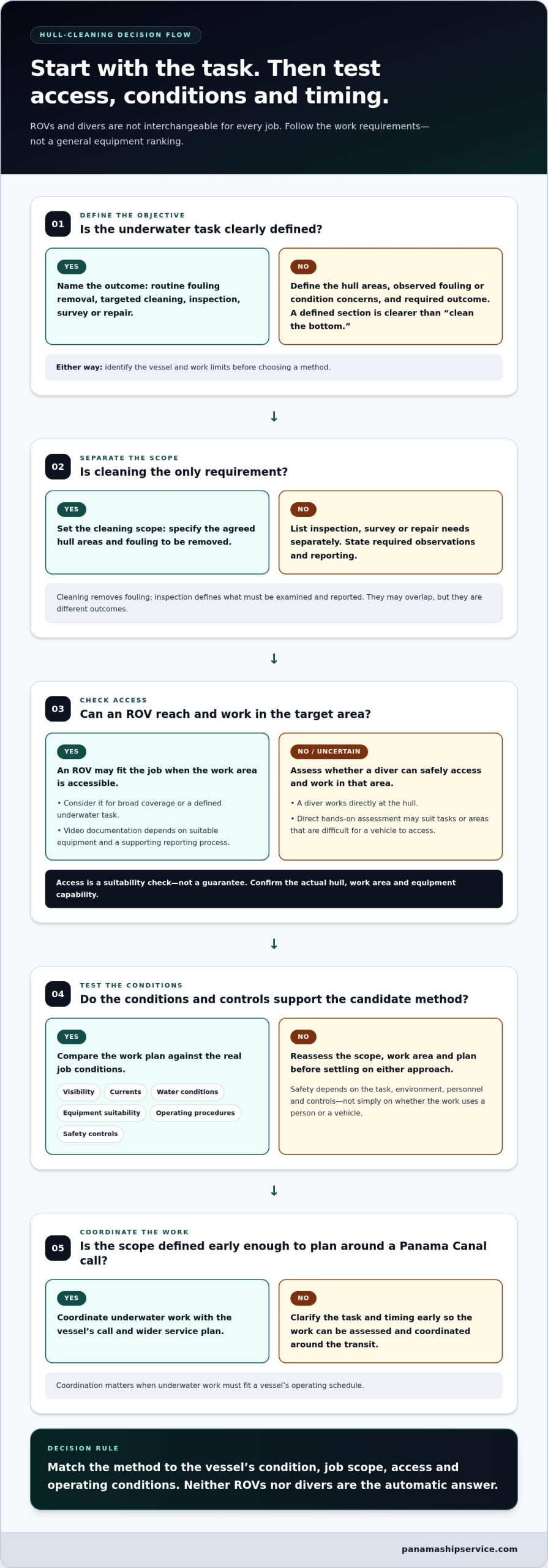
A tight operating schedule leaves little room for underwater work that doesn’t fit the vessel or the job. ROVs may suit broad, accessible areas and can provide video documentation when the equipment and reporting process support it. Divers can work directly at the hull and may be better suited to tasks that need hands-on assessment. The practical choice depends on what needs cleaning or inspecting and the conditions in which the work will take place.
This guide compares both methods against vessel condition, job scope and operating constraints, including environmental considerations that can affect in-water cleaning. It also explains how to plan the work around a Canal transit, where coordination matters. Panama Ship Service provides Underwater Inspection / Underwater Work, including hull cleaning, on both sides of the Panama Canal. These services can be coordinated with other vessel needs as part of a broader service plan.
Key Takeaways
- Start with the underwater task and vessel condition, then match the method to the work rather than assuming one approach is always better.
- Compare ROV and diver-led cleaning by control, access, scope and reporting needs to identify practical trade-offs.
- When choosing between ROV and diver hull cleaning, weigh job conditions and procedures alongside safety, not just the equipment involved.
- Separate cleaning requirements from inspection, survey or repair needs before selecting a method.
- Define the work early to support coordination around a Panama Canal call and fit underwater services into the vessel’s wider plan.
Why Choosing Between ROV and Diver Hull Cleaning Depends on the Job
The right method is the one that fits the work, not the one that wins a general comparison. ROV hull cleaning uses a remotely operated underwater vehicle controlled from the surface, while diver-led cleaning relies on a person working directly underwater. Both approaches can support hull work, but they aren’t interchangeable for every vessel or task. A general overview of the Remotely Operated Underwater Vehicle (ROV) explains the technology; the operational decision still comes down to the specific job.
Start by defining the objective. Is the vessel seeking routine fouling removal, cleaning of a particular area, or underwater work that also needs visual or hands-on assessment? Hull condition, the extent and location of fouling, access, water conditions and the vessel’s schedule can all affect which method is suitable. Getting specific at this stage helps avoid planning a broad cleaning task when the actual requirement is a targeted inspection, or vice versa.
What does the hull-cleaning job need to achieve?
Separate cleaning from inspection, survey or repair requirements. Routine cleaning focuses on removing fouling from agreed hull areas. An inspection-led task may require observations of coating condition or visible damage, while repair work has a different scope from fouling removal alone. These objectives can overlap, but they shouldn’t be treated as identical.
Define the vessel and task before selecting a method: identify the areas to be addressed, describe observed fouling or condition concerns, and state the required outcome. For example, a request to clean a defined section of the hull is more actionable than a general instruction to “clean the bottom.” If inspection is also required, specify it separately so the work plan includes the required observations and reporting. A clear scope gives the underwater team a practical basis for assessing access, work limits and timing.
Why neither ROVs nor divers are the automatic answer
Each method has different strengths. An ROV may suit broad surface coverage and visual documentation when the vehicle can reach the work area and the equipment supports the required records. A diver can work directly at the hull and provide hands-on assessment, including in some areas that may be difficult for a vehicle to access. These are practical distinctions, not guarantees. The vessel’s condition, the specific work area, visibility, currents, equipment suitability and operating procedures all influence whether either approach fits.
Safety also depends on the task and conditions, not simply on whether the work is performed by a person or a vehicle. Compare the environment, work plan, personnel and controls alongside the cleaning objective. A method that suits an accessible hull area may not suit a restricted space or a job requiring close physical assessment.
Method suitability depends on the vessel’s condition, work scope, access and operating conditions, not on a universal ranking of ROVs and divers. That’s the core of choosing between ROV and diver hull cleaning: define what must be done first, then match the approach to the actual job.
How ROV and Diver Hull Cleaning Differ in Practice
The practical difference is how underwater work is carried out and what the task requires from the person or system doing it. An ROV is operated remotely from the surface; diver-led work is performed by a person underwater. Neither label alone tells you whether the hull will be cleaned effectively or whether inspection findings will meet the need. Scope, access, conditions and the required record of work all matter.
| Factor | ROV-led work | Diver-led work |
|---|---|---|
| Personnel | An operator controls the vehicle remotely. | A diver carries out the underwater task directly. |
| Control | Control is exercised remotely, with the operator guiding the system. | Control comes from the diver working at the hull. |
| Visibility | Visual assessment depends on conditions and the system’s imaging setup, where used. | What the diver can see depends on underwater visibility and working conditions. |
| Access | Suitability depends on whether the vehicle can reach and work in the target area. | Suitability depends on whether the diver can safely access and work in that area. |
| Scope | Can be considered for defined underwater cleaning or inspection tasks. | Can be considered for cleaning or tasks that require direct human execution. |
| Reporting | Records depend on the task and documentation process. | Observations and records depend on the task and reporting process. |
Where remotely operated vehicles may fit the work
Remote operation may suit a clearly bounded cleaning or inspection task, particularly when the planned work area is accessible to the vehicle. But “ROV” doesn’t specify a particular tool, camera or cleaning capability. Those details vary by system. Consider visibility, control and access for the actual hull and conditions rather than assuming they from the equipment category.
Cleaning and inspection are related, but they’re distinct outcomes. A cleaning scope defines what fouling is to be removed; an inspection scope defines what must be examined and reported. A vehicle used for one purpose shouldn’t automatically be assumed to deliver the other. State whether visual records or specific observations are required so the work can be planned accordingly.
Where diver-led hull cleaning may fit the work
A diver may be suitable when a task calls for direct human execution, such as work where hands-on assessment is part of the scope. That doesn’t mean every confined area is accessible, or that a diver will always have better visibility or working conditions. Water conditions, hull access and the nature of the task remain decisive.
Direct involvement also doesn’t guarantee a more complete inspection or a better finish. Describe the requested cleaning result and inspection findings separately, then document them against the agreed scope. This keeps expectations clear and distinguishes “clean the area” from “assess and report its condition.”
For operators choosing between ROV and diver hull cleaning, compare the work method against the task and reporting requirements, not assumptions about equipment or personnel. Panama Ship Service’s underwater hull services include cleaning and underwater inspection, which can be coordinated around the vessel’s defined needs.
Is ROV Hull Cleaning Always Safer, Faster, or More Effective?
No. An ROV isn’t automatically safer, faster or more effective than diver-led cleaning for every vessel. The outcome depends on the task, operating conditions, work plan and people involved. Equipment type is one factor, not a complete decision rule.
Assess safety against the actual job. Consider the work area, access, underwater visibility, currents and other conditions, along with procedures and personnel. Remote operation changes how the task is carried out, but it doesn’t remove the need to assess the worksite and plan controls. Diver-led work likewise requires task-specific planning. Neither method should be judged safe simply by its label.
How to weigh safety, operating conditions, and environmental factors
Conditions can affect each approach differently. Poor visibility may limit visual assessment, while restricted access may affect whether a vehicle or diver can reach the target area and perform the required work. Currents and other site conditions also belong in the operational assessment. The relevant question is not which method is safer in general, but which work plan suits the vessel and conditions at the time.
Environmental impact also deserves attention. In-water cleaning can remove biological growth and other material from the hull, so the planned method and handling of removed material matter to the environmental assessment. Don’t assume that a particular system captures debris or that a cleaning approach is acceptable under local conditions. Account for the requirements that apply at the work location before planning in-water cleaning.
How to compare speed, quality, and operational impact
Work duration is only one part of the schedule. The total time impact can also include defining the scope, arranging access, preparing the work, carrying it out and recording completion. A method that appears faster during the underwater task may not reduce the overall coordination required. For a vessel with a tight call window, clear communication about the job and timing supports a more practical plan than relying on a general speed claim.
Compare quality against the agreed result. For cleaning, specify the hull areas and the required completion criteria. For inspection, define the observations or records needed. These are separate outputs: a surface may be cleaned without a condition assessment, and an inspection may not include cleaning. Keeping the objectives distinct makes completion easier to assess and helps avoid mismatched expectations.
ROV and diver cleaning have no universal winner: suitability depends on the task, conditions, procedures, scope and schedule. That’s the basis for choosing between ROV and diver hull cleaning. Assess these factors together, then select the approach that fits the defined work rather than assuming one method guarantees a better result.
How to Choose an ROV or Diver for a Specific Hull-Cleaning Job
Make the choice job-specific. Start with the vessel and required work, account for condition and operating constraints, then select the method that best fits the defined scope. This sequence keeps cleaning, inspection, survey and repair needs distinct, so the work plan and expected deliverables are clear before the vessel’s schedule is affected.
A practical sequence for defining the work
- Specify the vessel, task and areas. Provide relevant vessel details and identify which hull sections need attention. Describe the requested outcome, such as removing fouling from a defined area, rather than using a broad instruction that leaves the work boundaries unclear.
- Describe condition and constraints. Share known information about hull condition and fouling, along with access limitations and operational timing. Include relevant conditions in the planned work area, such as visibility or currents, so the assessment reflects the job rather than assumptions.
- Separate cleaning from assessment. State whether the requirement is hull cleaning, underwater inspection, survey, repair work or a combination. Cleaning removes fouling; inspection assesses and reports condition. If survey or repair work is involved, define those needs separately instead of treating them as automatic parts of cleaning.
- Set reporting expectations. Specify what completion evidence or inspection findings are required. A clear deliverable helps align the work plan with the operational reason for the job.
- Select the method against the scope. With the task, condition, access, environmental factors, timing and reporting needs defined, compare whether ROV or diver-led work is the better fit.
This vessel-specific sequence is more useful than choosing by a general claim about speed or safety. Panama Ship Service’s underwater hull services guide provides context for planning underwater work for vessels in Panama.
How to compare proposals without relying on generic claims
Give each proposal the same defined scope. Compare the described method, work areas, cleaning objectives, inspection requirements, deliverables and schedule assumptions. If one proposal includes inspection and another covers cleaning only, they aren’t like-for-like, even if both address the same hull. Clarify the difference before weighing the options.
Useful points to compare include:
- The hull areas and tasks included in the scope
- Whether inspection, survey or repair work is included or separate
- How completion and any findings will be reported
- The access, operating conditions and schedule assumptions behind the plan
- How changes to the scope will be communicated and coordinated
Keep inspection objectives distinct from cleaning. A marine surveys guide can help clarify how survey requirements fit into a broader vessel assessment. Panama Ship Service coordinates underwater work in Panama as part of its vessel services. Learn about the company’s underwater services.
Plan Hull Cleaning Around a Panama Canal Call
A Canal call creates a defined operating context for underwater work: vessel movements, other planned services and the vessel’s schedule must be coordinated. Early clarity about the hull-cleaning or inspection scope gives the service team a practical basis for planning. It also helps identify work that can be grouped into the vessel’s broader service plan and requirements that need separate coordination.
Coordinate underwater work with vessel operations
Share the vessel’s details and operational constraints as early as possible. Describe the requested work, the hull areas involved, known condition concerns, and whether the job includes cleaning, inspection or both. Include the intended call location and schedule considerations without assuming a particular work window or completion time.
Clear information supports coordination between underwater work and other vessel needs. For example, if hull cleaning and an underwater inspection are both required, stating each objective keeps the scope and expected reporting clear. If repairs, surveys or supplies are also part of the vessel’s plan, communicate those requirements together to help organize the work without treating them as automatic parts of cleaning.
For an efficient exchange, prepare the relevant details:
- Vessel name and identifying details
- Requested underwater work and specific hull areas
- Known condition or fouling observations
- Whether inspection findings or other deliverables are required
- Call timing and any operational constraints that affect coordination
This information gives the service team a clearer picture of the requirement and supports responsive communication as plans develop. Panama Ship Service has 24/7 contact availability for vessel-service coordination. Communicate any changes to the vessel’s schedule or work scope promptly so the plan can be adjusted to the updated requirement.
Use a Panama-based service partner for the next step
Panama Ship Service provides operational and technical services on both sides of the Panama Canal. Its Underwater Inspection / Underwater Work includes hull cleaning and underwater inspections. Operators can coordinate these needs alongside other vessel services, including repairs, marine surveys and ship supplies, through a broader service plan. Consolidating requirements can simplify communication across multiple services, while the work plan remains specific to the vessel’s needs and schedule.
Choosing between ROV and diver hull cleaning is one part of the plan; a clearly described scope and schedule connect that choice to the vessel’s actual needs. Share the vessel details, requested underwater work and timing constraints to start a focused discussion.
Discuss underwater hull services for your vessel.
Turn the Decision Into a Clear Work Plan
The method decision is most useful when it becomes part of a practical maintenance plan. Record the reason for the work, the areas addressed and any relevant observations, so future planning can draw on what the vessel actually needed rather than defaulting to the same approach each time. This gives operators a stronger basis for reviewing hull condition and preparing the next underwater job.
For choosing between ROV and diver hull cleaning, carry the decision into the work brief: define the objective, note the agreed approach and keep cleaning requirements distinct from any inspection or repair follow-up. Clear records help teams align vessel maintenance with operational priorities and communicate requirements consistently across calls.
When you’re ready to plan the next job, share the vessel’s requirements and schedule. Discuss your vessel’s underwater-service requirements with Panama Ship Service.
Frequently Asked Questions
Is an ROV always safer than diver hull cleaning?
No. An ROV can remove a diver from the underwater task, but that alone doesn’t make the complete operation safe. Suitability still depends on conditions, equipment, procedures and the work being attempted. For example, poor visibility or a confined area may change how the team plans access and observation. Compare the hazards and controls for the specific job rather than treating remote operation as a guarantee of safety.
Can an ROV clean every part of a ship’s hull?
No single assumption applies to every ROV or hull. Whether a vehicle can reach and work in a particular area depends on the equipment, hull geometry and access conditions. Projections, recesses, intakes and appendages may need separate consideration. Identify hard-to-reach areas in the work request, and state whether each requires cleaning, inspection or both, rather than assuming one method will cover the entire underwater surface.
How do I choose between an ROV and divers for hull cleaning?
When choosing between ROV and diver hull cleaning, start with the outcome needed for this call, then compare the scope against access, hull condition, site conditions, reporting and timing. A broad fouling-removal task and a request to assess a suspected defect are different jobs, even if they involve the same hull section. Select the method that fits the task and required deliverable, not a general preference for one type of equipment.
What should a vessel operator include in a hull-cleaning work scope?
Include the vessel’s name and type, requested work, hull areas involved, known fouling or damage, coating concerns, access limitations, location and schedule constraints. Add photographs or recent inspection notes if available, and state what completion records or findings are needed. If a suspected defect is part of the request, describe it separately from cleaning so the scope doesn’t imply repair or survey work that wasn’t requested.
Can hull cleaning and underwater inspection be planned together?
Yes. They can be planned together, but describe cleaning and inspection as separate requirements. Identify which areas are to be cleaned and what observations or records are expected from inspection. This helps prevent a cleaned surface from being mistaken for a condition report, or a visual check from being treated as completion of the cleaning task. Keep the deliverables distinct in the work request.
Does the vessel’s operating location affect the choice between an ROV and divers?
Yes. Location can affect site access, underwater conditions and the operating or environmental requirements that apply to in-water work. Don’t assume conditions or requirements are identical at every port. For a Panama Canal call, include the intended work location and timing in the planning information, and account for actual site conditions when selecting a method. Consider current local requirements before making regulatory assumptions about the work.
What information should I provide when arranging hull cleaning in Panama?
Provide the vessel’s identifying details, intended call location and schedule, requested work, specific hull areas, and any known fouling, damage or access concerns. Note whether you need cleaning, inspection or both, and describe any records or findings required. Relevant photographs and recent condition notes can help clarify the request. Include other vessel services being coordinated at the same time so the underwater work can fit the wider operational plan.