
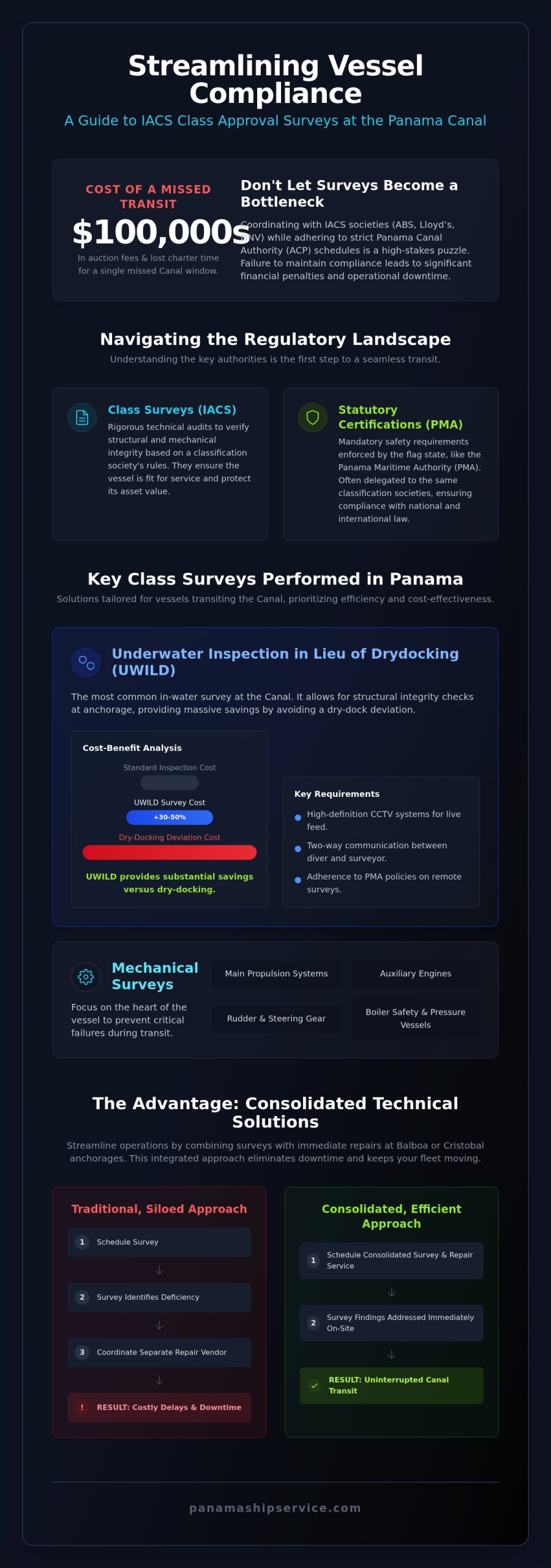
A single missed Panama Canal transit window can cost your operation hundreds of thousands of dollars in auction fees and lost charter time. When your vessel is approaching the Isthmus, securing class approval surveys panama shouldn’t be the bottleneck that keeps you at anchor. We understand that coordinating with IACS societies like ABS, Lloyd’s, or DNV while adhering to strict Panama Canal Authority (ACP) schedules is a high-stakes logistical puzzle. The pressure to maintain compliance without incurring the high costs of unscheduled downtime is a constant reality every ship operator faces.
You shouldn’t have to choose between thorough safety inspections and your operational schedule. This guide explains how to secure IACS-compliant class approval surveys in Panama to ensure vessel safety, regulatory compliance, and uninterrupted Canal transits. We’ll explore the advantages of consolidating your technical surveys with immediate mechanical repairs and underwater hull services. By the end of this article, you’ll have a clear roadmap for managing documentation and technical requirements to keep your fleet moving through the Balboa and Cristobal hubs without delay or non-compliance fines.
Key Takeaways
- Understand how IACS-recognized technical audits ensure your vessel meets both international standards and Panama Maritime Authority requirements.
- Learn the critical timing strategies needed to coordinate class approval surveys panama with your scheduled Canal transit slots to prevent costly delays.
- Discover the operational advantages of in-water survey solutions that allow for structural integrity checks without the need for expensive dry-docking.
- Gain clarity on specific Panama Canal Authority (ACP) safety mandates to ensure a seamless passage through the locks.
- Find out how a consolidated service model allows you to address survey findings with immediate mechanical repairs while at the Balboa or Cristobal anchorages.
What are Class Approval Surveys in Panama?
Class approval surveys are rigorous technical audits designed to verify the structural and mechanical integrity of a vessel. These inspections ensure that a ship complies with the established rules of its chosen ship classification society. In the high-stakes environment of the Panama Canal, these surveys are critical. They provide the technical assurance that a vessel is fit for its intended service and won’t experience catastrophic failure during transit.
The International Association of Classification Societies (IACS) plays a central role here. Most global tonnage is classed by IACS members like ABS, Lloyd’s, or DNV. Panama’s strategic position makes it a premier hub for these inspections. With major port facilities at both Balboa on the Pacific side and Cristobal on the Atlantic side, operators can schedule class approval surveys panama without deviating from their primary trade routes. This geographic advantage minimizes downtime and simplifies logistics for transiting vessels.
The Importance of Periodic Class Inspections
Ship owners must adhere to strict survey cycles to maintain their vessel’s class status. This typically includes annual, intermediate, and special surveys. A special survey, occurring every five years, involves an extensive examination of the hull and machinery. If a class status lapses, the consequences are immediate and severe. Insurance coverage often becomes void, and port state control authorities may detain the vessel. Regular inspections protect the ship’s asset value and provide evidence of diligent maintenance for future buyers or charterers.
Class Surveys vs. Statutory Certifications
It’s vital to distinguish between class surveys and statutory certifications. Class surveys focus on the ship’s structural and mechanical health based on the society’s rules. Statutory certifications are safety requirements mandated by the flag state, such as the Panama Maritime Authority (PMA). The PMA often delegates these statutory duties to Recognized Organizations (ROs), which are frequently the same classification societies.
Panama Ship Service streamlines this complexity. We facilitate both structural inspections and safety certification requirements for vessels at the Canal anchorages. This makes it easier to complete class approval surveys panama while simultaneously addressing flag state compliance. By coordinating these efforts, we help operators manage the intersection of flag state mandates and class standards efficiently. This consolidated approach reduces overhead and ensures that all documentation is ready before the vessel enters the locks.
Primary Types of Class Approved Surveys Conducted in Panama
Vessels arriving at the Panama Canal face unique operational demands that dictate the type of technical oversight they require. Most class approval surveys panama requests center on maintaining operational readiness without disrupting tight transit schedules. While bulkers might prioritize hull integrity and cargo hold condition, tankers and container ships often focus on propulsion efficiency and steering gear reliability. The most significant trend in the region is the transition toward in-water solutions. This shift allows operators to satisfy classification society requirements while the vessel remains at anchorage, bypassing the extreme costs and scheduling delays associated with regional dry-docking.
Underwater Inspection in Lieu of Drydocking (UWILD)
An Underwater Inspection in Lieu of Drydocking (UWILD) is the most common class-approved in-water survey conducted at the Canal. These inspections require specialized equipment, including high-definition CCTV systems and two-way communication between the diver and the class surveyor. While a class-approved UWILD can cost 30% to 50% more than a standard inspection, the savings compared to a dry-docking deviation are substantial. Operators should note that the PMA Policy on Remote Surveys provides a framework for how technology can assist in these verifications. You can find more technical details on these procedures in our guide to underwater hull services.
Mechanical and Engine Room Class Surveys
Mechanical surveys focus on the heart of the vessel: the main propulsion systems, auxiliary engines, and rudders. Classification societies require periodic verification of boiler safety and pressure vessel integrity to prevent engine room failures. If a surveyor identifies a deficiency during these inspections, immediate action is required to avoid a “condition of class” or a transit refusal by the ACP. We specialize in integrating mechanical ship repairs directly following a survey finding. This proactive approach ensures your vessel remains compliant and operational.
Condition and Pre-Purchase Surveys
Panama’s status as a global maritime crossroads makes it an ideal location for pre-purchase and condition surveys. When a vessel changes ownership, a standardized IACS-compliant report is essential for the new owners and their insurers. These surveys often include a detailed review of the vessel’s maintenance history and a physical inspection of accessible spaces. Bunker surveys are also frequently conducted at Balboa and Cristobal to verify fuel quantity and quality during these transitions. If you are planning an ownership transfer, scheduling a comprehensive survey ensures a transparent transaction.
Finally, damage surveys are mandatory following any incident in the Canal or at sea. Whether it’s a minor contact with a lock wall or a machinery failure, a class surveyor must attend to verify that the vessel remains seaworthy. These surveys are often high-pressure situations where quick turnaround is essential to minimize the cost of unscheduled downtime.
Navigating Local Regulations: ACP and Panama Maritime Authority
Operating in Panamanian waters requires navigating a dual-layered regulatory framework that is among the most stringent in the global maritime industry. The Panama Canal Authority (ACP) manages the technical and safety requirements for the waterway itself, while the Panama Maritime Authority (PMA) handles flag state and statutory oversight for the territory. For ship operators, coordinating class approval surveys panama involves more than just classification society rules. It requires strict adherence to local mandates that are updated annually to reflect changing safety and environmental standards.
The ACP is notoriously strict regarding vessel condition. According to the Panama Canal Vessel Requirements outlined in the OP Notice to Shipping No. N-01-2026, vessels must meet specific technical standards before they are permitted to enter the locks. Local service providers act as essential technical liaisons during this process. We ensure that the findings from a class survey are translated into the specific documentation required by Canal inspectors, preventing administrative friction that could stall your transit.
ACP Specific Requirements for Vessels in Transit
Canal inspectors prioritize steering gear, propulsion systems, and navigational equipment during pre-transit boardings. Any deficiency in these areas can lead to immediate transit delays or heavy fines. The updated LoTSA 2.0 reservation system requires vessels to be in full technical compliance to maintain their scheduled slots. If a vessel fails an inspection, the costs of lost time and the potential need to auction a new slot can reach hundreds of thousands of dollars. Ensuring your class approval surveys panama specifically address ACP readiness is a strategic necessity for maintaining your schedule.
Environmental Compliance and MARPOL
Environmental standards in Panama have become increasingly rigorous. The Panama Maritime Authority has adopted IMO Resolution MEPC.278(70), requiring ships of 5000 gross tonnage and above to collect and report fuel consumption data through the IMO Data Collection System (DCS). Surveys now frequently include audits of oily water separators and sewage treatment plants to ensure MARPOL compliance. We help operators bridge the gap between technical surveys and physical compliance by providing MARPOL disposal services for sludge and bilge water at both the Balboa and Cristobal anchorages. Staying ahead of these 2026 standards prevents environmental penalties and ensures your vessel remains compliant with international conventions like SOLAS and Load Line.
Beyond the Canal’s immediate requirements, the PMA ensures that all vessels operating in Panamanian jurisdiction meet global safety standards. Because Panama is a premier flag state, their statutory requirements often overlap with class inspections. Professional coordination ensures that a single attendance by a surveyor can satisfy both class and statutory needs. This approach reduces overhead and simplifies the complex documentation process for the ship owner.
How to Prepare for a Class Survey in Panama
Successful class approval surveys panama depend entirely on proactive planning. The Panama Canal is a high-pressure environment where every hour counts. Poor preparation often leads to “Conditions of Class” or recommendations that can prevent your vessel from entering the locks. Operators must align their technical readiness with their Canal transit slots to avoid the 25% premium often charged for emergency inspections requested within 24 hours of transit.
Documentation and Pre-Survey Checklist
Start by organizing your technical records. The attending surveyor will require immediate access to previous survey reports and thickness measurement records. Verify that all technical manuals and certificates are current and readily available. You must also ensure clear access to all compartments and machinery scheduled for inspection. A surveyor cannot approve what they cannot see, and delays in opening hatches or clearing spaces will extend the survey duration and increase costs.
- Previous IACS survey reports and thickness measurement data.
- Updated statutory certificates and technical manuals.
- Compartment access plans and safety permits.
- Calibration certificates for onboard testing equipment.
Coordinating with Classification Societies
Booking an attending surveyor from ABS, DNV, or Lloyd’s in Panama requires careful timing. You should work with a service provider that maintains established relationships with these societies to streamline the process. This simplifies the logistics of transporting the surveyor to the anchorage at Balboa or Cristobal. We handle these complex coordination tasks to ensure the surveyor arrives exactly when the vessel and diving teams are ready. Contact us to coordinate your upcoming survey logistics and minimize wait times.
Physical Vessel Preparation
Physical readiness is critical for a smooth inspection. For in-water surveys, you must ensure the cleaning of specific areas like sea chests, rudders, and propellers prior to the surveyor’s arrival. This allows for high-definition CCTV to capture accurate data on hull integrity. Ensure that lighting and ventilation in confined spaces meet safety standards to protect the surveyor and diving teams. Test all critical machinery, including steering gear and emergency generators, before the surveyor boards to identify any hidden issues.
Once the survey is complete, address any findings immediately. In the Panama Canal, a recommendation can quickly escalate into a transit refusal. We provide the technical support needed to rectify findings on-site, allowing you to clear your class status and proceed through the waterway without further delay. Our teams are equipped to handle repairs immediately following a survey finding, ensuring your vessel remains compliant and on schedule.
The Panama Ship Service Advantage: Consolidated Technical Solutions
Most agencies treat technical audits as a standalone bureaucratic task. We don’t. At Panama Ship Service, we provide a consolidated model that integrates class approval surveys panama with immediate technical action. This “one-stop-shop” approach is critical for vessels transiting the Canal. Instead of managing multiple vendors and conflicting schedules, you delegate the complexity to a single, experienced partner. Our presence at both the Pacific (Balboa) and Atlantic (Cristobal) entrances ensures your vessel receives consistent support regardless of its direction of travel or anchorage location. Furthermore, to support the professional growth of your crew, you can explore Onlayn testlərə giriş üçün abunəlik ödənişləri through Seaman.az for comprehensive maritime exam preparation and technical study resources.
When a surveyor identifies a “condition of class,” the clock starts ticking against your transit schedule. We transition from class approval surveys panama to mechanical ship repairs instantly. Our on-site steel fabrication and mechanical troubleshooting teams are ready to intervene at the anchorage. For example, if a scheduled survey at the Balboa anchorage identifies a steering gear misalignment or a rudder defect, our mechanical teams can begin troubleshooting while the surveyor is still on board. This proactive approach allows for the immediate rectification of findings, ensuring the vessel receives its class endorsement without missing its transit slot.
Streamlining Canal Logistics
Efficiency at the Panama Canal requires more than just technical skill; it requires 24/7 responsiveness. We coordinate ship supplies and MARPOL disposal alongside your technical surveys. This consolidation reduces the logistical overhead of managing multiple boat transfers and administrative filings. Our deep understanding of the Panama Canal Authority’s operational rhythm allows us to schedule services that fit your specific transit window perfectly. We operate around the clock to match the non-stop nature of Canal operations, ensuring that your vessel is never waiting on us.
By consolidating technical surveys with repairs and supplies, we significantly reduce the total cost of ownership for your Panama operations. You avoid the high costs of unscheduled downtime and the premiums associated with last-minute coordination. Our goal is to handle the technical and regulatory complexity so you can focus on your primary operational objectives. Whether you require a routine annual inspection or emergency damage verification, our integrated service model provides the reliability and proficiency required in this strategic geographical hub.
Securing Your Vessel’s Operational Future at the Panama Canal
Maintaining a valid class status is more than a regulatory requirement; it’s a strategic necessity for any operator transiting the Isthmus. By integrating class approval surveys panama with immediate repair capabilities, you eliminate the threat of transit delays and costly auction fees. You’ve seen how proactive preparation and a clear understanding of ACP mandates can transform a potential bottleneck into a routine operational success. Efficiently managing these technical audits ensures your fleet remains safe, insured, and ready for service in this critical maritime corridor.
Panama Ship Service is authorized by major IACS societies and maintains a strategic presence at both the Balboa and Cristobal ports. We have a proven track record of minimizing vessel downtime in the Panama Canal by addressing survey findings with on-site technical solutions. Don’t let technical complexity disrupt your schedule. Request a Class Approval Survey Quote today to secure your transit window. We’re here to handle the logistics so you can focus on your voyage. Delegate the complexity to a partner that prioritizes your schedule and operational efficiency.
Frequently Asked Questions
Which classification societies recognize surveys performed in Panama?
Most IACS members recognize surveys performed in Panama because the region hosts major technical offices for societies like ABS, DNV, Lloyd’s Register, and ClassNK. These organizations have permanent surveyors stationed at both ends of the Canal. Because Panama is a primary flag state, these societies also act as Recognized Organizations. This ensures that any technical audit conducted here meets global standards and is accepted by insurers and port state control authorities worldwide.
Can an in-water survey (UWILD) completely replace a dry-dock inspection?
A UWILD cannot permanently replace a dry-docking, but it does extend the time between required out-of-water inspections. Classification societies typically allow an in-water survey to satisfy intermediate requirements during a five-year cycle. However, a physical dry-docking is still mandatory for special surveys to allow for a comprehensive internal and external examination. Utilizing class approval surveys panama for UWILDs is a strategic way to manage costs while maintaining continuous compliance and vessel safety.
How much lead time is required to schedule a class approval survey in Panama?
You should ideally provide at least 48 to 72 hours of lead time to coordinate with classification societies and local service teams. While emergency inspections can be arranged, requests made within 24 hours of a scheduled transit often carry a 25% premium. Advance booking ensures that the surveyor, diving teams, and necessary equipment are available at the correct anchorage. This proactive scheduling is essential for aligning technical requirements with your strict Panama Canal Authority transit slot.
What happens if the surveyor finds a major deficiency during the transit?
If a surveyor identifies a major deficiency, the Panama Canal Authority may delay your transit or refuse entry until the issue is rectified. This situation often leads to significant financial losses due to missed slots and auction fees. In these cases, immediate intervention is required. We provide the mechanical troubleshooting and repair capabilities necessary to address findings on-site. This rapid response allows you to clear the deficiency and proceed through the waterway with minimal disruption to your schedule.
Is it possible to conduct a class survey while the vessel is at anchor?
Conducting a class survey at anchor is the standard practice for vessels transiting the Canal. Most inspections take place at the Balboa or Cristobal anchorages while the ship waits for its transit window. This location allows for both internal machinery audits and underwater hull inspections without interfering with port operations or cargo handling. It’s a highly efficient model that utilizes wait times to complete mandatory technical requirements and maintain the vessel’s class status.
Do class surveys in Panama include thickness measurements (UTM)?
Yes, thickness measurements are a standard component of many class approval surveys panama, particularly during intermediate or special survey cycles. These measurements verify the hull’s structural integrity by checking for steel wastage and corrosion. Our teams coordinate with certified technicians to provide the precise data required by IACS surveyors. Having this data ready ensures a smoother approval process and provides a clear record of the vessel’s condition for the flag state and owners.
Are local Panamanian surveyors authorized to issue interim certificates?
Local surveyors representing IACS societies are fully authorized to issue interim certificates once a survey is successfully completed. These documents allow the vessel to continue its voyage and transit the Canal while the final certificates are processed at the society’s headquarters. This authority is crucial for preventing administrative delays. It ensures that the ship has the necessary legal documentation to meet both international safety standards and the specific entry requirements of the Panama Canal Authority.
How do class surveys impact my Panama Canal transit fee or priority?
Class surveys don’t directly change your transit fees or your position in the priority queue. However, a successful survey prevents the heavy fines and administrative surcharges associated with technical non-compliance. If a vessel fails a pre-transit inspection, it may lose its reservation, which can cost hundreds of thousands of dollars in a slot auction. Maintaining a valid class endorsement through regular surveys is the most effective way to protect your investment and ensure a predictable transit cost.