
A hull breach or structural defect doesn’t have to mean an immediate detour to an expensive dry-dock facility. For vessels transiting the Isthmus, securing class-approved underwater hull repair panama is often the difference between maintaining a schedule and facing weeks of costly downtime. You’ve likely experienced the pressure of strict Panama Canal Authority (ACP) transit requirements where even a minor defect can lead to a denied passage. It’s a high-stakes environment where every hour spent idle at anchor translates to lost revenue and mounting pressure from cargo owners.
We recognize that maintaining your vessel’s integrity while keeping it in the water is essential for your bottom line. This article shows you how to execute critical repairs without dry-docking to minimize vessel downtime and maintain your Canal schedule. We’ll preview the specific technical engineering solutions available, from permanent wet welding to complex cofferdam installations. You’ll learn how to secure the necessary Class approvals and coordinate with local authorities to ensure your vessel remains compliant and ready for transit with minimal interruption to your operations.
Key Takeaways
- Avoid the logistical and financial burden of unplanned dry-docking by utilizing class-approved in-water engineering.
- Discover advanced techniques for underwater hull repair panama, such as AWS D3.6M standard wet welding and specialized cofferdam installations.
- Analyze the cost-benefit ratio of diving interventions versus shipyard fees to minimize your vessel’s off-hire time.
- Navigate the complexities of Class Society approvals and ACP regulations to ensure your vessel remains compliant for transit.
- Leverage rapid response technical teams to resolve hull defects without disrupting critical cargo schedules.
The Strategic Importance of Underwater Hull Repair in Panama
Underwater hull repair panama is the execution of structural restoration and maintenance below the waterline by certified diving engineers while the vessel remains afloat. For global operators, the Panama Canal isn’t just a transit point; it’s a high-stakes operational corridor where structural integrity is strictly monitored by the Panama Canal Authority (ACP). The Canal’s complex lock systems and high traffic density make it a frequent site for impact damage or the discovery of existing defects that could halt a voyage.
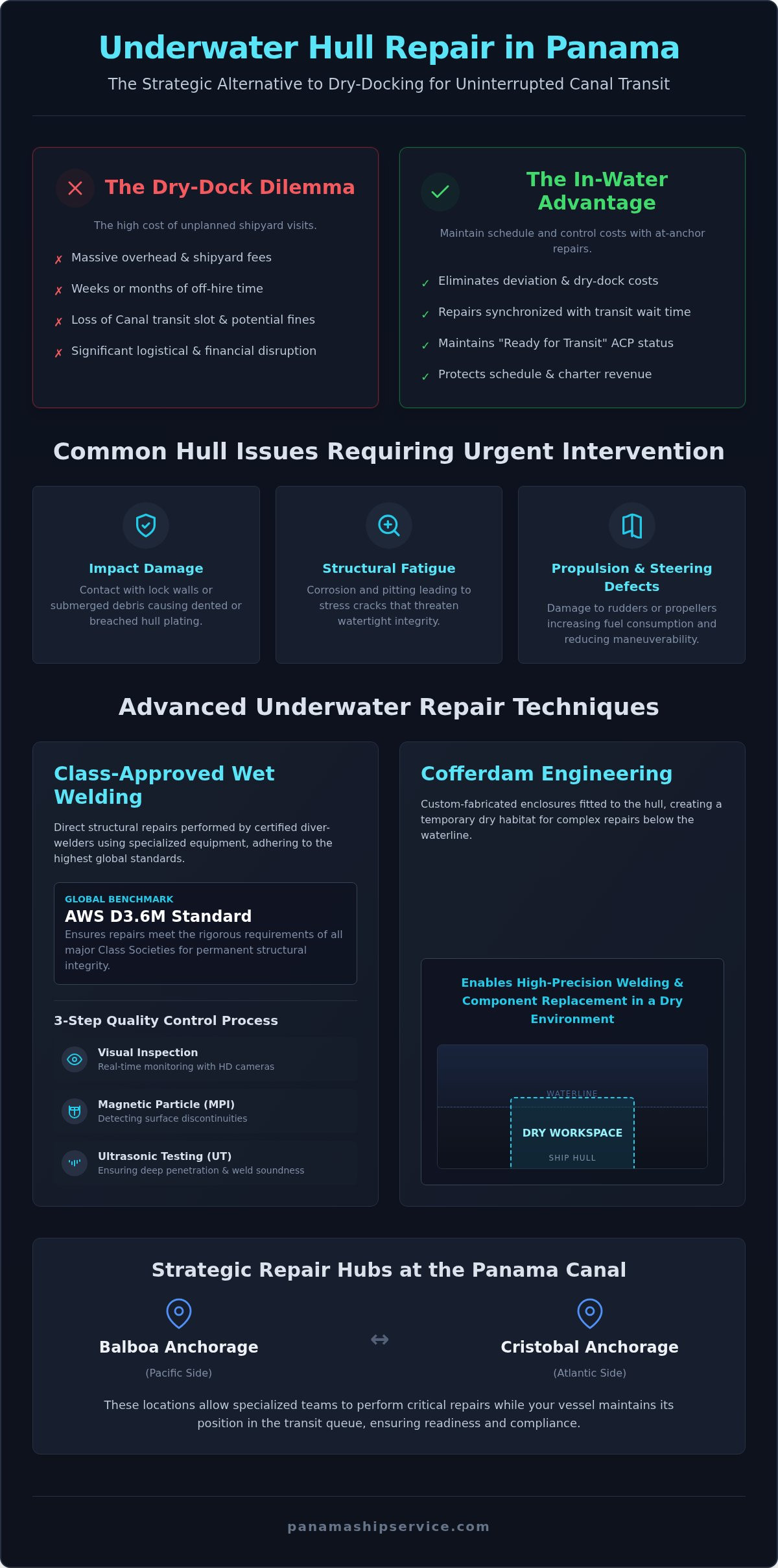
Strategic anchorages at Balboa on the Pacific side and Cristobal on the Atlantic side serve as essential technical hubs for these interventions. These locations allow specialized teams to perform critical repairs while your vessel maintains its position in the transit queue. The economic benefit is direct and substantial. By resolving issues in-water, you eliminate the massive overhead of deviating to a distant dry-dock and the associated loss of charter revenue. In an industry where daily off-hire costs can reach five or six figures, the ability to repair in situ is a vital financial safeguard.
Common Hull Issues Requiring Urgent Attention
Vessels frequently encounter specific challenges that require immediate underwater intervention to remain compliant with international safety standards and local regulations. We focus on resolving these common points of failure:
- Impact damage: Kinetic contact with lock walls or submerged debris often results in dented or breached hull plating.
- Structural fatigue: Localized corrosion and pitting can lead to stress cracks that threaten the vessel’s watertight integrity if left unaddressed.
- Propulsion and steering defects: Damage to rudders or propellers significantly increases fuel consumption and can render a vessel unmaneuverable in the tight confines of the Canal locks.
The ‘In-Water’ Advantage for Canal Transits
The primary advantage of underwater hull repair panama is the optimization of your vessel’s schedule. Instead of losing weeks in a shipyard, repairs are synchronized with your scheduled transit wait time. Panama’s dry-docking capacity is limited and often booked months in advance. Attempting to secure an emergency slot on short notice is both difficult and prohibitively expensive.
Performing repairs at anchorage ensures you maintain your “Ready for Transit” status with the ACP. This proactive approach prevents the cancellation of transit slots, which can lead to significant fines and logistical disruptions. When your technical needs extend beyond the hull, consolidating services with mechanical ship repairs ensures that all systems are operational without extending your time at anchor. We provide a comprehensive solution that prioritizes your vessel’s return to sea.
Advanced Underwater Repair Techniques: From Wet Welding to Cofferdams
The execution of advanced underwater hull repair panama relies on a fusion of commercial diving and precision marine engineering. Panama Ship Service utilizes specialized techniques to resolve structural failures without the need for dry-docking. Each operation begins with a comprehensive assessment to determine the most effective intervention, whether it’s a matter of direct wet welding or the installation of a temporary dry habitat.
Underwater Wet Welding Standards
Achieving structural integrity in a wet environment requires specialized equipment and highly trained diver-welders. The process involves using waterproof electrodes designed to minimize hydrogen embrittlement in the weld pool. AWS D3.6M is the global benchmark for underwater welding quality. Adhering to this standard ensures that repairs meet the rigorous requirements of Class Societies.
Quality control is paramount. Once a weld’s completed, our teams perform Non-Destructive Testing (NDT) to verify the result. This typically includes:
- Visual Inspection: Using high-resolution underwater cameras for real-time monitoring.
- Magnetic Particle Inspection (MPI): Detecting surface and near-surface discontinuities.
- Ultrasonic Testing (UT): Ensuring deep penetration and internal weld soundness.
Cofferdam Engineering for Complex Repairs
When a repair requires a dry environment for high-precision welding or component replacement, we deploy cofferdams. These are specialized enclosures fitted to the hull that allow us to pump out water and create a dry workspace below the waterline. We utilize both standard modular cofferdams and custom-built units tailored to specific hull geometries for underwater hull repair panama.
This technique is essential for sea chest repairs, valve replacements, and major plate inserts where wet welding isn’t enough. By creating a localized dry habitat, we can perform permanent repairs that satisfy even the strictest Class requirements. If your vessel requires a technical assessment of a hull defect, our underwater hull services team provides the engineering expertise to determine if it’s the most efficient path forward.
Crack Arrestment and Reinforcement
For immediate stabilization of structural cracks, we employ proven arrestment techniques. Stop-drilling at the crack tips prevents further propagation by redistributing stress. In many cases, we reinforce the area with doubler plates or stiffeners, secured via class-approved welding methods. These measures provide the necessary security to complete a voyage or wait for a scheduled maintenance window.
In-Water Repair vs. Dry-Docking: A Cost-Benefit Analysis
Choosing between in-water intervention and dry-docking is a decision that dictates the profitability of a voyage. While dry-docking offers a comprehensive environment for repairs, the logistical and financial burden is often disproportionate to the actual defect. For most structural issues discovered during transit, underwater hull repair panama provides a high-efficiency alternative. A diving team can mobilize to an anchorage in hours; a shipyard requires days of scheduling, docking procedures, and undocking maneuvers before work even begins. In-water repairs focus strictly on the defect, allowing the vessel to remain operational and loaded throughout the process.
The Hidden Costs of Emergency Dry-Docking
The invoice from a shipyard is only a fraction of the total expense. If you’re forced into an emergency docking, you’ll likely face deviation costs to reach the nearest available facility, which may be hundreds of miles from the Canal. Most shipyards won’t accept a loaded vessel for significant hull work, necessitating expensive cargo discharge and storage. You also have to account for port fees, agency costs, and the massive loss of charter revenue during extended downtime. These factors can quickly turn a minor structural fix into a million-dollar operational crisis. Choosing an in-water solution avoids these compounding expenses entirely.
ROI of Professional Underwater Maintenance
Investing in regular underwater hull services delivers a measurable return by extending the intervals between scheduled dry-dockings. Preventative inspections catch localized corrosion or minor pitting before they evolve into transit-stopping defects. This proactive approach is essential for risk management; the Panama Canal Authority (ACP) won’t hesitate to deny entry to a vessel with known hull integrity issues. A denied transit can lead to missed delivery windows and contractual penalties that far exceed the cost of a diving intervention.
Beyond structural safety, there’s a direct impact on fuel economy. Performing propeller polishing and hull cleaning as part of a repair operation significantly reduces hydrodynamic drag. This improves your vessel’s Carbon Intensity Indicator (CII) rating, helping you stay compliant with evolving environmental regulations while cutting daily fuel consumption. By resolving technical issues at the anchorage, you maintain your schedule and optimize your vessel’s performance in a single, cost-effective intervention.
Navigating Class Approvals and Panama Canal Regulations
Success in underwater hull repair panama depends as much on regulatory compliance as it does on engineering precision. Class Societies such as ABS, Lloyd’s Register, and DNV impose strict protocols on in-water structural work to ensure the vessel’s safety and seaworthiness. We manage the tri-party communication between the ship owner, the Class surveyor, and our technical diving team from the outset. This coordination starts with the submission of a detailed Welding Procedure Specification (WPS) for approval before any intervention begins. Pre-clearing these procedures prevents costly delays and ensures the work meets international maritime standards.
Documentation is the foundation of a successful class-approved repair. Our teams produce high-definition video surveys that capture the defect, the preparation phase, and the finished repair in real time. We complement this with comprehensive technical reports, including Non-Destructive Testing (NDT) results and welder certifications. This technical file becomes a permanent part of the vessel’s records, providing the necessary evidence for future inspections and maintaining the vessel’s valuation. Transparency in these records is vital for satisfying the rigorous requirements of both Class and the Panama Canal Authority (ACP).
Achieving Permanent Repair Status
Vessel operators must distinguish between temporary ‘patches’ and permanent structural fixes. A permanent repair typically involves cofferdam-assisted dry welding or specific wet welding techniques that match the mechanical properties of the original hull plating. Class surveyors evaluate the repair based on the depth of the defect, the materials used, and the quality of the weld fusion. Class approval is mandatory for any structural underwater fix to maintain insurance validity. Our goal is always to provide a solution that restores the vessel to full operational status without recurring inspection requirements.
ACP Compliance and Transit Safety
The ACP maintains zero tolerance for hull defects that threaten the safety of the Canal infrastructure or other transiting vessels. Boarding officers will scrutinize any reported damage or recent repairs before authorizing a transit slot. Utilizing specialized marine surveys in Panama provides the objective data needed to prove your vessel meets all local safety standards. These surveys act as a technical defense, ensuring your ship isn’t held at anchor due to regulatory uncertainty. We provide the documentation required to demonstrate that your vessel is “Ready for Transit” in full compliance with ACP regulations.
If your vessel requires immediate technical intervention to satisfy regulatory requirements, contact our team to coordinate your underwater hull repair panama and Class approvals today.
Panama Ship Service: Rapid Response Underwater Engineering
Panama Ship Service operates as a specialized technical partner for vessels facing critical timelines. We maintain a 24/7 emergency response posture, recognizing that hull defects don’t adhere to business hours. Our teams are stationed to deploy rapidly to Balboa or Cristobal anchorages, ensuring that underwater hull repair panama is initiated the moment your vessel arrives. This proactive mobilization is essential for keeping your transit slot and avoiding the heavy penalties associated with delays.
Our commercial divers are more than just technicians; they’re engineering specialists trained specifically for the unique environmental conditions of the Panama Canal. They manage variable visibility and current challenges while maintaining the precision required for Class-approved structural work. We focus on the outcome: a vessel that’s safe, compliant, and ready for sea. By delegating these complex tasks to our experienced teams, you simplify your operations during a high-pressure transit window.
One-Stop-Shop Efficiency
We operate on a consolidated service model to minimize the time your vessel spends idle. While our diving teams execute hull repairs, we can simultaneously coordinate mechanical ship repairs for topside or engine room issues. This synchronization reduces the administrative burden on the ship’s Master and the local agency by centralizing technical management under one reliable partner.
Environmental compliance is also integrated into our repair windows. By coordinating MARPOL disposal in Panama during the same downtime, we ensure your vessel remains compliant with international waste regulations without requiring separate stops. This holistic approach transforms a repair window into a comprehensive maintenance opportunity, maximizing the value of every hour spent at anchor.
Requesting an Underwater Repair Quote
Efficiency starts with the initial inquiry. To provide an accurate technical assessment and quote for underwater hull repair panama, we require specific data points:
- Vessel type, dimensions, and current draft.
- Detailed location and nature of the damage, including photos if available.
- Specific Class Society requirements or existing survey reports.
- Scheduled timeline for the upcoming Canal transit.
Our pricing is transparent and reflects the high-stakes nature of Canal operations. We prioritize business outcomes, focusing on the total savings achieved by avoiding dry-docking and maintaining your schedule. Contact Panama Ship Service for an immediate technical assessment to secure your vessel’s operational continuity and ensure a smooth transit through the Isthmus.
Securing Operational Continuity at the Panama Canal
Securing your vessel’s integrity doesn’t have to mean accepting weeks of off-hire time. We’ve detailed how in-water engineering serves as a strategic alternative to the high costs and logistical delays of unplanned dry-docking. By utilizing advanced techniques like wet welding and cofferdam installations, you maintain your schedule while meeting the rigorous safety standards of Class Societies and the ACP. This approach ensures your vessel remains a profitable asset rather than a logistical burden.
Every hour at anchor impacts your bottom line. Professional underwater hull repair panama offers the technical resolution required to keep your vessel moving without cargo discharge or deviation. Our Class-approved diving teams provide 24/7 emergency response at both Balboa and Cristobal anchorages. We act as your technical partner, ensuring full compliance and minimal downtime through expert coordination with surveyors and authorities. Don’t let a structural defect disrupt your transit. Our experts are ready to resolve your technical challenges and ensure your vessel remains ready for sea.
Request an Urgent Underwater Repair Technical Assessment to secure your vessel’s schedule and ensure a successful transit.
Frequently Asked Questions
Is underwater welding considered a permanent repair by Class societies?
Underwater welding is considered permanent when it meets specific Class Society criteria and AWS D3.6M Class A standards. The designation depends on the repair’s location, the welding method used, and the final inspection results by a Class surveyor. While wet welding is often temporary, cofferdam-assisted dry welding frequently achieves permanent status. This allows your vessel to continue operations without a mandatory dry-docking follow-up.
Can underwater hull repairs be performed while the vessel is loading or discharging?
Most underwater hull repair panama operations can be executed at anchorage while the vessel awaits its transit slot. Performing repairs during cargo loading or discharging depends on the specific port facility’s safety regulations and the nature of the repair. We coordinate with port authorities and the ship’s Master to ensure diving operations don’t conflict with cargo handling or jeopardize the safety of the crew and divers.
What is a cofferdam, and how is it used in ship repair?
A cofferdam is a custom-engineered, watertight enclosure fitted externally to the vessel’s hull. Once secured, the water is pumped out to create a dry habitat below the waterline. This allows diving engineers to perform high-precision dry welding or valve replacements that would be impossible in a wet environment. It’s a critical tool for achieving permanent repair status without the expense of a shipyard.
How long does a typical underwater hull crack repair take in Panama?
The duration of a repair depends entirely on the defect’s complexity and the required Class approvals. A simple crack arrestment using stop-drilling and a temporary patch may take 6 to 12 hours. More complex interventions involving cofferdams and plate inserts can require 24 to 48 hours. We prioritize rapid mobilization to ensure all work is completed within your scheduled wait time at the Balboa or Cristobal anchorages.
Will an underwater repair affect my Panama Canal transit slot?
Properly coordinated underwater hull repair panama should not affect your scheduled transit slot. Our team works within the vessel’s existing schedule while it’s at anchor. We maintain constant communication with the Panama Canal Authority (ACP) and the vessel’s agent to ensure the repair is finished and the vessel’s “Ready for Transit” status is confirmed before your slot begins. Efficiency is our primary operational focus.
What certifications should I look for in an underwater repair team?
You must verify that the diving team holds current approvals from major Class Societies like ABS, DNV, or Lloyd’s Register. Welders should be certified to AWS D3.6M standards for underwater specifications. Additionally, the company must be recognized by the ACP for operations within Canal waters. These certifications ensure the technical integrity of the repair and maintain your vessel’s insurance validity and regulatory compliance.
Does Panama Ship Service provide video documentation of the repair?
Yes, we provide comprehensive HD video documentation and high-resolution photography for every stage of the repair process. This includes the initial damage assessment, the work in progress, and the final completed repair. These visual records are essential for Class surveyors to verify the quality of the work. They also serve as a permanent technical record for the vessel’s maintenance history and future inspections.
Can you perform propeller repairs underwater at the Panama Canal anchorages?
We perform a full range of propeller services at both the Pacific and Atlantic anchorages. This includes underwater cropping of damaged tips, straightening bent blades, and precision polishing to restore hydrodynamic efficiency. These repairs are critical for maintaining maneuverability during Canal transits and reducing fuel consumption. Our teams utilize specialized hydraulic tools designed for high-accuracy underwater machining to ensure your propulsion system meets operational standards.