Could a vessel be ready for a Panama Canal transit and still have a flag-state compliance gap? Yes. Compliance with Panama Maritime Authority requirements and Canal transit readiness involve related work, but they are not the same responsibility. The PMA oversees flag-state matters, while the Panama Canal Authority (ACP) manages Canal operations and transit requirements. Confusing the two can leave teams unsure which circular, certificate, or record to review.
Requirements can be difficult to track because obligations depend on a vessel’s flag, type, activity, and circumstances. Outdated or incomplete records can also complicate operations. A repeatable review process helps shore teams and crews identify what applies, assign follow-up, and organize supporting records before arrival.
This checklist explains how to distinguish PMA obligations from ACP transit requirements, organize checks for certificates and operational readiness, and coordinate tasks across the vessel and shore team. It also outlines how practical support, including surveys, repairs, underwater work, and MARPOL disposals, can address vessel needs without replacing the operator’s regulatory responsibilities.
Key Takeaways
- Compliance with panama maritime authority requirements depends on the vessel’s flag, type, activity, and circumstances. Establish which obligations apply before building the checklist.
- Organize readiness checks across vessel documents, safety, environmental procedures, security, and crew records, then assess relevant maritime frameworks for applicability.
- Distinguish the roles of the PMA, ACP, IMO, and recognized organizations so each compliance question goes to the right source.
- Use a repeatable process to verify current official requirements, review records, coordinate outstanding tasks, and retain evidence.
- Operational support such as On-Time Repairs, Surveys, MARPOL Disposals, and Underwater Inspection / Underwater Work can help address identified vessel needs without replacing operator responsibilities.
What compliance with the Panama Maritime Authority means for vessel operators
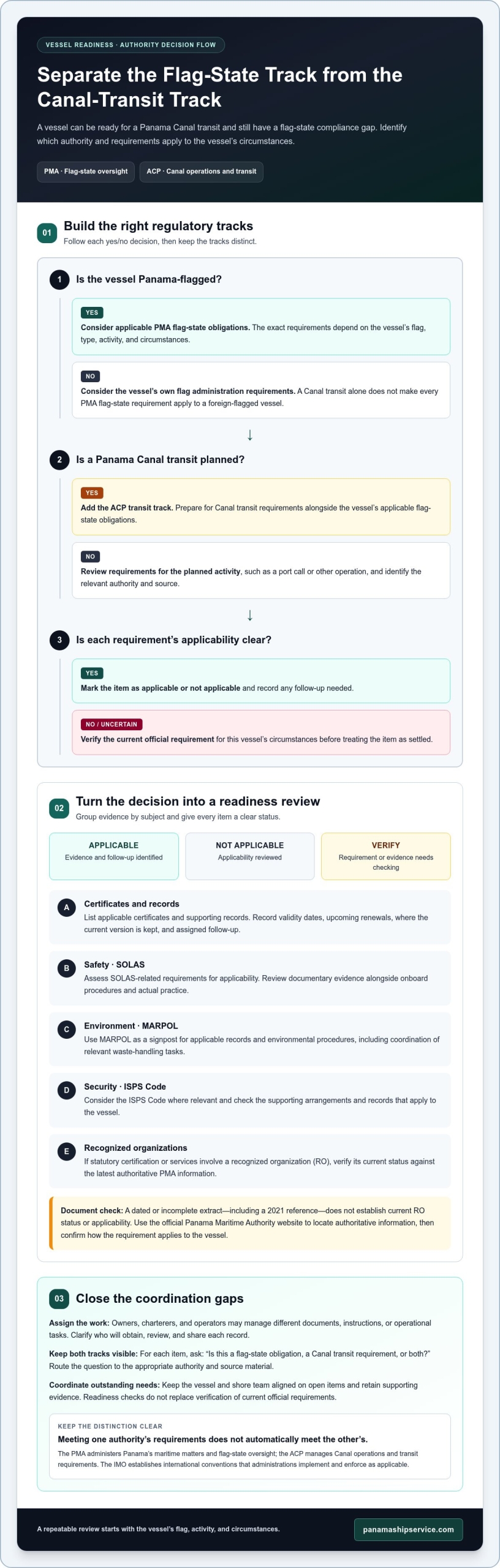
Compliance with the Panama Maritime Authority means meeting the maritime obligations that apply to a vessel based on its flag, activity, and circumstances. It is not one universal checklist for every ship. The PMA handles Panama’s maritime administration and flag-state oversight; the Panama Canal Authority (ACP) governs Canal operations and transit requirements.
For operators, this distinction affects how readiness work is assigned. A vessel may need to meet its flag administration’s requirements while also preparing for a Canal transit under ACP rules. The checks can overlap in timing and planning, but they remain separate regulatory tracks. Meeting one authority’s requirements does not automatically meet the other’s.
PMA and ACP: different authorities, distinct responsibilities
The PMA is Panama’s maritime authority, including its role in administering the Panamanian ship registry and overseeing obligations applicable to Panama-flagged vessels. The ACP operates and manages the Panama Canal and sets requirements related to transit. The International Maritime Organization (IMO), by contrast, establishes international conventions that administrations implement and enforce as applicable.
Consider a Panama-flagged vessel scheduled to transit the Canal. Its team should consider applicable flag-state obligations alongside ACP transit procedures. A foreign-flagged vessel making the same transit must prepare for ACP requirements and the rules of its own flag administration. The transit alone does not make every PMA flag-state requirement apply to that vessel.
Which vessels and operators need to consider PMA requirements?
Start with the vessel’s flag, then consider its activity and specific circumstances. These factors help determine which national requirements and international obligations are relevant. A Panamanian-flagged vessel and a foreign-flagged vessel may therefore have different compliance checks, even when both call at the same port or transit the Canal.
Readiness also depends on coordination between parties. Owners, charterers, and operators may manage different documents, instructions, or operational tasks. Assign responsibility for obtaining, reviewing, and sharing each record. This makes it less likely that an assumption another party has handled a requirement will become a gap before departure or transit.
- Identify the flag administration. Record the vessel’s flag and the authority responsible for its flag-state oversight.
- Define the planned operation. Note whether the vessel is transiting the Canal, calling at a port, or conducting another activity, then identify the relevant operational requirements.
- Assign coordination tasks. Clarify which shore and vessel personnel will gather documents, track applicable instructions, and communicate outstanding readiness needs.
Keep the two tracks visible in the vessel’s planning process. For each item, ask: “Is this a flag-state obligation, a Canal transit requirement, or both?” The answer helps direct the team to the appropriate authority and source material. Verify the exact requirement for the vessel’s circumstances. This distinction is the starting point for a reliable compliance checklist, not a substitute for checking current official requirements.
Which PMA compliance areas belong on a vessel-readiness checklist?
A useful checklist groups evidence by subject and marks each item as applicable, not applicable, or requiring verification. This gives the vessel and shore team a clear view of what is current and where follow-up is needed. The areas below are practical signposts for reviewing compliance with panama maritime authority requirements, not a declaration that every framework applies to every vessel.
Certificates, records, and recognized organizations
Start with the vessel’s applicable certificates and supporting records. For each document, record its validity date, note upcoming renewals, and identify where the current version is kept. Confirm that the evidence relates to the vessel and its operation instead of relying on a folder assembled for an earlier voyage.
If statutory certification or services involve a recognized organization (RO), verify that organization’s current status against the latest authoritative PMA information. A dated or incomplete document extract, including a 2021 reference, does not establish current status or applicability. Use the official Panama Maritime Authority website to locate authoritative information, then confirm how the relevant requirement applies to the vessel.
- Vessel documents: List applicable certificates, validity dates, supporting records, and assigned follow-up.
- Safety: Assess SOLAS-related requirements for applicability, then review documentary evidence alongside onboard procedures and actual practice.
- Environment: Use MARPOL as a signpost for reviewing applicable records and environmental procedures, including how relevant waste-handling tasks are coordinated.
- Security: Consider the ISPS Code where relevant, distinguishing documented arrangements from how procedures are put into practice.
- Crew: Review relevant MLC and STCW records and confirm they align with the vessel’s circumstances and applicable requirements.
A vessel-readiness checklist is a practical starting point, not legal advice or a substitute for verifying the requirements that apply to a specific vessel. When operators encounter complex statutory or transportation disputes, specialized counsel such as Jahani Law can provide legal guidance across maritime matters. SOLAS, MARPOL, the ISPS Code, MLC, and STCW are frameworks to assess, not blanket proof that a particular obligation applies. Their implementation and relevance can depend on the vessel, flag, operation, and circumstances. Verify current requirements through official sources before treating an item as mandatory or complete.
Check documents against onboard readiness
Paperwork alone may not show whether a procedure is understood or workable. For each applicable area, pair the record with a practical onboard check: identify the procedure, confirm who is responsible, and establish how completion or follow-up is recorded. Keep documentary evidence distinct from operational practice, then address any mismatch before the next operation.
When a review identifies a physical vessel need, coordinate it as an operational task rather than treating a service as a regulatory determination. Panama Ship Service supports vessel needs on both sides of the Canal through surveys and other vessel-readiness support.
PMA, ACP, IMO, and recognized organizations: how to compare their roles
Compliance is easier to coordinate when each requirement is linked to the body or framework behind it. The PMA, ACP, IMO, and recognized organizations (ROs) have different functions. Their work may connect through a vessel’s flag, statutory documents, or Canal transit, but their authority is not interchangeable. Use the comparison below to route each question to the right source.
Use a role-by-role comparison rather than one combined compliance label
The PMA addresses Panama’s maritime administration and applicable flag-state matters. The ACP manages Canal operations and transit requirements. The IMO establishes international maritime conventions, which are given effect through applicable rules and administrations. The operator’s practical task is to identify the source of each obligation and verify how it applies to the vessel and planned operation.
| Body or framework | General role | Operator question | Source to verify |
|---|---|---|---|
| PMA | Panama maritime administration and relevant flag-state matters. | Does this requirement apply to the vessel’s flag, status, or activity? | Current PMA circulars, notices, and official guidance. |
| ACP | Panama Canal operations and transit requirements. | What does the vessel need to meet for its planned transit? | Current ACP notices and transit procedures. |
| IMO conventions | International frameworks covering areas such as safety, pollution prevention, and crew matters. | Which convention provisions have been implemented and apply to this vessel? | The relevant convention text and applicable flag-state requirements. The International Maritime Organization (IMO) provides convention information. |
| Recognized organizations | May carry out survey, certification, or other statutory work when authorized for the relevant purpose. | Is this organization currently recognized and authorized for the work in question? | Current PMA recognition information and the applicable authorization. |
A vessel can face requirements connected to more than one row. For example, a Panama-flagged ship preparing for a Canal transit may need its team to coordinate flag-state matters and ACP transit preparation. That is coordinated compliance, not evidence that the PMA and ACP perform the same function. Keep separate task owners and records for each requirement.
What recognized organizations do, and what to verify
An RO’s role depends on the authority granted and the specific work involved. Recognition for one purpose does not necessarily cover every survey or certification task. Verify current PMA recognition status, the scope of authorization relevant to the vessel, and whether the requested work falls within it. A corrupted or dated 2021 document extract cannot establish present-day status or requirements.
For dependable compliance with panama maritime authority requirements, check current official material and confirm its relevance to the vessel’s circumstances. Keep the source, document date, and responsible person with each checklist item so the team can trace the basis for its decision. Panama Ship Service can also coordinate operational support, including vessel surveys and readiness needs, while regulatory decisions remain with the responsible parties and authorities.
A practical checklist for Panama maritime compliance before operations
Turn applicable requirements into assigned tasks before the vessel’s next operation. This sequence helps the shore team and vessel work from the same record while keeping flag-state document review separate from Canal transit planning and onboard preparation. For compliance with panama maritime authority requirements, verify each item against current official sources and the vessel’s circumstances.
Before the vessel approaches Panama
- Establish applicability. Confirm the vessel’s flag, planned activity, and relevant authorities. Identify the owner, operator, charterer, and shore-side contacts responsible for each part of the readiness process. Record flag-state matters, Canal transit requirements, and onboard operational tasks separately.
- Review authoritative sources. Check current PMA circulars and notices relevant to the vessel, then review current ACP information for the planned Canal transit. Note the source and review date for each requirement. Do not rely on an old checklist or circular summary without confirming that it remains current and applies.
- Check documents and records. Review applicable certificates, validity dates, supporting records, and open findings. Compare the documents with the vessel’s actual readiness. For each gap, record the responsible person, target date, next action, and evidence needed to close it.
- Coordinate tasks. Assign each action to a named vessel or shore-side contact, then track it through completion. Separate document updates from physical or procedural work onboard. If an operational issue requires a survey, the marine surveys guide can help frame that task. For relevant waste-handling needs, use the MARPOL disposal compliance guide.
- Retain evidence. Keep the completed review, source references, communications, service records, and follow-up evidence together. Make sure the shore team and vessel know where the current record is held, and update it when requirements or operational circumstances change.
Coordinate services and preserve a clear record
Operational support can help address a vessel need identified during the readiness review, but it does not replace statutory decisions, certification, or the operator’s compliance responsibilities. Match the task to the issue. For example, where underwater inspection or work is relevant, consult the underwater hull services in Panama guide. Keep related service records with the vessel’s compliance documentation so the team can trace what was requested and completed.
Panama Ship Service supports vessel operations on both sides of the Canal. Coordinate vessel readiness needs with Panama Ship Service for relevant surveys, repairs, MARPOL disposals, and underwater work, while your team remains responsible for confirming applicable requirements and maintaining compliance records.
How Panama Ship Service supports vessel readiness on both sides of the Canal
Compliance planning can identify a vessel need that requires operational follow-up, such as a repair, survey, disposal, underwater task, or supply requirement. Panama Ship Service supports shipping operations on both sides of the Panama Canal, helping owners, charterers, and operators coordinate technical and operational needs. This support can contribute to readiness, but it does not replace the owner’s or operator’s compliance duties, flag-state obligations, or decisions made by the relevant authorities.
Bring related vessel needs together during a Panama call
Coordinating related needs through one service partner can simplify communication between the vessel and shore team. Panama Ship Service provides On-Time Repairs, Surveys, MARPOL Disposals, Underwater Inspection / Underwater Work, and supplies. The team brings a personalized, cost-conscious approach to coordinating identified needs. The appropriate service depends on the issue the operator has identified.
- Repairs: Coordinate On-Time Repairs when a vessel need calls for repair work.
- Condition review: Arrange Surveys to support the operator’s assessment of a vessel-related issue.
- Waste handling: Coordinate MARPOL Disposals where relevant to the vessel’s operational requirements.
- Underwater needs and supplies: Discuss Underwater Inspection / Underwater Work or ship supplies when identified as part of readiness planning.
Clear communication keeps each task visible alongside the vessel’s schedule and other preparations. Service coordination addresses operational requirements. It should not be treated as statutory certification or confirmation that a vessel meets a particular regulatory obligation. Keep the compliance decision and supporting records with the responsible owner or operator.
Plan the next step with a Panama-based service partner
Share the vessel’s relevant operational or technical requirements, planned timing, and the need identified by the vessel or shore team. Panama Ship Service maintains 24/7 contact availability, and quotes are provided on request. Ship owners, charterers, and operators can discuss the work and coordinate next steps while keeping service arrangements separate from regulatory approval.
For a vessel calling on either side of the Canal, bring related needs together where that supports efficient planning. Discuss repairs, Surveys, MARPOL Disposals, underwater work, or supplies as applicable. Panama Ship Service emphasizes personalized communication and cost-conscious efficiency, while the operator retains responsibility for confirming applicable requirements and maintaining compliance evidence.
Discuss your vessel’s operational and technical requirements with Panama Ship Service to plan relevant support around your Panama call.
Make your next readiness review easier to act on
Use the checklist as a working tool, not a document to file away after one voyage. Keep responsibilities visible, record the source behind each requirement, and revisit open items when the vessel’s flag, activity, or operating plans change. A consistent review gives shore teams and vessel personnel a clearer basis for deciding what needs attention next.
For compliance with panama maritime authority, regulatory obligations remain with the responsible owner, operator, and flag administration. Operational needs identified during readiness planning can be coordinated separately, with records showing what work was arranged and how it relates to the vessel’s preparations.
Panama Ship Service supports operational and technical vessel requirements in Panama and internationally, with a personalized, cost-conscious approach and 24/7 contact availability. If a repair, survey, MARPOL disposal, underwater task, or supply need is part of your upcoming plans, discuss your vessel’s operational and technical needs with Panama Ship Service. Start the next review with a clear action list and move forward with greater confidence.
Frequently Asked Questions
Does Panama Maritime Authority compliance apply only to Panama-flagged vessels?
Not necessarily, and applicable requirements are not identical for every vessel or activity. For compliance with panama maritime authority requirements, first identify the vessel’s flag and the circumstances of its operation. A Panama Canal transit also brings separate ACP operational considerations, whether the vessel is Panamanian-flagged or not. Use a general checklist to organize questions and records, then verify the vessel’s position against current official sources rather than treating the checklist as a legal determination.
What is a recognized organization in the context of Panama maritime compliance?
A recognized organization may carry out specified maritime functions for an administration when authorized, but its role depends on the scope of that authorization. For a particular survey or certification task, establish whether the organization’s current recognition covers both the work and the vessel involved. Check the latest authoritative PMA information. A familiar organization name, an old listing, or a certificate from an earlier assignment does not by itself establish current authorization for a different task.
How often should vessel operators review PMA circulars?
Review relevant official circulars when planning operations and whenever a change could affect the vessel, its flag, or the work being performed. For example, if the vessel’s activity changes, review whether that affects the guidance previously selected for the readiness file. Keep a dated note of the publication consulted, why it applies, and any follow-up assigned. An old summary may help locate a topic, but it should not stand in for the latest official publication.
Does following a PMA checklist guarantee Panama Canal transit approval?
No. A checklist helps organize document review and open tasks, but it cannot guarantee transit approval. PMA-related matters and ACP transit requirements are distinct, and the checks needed depend on the vessel’s circumstances. Keep transit planning as a separate workstream from flag-state compliance, even when the same team coordinates both. Verify current requirements with the relevant official authority and ensure the transit file addresses applicable ACP procedures as well as other relevant obligations.
Should operators rely on the 2021 CMM-136 recognized-organizations document?
Treat the 2021 CMM-136 reference as a historical lead, not confirmation of the current recognized-organizations list or its scope. The extracted text available for this article is corrupted, so it cannot reliably establish detailed requirements. Before relying on an organization’s listing for a specific task, locate current authoritative PMA information and check the relevant authorization. Record the source and date reviewed so the decision can be traced if the vessel’s work changes.
Can a vessel services company take over the operator’s PMA compliance responsibility?
No. A vessel services company can coordinate operational work, but the owner or operator retains oversight of applicable requirements, records, and decisions. For example, Panama Ship Service can support a vessel need through repairs, surveys, MARPOL disposals, or underwater work, while the responsible team manages how that work relates to its compliance obligations. Keep service communications and records in the vessel’s files, and maintain a clear distinction between operational support and regulatory responsibility.