
A single overlooked defect discovered during a condition survey for P&I clubs can halt your vessel’s operations and trigger an immediate suspension of insurance coverage. Since the 2016 expansion of the Panama Canal, the margin for error regarding vessel condition has tightened, and a failed inspection often leads to significant delays that disrupt entire supply chains. You’ve likely felt the pressure of distinguishing between Class requirements and the specific demands of P&I clubs, especially when a missed detail means losing your scheduled slot at the locks. We understand that in this industry, timing is everything and costs increase every hour your ship isn’t moving.
You already know that maintaining high operational standards is the only way to protect your bottom line. This guide provides the expert knowledge you need to master the complexities of P&I surveys, ensuring your vessel meets global benchmarks and avoids expensive bottlenecks. You’ll learn the critical differences between survey types, how to secure a clean report with minimal recommendations, and the exact steps to guarantee an uninterrupted journey through the Panama Canal. We are experts so you don’t have to be. Navigate the survey process with total confidence and keep your transit on schedule.
Key Takeaways
- Identify the specific triggers—such as vessel age and ownership changes—that make a P&I survey mandatory for maintaining your insurance coverage.
- Learn the precise focus areas of a surveyor’s inspection, from structural integrity to engine room standards, to prepare your vessel for a passing grade.
- Discover why conducting a condition survey for P&I clubs during Panama Canal wait times is the most cost-effective way to manage compliance.
- Follow a comprehensive preparation checklist for documentation and deck spaces to minimize inspection time and avoid costly transit delays.
- Gain insights into navigating the Panama Canal jurisdiction with expert guidance that simplifies complex maritime regulations for ship owners.
What is a Condition Survey for P&I Clubs and Why is it Mandatory?
A condition survey for P&I clubs is a targeted risk assessment used by insurers to determine the liability profile of a vessel. Unlike a standard valuation, this survey focuses on the likelihood of a ship generating a claim. Every Protection and Indemnity (P&I) Club uses these inspections to protect the mutual interests of its members by identifying sub-standard tonnage before it enters the pool.
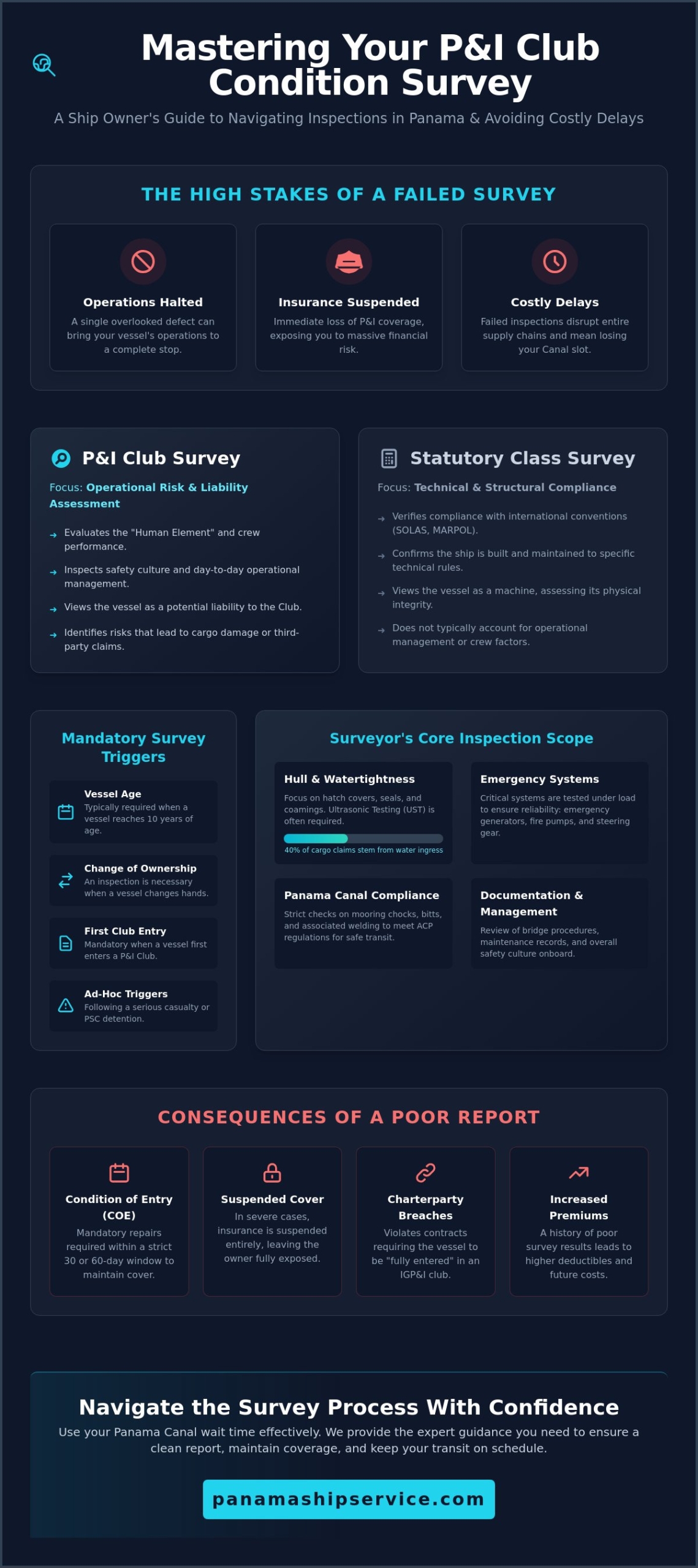
Timing is everything in maritime operations. Most clubs trigger a mandatory survey when a vessel reaches 10 years of age. A change of ownership or a vessel’s first entry into a specific club also necessitates an inspection. Beyond these routine triggers, clubs may demand an ad-hoc survey following a serious casualty, a Port State Control (PSC) detention, or intervention by a flag state. The International Group of P&I Clubs (IGP&I) maintains strict standards for these surveys; this ensures that whether your ship is in Singapore or waiting for a Panama Canal transit, the inspection criteria remain consistent and rigorous.
The Purpose of P&I Surveys vs. Statutory Class Surveys
Shipowners often ask why they need a P&I survey if they already hold valid Class certificates. The answer lies in the scope of the assessment. Class surveys verify technical and structural compliance with international conventions. They confirm the ship is built and maintained to specific rules. They don’t, however, account for the “human element.”
P&I surveys evaluate operational management and crew performance. An inspector looks at how the ship is actually run. This includes bridge procedures, maintenance records, and safety culture. While Class looks at the vessel as a machine, the P&I club views it as a liability risk. We are experts in these distinctions so you don’t have to be. We focus on the operational realities that lead to cargo damage or third-party claims.
Consequences of a Poor Survey Report
A failed or poor survey report has immediate, expensive consequences. If the inspector finds significant defects, the club may issue “subject to” cover. This means insurance is only valid once you rectify the listed deficiencies. In severe cases, the club can suspend cover entirely, leaving the owner exposed to massive financial risk.
- Condition of Entry (COE): The club may impose a COE, requiring specific repairs within a 30-day or 60-day window.
- Charterparty Breaches: Most charterparty agreements require the vessel to be “fully entered” in an IGP&I club. If cover is suspended, you are likely in breach of your contract.
- Increased Premiums: A history of poor survey results leads to higher deductibles and increased calls.
Panama Ship Service provides the rapid response you need to address these findings. Don’t let a poor report stall your operations. Our team ensures your vessel meets the high standards required for continued, uninterrupted cover.
The Core Scope: What a P&I Surveyor Inspects in Panama
A condition survey for P&I clubs isn’t a casual walkthrough. It’s a technical audit designed to identify vessel-at-risk scenarios before they become expensive claims. The standard questionnaire used by surveyors is typically divided into three distinct segments. Part A covers vessel particulars and documentation. Part B focuses on the physical condition of the ship, including its structural integrity. Part C provides the surveyor’s professional summary and a list of required corrective actions. We’ve seen that thoroughness here prevents delays that can cost owners thousands of dollars in lost transit slots.
Surveyors prioritize the reliability of emergency systems. This includes testing the emergency generator, fire pumps, and steering gear to ensure they function under load. For Panama transits, specific attention is paid to mooring chocks and bitts. These must strictly comply with Panama Canal Authority (ACP) regulations. If these components show signs of excessive wear or improper welding, the vessel may be denied transit until repairs are certified.
Hull Integrity and Watertightness
Hatch cover failure is a leading cause of cargo damage. Statistics show that nearly 40% of cargo claims stem from water ingress. During a condition survey for P&I clubs, inspectors often require ultrasonic testing (UST) to verify that hatch seals are truly weather-tight. They also examine ballast tanks for signs of advanced corrosion or coating failure. Because the hull’s condition below the waterline is just as critical, underwater hull services are often scheduled alongside these surveys to provide a full picture of the vessel’s health. We’ve operated in these waters for 20 years and know that a clean hull is vital for both safety and fuel efficiency during the canal crossing.
Safety and Pollution Prevention (MARPOL)
Environmental compliance is a non-negotiable priority in the Panama Canal. Surveyors audit the Oily Water Separator (OWS) and the ship’s incinerator to ensure they operate within the International Maritime Organization (IMO) guidelines for pollution prevention. Any discrepancy in the Oil Record Book or garbage management logs is a major red flag that can lead to heavy fines or vessel detention. It’s essential to verify your current status regarding MARPOL disposal in Panama to ensure all waste is handled by certified contractors. If you’re unsure about your vessel’s current compliance status, our team can provide a pre-survey assessment to minimize your vessel expenses before the official P&I inspector arrives. We are experts so you don’t have to be.
Why Panama is a Strategic Location for P&I Condition Surveys
Conducting a condition survey for P&I clubs while anchored at the Panama Canal transforms mandatory downtime into a strategic advantage. Most vessels face a waiting period of 48 to 96 hours before their scheduled transit window. This idle time provides a cost-free opportunity to complete rigorous inspections without disrupting the commercial voyage. By performing these surveys at the canal, owners avoid the high costs of dedicated deviations or additional port stays in other regions. It’s a matter of operational efficiency; the vessel is already stationary, so the survey doesn’t add a single hour to the total voyage time.
Panama serves as a global maritime crossroads where technical expertise and logistical infrastructure converge. Having a qualified surveyor board at the outer anchorage allows for a comprehensive assessment of the vessel’s hull, machinery, and safety equipment. This proactive approach aligns with the academic analysis of marine insurance law which emphasizes the owner’s ongoing duty to maintain seaworthiness to ensure coverage remains intact. Beyond the survey itself, the local infrastructure facilitates seamless crew changes and the delivery of critical spare parts via high-speed launch services, making the canal much more than just a transit point.
Balboa and Cristobal: Key Survey Hubs
The logistics of a survey depend heavily on whether the vessel is positioned on the Pacific or Atlantic side. Balboa, on the Pacific entrance, typically handles a higher volume of northbound traffic, while Cristobal serves as the Atlantic gateway. Panama Ship Service maintains a constant presence at both ports, coordinating directly with the Panama Canal Authority (ACP) to sync boarding times with the vessel’s AIS-tracked arrival. Our rapid response teams understand that transit windows are volatile. We deploy surveyors immediately to ensure the report is finalized before the pilot boards for the transit, preventing any delay in the canal schedule.
Combining Surveys with Mechanical Repairs
The greatest efficiency gain comes from the ability to address survey findings on the spot. If a condition survey for P&I clubs identifies a deficiency in the engine room or deck machinery, we transition immediately to mechanical ship repairs. This eliminates the need to hire separate contractors or wait for the next port of call. Our technical teams remain stationed nearby with the tools and parts required to fix defects while the vessel is still at anchor. The one-stop-shop model functions as a streamlined solution where inspection and maintenance are unified to save up to 20% in logistical overhead. We are experts so you don’t have to be, ensuring your vessel enters the canal in full compliance with both P&I requirements and ACP regulations.
Preparing for Your P&I Survey: A Checklist for Ship Owners
A surveyor’s evaluation begins the moment they step onto the gangway. First impressions are critical during a condition survey for P&I clubs. If the deck is cluttered or safety signage is faded and illegible, the surveyor immediately questions the vessel’s overall management. You need to ensure the engine room bilges are dry and deck spaces are free of oil or trip hazards. Cleanliness isn’t just about aesthetics; it’s a primary indicator of a proactive safety culture. Professionalism on the bridge and a well-organized ship’s office signal that the vessel is under competent command. We’ve seen that vessels presenting a tidy appearance face 30% fewer follow-up inquiries during the physical inspection.
Documentation Audit
Organization is a direct reflection of your Safety Management System (SMS) efficiency. Have all your files ready in a central location to avoid delays and frustration. You must ensure all marine surveys in Panama from the previous 12 months are filed and accessible. Surveyors will scrutinize the following documents:
- Current Class certificates and all statutory documentation.
- Port State Control (PSC) inspection reports from the last 24 months.
- Detailed maintenance records and the Planned Maintenance System (PMS) dashboard.
- Updated drill logs for fire, abandon ship, and SOPEP responses.
It’s vital to address any “overdue” items in the PMS before the surveyor arrives. If a task is pending, have a clear, documented explanation and a scheduled date for completion. Surveyors look for patterns of neglect, so showing a history of closed-out deficiencies is essential for a positive report.
Operational Readiness Tests
A successful condition survey for P&I clubs hinges on the functional testing of critical systems. Don’t wait for the surveyor to request a test; verify these components 48 hours in advance. The crew must demonstrate proficiency during emergency drills, as their response time is a key metric for the surveyor’s risk assessment. If the crew fumbles with a fire pump or a lifeboat engine, it reflects poorly on the vessel’s operational readiness.
- Emergency Systems: Test the emergency generator and the emergency fire pump under load for 15 to 20 minutes to prove reliability.
- Remote Controls: Verify the functionality of all quick-closing valves and remote engine stops to ensure they trigger without delay.
- Life-Saving Appliances: Check the condition of lifeboat launching gear, limit switches, and the integrity of all fire-fighting equipment.
Panama Ship Service has assisted ship owners for 20 years in navigating these rigorous inspections. Our team provides the local expertise needed to clear hurdles quickly and efficiently. Contact our experts today to prepare your vessel for its next transit and ensure full compliance.
Panama Ship Service: Your Expert Partner for P&I Club Surveys
Panama Ship Service operates with a singular focus: we are experts so you don’t have to be. For more than 20 years, we have served the Panama Canal jurisdiction, providing critical technical support to ship owners, managers, and charterers. Conducting a condition survey for P&I clubs requires more than a simple checklist; it demands a deep understanding of local Canal regulations and international maritime standards. Our team ensures that every vessel meets these stringent requirements before the transit process begins.
We understand that a survey is only the first step in maintaining vessel readiness. We bridge the gap between technical assessment and physical action. If a survey identifies a deficiency that could jeopardize a transit slot, we provide seamless integration with our mechanical ship repairs in Panama. This one-stop-shop approach prevents the need for multiple contractors and significantly reduces administrative friction for the crew and shore-based management.
Our commitment to your vessel includes:
- Constant daily communication with all stakeholders to ensure transparency.
- Cost-conscious solutions that prioritize essential repairs without compromising safety.
- 24/7 availability to match the high-speed nature of Canal operations.
- Proactive identification of potential P&I Club liabilities.
Qualified Surveyors and Technical Expertise
Our surveyors hold industry-standard certifications and possess years of hands-on experience within the Panama maritime cluster. They act as a neutral, authoritative bridge between the P&I Club, the ship owner, and the Panama Canal Authority. We know exactly what inspectors look for and how to present findings that satisfy Club requirements. To ensure the highest level of accuracy, our team utilizes advanced diagnostic tools. We employ UT gauging for precise hull thickness measurements and thermal imaging to detect hidden electrical or engine room hotspots. By identifying these potential failures before they manifest, we protect your vessel’s integrity and your Club’s liability during the difficult transit through the locks.
Minimizing Transit Expenses and Delays
Timing is everything at the Canal. A failed inspection or a delayed report can result in thousands of dollars in extra fees, tugboat charges, or missed transit slots. Panama Ship Service is the most efficient choice for vessels because we prioritize rapid response times. We ensure your condition survey for P&I clubs is completed and filed without disrupting your schedule. Proactive condition management is the most effective way to avoid the high costs of emergency repairs or transit denials. Don’t leave your vessel’s compliance to chance in a high-stakes environment. Put your transit in our hands and let our two decades of experience work for you. Contact us today to get a quote and secure your vessel’s status.
Secure Your Panama Canal Transit Today
Navigating the complexities of the Panama Canal requires more than just a passing grade. It demands a proactive approach to vessel maintenance and compliance. A professional condition survey for P&I clubs ensures your ship meets mandatory standards while identifying potential risks before they cause expensive delays. With 20 years of maritime expertise at the Panama Canal, we’ve refined a system that prioritizes speed and technical accuracy. We operate as a one-stop-shop, handling everything from technical surveys and emergency repairs to MARPOL disposal. You’ll receive rapid responses and constant daily communication throughout the entire process. Our surveyors are available 24/7 to provide the technical oversight required by major P&I clubs. Don’t leave your transit to chance. We’re the experts on the ground so you don’t have to be. Our team manages the technical details while you focus on your core operations. We ensure your vessel stays on schedule and within budget during this critical passage.
GET A QUOTE for your P&I Condition Survey in Panama
Frequently Asked Questions
How long does a P&I condition survey typically take in Panama?
A standard inspection typically takes 8 to 12 hours to complete. This timeframe depends on the vessel type and the accessibility of cargo holds or tanks. Our surveyors board at the Pacific or Atlantic anchorages to ensure the work finishes before your scheduled transit time. We focus on efficiency to minimize your vessel’s idle time in Panamanian waters.
Can a P&I survey be conducted while the vessel is at anchor waiting for the Canal?
Yes, we conduct the condition survey for P&I clubs while the vessel stays at the Pacific or Atlantic anchorage waiting for its canal slot. Performing the inspection at anchor prevents operational delays and allows the crew to focus on transit preparations. Our team coordinates with local agents to ensure boarding occurs as soon as the vessel arrives at the designated coordinates.
What happens if the surveyor finds serious deficiencies during the inspection?
If a surveyor identifies serious deficiencies, they issue a list of recommendations that the owner must address to maintain P&I coverage. The surveyor categorizes these findings by urgency, often requiring rectification prior to departure for safety-critical items. We provide a detailed report within 24 hours so you can initiate repairs immediately and avoid potential insurance exclusions or port state control detentions.
Is a P&I condition survey the same as a Pre-Purchase survey?
No, a P&I survey focuses on risk assessment for the insurer, while a pre-purchase survey evaluates the commercial value and asset condition. P&I inspections prioritize seaworthiness, cargo worthiness, and management systems to prevent future claims. Pre-purchase surveys are more exhaustive, often taking 2 days and covering detailed maintenance records that a standard club inspection might overlook.
Do I need a follow-up survey if I repair the defects immediately?
You usually need a follow-up survey if the initial report contains major safety gaps or Class-item deficiencies. If you repair minor defects immediately, providing documented evidence like high-resolution photos or invoices might suffice for the club. However, 85 percent of serious findings require a physical re-inspection by a qualified surveyor to verify that the vessel meets the required standards.
Who pays for the P&I condition survey—the Club or the Member?
The Member typically pays for the condition survey for P&I clubs, though specific club rules vary. Some P&I Clubs cover the cost if the vessel passes without major issues, but the owner usually bears the expense for surveys triggered by vessel age or claims history. We provide transparent, competitive quotes to help you manage these operational costs without hidden surcharges during your Panama stay.
Can Panama Ship Service perform the survey and the repairs simultaneously?
Panama Ship Service can coordinate both the survey and necessary repairs simultaneously to maximize your time at anchor. Our technical teams stand ready to fix mechanical or structural issues identified during the inspection. This integrated approach ensures your vessel remains compliant and ready for its Panama Canal transit without needing multiple service calls or different contractors.
Will a P&I survey cause me to miss my Panama Canal transit slot?
A properly managed P&I survey won’t cause you to miss your Panama Canal transit slot. We schedule our boarding 4 to 6 hours after arrival to ensure the inspection concludes well before the Panama Canal Authority pilot boards. Our 20 years of experience in Panama ensures we navigate local logistics efficiently, keeping your schedule on track and your costs down.