
For ship owners and charterers, accurate operational budget forecasting is a high-stakes challenge where every variable counts. An unexpected invoice for complex biofouling removal or extended vessel downtime can derail profitability and disrupt tight schedules. As we look ahead, the ability to anticipate these critical maintenance expenses becomes paramount. Accurately projecting the cost of underwater hull cleaning 2026 is not just an estimate-it is a strategic necessity for maintaining a competitive edge and ensuring operational efficiency.
This expert forecast is designed to provide the clarity you need. We will dissect the key factors that drive pricing, from vessel specifications and fouling severity to emerging environmental regulations and advanced cleaning technologies. By understanding these variables and the different pricing models used by service providers, you will be equipped to plan your 2026 operational budget with confidence. Our analysis will help you evaluate quotations for true value, make cost-conscious decisions, and secure efficient services that minimize downtime while ensuring full compliance.
The ROI of Hull Cleaning: Why It’s an Investment, Not an Expense
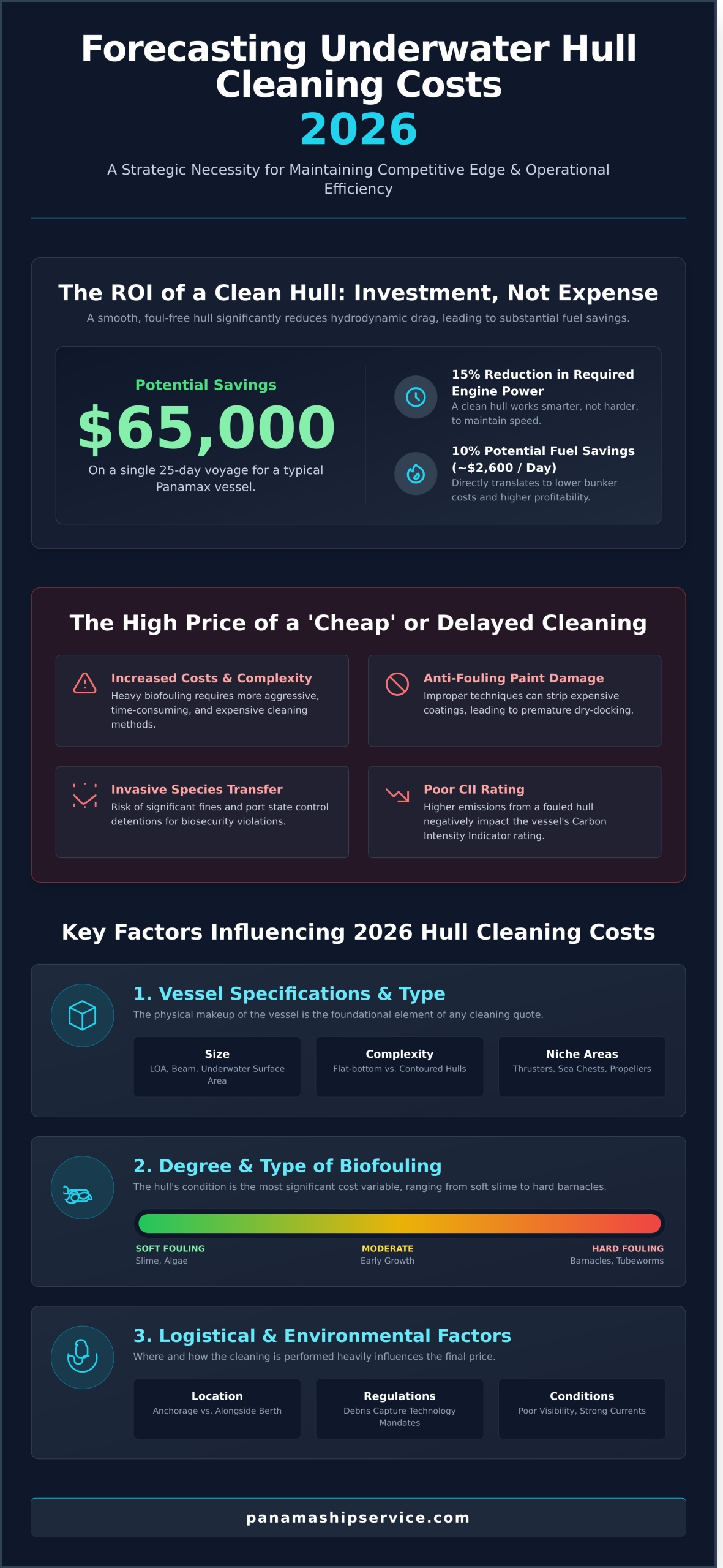
For vessel owners and charterers, operational efficiency is paramount. Every decision must be weighed against its impact on the bottom line and schedule integrity. While often viewed as a routine maintenance task, underwater hull cleaning is a high-return investment in vessel performance. The accumulation of marine organisms, a process known as biofouling, creates significant hydrodynamic drag. This drag forces the main engine to work harder to maintain speed, directly increasing fuel consumption and operational costs. A proactive cleaning strategy is not an expense; it is a critical component of efficient and profitable vessel management.
Fuel Efficiency Gains and Bunker Cost Savings
The correlation between a clean hull and fuel consumption is direct and significant. A smooth, foul-free hull can reduce the required engine power by up to 15%, translating into substantial bunker cost reductions. This saving far outweighs the upfront service fee, making the decision to clean a clear financial positive. When forecasting the cost of underwater hull cleaning 2026, this ROI must be the primary calculation.
Consider a typical Panamax vessel on a 25-day voyage:
- Daily Bunker Consumption (Fouled Hull): 40 Metric Tons (MT)
- Cost of VLSFO: ~$650 per MT
- Daily Fuel Cost: $26,000
- Potential Fuel Saving with Clean Hull (10%): $2,600 per day
- Total Voyage Savings: $65,000
The High Price of a ‘Cheap’ or Delayed Cleaning
Delaying hull maintenance or opting for unqualified service providers introduces severe financial and operational risks. Heavy biofouling requires more aggressive, time-consuming, and costly cleaning methods. Worse, improper techniques using overly abrasive brushes can strip expensive anti-fouling paint, compromising the coating’s long-term effectiveness and necessitating a premature and costly dry-docking. Furthermore, heavily fouled hulls risk transferring invasive aquatic species between ecosystems, a violation that can result in significant fines and port state control detentions.
Ultimately, a proactive approach to hull maintenance directly supports schedule integrity by ensuring the vessel can maintain its planned speed. This reliability, combined with improved Carbon Intensity Indicator (CII) ratings from lower emissions, reinforces that the true cost of underwater hull cleaning 2026 is measured not by the service invoice, but by the substantial savings and risk mitigation it provides.
Key Factors That Will Influence Hull Cleaning Costs in 2026
Determining the exact cost of underwater hull cleaning is not a one-size-fits-all calculation. A professional quote is a tailored assessment based on a range of dynamic variables specific to your vessel and its operational context. For ship owners and charterers planning their budgets, understanding these components is essential to accurately forecast the cost of underwater hull cleaning 2026. These factors can be grouped into three primary categories: the vessel’s physical characteristics, its biofouling condition, and the logistical realities of the operation.
Vessel Specifications and Type
The physical makeup of your vessel is the foundational element of any cleaning quote. Larger vessels with a greater Length Overall (LOA), beam, and total underwater surface area naturally require more time and resources to clean. Hull complexity is also a major driver; a flat-bottomed bulk carrier presents a more straightforward task than a container ship with intricate hull contours. Furthermore, niche areas demand specialized attention and add to the total work scope. These include:
- Bow and stern thrusters
- Sea chests and gratings
- Rudder and propeller assemblies
- Stabilizer fins
Degree and Type of Biofouling
The condition of the hull is the most significant cost variable. There is a critical difference between soft fouling (slime, algae) and hard fouling (barnacles, tubeworms, mussels). Hard growth is significantly more difficult and time-consuming to remove, requiring more robust equipment and increasing costs. Cleaning providers use standardized fouling rating scales to classify the extent of growth and estimate the required labor. A vessel’s recent activity-including its trading routes, time spent idle in warm waters, and the period since its last cleaning-directly impacts this rating. Proactive management, as encouraged by the IMO’s Biofouling Guidelines, is crucial for controlling the severity of fouling and, consequently, the long-term operational costs.
Logistical and Environmental Factors
Where and how the cleaning is performed heavily influences the final price. An operation at an anchorage often involves higher mobilization costs for a dedicated dive support vessel compared to a more accessible alongside berth cleaning. Looking ahead, the regulatory landscape will be a key factor in the cost of underwater hull cleaning 2026. Stricter port-specific rules on in-water cleaning, particularly those mandating advanced debris capture technology to protect marine ecosystems, will become more common. Finally, local water conditions such as poor visibility and strong currents can reduce diver efficiency, extending the duration and cost of the job.
Pricing Models Explained: How Companies Quote for Commercial Hull Cleaning
Understanding how providers structure their quotes is critical for accurately forecasting operational expenses. For commercial vessels, the total cost of underwater hull cleaning 2026 is typically presented in one of two primary models: a fixed lump-sum price or a day rate. Choosing the right model depends on the vessel’s condition, the operational timeline, and the level of budget predictability required by the owner or charterer. An expert provider will recommend the most cost-conscious and efficient model for your specific situation.
Lump-Sum / Fixed Price Quotation
This model offers complete budget certainty. The provider quotes a single, all-inclusive price based on the vessel’s specifications (LOA, beam, draft), hull coating type, and the anticipated level of fouling. It is the preferred model for standard, predictable cleaning operations where the scope of work is clearly defined. For vessel operators, a fixed price eliminates financial surprises and simplifies budget management, making it ideal for routine maintenance.
- Pros: Predictable costs, simplified budgeting, ideal for standard fouling.
- Cons: May be less flexible if unexpected issues arise.
Day Rate / Hourly Rate Model
A day-rate model is employed for complex projects with unpredictable variables, such as extremely heavy or unusual marine growth that requires specialized techniques. The rate covers a complete dive team, support craft, and all necessary equipment for a set period (e.g., a 12-hour day). While this model offers less budget certainty, it provides the flexibility needed to address challenging conditions thoroughly. Success with this model hinges on constant communication and detailed progress reporting from the service provider.
- Pros: Flexible for complex jobs, ensures a thorough cleaning regardless of fouling severity.
- Cons: Final cost is uncertain, requires close project monitoring.
Per Square Meter (Less Common for Large Vessels)
While common for yachts and smaller craft, per-square-meter pricing is rarely used for full-hull cleaning on commercial vessels. Its application is typically limited to specific, small-scale tasks like niche area cleaning or patch repairs. For a full hull, this method is difficult to quote accurately and makes large-scale budgeting unpredictable for the client.
Regardless of the model chosen, a comprehensive service agreement is non-negotiable. It must clearly define the scope of work, including areas to be cleaned (e.g., vertical sides, flat bottom, rudder, propeller), the cleaning standard to be achieved, and procedures for handling unforeseen circumstances. This clarity is essential for operational efficiency and compliance, especially as new IMO shipping regulations place greater emphasis on vessel performance. A detailed agreement ensures both parties are aligned on expectations, protecting your investment and minimizing vessel downtime.
2026 Cost Projections: Benchmark Pricing for Different Vessel Types
Forecasting operational expenses is critical for fleet managers and charterers. While the final price for hull cleaning is always determined by the vessel’s specific condition and fouling level, these 2026 benchmark projections provide a valuable baseline for budgetary planning. Please note these are estimates based on current market data and anticipated trends; a formal inspection and quote are required for firm pricing.
Projected Costs for Bulk Carriers and Tankers
For the workhorses of global trade, efficiency is paramount. We project the following cost ranges for standard hull cleaning at the Panama Canal anchorage:
- Handysize/Handymax: $5,500 – $8,500
- Panamax/Aframax: $9,000 – $14,000
- Capesize/VLCC (where applicable): $15,000 – $22,000+
Projected Costs for Container Ships and LNG Carriers
Vessels with more complex hull forms or specialized coatings require a different approach. Container ships often have intricate designs, while LNG carriers demand meticulous care to protect their advanced systems.
- Feeder/Panamax Containers: $9,500 – $15,000
- Post-Panamax/Neopanamax Containers: $16,000 – $25,000+
- LNG Carriers: $18,000 – $28,000+ (subject to coating and fouling)
Market Trends Driving 2026 Prices
Several key factors will influence the final cost of underwater hull cleaning 2026. As your trusted partner at the Panama Canal, we monitor these trends to provide competitive and transparent solutions. Key drivers include:
- Rising Operational Costs: Global inflation continues to impact labor, insurance, and equipment maintenance costs for all service providers.
- Stricter Environmental Regulations: Increased enforcement of biofouling regulations will necessitate the use of advanced cleaning systems with debris capture technology, adding to the operational complexity and cost.
- Investment in Advanced Robotics: While initial investment is high, the deployment of more efficient and precise ROV cleaning systems can help mitigate labor costs and reduce vessel downtime over the long term.
To navigate these variables and secure an accurate budget for your fleet, proactive planning is essential. For a precise 2026 budget forecast tailored to your vessel’s requirements, request a preliminary quote today.
Choosing a Cost-Effective Partner at the Panama Canal
When evaluating service providers at a critical chokepoint like the Panama Canal, focusing solely on the lowest price is a significant operational risk. An inexperienced provider or a poorly executed cleaning can lead to failed inspections, transit delays, and additional port fees that dramatically inflate the real cost of underwater hull cleaning 2026. The most cost-effective partner is not the cheapest-it is the one who delivers certified, efficient service that protects your schedule, mitigates risk, and ensures a seamless passage.
What to Look for in a Hull Cleaning Quote
A professional quote is a detailed plan, not just a price. Vague proposals often hide exclusions and create openings for unexpected charges. To accurately assess value and avoid costly surprises, demand a quote that explicitly details the following:
- Clear Scope of Work: A precise breakdown of all areas to be cleaned (e.g., vertical sides, flat bottom, propeller, sea chests) and any specific exclusions.
- Specified Technology: The exact equipment to be used, such as multi-brush ROVs for large areas or diver-operated brush-karts for precision work, and the cleaning standard to be achieved.
- Safety & Compliance: Verifiable proof of insurance, Class approvals for their equipment, and confirmation of all necessary permits from the Panama Maritime Authority (AMP).
The Panama Ship Service Advantage
Navigating the operational and regulatory complexities of the Panama Canal requires specialized local expertise. Missteps here are not an option; they result in expensive delays. Panama Ship Service is your trusted partner on the ground, delivering solutions designed for this unique and demanding environment.
- Unmatched Local Expertise: We expertly manage all Panama Canal Authority (ACP) and AMP requirements, ensuring every operation is fully compliant to avoid fines and scheduling disruptions.
- 24/7 Rapid Response: Our teams work around the clock to meet tight transit windows and minimize vessel downtime. We understand that in shipping, timing is everything.
- Integrated Service Solutions: Streamline your port call by combining hull cleaning with UWILD surveys, propeller polishing, or minor repairs in one efficient service, saving you critical time and coordination costs.
Ultimately, managing the cost of underwater hull cleaning 2026 effectively comes down to choosing a partner who provides operational certainty. An experienced, well-equipped, and locally knowledgeable team eliminates the variables that lead to budget overruns and logistical headaches. We deliver not just a clean hull, but a smooth, predictable, and timely transit.
Put your vessel’s transit in our expert hands. Contact Panama Ship Service today for a comprehensive and competitive quote.
Your Strategic Partner for Cost-Effective Hull Cleaning in 2026
As we look toward 2026, it is clear that proactive hull maintenance is a critical investment delivering significant ROI through enhanced fuel efficiency. Understanding the key factors that will shape the cost of underwater hull cleaning 2026-from stringent environmental regulations to advanced robotic technology-is essential for any cost-conscious ship owner or charterer. Selecting the right service provider is not just a line item expense; it is a strategic decision that impacts your bottom line.
Navigating these future costs requires a trusted, expert partner. At the Panama Canal, Panama Ship Service provides that decisive advantage. With over 20+ years of maritime expertise, our Class-Approved underwater services are delivered by a 24/7 rapid response team dedicated to minimizing your vessel’s downtime and maximizing its performance. We provide the efficient, reliable solutions needed to protect your assets.
Take control of your future operational costs and ensure your vessel maintains peak efficiency. Get a Competitive Quote for Your Vessel’s Hull Cleaning in Panama.
Put your transit in our expert hands and sail into a more profitable future.
Frequently Asked Questions About Underwater Hull Cleaning
How often should a commercial vessel’s hull be cleaned to remain efficient?
There is no fixed schedule; cleaning frequency depends on operational factors. Key variables include the vessel’s trading routes (warm water accelerates biofouling), idle time, vessel speed, and the type and condition of its anti-fouling coating. A proactive approach involves regular underwater inspections every 6-12 months. This allows for cleaning to be performed based on the actual fouling condition, optimizing fuel efficiency and preventing the excessive buildup that leads to higher operational costs and performance loss.
Can underwater hull cleaning damage my vessel’s anti-fouling paint?
Yes, improper cleaning techniques can damage the anti-fouling coating. Using overly aggressive tools, incorrect brush types, or excessive pressure can strip the paint, reducing its effectiveness and requiring premature re-coating. A qualified and expert cleaning provider uses calibrated equipment and selects the appropriate cleaning method-from soft brushes for light slime to more robust tools for hard fouling-to preserve the integrity of your coating. This protects your investment and ensures optimal performance between dry-docks.
Is it possible to perform hull cleaning during cargo operations at berth?
Yes, conducting hull cleaning while the vessel is at berth for cargo operations is a highly efficient solution. This practice minimizes vessel downtime and eliminates the need for a separate, off-hire period dedicated solely to cleaning. However, this is always subject to local port authority regulations and terminal permissions. A trusted service partner will manage the necessary permits and coordination to ensure the operation is performed safely, efficiently, and in full compliance with port requirements.
What is the difference in cost between ROV cleaning and diver-based cleaning?
ROV (Remotely Operated Vehicle) cleaning may have a higher initial day rate due to equipment complexity, but it can be faster and more cost-effective for large, flat hull surfaces on VLCCs or container ships. Diver-based cleaning is often more economical for smaller vessels, complex hull shapes, or targeted cleaning of niche areas like propellers and sea chests. The total cost of underwater hull cleaning 2026 is determined by selecting the most efficient method for the specific vessel and fouling condition.
How do new environmental regulations (like CII) affect the need for hull cleaning?
Regulations like the IMO’s Carbon Intensity Indicator (CII) make proactive hull maintenance a commercial imperative. A fouled hull increases hydrodynamic drag, which directly increases fuel consumption and greenhouse gas emissions. This negatively impacts a vessel’s CII rating. Regular, effective hull cleaning is one of the most immediate and cost-effective operational measures to improve fuel efficiency, maintain a favorable CII rating, and ensure the vessel remains compliant and commercially competitive in a stricter regulatory environment.
What kind of report or documentation is provided after a hull cleaning service?
Following a professional hull cleaning service, you should receive a comprehensive documentation package. This report typically includes a detailed summary of the work performed, pre- and post-cleaning video footage, and high-resolution photographs. It will outline the fouling levels observed, the condition of the anti-fouling paint, and confirm which areas were cleaned. This documentation provides a crucial record for your vessel’s maintenance logs, verification for charterers, and proof of performance for class societies.