
A single breakdown in shore-side coordination at the Pacific entrance of the Panama Canal can inflate your port call expenses by $4,500 in just six hours of idle time. For ship owners and managers, the pressure to maintain schedules while navigating complex visa requirements and fluctuating launch boat availability is constant. You already know that efficient crew change services panama are not just about transportation; they’re a critical component of your vessel’s operational success and fiscal responsibility.
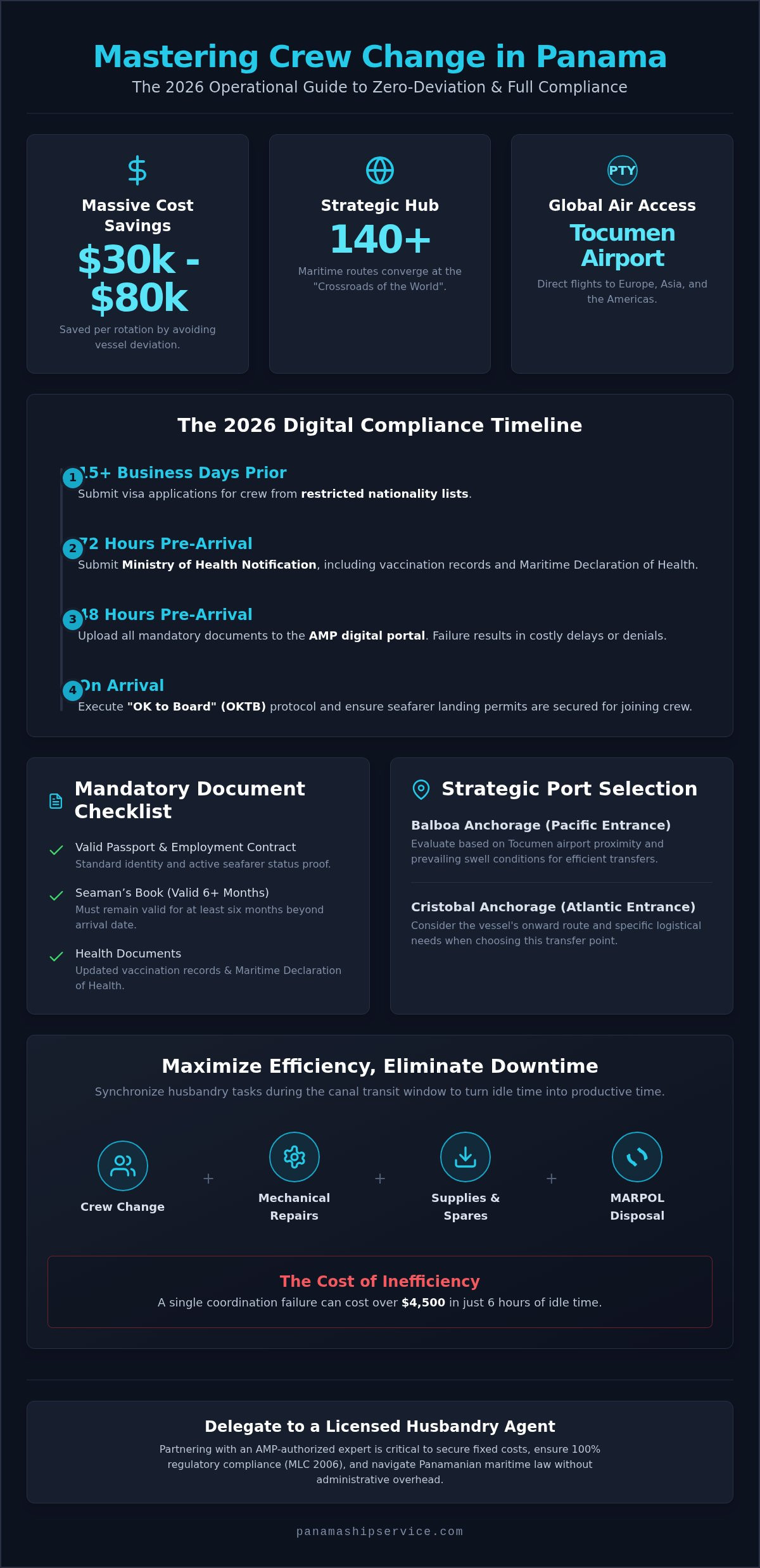
This 2026 operational guide gives you the tools to master these logistics, ensuring 100% compliance with Panama Maritime Authority regulations while minimizing downtime. We’ll explore the latest digital document submission protocols, compare the strategic advantages of Balboa versus Cristobal, and provide a clear roadmap for handling restricted nationality visas. By the end of this article, you’ll know exactly how to secure fixed husbandry costs and guarantee a seamless transition for your seafarers during their next Canal transit.
Key Takeaways
- Utilize Panama’s strategic location and global flight connectivity to execute zero-deviation crew swaps that save up to $80,000 per rotation compared to regional alternatives.
- Master the 2026 digital submission protocols and visa requirements to ensure 100% regulatory compliance and avoid costly 72-hour pre-arrival notification errors.
- Evaluate the operational differences between Balboa and Cristobal anchorages to select the most efficient transfer point based on swell conditions and airport proximity.
- Optimize vessel schedules by integrating crew change services panama with mechanical repairs or MARPOL disposal to drastically reduce idle time.
- Delegate complex logistics to authorized local husbandry experts to secure fixed costs and navigate Panamanian maritime law without unnecessary administrative overhead.
The Strategic Advantage of Crew Change Services in Panama
Panama sits at the intersection of more than 140 maritime routes, earning its reputation as the “Crossroads of the World.” For operators, the primary benefit of utilizing crew change services panama is the ability to conduct rotations without deviating from the primary trade route. The Panama Canal acts as a natural staging point where vessels must already pause for transit. Combined with the global connectivity of Tocumen International Airport (PTY), which offers direct flights to major maritime hubs in Europe, Asia, and the Americas, the logistics of moving personnel become significantly more manageable. Ship operators can save between $30,000 and $80,000 per rotation by avoiding deviations to other regional ports. By delegating these tasks to a one-stop-shop provider, the Master is freed from the administrative complexity of local immigration and health protocols.
Husbandry services in the Panama Canal context comprise the coordination of all shore-based requirements, from crew transfers and medical assistance to technical support and vessel supplies, ensuring seamless operations while the ship remains under the agent’s care.
Why Timing Matters at the Panama Canal
In 2026, canal traffic is projected to stay at 36 daily transits, meaning anchorage time is a valuable commodity. Effective managers use this window to perform multiple husbandry tasks at once. Instead of treating a crew swap as a standalone event, you can synchronize it with bunkering or mechanical ship repairs. This approach eliminates “dead time” at the Balboa or Cristobal anchorages. When your agent coordinates launch boat schedules with the arrival of technicians or supplies, you reduce the total time the vessel spends idle and ensure your crew rotation window aligns perfectly with your transit slot.
Regulatory Oversight by the Panama Maritime Authority (AMP)
The Panama Maritime Authority (AMP) maintains rigorous oversight to protect seafarer rights and ensure maritime safety. Compliance with the Maritime Labour Convention (MLC 2006) is a non-negotiable requirement for all crew change services panama. Your chosen agent must be fully licensed by the AMP to handle sensitive immigration and health clearances. In 2026, the digital submission of passports and employment contracts must occur at least 48 hours before arrival. Working with an authorized expert ensures these deadlines are met, preventing the administrative delays that often plague restricted nationality visa applications. This oversight guarantees that your crew transitions are both legal and efficient, protecting you from heavy fines and port delays.
Navigating Panama Crew Change Logistics: Visas and Documentation
Compliance is the foundation of successful crew change services panama. Because the Panama Canal serves as a critical cornerstone of global maritime transportation, the National Migration Service and the Panama Maritime Authority (AMP) enforce strict entry and exit protocols. In 2026, the digital transition is complete; all mandatory documents, including passports, Seaman’s Books, and employment contracts, must be uploaded to the AMP digital portal at least 48 hours before the crew member’s arrival. Failure to meet this window often results in immediate boarding denials or vessel delays. Seaman’s Books must remain valid for at least six months beyond the arrival date, as authorities do not permit entry on expired credentials.
Health and safety clearances remain a priority. Vessels must provide a 72-hour pre-arrival notification to the Ministry of Health. This notification includes updated vaccination records and a Maritime Declaration of Health. Partnering with an experienced agent like Panama Ship Service ensures these administrative hurdles don’t delay your vessel’s transit.
Managing the OK to Board (OKTB) Protocol
The “OK to Board” process is the first line of defense against logistical failure. For joining crew, airline clearance depends on the agent’s ability to secure a specialized seafarer landing permit. If your crew members are from nations on Panama’s restricted list, you must submit visa applications at least 15 business days in advance. A common pitfall is the mismatch between flight arrival times and the 72-hour pre-arrival notification sent to Migration. We coordinate directly with immigration officers at Tocumen International Airport (PTY) to verify that every seafarer has the necessary electronic authorization before they reach the check-in counter at their origin airport.
Immigration Clearance for Off-Signers
Processing off-signers requires precision to avoid overstay penalties. Once a seafarer leaves the vessel, they receive a 72-hour shore pass. Our logistics team manages the entire transit from the pier to the airport, typically keeping the total travel time under four hours. We handle all temporary stay permits and ensure the Seaman’s Book is properly endorsed by Panamanian authorities. In the event of emergency repatriations or medical sign-offs, we provide immediate coordination with local clinics and airlines to facilitate a rapid, compliant exit. This organized approach prevents “hidden” costs associated with hotel stays or missed flights, keeping your husbandry budget predictable and transparent.
Port Operations: Balboa vs. Cristobal Transfers
Selecting the correct transfer point is a fundamental decision in managing crew change services panama. While both the Pacific and Atlantic entrances provide the necessary infrastructure, they present distinct operational profiles that impact vessel downtime. Balboa, on the Pacific side, is often the preferred choice for ship managers due to its proximity to the capital and generally calmer sea states. Cristobal, on the Atlantic side, serves as the primary hub for southbound vessels and those calling at the Colon container terminals. During the rainy season, sea conditions and visibility can fluctuate rapidly. We mitigate these risks by using launch boats that exceed standard safety certifications, ensuring every vessel has the appropriate engine capacity and stability to handle personnel transfers safely in varying weather.
Anchorage locations significantly influence launch boat transit times. Vessels anchored in the outer “Area F” at Balboa or the breakwater at Cristobal require longer transit windows than those in inner anchorages. We monitor these positions in real-time to adjust shore-side logistics, ensuring that transport vans and launch crews are synchronized to prevent personnel from waiting at the pier. This level of coordination is what keeps your husbandry costs fixed and your schedules predictable.
Pacific Side: Balboa Anchorage Logistics
The Port of Balboa is the strategic choice for vessels awaiting northbound transit. Its location, just 25 kilometers from Tocumen International Airport (PTY), allows for transit times of under 45 minutes. This efficiency reduces the need for expensive hotel stays and minimizes the risk of missed flight connections. Launch boat operations primarily utilize the Flamenco and Balboa piers. Because the Pacific side typically experiences lower swell heights, launch transfers are generally faster. This environmental advantage makes Balboa the most reliable location for crew change services panama, particularly when dealing with tight crew rotation windows.
Atlantic Side: Cristobal and Manzanillo Operations
For vessels calling at Manzanillo International Terminal (MIT) or preparing for southbound transit, Cristobal is the mandatory operational base. Logistics on the Atlantic side require more rigorous planning due to the 80-kilometer distance between the Colon terminals and Panama City. Land transport usually takes between 60 and 90 minutes, depending on traffic. We implement strict port access protocols and security measures for all transfers in the Colon area to ensure seafarer safety. While the road transit is longer, we manage these Atlantic transfers by precisely timing vehicle arrivals with launch boat availability. This ensures that off-signing crew members move directly from the vessel to their airport transport without unnecessary delays in the terminal area.
Optimizing Efficiency: Minimizing Vessel Downtime
Efficiency at the Panama Canal is measured in hours, not days. For operators, the goal is to execute crew change services panama without adding a single unnecessary minute to the port call. This requires precise synchronization with the Panama Canal Authority (ACP) transit slots. We monitor your vessel’s position and transit schedule in real-time to ensure the launch boat is ready the moment the ship enters the anchorage. By 2026, the integration of digital port management systems has already reduced vessel idle time by 15%. Achieving these results depends on a rigorous pre-arrival countdown:
- 72 Hours: Submit pre-arrival notifications to the National Migration Service and the Ministry of Health.
- 48 Hours: Upload all seafarer documentation to the AMP digital portal to secure landing permits.
- 24 Hours: Finalize flight arrivals and ground transport logistics to ensure personnel are at the pier before the vessel arrives.
Effective agents don’t just wait for instructions; they proactively coordinate with the ACP to adjust for any changes in the transit queue. This proactive communication prevents your vessel from sitting idle while waiting for crew, or worse, missing a transit slot because the rotation was behind schedule.
Integrated Technical and Husbandry Services
The most cost-effective way to manage your vessel is to consolidate operational needs. Performing marine surveys in Panama during a crew rotation eliminates the need for separate anchorage windows. We also coordinate the delivery of critical spare parts and provisions to coincide with crew arrival. Consolidating personnel transfers with technical deliveries or survey teams allows you to maximize the utility of a single trip, significantly reducing the total launch boat costs per operation. If your vessel requires mechanical ship repairs, we schedule technicians to board alongside the joining crew, ensuring all technical and personnel needs are met in one efficient window.
Emergency and Last-Minute Crew Rotations
Operational reality often involves the unexpected. Whether you need an emergency medical evacuation or have a sudden requirement for specialized technicians to perform underwater hull services, responsiveness is critical. We maintain 24/7 availability, 365 days a year, to handle these high-pressure scenarios. Our team manages the entire protocol for medical sign-offs, including coordination with local clinics and rapid repatriation logistics. This level of support ensures that even during an emergency, your vessel remains compliant with Panamanian maritime law and minimizes its time out of service. To secure your vessel’s schedule and minimize overhead, contact Panama Ship Service for a consolidated husbandry quote.
Panama Ship Service: Your Partner for Reliable Crew Changes
Panama Ship Service provides a comprehensive suite of husbandry solutions designed to streamline your port call. Unlike agents who outsource core functions, we act as a direct service provider, which eliminates the “Panama surcharge” often added by third-party intermediaries. Our team handles everything from Cash to Master (CTM) deliveries to full-scale crew manning, ensuring that every operational requirement is met under one point of contact. Because we maintain deep, long-standing relationships with the Panama Maritime Authority (AMP) and the National Migration Service, we can resolve documentation issues in real-time. This localized expertise is vital for maintaining the flow of crew change services panama, especially when dealing with the strict digital submission deadlines required in 2026.
Our operations create natural synergies with your vessel’s technical and environmental requirements. For instance, coordinating a crew swap alongside MARPOL disposal in Panama allows you to fulfill environmental compliance and personnel needs simultaneously. This integrated approach ensures your vessel remains productive while at anchorage, turning a mandatory stop into a highly efficient multi-tasking window.
The One-Stop-Shop Advantage
Managing multiple vendors for repairs, supplies, and crew rotations creates administrative friction and increases the risk of miscommunication. By utilizing our one-stop-shop model, you benefit from volume-based cost savings and a single, transparent invoice. For those looking to optimize their workforce, SourceLine provides specialized recruiting for the marine and heavy equipment industries, ensuring you have the right talent on board. Consider a scenario where we synchronized a 12-person crew rotation with emergency engine part delivery and a hull survey. By consolidating these into a single launch boat window, the operator avoided three separate anchorage fees and saved over six hours of idle time. We prioritize fiscal responsibility alongside operational speed, ensuring that every dollar spent contributes to reduced downtime.
Our 24/7 operations center provides proactive communication, giving you constant visibility into the status of your personnel and technical requests. We understand that seafarer welfare is paramount to vessel safety. Our logistics team ensures that joining and off-signing crew experience comfortable, air-conditioned transport and efficient processing, reducing the stress of international travel. Beyond logistics, supporting seafarer welfare includes access to reliable financial tools; you can learn more about DUC App for fast and secure money transfers that help crew members support their families globally. We don’t just move people; we manage a critical link in your global supply chain with the precision that a strategic hub like the Panama Canal demands. Contact Panama Ship Service today for a tailored husbandry quote that reflects the specific needs of your next transit.
Executing efficient crew change services panama requires more than just transportation; it demands a deep understanding of AMP digital protocols and the operational nuances of Balboa and Cristobal anchorages. By synchronizing personnel rotations with technical repairs or MARPOL disposal, you transform mandatory wait times into productive windows that protect your bottom line. Success in 2026 relies on proactive coordination and 100% regulatory compliance to prevent the costly delays associated with missed transit slots.
Panama Ship Service provides the expertise needed to navigate these complexities. As a provider authorized by the Panama Maritime Authority (AMP), we offer 24/7 operational support and complete technical and husbandry integration to ensure your vessel stays on schedule. We handle the administrative burden so you can focus on the voyage ahead. Contact Panama Ship Service for Professional Crew Change Support and secure a reliable partner at the crossroads of global trade. We look forward to supporting your fleet’s operational excellence and ensuring a seamless transition for your crew.
Frequently Asked Questions
What are the main requirements for a crew change in Panama?
The main requirements for a crew change in Panama include a valid passport with at least six months of validity, a current Seaman’s Book, and a signed employment contract. In 2026, the Panama Maritime Authority (AMP) requires all documentation to be uploaded to their digital portal at least 48 hours before arrival. Additionally, vessels must provide a 72-hour pre-arrival notification to the National Migration Service and the Ministry of Health to ensure medical clearance.
How long does it take to process a seafarer transit visa in Panama?
Processing times for seafarer transit visas depend on the crew member’s nationality. Seafarers from nations on the restricted list must submit their visa applications at least 15 business days before arrival. For most other nationalities, a 72-hour shore pass is issued upon arrival at the port or airport. We coordinate these applications directly with the National Migration Service to prevent administrative delays that could impact your vessel’s transit schedule.
Can crew changes be performed while the vessel is transiting the Panama Canal?
No, crew changes are strictly prohibited during the actual transit of the Panama Canal. Personnel transfers must occur at the designated anchorages in Balboa on the Pacific side or Cristobal on the Atlantic side before or after the transit. Performing these rotations while the vessel is at anchorage allows for a safer operation and ensures compliance with Panama Canal Authority (ACP) safety regulations, which prioritize uninterrupted vessel movement through the locks.
What is an OKTB and why is it necessary for joining crew?
An OKTB, or “OK to Board,” is an electronic authorization required by airlines to ensure a joining seafarer has the necessary landing permits to enter Panama. It’s necessary because it prevents crew members from being denied boarding at their origin airport. Panama Ship Service coordinates with immigration authorities at Tocumen International Airport (PTY) to verify that all seafarer credentials and landing permits are in order before the flight departs.
Are there specific medical or vaccination requirements for crew entering Panama in 2026?
In 2026, all crew entering Panama must comply with the Ministry of Health’s updated maritime protocols. This includes submitting a Maritime Declaration of Health and a 72-hour pre-arrival notification. While specific vaccination requirements can vary based on global health trends, all seafarers must have their standard maritime medical clearances documented. We monitor these regulations daily to ensure your joining and off-signing crew meet all current Panamanian and international health standards before they arrive.
How does Panama Ship Service coordinate with the Panama Canal Authority (ACP)?
Panama Ship Service maintains real-time communication with the Panama Canal Authority (ACP) to synchronize crew change services panama with your vessel’s assigned transit slot. We monitor the transit queue and anchorage positions to ensure launch boats are ready exactly when the vessel arrives. This proactive coordination minimizes idle time and ensures that personnel rotations don’t interfere with the ship’s ability to meet its scheduled lockage time.
What is the cost difference between crew changes in Balboa versus Cristobal?
The primary cost difference between Balboa and Cristobal involves land transportation and logistics. Balboa is located just 25 kilometers from Tocumen International Airport (PTY), leading to lower ground transport expenses and shorter transit times. Cristobal is approximately 80 kilometers from the airport, requiring longer travel times and higher logistics costs. However, the best choice depends on your vessel’s transit direction and the specific anchorage assigned by the Panama Canal Authority.
Can you handle emergency medical evacuations at the Panama Canal?
Yes, we provide 24/7 support for emergency medical evacuations at both the Pacific and Atlantic entrances of the Canal. Our team coordinates the entire process, including the launch boat transfer, land ambulance transport, and admission to local specialized clinics. We also manage the administrative requirements for emergency sign-offs and repatriation, ensuring the seafarer receives immediate care while keeping the vessel in compliance with all Panamanian maritime and health laws.