
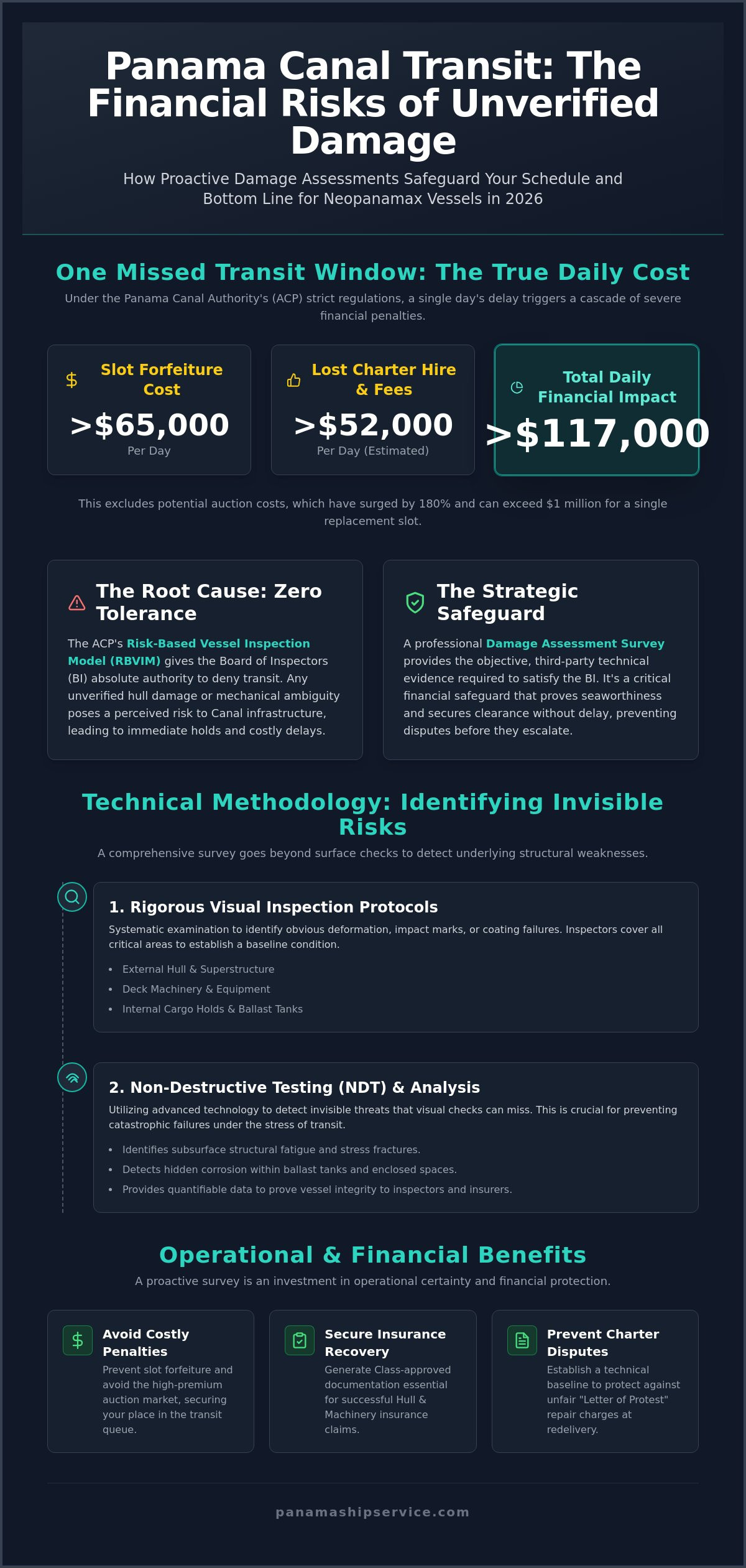
For a Neopanamax vessel in 2026, a single missed transit window due to unverified damage doesn’t just stall your schedule. It triggers a slot forfeiture cost exceeding $65,000 per day. When you factor in lost charter hire and rescheduling fees, the price of a single day’s delay often surpasses $117,000. You already understand that the Panama Canal Authority (ACP) maintains zero tolerance for ambiguity under the Risk-Based Vessel Inspection Model (RBVIM). A precise damage assessment survey panama is no longer just a routine check; it’s a critical financial safeguard for your operations.
We’ll show you how to navigate these technical and regulatory hurdles to prevent costly transit delays and secure the evidence needed for successful insurance claims. This guide breaks down the specific documentation the Board of Inspectors requires to grant rapid clearance. You’ll also learn how to leverage technical data to ensure a seamless transition to mechanical repairs at either the Balboa or Cristobal anchorages. By the end of this article, you’ll have a clear roadmap for protecting your bottom line and maintaining your schedule in the high-stakes environment of the 2026 Canal landscape.
Key Takeaways
- Learn why securing a professional damage assessment survey panama is the most effective way to avoid auction price surges and slot forfeiture during high-traffic periods.
- Identify the specific visual and Non-Destructive Testing protocols required to detect subsurface structural fatigue before it triggers a mandatory transit denial.
- Understand the documentation requirements that distinguish Class-approved surveys from independent assessments to ensure full hull and machinery insurance recovery.
- Evaluate the “Transit-First” strategy to determine if your vessel can safely proceed through the Canal before permanent repairs are executed at local anchorages.
- Discover how combining damage assessment with mechanical ship repairs reduces operational overhead and accelerates the clearance process with the Board of Inspectors.
The Strategic Role of Damage Assessment Surveys in Panama Canal Transits (2026)
Panama remains one of the world’s most critical maritime bottlenecks, facilitating over 13,000 transits annually. In this high-pressure environment, a damage assessment survey panama is not a mere administrative formality; it’s a strategic necessity. The Panama Canal Authority (ACP) Board of Inspectors (BI) holds absolute power over vessel entry. If they detect unverified hull damage or mechanical failure, they will deny transit immediately to protect the Canal’s infrastructure. You cannot afford to leave these technical details to chance when the vessel is already at the locks.
The financial consequences of a transit denial are severe. Beyond the $100,000 base reservation fee for Neopanamax vessels, a missed window triggers slot forfeiture costs exceeding $65,000 per day. When you include lost charter hire and rescheduling fees, the total daily loss often climbs above $117,000. Operators must resolve technical disputes before the vessel reaches the pilot station to avoid these penalties. A professional survey provides the technical evidence required to satisfy the BI and secure clearance without delay.
The High Cost of Transit Denials and Slot Forfeiture
Unverified damage is the primary cause of last-minute transit delays in the 2026 Canal schedule. The Neopanamax locks operate on a rigid allocation system where any deviation creates a ripple effect throughout the entire queue. If a vessel arrives with documented but unverified structural issues, the ACP will likely pull it from the rotation. This forces the operator into the auction market, where prices have recently surged by 180%, sometimes exceeding $1 million for a single slot. Securing a professional damage assessment survey panama allows for the resolution of technical disputes before they escalate into a six-figure financial loss. Using a Marine Surveyor Roles framework, independent experts verify that a vessel meets the Risk-Based Vessel Inspection Model (RBVIM) standards.
Damage Assessment as a Risk Management Tool
A comprehensive survey also protects against “Letter of Protest” disputes during charter redelivery. Without a technical baseline established in Panama, owners often face unfair repair charges for damage they didn’t cause. High-quality marine surveys in Panama ensure that charter party obligations are met with objective, third-party data. This independent oversight is vital in a strategic hub where timing and cost management are the only priorities. You can delegate this technical complexity to a local partner to simplify your operations and secure your insurance recovery. It’s about maintaining a clear record of the vessel’s condition to prevent long-term liabilities.
Technical Methodology: How Professional Damage Surveys Identify Invisible Risks
A professional damage assessment survey panama relies on a multi-layered diagnostic approach to ensure vessel seaworthiness. It begins with rigorous visual protocols covering the hull, deck machinery, and cargo holds. While visual checks identify obvious deformation or coating failure, they often miss the underlying structural weaknesses that lead to catastrophic failure. Reports from the Marine Accident Investigation Branch (MAIB) consistently show that undetected corrosion and fatigue are primary catalysts for maritime incidents. Our methodology prioritizes finding these invisible risks before they compromise vessel safety or Canal infrastructure.
Visual inspection protocols are systematic. Inspectors examine the vessel’s exterior for impact marks, then move to internal cargo spaces and ballast tanks to check for buckling or internal stress. This sequence ensures that no area remains unexamined before the vessel enters the high-stress environment of the locks. By identifying these issues early, operators can make informed decisions about whether to proceed with transit or seek immediate mechanical intervention.
Non-Destructive Testing (NDT) and Structural Analysis
NDT identifies hull fatigue before it leads to a breach. We utilize ultrasonic thickness gauging to measure steel depletion and magnetic particle inspection to pinpoint microscopic cracks in high-stress areas. These tools reveal subsurface structural fatigue that standard visual inspections simply cannot see. By identifying these issues at the anchorage, you prevent a minor hairline fracture from becoming a major structural failure during transit. If you suspect hidden damage, you can contact our technical team for a rapid, data-driven evaluation.
Underwater Hull and Machinery Evaluation
The most critical risks often lie below the waterline, where visibility is limited and access is difficult. We utilize high-resolution CCTV and photography to evaluate the integrity of the rudder, propeller, and sea chests. Coordinating these underwater hull services with a comprehensive damage survey provides a complete picture of the vessel’s condition. This allows for immediate assessment while the vessel remains at the Balboa or Cristobal anchorages. Divers check for entanglement, impact damage, and cavitation, providing clear evidence for both the ACP and insurance underwriters.
The final phase of the process involves converting these technical findings into actionable repair plans. Every report includes high-definition imagery, NDT data sheets, and a prioritized list of repair recommendations. This documentation is essential for ACP clearance and insurance subrogation. It ensures that every repair recommendation is backed by empirical data rather than speculation, allowing you to manage your maintenance budget with precision.
Navigating Insurance Claims and ACP Regulatory Compliance
Transit clearance in 2026 hinges on more than just physical repairs. You must prove the vessel meets the Panama Canal Authority’s (ACP) latest safety thresholds through precise documentation. As of 2026, all damaged vessels must comply with the Risk-Based Vessel Inspection Model (RBVIM) for transit clearance. This model uses data from your damage assessment survey panama to categorize the operational risk your vessel poses to the locks. If your technical documentation is incomplete or fails to meet VUMPA (Vessel Traffic Management) standards, the ACP will default to the highest risk category, often resulting in mandatory delays or forced discharge of cargo.
The Board of Inspectors (BI) requires a transparent data trail to grant passage. This isn’t just about safety; it’s about financial recovery. Underwriters for hull and machinery (H&M) insurance will scrutinize every detail of the survey to determine if the damage was a result of an insured peril or wear and tear. Your survey report serves as the primary evidence in these negotiations, bridging the gap between technical reality and financial liability.
Class vs. Independent Commercial Surveys
Operators often confuse the roles of Class surveyors and independent experts. While a Class surveyor from an IACS member is mandatory for maintaining statutory certificates and seaworthiness, they represent the interests of the flag state and classification rules. In contrast, an independent surveyor provides the granular commercial evidence needed for arbitration or insurance disputes. Independent surveys prioritize the shipowner’s operational schedule and provide the “Commercial” evidence that Class reports often omit. Maintaining IACS standards while protecting your bottom line requires a partner who understands the nuances of both regulatory compliance and commercial protection.
Documentation for Underwriters and ACP Clearance
The backbone of any successful insurance claim is the ‘Statement of Fact’ (SOF). This document must include chronological data, environmental conditions at the time of damage, and the specific NDT results gathered during the inspection. When you present this technical data to the ACP Board of Inspectors, it must be formatted for immediate review to facilitate rapid clearance. A ‘Transit-Ready’ certification is the definitive technical endorsement issued by authorized inspectors stating that a vessel’s damaged components or temporary repairs satisfy all ACP safety criteria for immediate lockage. Without this certification, your vessel remains an operational liability in the eyes of the Canal Authority. We ensure that every report we generate provides the clarity needed to move your vessel from the anchorage to the locks without unnecessary administrative friction.
Minimizing Downtime: Transitioning from Assessment to Emergency Repair
The ‘Transit-First’ strategy is the most effective way to protect your operating margin when damage is detected. Instead of defaulting to immediate, time consuming permanent repairs, our technical team evaluates whether the vessel safely meets ‘Sea-Going’ standards for a single transit. This approach is designed to prevent the $65,000 daily slot forfeiture and the cascading costs of rescheduling. A rapid damage assessment survey panama provides the empirical data needed to convince the ACP that the vessel’s current state does not threaten the safety of the locks. Planning temporary repairs allows you to maintain your schedule while deferring permanent work to a more convenient window.
Speed of response is non-negotiable in the Panama Canal hub. Because transit windows are rigid, a delay of just a few hours in securing a surveyor can result in the loss of a Neopanamax slot. Technical teams must be ready to board at any hour, providing a seamless transition from the initial inspection to the execution of temporary fixes. This proactive stance ensures that technical hurdles do not translate into operational paralysis.
Coordinating Response in Balboa and Cristobal
Logistical challenges vary significantly between the Pacific and Atlantic anchorages. Balboa often faces high traffic density for Neopanamax arrivals, while Cristobal requires managing surveyor transfers via launch during heavy seasonal swells. We coordinate these movements with precision to ensure inspectors reach the vessel without delay. By integrating the initial inspection with mechanical ship repairs in Panama, we eliminate the communication gap between the surveyor and the repair crew. This integrated model allows for the simultaneous assessment of hull integrity and the mobilization of repair equipment, significantly reducing total vessel downtime.
The ACP Board of Inspectors (BI) Process
Preparing the vessel master for an ACP Board of Inspectors review is a critical step in the clearance process. The BI will scrutinize the damage incident to determine if the vessel poses a risk to the Canal’s infrastructure. Our surveyors act as technical advocates, presenting the findings of the damage assessment survey panama to justify the vessel’s safety. We help the crew navigate ‘Condition of Transit’ requirements, which may include mandatory tug assistance or specific draft restrictions. If your vessel requires an immediate technical evaluation at either anchorage, request a rapid response survey here to secure your transit window. Having a seasoned professional present during the BI review ensures that technical facts are prioritized over conservative assumptions, facilitating a faster return to sea.
Why Panama Ship Service is Your Technical Partner for Damage Recovery
Choosing a partner for your damage assessment survey panama requires more than just technical certification. It demands a deep understanding of the Panama Canal Authority’s (ACP) operational rhythm and the financial pressures of modern shipping. We provide a bridge between the technical findings of an inspection and the immediate execution of mechanical ship repairs. Most competitors separate these functions, creating logistical friction that leads to missed transit windows. We eliminate this delay by providing a unified response team that handles the assessment, the advocacy with the Board of Inspectors, and the necessary repairs under one technical umbrella.
Our independence is our greatest asset for shipowners and underwriters. We provide unbiased, data-driven evidence that stands up to the scrutiny of insurance adjusters and charterer disputes. In a high-stakes environment where a single day of transit delay can cost a Neopanamax vessel over $52,000 in charter hire alone, having an objective technical record is essential. We focus on fiscal responsibility by identifying the most efficient path to seaworthiness, ensuring you don’t overpay for unnecessary work while meeting all 2026 RBVIM safety standards.
A One-Stop-Shop for Canal Operations
Efficiency in Panama is built on consolidation. We reduce your operational overhead by coordinating surveys, repairs, and MARPOL disposal in Panama through a single point of contact. Our permanent presence at both Balboa and Cristobal anchorages ensures zero response lag, regardless of which side of the Isthmus your vessel arrives. We’ve spent decades navigating the unique maritime laws and ACP protocols of this hub. This localized expertise allows us to anticipate regulatory hurdles before they become transit-stopping issues. You can delegate the technical complexity of the Canal to us, allowing your crew to focus on safe navigation and cargo operations.
Contact Our Emergency Response Team Today
Time is the most expensive commodity at the Panama Canal. To initiate a rapid-response damage assessment survey panama, our team is available 24/7 to mobilize to your position. When contacting us, please provide your vessel’s current ETA, exact anchorage position, and a brief description of the suspected damage. This information allows our technical divers and NDT technicians to deploy with the correct equipment for an immediate evaluation. Don’t risk a $65,000 slot forfeiture due to unverified technical issues. Protect your vessel’s schedule and your bottom line by partnering with a veteran service provider that understands the urgency of the Panama Canal. Reach out to our technical team now to secure your 2026 transit window.
Protecting Your Operating Margin in the 2026 Canal Landscape
Maintaining operational momentum in the Panama Canal requires a shift from reactive repairs to proactive technical management. By integrating high-resolution underwater evaluations with Non-Destructive Testing, you ensure that your vessel meets the strict 2026 Risk-Based Vessel Inspection Model (RBVIM) criteria before reaching the locks. This approach satisfies the Board of Inspectors and provides the technical evidence your underwriters require for full insurance recovery. It’s about identifying risks early and documenting them with precision to avoid the volatile auction market.
Delegating these technical complexities to a localized partner allows you to focus on cargo operations while we manage the regulatory hurdles. A professional damage assessment survey panama is your most effective tool for preventing slot forfeiture and the associated $65,000 daily penalties. With our 24/7 emergency response and Class-approved methodology, we provide the clarity needed to move your vessel from the anchorage to the locks without administrative friction.
Secure your Panama Canal transit and protect your assets with an expert damage assessment survey. Our team is ready to deploy integrated repair solutions at both Balboa and Cristobal anchorages to keep your schedule on track. We look forward to supporting your fleet’s success in this demanding transit hub.
Frequently Asked Questions
What is a damage assessment survey and why is it required in Panama?
A damage assessment survey panama is a comprehensive technical inspection performed after a vessel sustains physical impact, grounding, or mechanical failure. The Panama Canal Authority requires these surveys to ensure that no vessel poses a risk to the locks or Canal infrastructure. Without verified documentation of the vessel’s condition, the Board of Inspectors will deny transit clearance to prevent potential operational disruptions and safety hazards.
How quickly can a surveyor board my vessel at the Balboa anchorage?
Surveyors can typically board a vessel at the Balboa anchorage within two to four hours of an emergency request. Technical teams maintain 24/7 readiness to respond to calls on both the Pacific and Atlantic sides of the Isthmus. This rapid deployment is critical for vessels attempting to preserve their allocated Neopanamax transit slots and avoid the heavy financial penalties associated with slot forfeiture.
Does the Panama Canal Authority (ACP) accept independent damage surveys?
The ACP accepts independent technical data if it aligns with the Risk-Based Vessel Inspection Model (RBVIM) and VUMPA standards. Independent surveys provide the granular technical detail that the Board of Inspectors needs to make informed safety decisions. These reports often serve as a vital technical bridge that facilitates faster transit clearance for vessels with documented but stable damage.
Can a damage assessment survey be conducted while the vessel is at sea?
Physical verification and Non-Destructive Testing must occur while the vessel is at a secure anchorage like Balboa or Cristobal. While masters can provide initial remote reports, technical divers and NDT technicians require a stationary vessel to perform accurate hull and machinery evaluations. Safety regulations prohibit these high-precision technical inspections while a ship is making way in open water.
What is the difference between a Class survey and a commercial damage survey?
Class surveys verify that a vessel meets international statutory and safety standards to maintain its certificates and seaworthiness. Commercial damage surveys focus on the shipowner’s specific interests by providing detailed evidence for insurance subrogation and charterer disputes. While Class determines if a ship can legally sail, a commercial survey ensures you have the technical documentation needed to recover repair costs.
How much money can a professional damage assessment save in insurance claims?
Professional assessments save money by providing the technical proof needed to secure full insurance payouts and prevent claim denials based on “unverified” causes. They also prevent the $65,000 daily slot forfeiture costs by facilitating rapid ACP clearance through data-driven advocacy. Accurate documentation ensures that every dollar of damage is accounted for during the settlement process with underwriters.
What NDT techniques are used during a ship damage assessment in Panama?
Technicians primarily use ultrasonic thickness gauging to measure steel integrity and magnetic particle inspection to detect microscopic cracks in high-stress areas. These Non-Destructive Testing methods identify structural fatigue that isn’t visible to the naked eye. By finding these subsurface issues at the anchorage, you prevent a minor fault from becoming a major structural breach during the transit process.
Can I combine a damage survey with an on-hire/off-hire inspection?
Combining a damage assessment survey panama with an on-hire or off-hire inspection is a common strategy to manage vessel redelivery efficiently. This dual-purpose approach establishes a clear technical baseline for the vessel’s condition, which protects both owners and charterers from unfair repair charges. It also consolidates launch fees and inspector time to reduce total operational overhead for the operator.