
In the high-stakes environment of the Panama Canal, a single administrative error can lead to costly delays, port rejection, or even quarantine. For ship operators, the pressure to ensure every piece of paperwork is flawless is immense, especially when navigating the specific health regulations mandated by Panamanian authorities. The confusion between a Deratting Certificate and a Ship Sanitation Control Exemption Certificate (SSCEC) often complicates the process, making it difficult to secure the correct documentation from a trusted, authorized provider. A mistake here isn’t just an inconvenience-it’s a direct threat to your schedule and budget.
This guide provides the expert clarity you need. We are here to eliminate the uncertainty surrounding the deratting certificate panama and its associated requirements. By reading this, you will gain a clear understanding of Panama’s specific ship sanitation protocols, master the official certification process, and learn how to ensure your vessel is fully compliant with both local and international health standards. Our objective is simple: to equip you with the essential knowledge for a fast, efficient, and delay-free transit through the Panama Canal.
Key Takeaways
- Clarify the correct terminology: Understand why the modern Ship Sanitation Control Exemption Certificate (SSCEC) has replaced the old ‘Deratting Certificate’.
- Discover why a valid Ship Sanitation Certificate is a non-negotiable requirement for any vessel transiting the Panama Canal to avoid costly delays and penalties.
- Master the step-by-step process for securing your deratting certificate panama (SSCEC) efficiently, from initial request to final issuance by port health authorities.
- Recognize how a trusted agent streamlines the entire certification process, ensuring compliance, minimizing vessel expenses, and saving valuable time.
Understanding Ship Sanitation Certificates in Panama: Deratting vs. SSCEC
For ship operators navigating Panamanian waters, understanding the correct terminology for vessel sanitation is crucial for compliance and efficiency. While many in the industry still refer to a “Deratting Certificate,” this term is outdated. The process to secure a valid deratting certificate panama now falls under a modern, internationally recognized framework designed to prevent the international spread of disease via shipping.
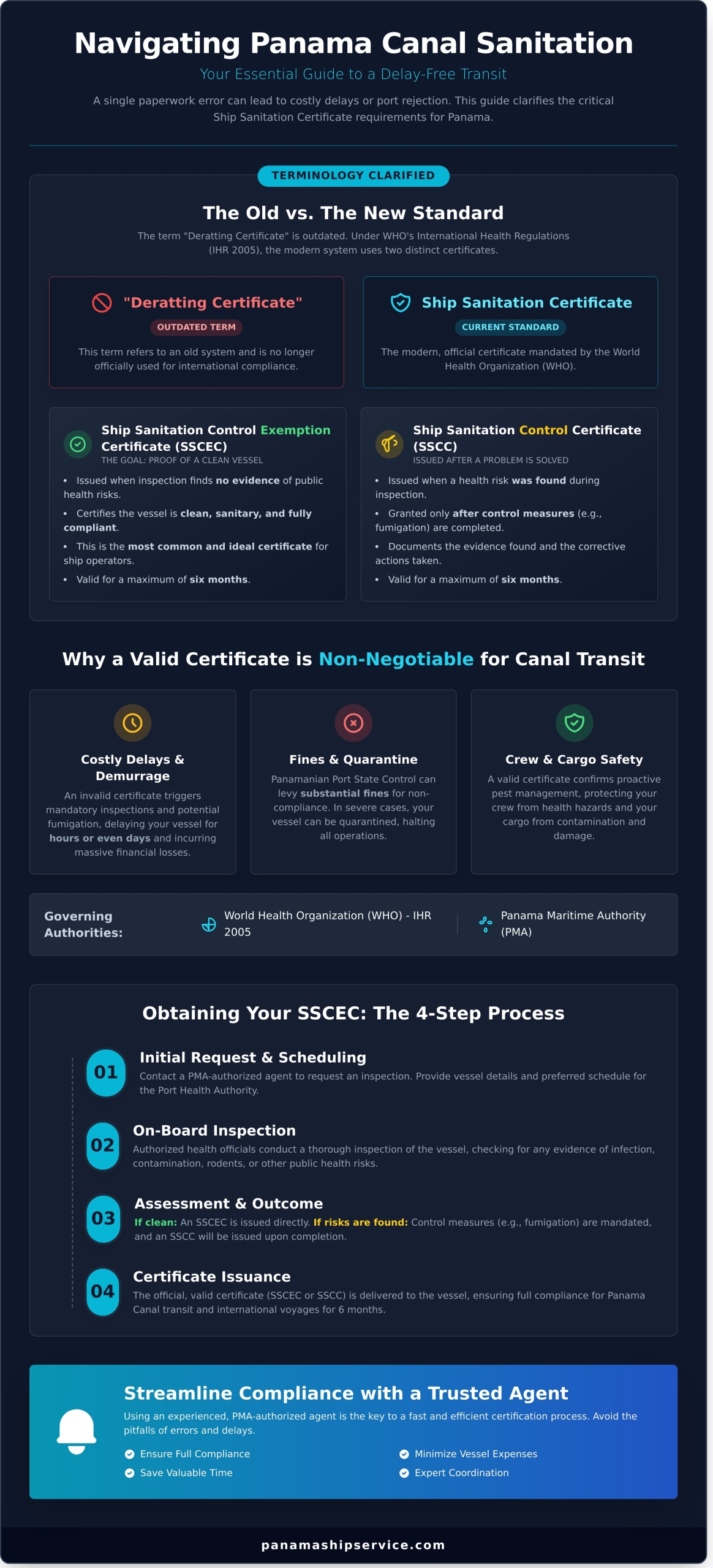
Under the World Health Organization’s (WHO) International Health Regulations (IHR 2005), the old deratting system was replaced by two distinct certificates. Understanding the difference is key to managing your vessel’s public health compliance and ensuring a smooth transit.
Ship Sanitation Control Exemption Certificate (SSCEC)
This is the ideal and most frequently issued certificate. An SSCEC is granted following a thorough inspection that finds no evidence of infection or contamination, including rodents, insects, or other public health risks. It officially certifies that the vessel is clean and sanitary. The SSCEC is valid for a maximum of six months and serves as proof of your vessel’s excellent condition and proactive health management.
Ship Sanitation Control Certificate (SSCC)
An SSCC is issued when an inspection reveals evidence of a public health risk. This certificate is only granted after necessary control measures, such as fumigation or disinfection, have been successfully completed and verified. The SSCC details the evidence found, the control measures applied, and the date of completion. Like the SSCEC, it is valid for six months, but it documents that a sanitation issue was recently identified and professionally resolved.
The Legal Framework: IHR (2005) and the Panama Maritime Authority (PMA)
The entire global system is mandated by the WHO’s International Health Regulations (IHR 2005). Under these regulations, the modern Ship Sanitation Certificate system was established to create a unified standard for maritime health security. In Panama, the sole authorized body for enforcing these regulations and issuing certificates is the Panama Maritime Authority (PMA). For operators, this means that any inspection or sanitation service must be conducted by a provider officially approved by the PMA to ensure your certificate is valid and recognized worldwide.
Why a Valid Sanitation Certificate is Crucial for Panama Canal Transit
For any vessel entering Panamanian waters, a valid Ship Sanitation Certificate (SSC) is not a recommendation-it is a mandatory requirement for transit. The Panama Canal Authority (ACP) rigorously verifies compliance upon arrival. Lacking a current certificate, or presenting an expired one, automatically triggers a series of events that can jeopardize your schedule and budget. A valid deratting certificate panama is the first line of defense against unforeseen complications and is essential for a smooth, predictable passage.
Avoiding Costly Delays and Demurrage
In the high-stakes environment of global shipping, timing is everything. An invalid sanitation certificate forces an unscheduled, mandatory inspection by port health officials. If any evidence of infestation is found, fumigation may be required. These procedures are not swift; they can delay your vessel for hours or even days, leading to significant financial losses from demurrage charges, missed berthing windows, and cascading operational disruptions across your entire schedule.
Preventing Port State Control Issues and Fines
Beyond operational delays, failing to meet sanitation standards exposes your vessel to direct penalties. Panamanian Port State Control and health authorities are empowered to levy substantial fines for non-compliance. These local regulations are grounded in globally recognized standards outlined in the World Health Organization’s International Health Regulations (IHR), which Panama enforces strictly. In severe cases, a vessel may be quarantined, halting all operations and creating a serious mark on its permanent compliance record.
Ensuring Crew and Cargo Safety
Ultimately, a valid sanitation certificate is a critical component of vessel safety management. Pest infestations pose a direct health hazard to the crew, carrying diseases and contaminating living quarters and food supplies. Furthermore, pests can damage or contaminate sensitive cargo, leading to rejected shipments and costly commercial disputes with charterers and receivers. Proactive pest management, validated by a proper certificate, protects your most valuable assets: your people and your cargo.
The Process: Obtaining Your SSCEC Certificate in Panama Step-by-Step
Navigating the requirements for a Ship Sanitation Control Exemption Certificate (SSCEC) in Panama is a straightforward, managed process when you have an expert partner. The procedure is governed by standards outlined in the World Health Organization’s International Health Regulations (IHR), which replaced the old ‘Deratting Certificate’ system. Our role is to coordinate every detail with the authorities, ensuring your vessel remains compliant with minimal disruption to your schedule. Here is the step-by-step process we manage on your behalf.
Step 1: Request and Scheduling
The process begins with a simple request. You provide our team with your vessel’s key details, its Estimated Time of Arrival (ETA), and a copy of its previous sanitation or deratting certificate. We immediately coordinate with the Panama Maritime Authority (PMA) to schedule a qualified inspector, securing a time slot that aligns with your vessel’s operational timeline. Our constant availability ensures arrangements are made efficiently to prevent delays. Contact us 24/7 to schedule your inspection.
Step 2: The Onboard Sanitary Inspection
A PMA-authorized sanitary inspector will board your vessel at a designated anchorage or port. The ship’s master or a designated senior officer must accompany the inspector during this comprehensive review. The inspection focuses on areas critical to public health, including:
- Galley and food preparation stations
- Provision and cold stores
- Accommodation quarters and common areas
- Engine room and waste management facilities
The inspector searches for any evidence of infection or contamination, such as live or dead rodents, insects, or other conditions that could pose a health risk.
Step 3: Control Measures (If Required)
If the inspection reveals evidence of pests or contamination, control measures become mandatory. This is the critical point that determines if a vessel receives an SSCEC (an exemption) or a Ship Sanitation Control Certificate (SSCC). Typically, this involves the targeted fumigation of affected areas. Our expert, certified teams perform these measures to the highest PMA and international standards, minimizing downtime. This is a crucial update to the older system for a deratting certificate panama.
Step 4: Certificate Issuance
Upon a successful inspection with no health risks found, the SSCEC is issued promptly by the PMA. If control measures like fumigation were required, the SSCC is issued immediately following their successful completion. As your trusted agent at the Panama Canal, we handle all necessary paperwork and ensure the original, stamped certificate is delivered directly to your vessel before its departure. This final step guarantees your vessel is fully compliant and ready for its onward journey.
Why Choose Panama Ship Service for Your Deratting Certificate Needs
Navigating the requirements for maritime documentation can be complex and time-consuming. When your vessel’s transit depends on compliance, you need a trusted partner on the ground who can eliminate delays and uncertainty. Panama Ship Service is your solution, transforming the process of obtaining a deratting certificate Panama from a logistical challenge into a streamlined, predictable part of your port call.
We are experts so you don’t have to be. Put your vessel’s compliance in our hands and focus on what matters most: a smooth and efficient transit.
PMA-Approved and Fully Authorized
Your certificate’s validity is non-negotiable. As an officially recognized provider for sanitary inspections, we work directly with the Panama Maritime Authority (PMA) and the Ministry of Health. This direct line of communication ensures there are no third-party delays or misinterpretations. Choosing us guarantees your Deratting Certificate or Deratting Exemption Certificate is 100% legitimate, properly documented, and universally accepted by port authorities worldwide.
Efficiency and Coordination to Minimize Delays
At the Panama Canal, timing is everything. A single delay can have significant financial consequences. Our team manages the entire certification process with unmatched efficiency, ensuring your vessel remains on schedule. Our commitment includes:
- End-to-End Management: We handle everything from scheduling the inspection with authorities to the final delivery of your certificate.
- 24/7 Operations: Our team is available around the clock to respond to urgent requests and adapt to changing schedules.
- Seamless Coordination: We synchronize the sanitation inspection with your vessel’s other activities, such as bunkering or crew changes, to optimize your time in port.
A Comprehensive One-Stop-Shop Solution
Securing your sanitation certificate is often just one of many tasks required during a port call. Instead of juggling multiple vendors, you can rely on Panama Ship Service as your single, expert point of contact. We integrate your deratting certificate needs with a full suite of essential services, including MARPOL disposal, technical repairs, bunker surveys, and chandlery supplies. This integrated approach saves valuable time, reduces administrative burdens, and minimizes overall vessel expenses.
Streamline your entire Panama Canal port call. Request a quote for all your Panama Canal service needs.
Streamline Your Canal Transit with Expert Sanitation Certification
Navigating the requirements for Panama Canal transit demands meticulous attention to detail, particularly regarding vessel sanitation. A valid Ship Sanitation Control Exemption Certificate (SSCEC) is not merely a recommendation-it is a mandatory requirement to prevent costly delays, inspections, and potential fines. Ensuring your vessel is compliant is the most critical step toward a smooth and efficient passage.
At Panama Ship Service, we eliminate the complexity from this essential task. As a fully authorized provider for the Panama Maritime Authority (PMA) and the Ministry of Health, we deliver a trusted, expert solution for your deratting certificate panama and SSCEC needs. Our 24/7 rapid response team ensures your certification is handled promptly, integrating seamlessly with our comprehensive one-stop-shop services for all your canal transit requirements.
Don’t let compliance issues disrupt your schedule. Ensure your vessel is compliant. Contact our experts for your Deratting Certificate in Panama. Put your transit in our hands and sail through the canal with confidence.
Frequently Asked Questions
How long is a Deratting Certificate (SSCEC/SSCC) valid for?
A Ship Sanitation Control Exemption Certificate (SSCEC) or a Ship Sanitation Control Certificate (SSCC) is valid for a maximum period of six months. This validity is mandated by the World Health Organization’s International Health Regulations (IHR 2005). To ensure uninterrupted port entry and transit, vessels must renew their certificate before this expiration date. Proactive scheduling is critical to avoid costly operational delays and maintain full compliance with port health authorities worldwide.
Can a vessel’s deratting certificate be extended?
Yes, a one-month extension can be granted, but only under specific circumstances. If the required inspection or necessary control measures cannot be accomplished at a port, the competent authority may issue an extension and annotate the existing certificate. However, this is an exception, not a standard procedure. Relying on extensions is not a recommended strategy; planning for a timely renewal is the most efficient way to guarantee your vessel remains compliant without interruption.
What documents are required to apply for a ship sanitation certificate in Panama?
To ensure an efficient and timely inspection for your deratting certificate in Panama, several key documents must be provided. These typically include a copy of the vessel’s registry, the previous Ship Sanitation Certificate (SSCEC/SSCC), the official crew list, and the last port of call clearance. Having these documents prepared and readily available for our agents allows for rapid processing and coordination with the Port Health Authority, minimizing any potential delays for your vessel’s operations.
What is the average cost of a deratting inspection and certificate in Panama?
The cost for a deratting inspection and certificate issuance varies based on several factors, including the vessel’s gross tonnage (GT), its location (port terminal vs. anchorage), and whether the service is required during or after regular working hours. For a precise, competitive, and transparent quote tailored to your vessel’s specific requirements, we recommend contacting our team directly. We provide cost-conscious solutions designed to minimize your operational expenses while ensuring full regulatory compliance.
Can the inspection be done while the vessel is at anchorage?
Yes, inspections can be efficiently conducted while your vessel is at either the Atlantic or Pacific anchorage. This is a standard and highly effective procedure that saves valuable time and port costs by avoiding the need for berthing. Our qualified inspectors coordinate with launch services to board your vessel at its anchorage position, performing the required survey with minimal disruption to your schedule and ensuring a swift and timely issuance of your certificate.
What are the most common pests found during inspections in Panama?
During ship sanitation inspections in Panama’s tropical climate, the most common evidence of pests includes rodents (rats and mice), various species of cockroaches, and flies. Inspectors are expertly trained to identify signs of infestation such as droppings, gnaw marks, tracks, and live or dead insects, particularly in galleys, provision stores, and accommodation areas. Maintaining a rigorous onboard pest management program is the most effective measure to ensure a successful inspection and receive an exemption certificate.