
A single expired document can turn a scheduled Panama Canal transit into a logistical nightmare costing your operation thousands in anchorage fees and missed windows. Understanding the specific deratting certificate requirements panama canal authorities enforce is no longer just a matter of paperwork; it’s a critical component of your arrival strategy.
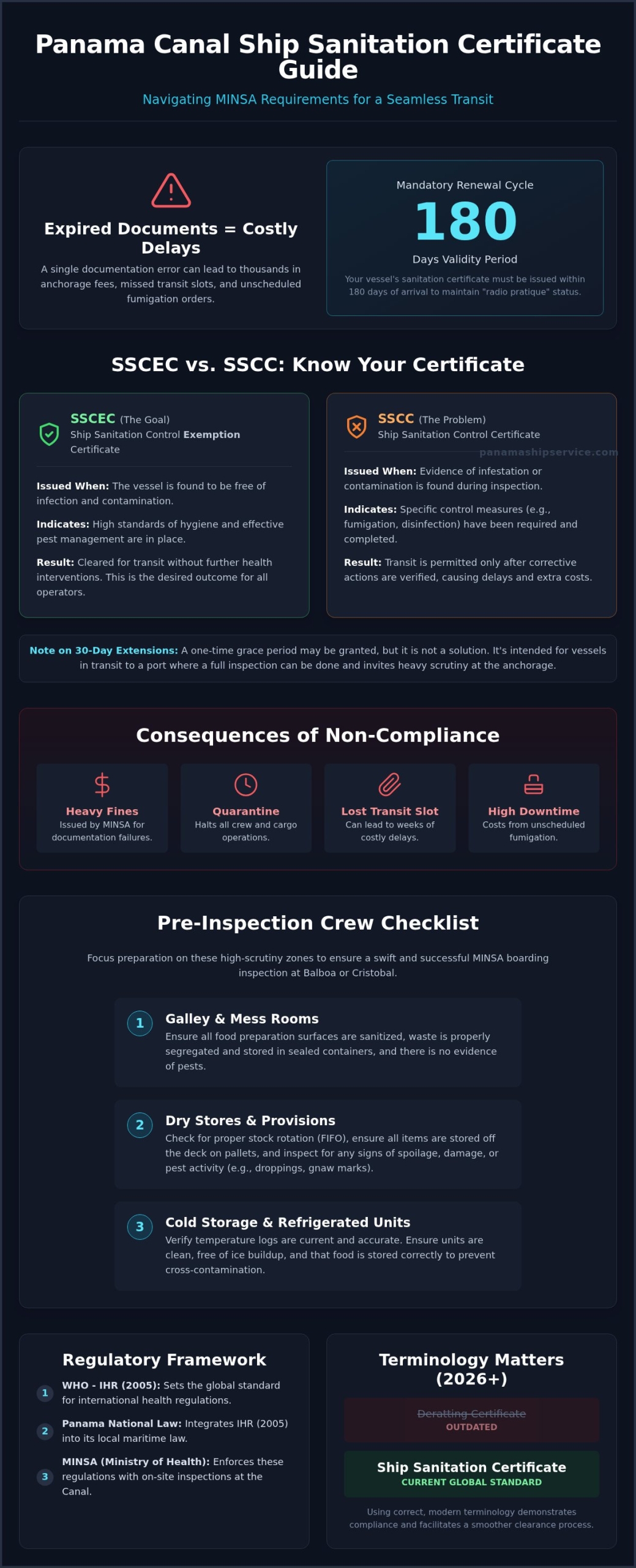
You’re likely aware of the pressure to maintain “radio pratique” while managing the transition from legacy “deratting” terms to modern Ship Sanitation Control Certificates (SSCC). The fear of an unscheduled fumigation order at Balboa or Cristobal is a valid concern for any seasoned port captain or vessel agent. Missing a transit slot because of a documentation technicality is an avoidable expense that no operator wants to explain to their stakeholders.
This guide provides the technical clarity you need to ensure your sanitation certificate remains valid and compliant with the latest 2026 Ministry of Health (MINSA) standards. We’ll break down the specific 180-day documentation timelines, the differences between SSCC and SSCEC, and provide a crew preparation checklist to guarantee a seamless entry into the Canal. By mastering these requirements, you can delegate the complexity of health compliance and focus on a successful transit.
Key Takeaways
- Verify that your vessel’s sanitation documentation was issued within 180 days of your arrival date to maintain “radio pratique” status and avoid transit delays.
- Understand the critical distinction between the Ship Sanitation Control Exemption Certificate (SSCEC) for clean vessels and the SSCC required when evidence of infestation is found.
- Master the specific deratting certificate requirements panama canal inspectors from the Ministry of Health (MINSA) enforce to ensure your paperwork is compliant before reaching the anchorage.
- Direct your crew to focus preparation on high-scrutiny zones including the galley, dry stores, and cold storage to facilitate a swift and successful boarding inspection.
- Optimize your operational budget by consolidating mandatory sanitation inspections with authorized fumigation services or mechanical ship repairs to minimize total vessel downtime.
Understanding Deratting Certificate Requirements for the Panama Canal
Compliance with the deratting certificate requirements panama canal authorities mandate is a non-negotiable prerequisite for any vessel intending to transit the waterway. The Panama Canal Authority (ACP) operates under a strict safety and health protocol to prevent the cross-continental spread of diseases and pests. While the Panama Maritime Authority (PMA) oversees the broader maritime standards, the Ministry of Health (MINSA) provides the technical inspection and certification necessary for a ship to be cleared for passage. Understanding the specific deratting certificate requirements panama canal officials enforce is vital for avoiding the Balboa anchorage bottleneck.
Failure to present valid documentation upon arrival at the Balboa or Cristobal anchorages leads to immediate operational friction. The consequences of non-compliance are severe. They include:
- Heavy administrative fines issued by MINSA.
- Mandatory quarantine periods that halt all crew and cargo operations.
- The potential loss of a reserved transit slot, leading to weeks of delay.
- High costs for unscheduled fumigation and associated vessel downtime.
In an industry where timing is synonymous with fiscal health, a single documentation error can result in significant unbudgeted expenses. Documentation errors cost money. Timing is everything here.
The Legal Framework: IHR 2005 and Panama National Law
The regulatory foundation for these inspections is the International Health Regulations (IHR 2005) established by the World Health Organization. Panama has fully integrated these global standards into its national maritime law, creating a rigorous enforcement environment. Every commercial vessel transiting the Canal must adhere to a mandatory 180-day renewal cycle for its health certification. This ensures that every ship in the system has undergone a recent, comprehensive audit of its sanitary conditions. By aligning local laws with international standards, Panama maintains a high level of biosecurity across its strategic hub.
Why Terminology Matters in 2026
In 2026, Port State Control inspections have moved entirely away from the historical “Deratting” terminology. The modern standard is the Ship Sanitation Certificate, which encompasses a broader scope of vessel hygiene beyond just rodent control. Relying on outdated forms or legacy terminology can trigger a full vessel audit. It suggests a lack of compliance with current international norms. The Ship Sanitation Control Certificate (SSCC) is the current global standard for maritime health. Using this correct terminology ensures that your vessel speaks the same regulatory language as the inspectors boarding at the anchorage, facilitating a faster and more efficient clearance process.
SSCC vs. SSCEC: Determining Your Vessel’s Certification Needs
While the term “deratting” persists in industry jargon, modern compliance relies on two distinct certificates. The Ship Sanitation Control Exemption Certificate (SSCEC) and the Ship Sanitation Control Certificate (SSCC) serve different purposes but share the same 180-day validity window. Understanding which one your vessel requires is central to meeting the deratting certificate requirements panama canal inspectors prioritize. While the documents look similar, the SSCEC indicates a vessel is free of infection, whereas an SSCC is issued only after specific control measures have been applied.
If your current certificate is nearing its expiration date, you’ll likely want to apply for a one-time, 30-day extension. This grace period is typically granted only if the vessel is in transit to a port where a full inspection can be conducted. It’s not a permanent solution. Relying on extensions without a clear inspection plan can lead to heavy scrutiny at the Balboa anchorage. Documentation errors cost money. Efficiency is the only way forward.
Criteria for an Exemption (SSCEC)
The SSCEC is the goal for most commercial operators. It proves that the vessel is maintained to a high standard of hygiene. To secure this exemption, the crew must demonstrate a proactive Integrated Pest Management (IPM) plan. Inspectors follow the guidelines found in the WHO Handbook for Inspection of Ships to verify the absence of rodents, cockroaches, and food-borne pathogens.
Key requirements for an exemption include:
- Documented evidence of regular pest control inspections and bait station monitoring.
- Sanitary food storage areas with no signs of contamination or structural gaps.
- Accurate medical logs and crew health records that show no signs of infectious disease outbreaks.
Maintaining these standards allows for a swift issuance of the 6-month exemption, keeping your transit schedule on track and avoiding the need for remedial action.
When Full Control (SSCC) is Mandatory
A Ship Sanitation Control Certificate (SSCC) becomes mandatory when an inspector finds evidence of an active infestation. This isn’t just about rodents. Significant insect populations or larvae in dry stores can trigger a control requirement. If your previous documentation has expired or if prior sanitation measures failed, MINSA will mandate a full inspection and potentially professional fumigation. A new SSCC won’t be issued until the vessel is cleared of all biological threats, a core part of the deratting certificate requirements panama canal authorities maintain.
This process often requires specialized intervention. If your vessel is identified as high-risk, you’ll need to coordinate immediate corrective actions. To simplify this process, many operators choose to coordinate sanitation with other essential services, managing both the health inspection and any necessary mechanical ship repairs simultaneously. This consolidated approach reduces the time spent at anchorage and ensures the vessel meets all PMA standards before the transit window opens.
Logistical Coordination: Securing Certificates at the Canal Entrances
Strategic coordination with the Ministry of Health (MINSA) is the only way to protect your transit slot. Your local agent acts as the primary conduit for this process, managing the communication between the vessel and health authorities. Meeting the deratting certificate requirements panama canal authorities mandate begins with a timely notification of arrival. If your documentation is nearing expiration, your agent must schedule the inspection well before the vessel reaches the “Waiting Room” at the locks to prevent costly delays.
The boarding process is systematic and fast paced. Once the vessel reaches the designated anchorage, a MINSA health officer will board to conduct a physical audit. They’ll verify the sanitary conditions of the galley, dry stores, and medical facilities while reviewing the vessel’s documentation. To facilitate a smooth inspection, the crew must have the following documents ready for immediate review:
- The Maritime Declaration of Health signed by the Master.
- Updated crew lists and vaccination records.
- Detailed cargo manifests.
- The current Ship Sanitation Control Certificate or Exemption.
Efficiency during this boarding window is paramount. Any delay in document presentation can lead the officer to extend the audit, potentially missing the window for the next transit pilot.
Balboa (Pacific Entrance) Logistics
At the Pacific entrance, health inspections typically take place at the Balboa anchorages. Turnaround times here are influenced by the volume of vessels waiting for the southbound transit. Proactive scheduling is essential to avoid being pushed to the back of the queue. Many operators find it efficient to schedule these inspections alongside mechanical ship repairs panama to maximize their time at the anchorage. This consolidated service model ensures that technical and sanitary compliance are addressed in a single window, reducing total vessel downtime before the transit begins.
Cristobal (Atlantic Entrance) Logistics
The Atlantic entrance at Cristobal presents different logistical challenges. Weather considerations, such as frequent swells in the Caribbean, can impact the safety and speed of the boarding process. Coordination with the Panama Canal Authority (ACP) is critical here. The proximity to major container terminals often allows for faster officer rotation, but the transit schedule is rigid. You must ensure all health documents meet the deratting certificate requirements panama canal inspectors look for before the pilot boards. Any delay in Cristobal ripples through the entire transit schedule, leading to missed windows and increased operational overhead. Reliable logistics management is your best defense against these risks.
Pre-Inspection Checklist: Preparing the Vessel for Success
Meeting the deratting certificate requirements panama canal inspectors enforce demands more than valid paperwork; it requires a vessel maintained in peak sanitary condition. MINSA officers conduct granular audits of high-scrutiny zones where pests or pathogens are most likely to thrive. If your crew isn’t prepared for this level of detail, you risk a failed inspection and a mandatory fumigation order that will derail your transit schedule. Preparation must be systematic and proactive.
Beyond pest control, officers evaluate your waste management and water safety protocols. You must ensure the Garbage Record Book is updated and fully compliant with MARPOL standards. Potable water tanks must have documented evidence of recent testing for chlorine levels and bacterial contaminants. A clean bridge and accommodation area are also essential, as they reflect the overall management of the vessel’s hygiene. Document everything. Inspectors value transparency and organized records.
The Galley and Food Storage Protocol
The galley is the first place an inspector will look. You must ensure all food items are stored in airtight, pest-proof containers to prevent contamination. Deep cleaning is mandatory. Grease traps and the often-overlooked areas behind heavy cooking equipment must be free of residue. Proper disposal of food waste is equally critical. Local regulations are strict about how organic waste is handled while at anchorage. If an inspector finds poorly managed waste or accessible food sources, they won’t issue an exemption certificate.
Rodent Control and Proofing
Effective rodent proofing is a core pillar of the deratting certificate requirements panama canal authorities prioritize. Crew members must verify that rat guards are correctly positioned on all mooring lines. You should also inspect the superstructure for any potential entry points. Seal cable transits and pipe penetrations with durable materials to prevent access. Health officers check for “evidence” (droppings/gnaw marks), not just live pests. Finding a single sign of rodent activity is enough to trigger a full Ship Sanitation Control Certificate (SSCC) requirement and immediate remedial action.
Medical and Logbook Readiness
Documentation is the final hurdle. The Medicine Chest Certificate must be current, and all controlled drug logs must be accurately maintained. Ensure the Maritime Declaration of Health is signed by the Master and ready for immediate presentation. To identify potential red flags before the official boarding, many operators utilize marine surveys panama for comprehensive vessel condition audits. This proactive step allows you to address compliance gaps in a controlled environment. If you need to ensure your vessel meets all standards, contact our canal transit agency team to coordinate your authorized sanitation and pest control services before arrival.
Panama Ship Service: Your Partner for Maritime Health Compliance
Meeting the deratting certificate requirements panama canal authorities enforce is a technical challenge that demands an experienced local partner. Panama Ship Service brings 20 years of specialized experience navigating the complex bureaucracy of the Panama Maritime Authority (PMA) and the Ministry of Health (MINSA). We understand that for ship operators, compliance isn’t just about paperwork; it’s about protecting the bottom line and ensuring zero transit delays. Our authorized status allows us to manage the entire health clearance process on your behalf, effectively reducing the administrative burden on your crew and shore-side management.
Our team operates with a sense of urgency that matches the high-stakes nature of the maritime industry. We provide a calm, expert presence in the potentially high-pressure environment of the Balboa and Cristobal anchorages. By delegating the complexity of sanitation compliance to us, you ensure that your vessel meets all 2026 standards without unnecessary operational friction. We focus on tangible business outcomes, specifically the reduction of overhead and the optimization of your transit schedule.
Professional Fumigation and Deratting
When an inspection identifies a need for remedial action, we provide rapid-response fumigation and pest control services for all vessel types. Our technicians utilize approved fogging, spraying, and baiting systems specifically designed for the maritime environment. These methods are highly effective against rodents and insects while adhering to strict safety protocols for the crew during and after chemical applications. Once the treatment is successfully completed, we facilitate the immediate issuance of the official certificate. This allows you to meet the deratting certificate requirements panama canal officials demand and resume your transit schedule without the risk of further detention.
The One-Stop-Shop Advantage
Operational efficiency is our primary value proposition. We specialize in consolidating essential maritime services to minimize your total time at anchorage. Instead of coordinating multiple vendors, you can manage your sanitation needs alongside mechanical ship repairs and underwater hull services through a single point of contact. This integrated model significantly reduces operational overhead and simplifies your logistical chain.
We also offer streamlined coordination for MARPOL disposal, ensuring your vessel is fully compliant with both environmental and health regulations simultaneously. Our consolidated service model is designed to handle tasks without unnecessary complication. Contact us directly for rapid quote generation and a coordinated scheduling plan that prioritizes your specific transit window.
Securing Your Transit with Expert Health Compliance
Mastering the 180-day documentation cycle and distinguishing between SSCC and SSCEC are the first steps toward a delay-free transit. A proactive crew that follows a granular pre-inspection checklist ensures that the vessel remains compliant with the latest 2026 MINSA standards. By addressing potential infestations or sanitary gaps before reaching the anchorage, you protect your schedule from unscheduled fumigation orders and administrative fines.
Navigating the deratting certificate requirements panama canal inspectors enforce is significantly easier with a reliable local partner. Panama Ship Service provides 24/7 support at both the Balboa and Cristobal anchorages to handle these complexities with precision. As a provider authorized by the Panama Maritime Authority, we specialize in integrating health inspections with MARPOL disposal and mechanical repairs to optimize your vessel’s efficiency and reduce overhead.
Request a Maritime Health Compliance Quote from Panama Ship Service today to streamline your next transit. Your operational success at the Canal is our priority; we’re ready to ensure your vessel achieves a seamless and compliant passage.
Frequently Asked Questions
Is a deratting certificate required for all ships transiting the Panama Canal?
Yes, every vessel transiting the Panama Canal is required to present a valid sanitation certificate upon arrival. While the term “deratting” is legacy, the requirement remains mandatory for all commercial and private ships. Authorities use this documentation to confirm the vessel is free of pests and infectious diseases. Failing to meet the deratting certificate requirements panama canal officials enforce will lead to immediate transit delays and potential quarantine at the anchorage.
How long is a Ship Sanitation Control Certificate (SSCC) valid for?
A Ship Sanitation Control Certificate is valid for exactly 180 days from its date of issuance. This six-month window is strictly enforced by the Panama Ministry of Health (MINSA). If your certificate expires during your voyage or shortly after arrival, you must schedule a new inspection. You should track this date carefully within your documentation management system to avoid the high costs associated with an expired certificate during the transit reservation window.
What is the difference between an SSCC and an SSCEC?
The Ship Sanitation Control Exemption Certificate (SSCEC) is issued when an inspector finds no evidence of pests or pathogens. It confirms the ship is maintained to high standards. Conversely, a Ship Sanitation Control Certificate (SSCC) is issued only after evidence of infestation is found and corrective control measures, such as fumigation, have been applied. Both documents have the same six-month validity period but reflect different sanitary statuses of the vessel at the time of inspection.
Can I extend my expired deratting certificate in Panama?
You can apply for a one-time, 30-day extension if your certificate is nearing its expiration date. This extension is typically granted only when the vessel is in transit to a port where a full inspection can be conducted. It is not a permanent solution for non-compliance. You must coordinate this request through your local agent and the Ministry of Health (MINSA) to ensure the extension is legally recognized before the vessel reaches the canal locks.
What happens if a health officer finds evidence of pests on my ship?
If an inspector finds evidence of rodents or insects, the vessel’s transit is immediately suspended. You will be ordered to undergo professional fumigation performed by an authorized service provider. Once the treatment is complete and the vessel is cleared, a Ship Sanitation Control Certificate (SSCC) will be issued. This process often results in the loss of your transit slot and significant anchorage fees, making pre-arrival crew inspections a vital operational priority.
How long does a ship sanitation inspection typically take at the Panama Canal?
A standard sanitation inspection usually takes between one and three hours to complete. This duration depends on the size of the vessel and the readiness of the crew and documentation. If the galley, dry stores, and medical logs are organized for immediate review, the process is significantly faster. Delays occur when officers must wait for access to high-scrutiny zones or when documentation is incomplete, which can push the boarding window past the scheduled transit time.
Which authority issues the sanitation certificate in Panama?
The Ministry of Health (MINSA) is the primary authority responsible for conducting inspections and issuing sanitation certificates in Panama. While the Panama Maritime Authority (PMA) oversees general maritime standards, MINSA health officers are the specific individuals who board the vessel at the Balboa or Cristobal anchorages. Your local agent coordinates the boarding schedule with MINSA to ensure that all deratting certificate requirements panama canal authorities mandate are met before the pilot boards for transit.
Can professional fumigation be performed while the ship is at anchorage?
Yes, professional fumigation can be performed while the vessel is at the Balboa or Cristobal anchorages. Authorized companies use specialized methods like fogging or baiting systems that are safe for marine environments. During the application, specific safety protocols must be followed to protect the crew. Once the service is completed and verified, the health officer can issue the necessary certification, allowing the vessel to proceed with its scheduled transit without further delay.