
Did you know a single layer of moderate marine fouling can drain $1.2 million from your annual bottom line? For vessel operators in 2026, the debate over dry dock vs in-water hull cleaning is no longer just about maintenance; it’s a high-stakes financial decision. You’re likely feeling the pressure of rising fuel costs and high daily hire rates that make every day of downtime a massive liability. Maintaining class compliance while keeping your vessel in service requires a precise, data-driven strategy.
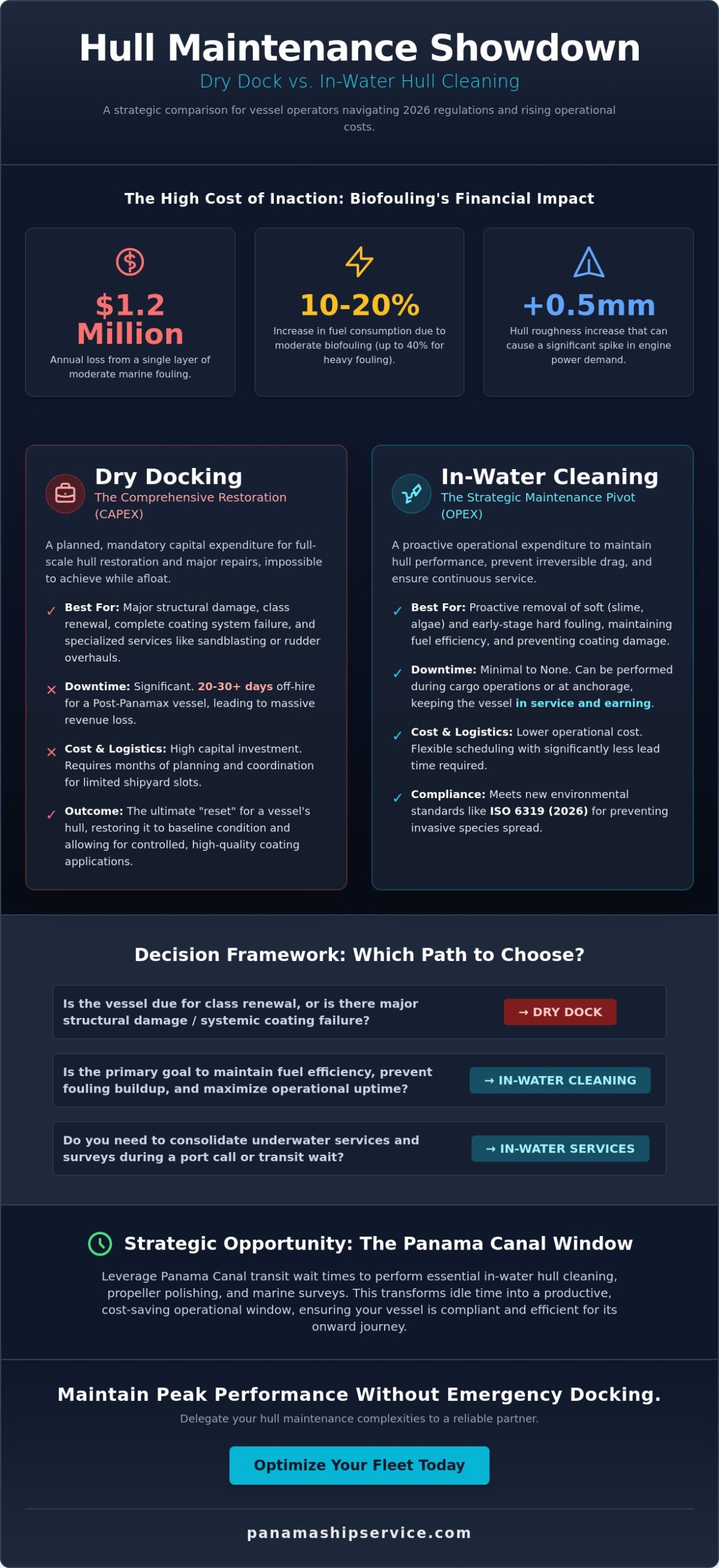
We understand that pulling a ship out of service for repairs leads to significant lost revenue and schedule disruptions. This guide compares the operational benefits and strategic advantages of both methods to help you optimize your fleet’s performance. You’ll learn how to leverage the new ISO 6319 standards and Panama Canal transit windows to reduce fuel consumption by 10-20%. We provide a clear analysis of technical efficiency and environmental regulations to ensure your vessel stays compliant and profitable. By delegating these complexities to a reliable partner, you can maintain peak performance without the need for emergency docking.
Key Takeaways
- Identify how hydrodynamic drag from biofouling impacts your bottom line and why proactive management is essential for 2026 fuel efficiency.
- Evaluate dry docking as a strategic CAPEX investment for full structural restoration and specialized services like sandblasting.
- Determine the best path for your fleet by comparing the costs and operational benefits of dry dock vs in-water hull cleaning.
- Master a decision framework that accounts for coating types and fouling severity to prevent unnecessary hull damage during maintenance.
- Learn to leverage Panama Canal transit wait times to consolidate underwater services and marine surveys into a single, efficient operational window.
Understanding Biofouling: The Financial Impact on Modern Shipping
Biofouling is a multi-stage biological process that directly compromises vessel speed-power performance. Technically defined as biological fouling (biofouling), it involves the accumulation of microorganisms, plants, and animals on submerged structures. This buildup creates a rough surface that disrupts the laminar flow of water around the hull. Even a microscopic layer of slime increases friction. For commercial operators, these small changes result in massive operational overhead. The correlation between hull roughness and hydrodynamic drag is direct; as the surface becomes uneven, the engine must consume more energy to maintain the same speed.
Data from the International Maritime Organization (IMO) indicates that a heavily fouled hull can increase a ship’s fuel consumption by 20% to 40%. Even moderate growth carries a steep price. A 0.5mm increase in hull roughness can lead to a significant spike in fuel consumption. Estimates show that a single layer of moderate marine fouling on a large vessel can cause a 10.3% increase in fuel use, costing approximately $1.2 million annually. When evaluating dry dock vs in-water hull cleaning, you have to weigh these daily fuel penalties against the cost of maintenance to protect your margins.
The Stages of Biofouling: From Slime to Barnacles
Biofouling begins within minutes of a vessel entering the water. It starts with soft fouling, such as biofilms and algae. While these may seem minor, they create a deceptive amount of friction that forces engines to work harder. If left untreated, this progresses to hard fouling. This includes calcareous growth like barnacles and tubeworms. Hard fouling is far more destructive. It can physically bond to the hull, making removal difficult and increasing the risk of coating damage. Early intervention through in-water cleaning prevents this “irreversible” drag and protects your hull’s integrity.
Environmental Compliance and Invasive Species
Regulations are tightening globally. As of March 2026, the new ISO 6319 standard provides a framework for environmentally sound in-water cleaning operations. This standard focuses on preventing the spread of invasive aquatic species and reducing greenhouse gas emissions. In the Panama Canal region, the “OP Notice to Shipping N-1-2026” outlines specific vessel requirements. Local authorities and international ports now enforce strict rules regarding hull discharge. Managing biofouling is no longer just about fuel; it’s about maintaining class compliance. Choosing the right approach in the dry dock vs in-water hull cleaning debate ensures you meet these 2026 environmental standards while keeping your vessel in service.
Dry Docking: The Comprehensive Approach to Hull Restoration
Dry docking is a mandatory regulatory requirement that serves as the ultimate reset button for a ship’s hull. In the strategic comparison of dry dock vs in-water hull cleaning, docking is a planned capital expenditure (CAPEX) that allows for restoration levels impossible to achieve while afloat. It’s non-negotiable for major damage, class renewal, or when the existing coating system has reached total failure. While in-water services maintain efficiency, only a dry dock allows for the complete removal of decades of paint buildup and systemic corrosion.
The logistical burden of a shipyard visit is substantial. For a Post-Panamax container ship, the off-hire period typically spans 20 to 30 days. This doesn’t include the time lost in transit to the yard or the potential for schedule creep. Because shipyard slots are limited, operators must manage these schedules with extreme precision to avoid compounding revenue losses. You can’t simply decide to dock a vessel on short notice; it requires months of planning and coordination with classification societies.
Major Mechanical and Steel Repairs
Certain tasks require a dry environment to meet strict technical specifications. This includes comprehensive mechanical ship repairs such as rudder overhauls, tailshaft removals, and propeller boss cap fin installations. Steel fabrication and internal tank cleaning also benefit from a dry environment where gas-freeing and welding can proceed without the thermal cooling effects of surrounding water.
Coating application is another critical factor. Achieving the correct Dry Film Thickness (DFT) requires controlled atmospheric conditions and a substrate free of moisture. While the industry standard for in-water cleaning ensures safe maintenance between dockings, only a dry dock allows for full grit blasting to Sa 2.5 standards. This level of surface preparation is essential for the application of advanced foul-release coatings that can last five years or more. If your hull coating has degraded to the point of “orange peel” roughness, a full recoat in dock is the only way to restore your vessel’s original hydrodynamic profile.
Class Surveys and Regulatory Milestones
Regulatory compliance drives the docking cycle. Members of the International Association of Classification Societies (IACS) require Special Surveys every five years, with intermediate surveys every 30 to 36 months. These milestones involve thickness gauging and structural integrity assessments that are only possible when the hull is dry and accessible. Operators must use these windows to address all underwater systems, from sea chests to bow thrusters.
While it’s a high-pressure environment, it’s also an opportunity to consolidate repairs. If you’re planning your next regulatory milestone, it’s wise to coordinate with a partner who can manage underwater hull services leading up to the event to keep your fuel performance stable. This proactive approach ensures you reach the shipyard without having wasted millions in excess fuel during the preceding years.
In-Water Hull Cleaning: The Strategic OPEX Pivot
While dry docking is a regulatory necessity, in-water hull cleaning serves as a proactive tool to manage operational expenditure (OPEX) and extend intervals between shipyard visits. In the tactical debate of dry dock vs in-water hull cleaning, the latter offers a significant advantage by maintaining hull smoothness without taking the vessel off-hire. Modern technology has moved beyond basic scrubbing; operators now choose between hydraulic brush systems and advanced cavitation cleaning. Hydraulic brushes are highly effective for removing established biofouling, while cavitation cleaning uses high-pressure micro-bubbles to collapse against the hull, lifting growth without abrasive contact.
Operational efficiency is the primary driver here. You can schedule these services during cargo operations at port or while the vessel is at a canal anchorage. This eliminates the downtime associated with moving to a shipyard. Robotic hull cleaning systems protect expensive anti-fouling coatings by applying precise, consistent pressure that removes growth without the aggressive, uneven wear often caused by manual scrubbing. This “grooming” approach keeps the coating intact and functioning as designed for its full service life.
Propeller Polishing and Underwater Inspections
The return on investment for propeller polishing is often the highest of any maintenance task. Even though the surface area is relatively small, a rough propeller significantly increases fuel consumption. Integrating underwater hull services with high-definition CCTV inspections allows for real-time assessments of the vessel’s condition. These inspections can support an Underwater Inspection in Lieu of Dry Docking (UWILD), providing class-approved evidence that the hull remains seaworthy without requiring an immediate haul-out.
Cost-Benefit of Frequent In-Water Maintenance
The financial logic is straightforward. The cost of a single in-water clean is a fraction of the fuel savings realized over the following six months. By “grooming” the hull before soft slime transitions into hard, calcareous growth, you prevent the permanent coating damage that hard fouling causes. This proactive management reduces the fleet’s carbon footprint and ensures you don’t arrive at the Panama Canal with a 40% fuel penalty due to drag. Regular maintenance ensures that when you finally face the dry dock vs in-water hull cleaning decision at the five-year mark, your hull is in the best possible condition for a standard recoat.
Decision Framework: Dry Dock vs. In-Water Cleaning
Choosing between a scheduled haul-out and a submerged service requires a rigorous technical assessment. You shouldn’t make the dry dock vs in-water hull cleaning decision based on price alone. Instead, evaluate the current state of your hull coating. Self-polishing antifouling coatings rely on controlled depletion, while foul-release systems use low surface energy to prevent adhesion. If you apply aggressive brush systems to a foul-release coating, you’ll strip the silicone layer and ruin a multi-million dollar investment. You need to know exactly what is on your hull before the divers enter the water.
Time is your most expensive commodity. An in-water clean typically takes 24 to 48 hours and occurs while you’re loading cargo or waiting for a canal transit. In contrast, a dry dock requires 10 to 21 days of off-hire time, plus the logistical nightmare of shipyard availability. Financial modeling must balance immediate fuel savings against long-term asset preservation. If your fuel consumption has spiked by 20% according to recent IMO data, waiting six months for a scheduled dry dock is fiscally irresponsible. Proactive maintenance pays for itself through reduced daily burn rates.
When to Choose In-Water Cleaning
In-water cleaning is the optimal choice when your vessel is mid-cycle between surveys. Following the new ISO 6319 standards published in March 2026, these operations are now more regulated and environmentally sound than ever. If performance monitoring shows rising exhaust temperatures or a drop in speed at a fixed RPM, biofouling is the likely culprit. This method is highly effective when growth is primarily soft, such as slime or algae. These can be removed without damaging the underlying paint system. Transiting a global hub like the Panama Canal provides a perfect opportunity to deploy expert divers without deviating from your commercial route.
When Dry Docking is Mandatory
There are scenarios where submerged services aren’t enough. Dry docking becomes mandatory when your antifouling coating reaches its end-of-life, which is usually every three to five years. You’ll also need a dry environment if there are visible signs of corrosion or structural damage that require mechanical ship repairs panama. Class requirements for internal sea valve overhauls and comprehensive thickness gauging also demand a dry hull. Don’t risk a patch job underwater if the structural integrity of the vessel is at stake. If you’re unsure which path fits your current schedule, contact us for a professional assessment of your underwater hull services needs to ensure your fleet stays efficient.
Strategic Hull Maintenance at the Panama Canal
Panama serves as the world’s most critical maritime crossroad, offering a unique logistical advantage for operators weighing the choice of dry dock vs in-water hull cleaning. You don’t have to deviate from your primary trade routes to reach a specialized shipyard. Instead, you can utilize mandatory transit wait times to perform essential maintenance. This preserves your commercial schedule and eliminates the massive fuel costs associated with unscheduled deviations. Panama Ship Service provides expert coordination of underwater and mechanical teams to ensure your vessel remains at peak efficiency without the overhead of a full shipyard visit.
Logistical efficiency is maximized when you treat the canal as a strategic service hub. By performing maintenance at the entrance or exit of the canal, you turn idle time into a productive operational window. This approach is particularly effective in 2026, as fuel prices and environmental regulations continue to tighten. Choosing to clean your hull here ensures your vessel is in optimal condition for the next leg of its voyage, whether that involves crossing the Pacific or heading toward the Atlantic hubs. It’s a pragmatic solution for modern fleet managers who prioritize schedule integrity.
Consolidating Services for Maximum Efficiency
Efficiency increases when you group multiple technical requirements into a single service window. While your vessel is at the Balboa or Cristobal anchorages, you can combine hull cleaning with marine surveys panama to verify class compliance. This “one-stop-shop” approach allows for simultaneous mechanical repairs and underwater inspections. You can also manage MARPOL disposal panama during the same call. Using a single local agency for all technical needs reduces the administrative burden on your shore-side staff. It ensures a streamlined flow of communication and clear accountability for every task performed on your hull.
Minimizing Transit Delays
Time management is critical when dealing with the Panama Canal Authority (ACP). Our 24/7 emergency response teams prevent minor technical issues from escalating into costly canal delays. We coordinate directly with the ACP to secure permits for safe anchorage work, ensuring all operations comply with the “OP Notice to Shipping N-1-2026.” Local expertise is vital for navigating Panama’s unique maritime regulations and environmental standards, such as the ISO 6319 framework. By managing the complexities of dry dock vs in-water hull cleaning within this strategic hub, you maximize your vessel’s uptime. You delegate the operational pressure to a seasoned veteran while your fleet maintains its competitive edge. This proactive stance ensures you don’t just transit the canal; you optimize it for long-term profit.
Optimizing Fleet Performance for the 2026 Maritime Landscape
Managing biofouling effectively is a critical component of fiscal responsibility in modern shipping. You’ve seen how the strategic choice between dry dock vs in-water hull cleaning impacts both your immediate fuel burn and your long-term asset value. While dry docking remains the gold standard for full restoration and mandatory class surveys, proactive in-water grooming keeps your vessel efficient between shipyard visits. By leveraging the strategic hub of the Panama Canal, you can eliminate route deviations and maintain peak hydrodynamic performance throughout the year.
Panama Ship Service provides the technical expertise and local coordination required to simplify your maintenance schedule. With 24/7 emergency repair availability and class-approved underwater surveyors, we ensure your vessel meets 2026 standards without unnecessary downtime. Our strategic presence at both Balboa and Cristobal ports allows for seamless service integration during your transit window. Optimize your vessel’s performance—Contact Panama Ship Service for a comprehensive hull maintenance quote. We’re ready to help you navigate the complexities of hull management with precision and reliability.
Frequently Asked Questions
Is in-water hull cleaning as effective as dry docking for fuel efficiency?
In-water cleaning is highly effective for maintaining hydrodynamic efficiency between scheduled shipyard visits. While it cannot match the total surface restoration of a dry dock sandblast, it prevents the 20% to 40% fuel consumption spikes caused by heavy biofouling. It’s a tactical maintenance choice in the dry dock vs in-water hull cleaning debate that keeps your daily operating costs manageable without taking the vessel off-hire.
Can in-water cleaning damage the anti-fouling paint on my ship?
Improper cleaning techniques can damage coatings, but modern robotic systems and cavitation technology minimize this risk. These systems apply consistent pressure to remove slime and barnacles without stripping the underlying anti-fouling layers. You must verify that the diver’s equipment matches your specific coating type. This is especially true for delicate foul-release silicone systems that require non-abrasive handling.
How often should a commercial vessel undergo in-water hull cleaning?
Commercial vessels typically require cleaning every six to twelve months depending on their operating environment and idle times. Ships transiting tropical waters like the Panama Canal experience accelerated growth due to higher water temperatures. Monitoring your speed-power performance data will indicate exactly when drag begins to impact your fuel efficiency and signals the need for a submerged clean.
Does the Panama Canal Authority allow hull cleaning during transit or at anchorage?
The Panama Canal Authority allows hull cleaning at designated anchorages in Balboa and Cristobal. You must obtain specific permits and comply with the “OP Notice to Shipping N-1-2026” guidelines. Cleaning is not permitted during the actual transit through the locks. We coordinate these permits to ensure work is completed safely while your vessel waits for its scheduled transit slot.
What is a UWILD survey, and can it replace a dry dock inspection?
A UWILD (Underwater Inspection in Lieu of Dry Docking) is a class-approved survey that can extend the interval between mandatory dry docks. It uses divers and high-definition CCTV to inspect structural integrity while the ship is afloat. While highly effective for intermediate surveys, it doesn’t replace the comprehensive 5-year special survey required by most classification societies for full hull and internal inspections.
What happens to the removed biofouling during an in-water clean?
Modern environmental regulations, including the ISO 6319 standard published in March 2026, require the capture of removed biofouling. This prevents the spread of invasive aquatic species in local ecosystems. Advanced cleaning systems now include suction and filtration units that collect debris for safe onshore disposal. This ensures your vessel remains compliant with international and local Panama Canal environmental laws.
How much fuel can I realistically save by cleaning my hull in Panama?
You can realistically reduce fuel consumption by 10% to 20% by removing moderate fouling before a long voyage. Given that a single layer of marine growth can cost a large vessel $1.2 million annually, the return on investment for a clean in Panama is almost immediate. This makes the dry dock vs in-water hull cleaning decision a simple calculation of fuel savings versus service cost.
Can mechanical repairs be performed underwater in Panama?
Our teams perform various mechanical repairs underwater, including propeller polishing, rudder inspections, and seal replacements. These services occur at the Balboa or Cristobal anchorages while the vessel is in queue. This allows you to address technical deficiencies and maintain class compliance without the high costs and significant downtime associated with an emergency dry dock.