
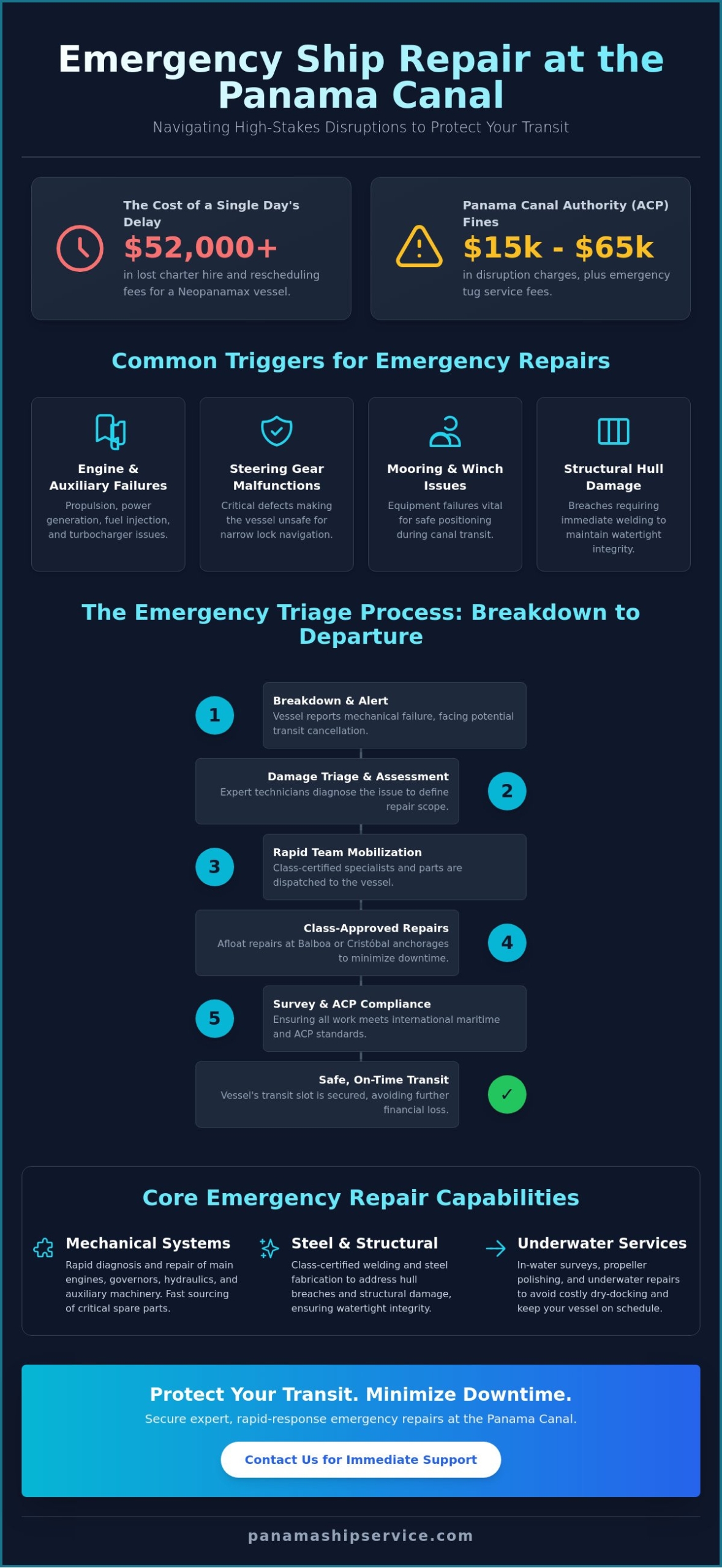
A single day of delay at the Panama Canal can cost a Neopanamax vessel over $52,000 in lost charter hire and rescheduling fees. When a mechanical failure strikes just hours before your scheduled slot, the financial impact escalates quickly through disruption charges and emergency tug costs. Securing reliable emergency ship repair panama is the only way to protect your transit window and avoid these massive overhead losses.
You know that navigating the complex ACP regulatory requirements and sourcing class-approved technicians in a foreign hub is a high-stakes challenge. We understand the urgency of your situation and the need for a partner who handles technical complexity without delay. This article explains how to manage critical vessel breakdowns with expert coordination and rapid technical repair strategies designed to minimize transit disruptions. You’ll learn the steps for successful class survey completion and how to mobilize technical teams to ensure your vessel meets all Panama Maritime Authority standards for a safe, on-time transit.
Key Takeaways
- Navigate Panama Canal Authority (ACP) emergency protocols to secure your transit slot and mitigate high-impact disruption penalties.
- Discover technical strategies for emergency ship repair panama, focusing on rapid mobilization for mechanical systems and structural hull integrity.
- Compare the advantages of afloat repairs at Balboa and Cristóbal anchorages to reduce port time and maintain your sailing schedule.
- Coordinate with class-certified specialists to manage the damage triage process and ensure all repairs meet strict international maritime standards.
- Optimize operational efficiency by integrating repairs with essential services like marine surveys and MARPOL disposal under a single coordination point.
The High Stakes of Emergency Ship Repairs at the Panama Canal
Every minute counts when a vessel approaches the Panama Canal. A mechanical failure in this corridor isn’t just a technical hurdle; it’s a financial emergency. Because the canal operates on a strict, pre-booked scheduling system, any deviation from your assigned slot triggers a chain reaction of penalties and operational hurdles. Securing emergency ship repair panama is the difference between a minor delay and a total operational catastrophe.
Panama serves as a strategic hub for rapid response due to its unique infrastructure. The proximity of the Balboa and Cristóbal ports allows for the swift mobilization of technical teams and the sourcing of critical spare parts that might be unavailable in other regional ports. Common triggers for emergency calls include:
- Main Engine and Auxiliary Failures: Issues that compromise the vessel’s propulsion or power generation.
- Steering Gear Malfunctions: Critical defects that make a vessel unsafe for the narrow navigation required in the locks.
- Structural Hull Damage: Incidents requiring immediate welding or steel fabrication to maintain watertight integrity.
- Mooring and Winch Issues: Failures in equipment necessary for the safe positioning of the ship during transit.
Understanding the Cost of Vessel Downtime
The financial impact of vessel downtime panama canal is staggering. For a Neopanamax vessel, a single day of delay can result in over $52,000 in lost charter hire and rescheduling fees. This figure doesn’t even account for the “ripple effect” on the global supply chain. When a ship misses its window, it’s not just one transit that’s affected; it’s every subsequent port call, cargo commitment, and fuel calculation for the remainder of the voyage. Rapid mobilization of emergency ship repair panama specialists is the only way to mitigate these escalating costs.
Regulatory Pressure and ACP Compliance
The Panama Canal Authority (ACP) maintains zero tolerance for vessels that pose a risk to canal operations. If a ship is declared “Not Under Command” (NUC) due to mechanical failure, it’s subject to mandatory reporting procedures and immediate intervention. The ACP can impose disruption charges ranging from $15,000 for smaller vessels to $65,000 for high-impact disruptions. Additionally, you may face emergency tug service fees that quickly inflate the total bill. Local expertise is vital here. A partner who understands ACP requirements ensures that repairs meet the necessary standards, preventing indefinite delays and ensuring a smooth transition back into the transit queue.
Core Emergency Repair Capabilities: Mechanical, Steel, and Underwater
Rapid response in the Panama maritime hub requires a multi-disciplinary approach. When a vessel is flagged for deficiencies under Panama Canal Authority (ACP) regulations, technical teams must mobilize immediately to restore operational status. Effective emergency ship repair panama involves specialized technicians capable of working under extreme time pressure to meet class requirements. This isn’t just about fixing a part; it’s about ensuring the vessel remains compliant with international safety standards while maintaining its transit slot.
Mechanical and Engine Room Emergencies
Engine room failures are the most frequent cause of transit cancellations. Technicians must quickly diagnose fuel injection issues, governor malfunctions, or turbocharger failures under tight time constraints. Beyond the main engine, hydraulic systems for winches, cranes, and steering gear must function perfectly for a safe transit. Sourcing critical spare parts is often the biggest bottleneck. A robust local network allows for the rapid acquisition of components, reducing the time spent waiting at anchorage. Mechanical ship repairs must be class-approved to ensure the vessel maintains its safety certification and meets the rigorous standards required for lock navigation. This certification process is a critical step that many operators overlook until it causes a delay.
Steel Fabrication and Structural Integrity
Hull breaches or internal structural damage require immediate attention from certified welders. Emergency steel fabrication often involves plate replacements, pipework repairs, and valve replacements while the vessel stays afloat. These interventions are designed to restore structural integrity without the need for immediate dry-docking. Technicians utilize specialized welding procedures that meet the standards of major classification societies like ABS, DNV, or Lloyd’s Register. This level of precision ensures that the repair is not just a temporary fix but a durable solution that satisfies port state control and canal inspectors alike.
Underwater Emergency Services
Underwater interventions are critical for vessels experiencing propeller entanglements or significant hull fouling. Deploying professional dive teams for immediate inspections can identify the root cause of maneuverability issues before they lead to a canal rejection. Underwater hull services, including hull cleaning and propeller polishing, are essential for maintaining the transit speed required by the ACP. Class-approved UWILD (Underwater Inspection in Lieu of Dry-docking) surveys allow owners to assess damage and verify repair quality while the ship is at anchorage. For operators managing tight schedules, coordinating these technical services through a single provider like Panama Ship Service ensures that all repairs align with canal transit windows.
Afloat vs. Anchorage Repairs: Choosing the Right Strategy
Selecting the optimal location for emergency ship repair panama is a tactical decision that directly impacts your bottom line. Ship owners must weigh the speed of anchorage interventions against the heavy-lifting capabilities of terminal berths. Because the canal environment is prone to significant transit delays caused by external factors like water levels and traffic congestion, choosing the wrong repair strategy can lead to missed slots and mounting penalties. Efficiency depends on matching the technical requirement with the right logistical setting.
Afloat repairs are the preferred choice for most transit-related emergencies. These repairs occur while the vessel is at anchor, allowing the ship to remain outside the formal port system and avoid expensive wharfage fees. In Panama, the Balboa anchorage on the Pacific side and the Cristóbal anchorage on the Atlantic side serve as the primary zones for these operations. The main advantage is speed; technicians can board via launch and begin work immediately without the bureaucratic delays often associated with port entry and berthing.
Afloat Repair Logistics
Terminal and Berth-Side Repairs
While anchorage repairs are faster for minor fixes, terminal-side repairs are mandatory for major structural failures or heavy component replacements. If your vessel requires the use of shore-side cranes for engine block sections or large-scale steel fabrication, moving to a berth is unavoidable. Terminal access provides a more controlled environment with direct access to heavy fabrication facilities and high-capacity power supplies. However, this comes with increased costs. You must account for terminal wharfage, pilotage, and tug assistance for the shift. Security and customs protocols are also more stringent at the berth, which can actually streamline the delivery of large-scale emergency ship repair panama spare parts that arrive via air freight. A cost-benefit analysis usually reveals that while terminal fees are higher, the access to specialized infrastructure can reduce the total repair hours for catastrophic failures.
The Emergency Triage Process: From Breakdown to Departure
Successful emergency ship repair panama requires a disciplined triage process that begins the moment a failure is reported. Once you notify your technical partner, experts must evaluate the damage to determine if the vessel can maintain its transit slot or if it requires immediate removal to an anchorage. This assessment involves reviewing engine logs, diagnostic data, and photographic evidence of structural damage to build a precise execution plan. Prompt coordination with the Panama Canal Authority (ACP) and port officials is essential to secure the necessary repair permits without triggering additional disruption charges.
Technical execution requires constant supervision. Specialists must work around the clock to meet the strict deadlines imposed by the canal scheduling system. The process concludes only after a final inspection and class approval. Once a class-certified specialist verifies the repair, the vessel receives the official clearance needed to proceed with its transit. This systematic approach ensures that every technical fix meets international standards while minimizing the risk of a secondary failure during lock navigation. The Panama Maritime Authority enforces these standards strictly, requiring that any identified deficiency is rectified within a set timeframe to maintain safety compliance.
Rapid Assessment and Mobilization
To receive an actionable response, owners must provide comprehensive technical data, including machinery specifications and failure descriptions. Maintaining 24/7 communication channels through WhatsApp or email ensures that technical teams can adjust mobilization plans as new information becomes available. A comprehensive ship repair quote panama must include mobilization timelines to ensure all stakeholders understand the window for technical intervention. Rapid response is the standard in this hub, where even a few hours of delay in mobilization can result in a missed slot and the loss of a significant auction investment.
Sourcing Spares and Logistics
Navigating Panama customs for “Ship Spares in Transit” is a critical logistical hurdle for any emergency. While international air freight is an option, utilizing local ship supplies panama canal networks often provides a faster route to critical components like valves, seals, and standard mechanical parts. This localized sourcing is vital for reducing lead times and keeping the repair on schedule. Technical stops also provide an efficient window to coordinate crew changes, ensuring that your personnel rotation stays on track despite the mechanical setback. For immediate assistance with technical triage and logistics coordination, contact the experts at Panama Ship Service to protect your transit window and minimize downtime.
Panama Ship Service: Integrated Emergency Response
Managing multiple vendors for technical repairs, waste disposal, and certification during a canal transit creates unnecessary risk. Panama Ship Service provides a comprehensive “one-stop-shop” model that streamlines every aspect of emergency ship repair panama. By consolidating technical execution with agency services and logistical support, we eliminate the communication gaps that often lead to missed transit slots. Our presence at both the Pacific and Atlantic entrances ensures that your vessel receives immediate attention regardless of its position in the queue.
Operational efficiency in Panama is not just about fixing an engine; it’s about navigating the intersecting requirements of the ACP and international maritime law. We’ve built a proven track record of minimizing delays for global operators by managing the entire lifecycle of an emergency stop. From the moment our technicians board at the anchorage to the final clearing of the vessel for transit, every action is synchronized to protect your schedule and reduce overhead costs. You don’t have to coordinate with different entities when a single partner can manage the technical, regulatory, and logistical load.
Repair and Compliance Synergy
Technical repairs often generate secondary operational needs that can stall a departure if not managed proactively. For instance, engine room interventions frequently require the handling of sludge, oily water, or contaminated bilge. Utilizing integrated MARPOL disposal panama services during the repair window ensures that environmental compliance doesn’t become a separate bottleneck. Similarly, we coordinate independent marine surveys panama to certify repair quality and satisfy class requirements immediately upon completion. This synergy simplifies billing and coordination through a single point of contact, allowing your crew to focus on navigation while we handle the regulatory complexity.
Contact Our 24/7 Emergency Team
When a critical failure occurs, time is your most expensive commodity. To initiate an immediate repair request, contact our emergency response team with your vessel’s current position, technical specifications, and a detailed description of the deficiency. This information allows us to deploy the right technicians and equipment to the Balboa or Cristóbal anchorages without delay. We’re committed to safety, quality, and operational efficiency, providing the reliable technical support needed to navigate the challenges of the Panama Canal. Don’t let a mechanical breakdown jeopardize your transit; reach out to our specialists today for a rapid, class-approved solution that keeps your fleet moving.
Secure Your Transit with Expert Technical Support
Navigating a mechanical failure at the Panama Canal requires more than just technical skill; it demands a strategic partner who understands the high stakes of canal scheduling. You’ve seen how choosing between afloat and anchorage repairs can save thousands in port fees and how a disciplined triage process ensures your vessel meets strict Panama Maritime Authority standards. By integrating technical fixes with essential compliance services, you protect your fleet from the ripple effects of global supply chain disruptions.
Our team provides the reliable, 24/7 emergency ship repair panama services needed to keep your operations on track. We deliver ACP-compliant coordination, class-certified mechanical and steel technicians, and full MARPOL and survey integration to simplify your technical stops. Don’t let a breakdown jeopardize your transit slot or result in massive financial penalties. Contact Panama Ship Service for 24/7 Emergency Repairs and ensure your vessel returns to sea with minimal delay and maximum safety. We are ready to mobilize immediately to support your success.
Frequently Asked Questions
How quickly can a repair team be mobilized in Panama?
Technical teams can typically be mobilized within two to four hours of notification, depending on the vessel’s location and the specific repair requirements. Rapid deployment to the Balboa or Cristóbal anchorages is standard to ensure that assessment and triage begin immediately. This speed is vital for vessels attempting to preserve their scheduled transit slots and avoid the high costs of canal delays. Prompt mobilization allows for a faster return to operational status.
Can emergency repairs be performed while the vessel is at the Panama Canal anchorage?
Yes, most emergency ship repair panama interventions are performed at the Balboa or Cristóbal anchorages while the vessel remains afloat. This strategy allows technical teams to board via launch and execute mechanical, steel, or underwater repairs without the need for formal port entry. Performing work at anchorage minimizes wharfage fees and provides the flexibility needed to resume transit as soon as class approval and ACP clearance are secured.
What classification societies do your technicians work with?
Technicians work with all major IACS classification societies, including ABS, DNV, Lloyd’s Register, and Bureau Veritas. Every repair is executed according to class-approved procedures to ensure the vessel maintains its safety certification. Technical supervisors coordinate directly with class surveyors on the ground in Panama to verify repair quality. This collaboration is essential for the immediate issuance of the necessary clearance documents required for a safe canal transit.
Is it possible to clear spare parts through Panama customs on weekends?
Clearing spare parts through Panama customs on weekends is possible through specialized protocols managed by authorized maritime agents. While standard administrative offices may have limited hours, emergency logistics channels for “Ship Spares in Transit” remain operational to support critical vessel needs. It’s essential to coordinate with your agent to ensure all documentation is submitted in advance. This proactive approach helps expedite the delivery of critical mechanical components to the vessel.
What are the ACP requirements for a vessel that breaks down during transit?
The Panama Canal Authority (ACP) requires immediate notification of any mechanical failure that affects a vessel’s maneuverability. Vessels declared “Not Under Command” (NUC) are subject to mandatory tug assistance and disruption charges, which can range from $15,000 to $65,000 depending on the impact. Compliance with ACP safety regulations is non-negotiable. You must demonstrate that all repairs are completed and certified by a class surveyor before the vessel is cleared to proceed.
Do you provide 24/7 emergency underwater repair services?
Professional dive teams are available 24/7 for emergency underwater hull services, including inspections, propeller polishing, and entanglement removal. These teams use specialized equipment to operate in the anchorage zones at any time of day or night. Rapid underwater intervention is often required to resolve maneuverability issues or to perform UWILD surveys. These surveys allow owners to assess structural damage and verify hull integrity without the need for expensive dry-docking.
How do you handle MARPOL waste generated during an emergency repair?
All MARPOL waste generated during an emergency repair, such as oily rags, sludge, or bilge water, is handled through integrated disposal services. Technical teams coordinate the collection and transport of waste to certified processing facilities in accordance with international environmental regulations. This integrated approach ensures that the vessel remains compliant with both local Panama laws and global MARPOL standards. Managing waste during the repair window prevents secondary delays during the transit clearance process.
Can you coordinate with the Panama Canal Authority for transit rescheduling?
Technical partners coordinate with the Panama Canal Authority and port officials to manage transit rescheduling following a mechanical failure. While the ACP manages slot allocations strictly, having a partner who understands the regulatory framework helps in presenting the technical status of the vessel accurately. This coordination is essential for minimizing disruption penalties and securing the earliest possible slot once the vessel is cleared. Effective communication with the ACP is vital for protecting your operational schedule.