
What if the biggest repair delay happens before a technician even starts work? During a Panama Canal transit, limited time makes unclear scope, missing vessel information, and late coordination costly in lost schedule flexibility. Knowing how to expedite ship repairs starts with closing those avoidable gaps before the vessel arrives.
Repair planning can be demanding when technical needs, personnel, and supporting services must align around a transit schedule. A clear request gives the repair team a practical starting point and reduces back-and-forth as plans take shape.
This guide explains what to include in a repair request, how to describe the work and share relevant vessel details, and how to coordinate repairs with personnel and related services. Panama Ship Service supports vessels on both sides of the Canal with mechanical ship repairs and related marine services. Clear communication and early coordination help your team make better use of the available repair window while maintaining appropriate technical oversight.
Key Takeaways
- Separate observed symptoms from suspected causes so the repair scope starts with clear, useful information.
- Learn how to expedite ship repairs by preparing vessel priorities and relevant technical details before arrival.
- Compare repair coordination approaches using practical criteria such as communication flow, scope clarity, and cost visibility.
- Follow a step-by-step workflow that keeps repair planning aligned with vessel-specific needs and the agreed scope.
- See how Panama Ship Service’s On-Time Repairs and Marine Repairs & Services support repair coordination on both sides of the Panama Canal.
Why Ship Repairs Slow Down During a Panama Canal Transit
A vessel with a repair need and a Canal transit to coordinate has little room for avoidable uncertainty. Access, technical work, personnel, and supporting services all need consideration, while inspection may be needed before the full repair scope is clear. The Panama Canal is a major maritime passage, so repair planning needs to account for the vessel’s operating schedule rather than treating the job as an isolated task.
Not every delay is repair time. Waiting for a clear fault description, a decision on priorities, or coordination between the people involved can hold up planning before technical work begins. Knowing how to expedite ship repairs means identifying these avoidable gaps early, not rushing a diagnosis or setting aside technical review.
An expedited repair is work coordinated around a clear scope, timely information, and suitable technical oversight, not a guaranteed completion deadline. Actual timing depends on the vessel’s condition, the work required, and the agreed scope.
Which repair delays can operators influence?
Operators can’t control every technical finding, but they can limit preventable pauses. A report that says only “engine problem” may prompt follow-up questions. Describing what was observed, when it occurred, and how it affects operations gives the repair team a more useful starting point. Keep observed symptoms separate from suspected causes, and clarify which issues are operational priorities.
- Share relevant vessel and equipment details with the initial request.
- Describe the fault’s symptoms and operating context.
- Identify priority work and known constraints around the vessel’s schedule.
- Keep decisions and scope updates clear among the responsible parties.
These steps reduce information gaps, but they don’t determine how long technical work will take. Inspection may reveal additional needs, and the work plan may change as the situation becomes clearer. Assess the vessel’s requirements and scope before treating a particular window as sufficient.
Does faster ship repair mean lower-quality work?
No. Faster coordination comes from preparation, clear communication, and fewer avoidable handoffs, not from reducing attention to the repair. A concise, accurate request helps the technical team understand the issue and discuss an appropriate scope. It also gives vessel personnel a clearer basis for timely decisions.
Suitable technical oversight still matters. The team needs to understand the proposed work, what inspection shows, and whether new findings call for a scope discussion. Keep the agreed work and any changes visible to the relevant decision-makers. Better coordination helps avoid confusion, while careful assessment supports a repair plan suited to the vessel’s needs.
Prepare a Complete Ship Repair Request Before the Vessel Arrives
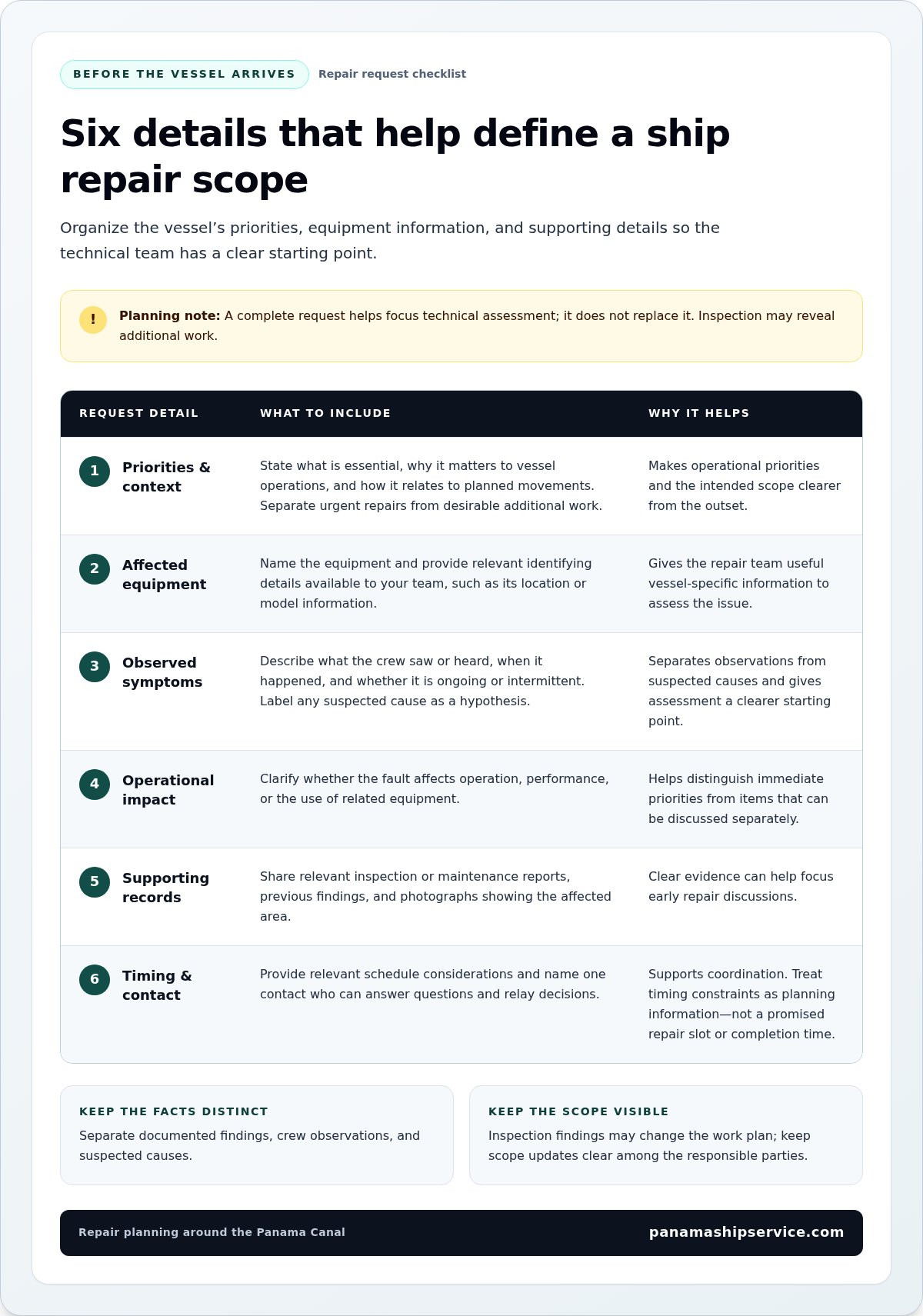
A useful repair request gives the technical team a clear starting point before the vessel reaches the Canal. Begin with what matters most to the vessel, then provide enough information to assess the issue and discuss a workable scope. Preparing these details early can reduce clarification rounds, although inspection may still reveal additional work.
Use this sequence to organize the request:
- Set repair priorities and operational context. State what work is essential, why it matters to vessel operations, and how it relates to the vessel’s planned movements. Separate urgent repairs from desirable additional work.
- Identify the affected equipment. Include the equipment name and relevant identifying details available to your team, such as its location or model information.
- Describe observed symptoms. Report what the crew saw or heard, when the issue occurred, and whether it is ongoing or intermittent. Label a suspected cause as a hypothesis, not a confirmed diagnosis.
- Explain the operational impact. Clarify whether the fault affects operation, performance, or the use of related equipment. This helps distinguish immediate priorities from items that can be discussed separately.
- Gather supporting records. Share relevant inspection or maintenance reports, previous findings, and photographs that show the affected area. Clear evidence can help focus early discussions.
- State timing constraints and contacts. Provide relevant schedule considerations and name one point of contact who can answer questions and relay decisions.
What information helps define the repair scope?
Specific details make the request actionable. Instead of reporting only “navigation equipment fault,” describe the observed behavior, identify the affected component if known, and explain how it affects operations. Attach available records or images that clarify the condition, distinguishing documented findings from crew observations and suspected causes. A broader overview of mechanical work and possible repair needs is available in this mechanical ship repairs guide.
How should operators prepare for a repair discussion?
Keep communication focused through one contact who can coordinate technical questions and decisions with the vessel’s responsible personnel. Share timing constraints as planning information, not as a promise of a particular repair slot or completion time. Panama Ship Service provides repair support with responsive communication and daily updates, keeping relevant parties informed as the scope develops.
A complete request doesn’t replace technical assessment. It helps make that assessment more focused. If you’re organizing how to expedite ship repairs around a Canal transit, prepare the information above and use Panama ship repair support to coordinate the discussion and next steps.
Compare Repair Coordination Approaches Without Sacrificing Oversight
Repair coordination can be distributed across multiple contacts or brought together through a more consolidated service approach. Either way, the repair still needs an appropriate technical assessment and a clearly agreed scope. The practical difference is how information, related work, and decisions move between the vessel and the people coordinating support.
Assess how each approach supports the repair using operational criteria, rather than assuming one process fits every vessel or job.
| Criterion | Fragmented coordination | Consolidated service approach |
|---|---|---|
| Communication flow | Updates and questions may pass through several separate contacts. | A more unified coordination point can help keep relevant updates together. |
| Scope clarity | Different parties may hold separate descriptions of the work and its status. | Repair needs and related tasks can be discussed in a more connected way. |
| Related-service coordination | Surveys, underwater work, spare deliveries, and supplies may need separate arrangements. | Related support can be considered alongside the repair, where relevant. |
| Cost visibility | Costs for separate workstreams may be harder to view together. | A defined scope and clear quote can support a more focused cost discussion. |
Clear, consistent communication helps limit avoidable repair delays by reducing missed updates, repeated questions, and uncertainty about next steps. Consolidating coordination doesn’t mean combining every task into one process. Vessel condition, work scope, access, and technical requirements still shape how each repair is planned and carried out. Keep technical decisions and oversight with the responsible people, even when coordination is streamlined.
When does a one-stop-shop approach help?
A one-stop-shop approach can be useful when a repair connects with other operational needs. A survey may help assess a condition, and underwater work, spare deliveries, or supplies may also be relevant. Panama Ship Service brings together repairs, underwater work, surveys, spare deliveries, and supplies as part of its one-stop-shop model. For repair-related assessment context, see the marine surveys guide.
How can cost-conscious planning support faster decisions?
A defined scope keeps discussion focused on the work being considered, related requirements, and open questions. A clear, cost-efficient quote makes the financial elements easier to review against the vessel’s priorities. The lowest quote alone doesn’t establish the best repair choice; scope, suitable technical oversight, and the vessel’s needs matter too.
For repairs around the Canal, Panama Ship Service supports vessels on both sides of the waterway with operational and technical services. A coordinated discussion can help align the repair scope and related needs. Explore Panama Ship Service repair support as part of your planning.
Use This Step-by-Step Workflow to Move Ship Repairs Forward
A practical workflow keeps the repair request, technical discussion, and coordination moving in sequence without assuming every vessel or job follows the same path. The next step depends on the vessel’s condition, the information available, and the agreed scope. Use this process as a framework, adapting it to the actual requirements and transit schedule.
- Submit the repair request. Send the issue, its operational impact, supporting records, repair priorities, and relevant timing constraints to the coordinating team. Identify a vessel representative who can respond to questions and share decisions.
- Discuss and clarify the proposed scope. Review the reported problem and available findings with the appropriate technical personnel. If information is missing or the condition needs further assessment, resolve those questions before treating the work scope as settled.
- Align the work with vessel requirements. Once the scope is understood, coordinate relevant personnel, access, materials, and supporting services according to the vessel’s needs. Arrangements depend on the agreed work and operational circumstances.
- Maintain communication as plans develop. Share updates when questions arise, the scope changes, or coordination details need attention. Timely communication gives vessel representatives an opportunity to address open decisions and keeps relevant parties working from current information.
- Review the work status and close out. Record completed work and, where applicable, note remaining items or follow-up needs. Keep the vessel’s responsible representatives informed so they have a clear record for onward planning.
From repair request to agreed work scope
The operator’s request starts the discussion; it doesn’t predetermine the technical conclusion. Responsive communication helps clarify what work is proposed and which questions remain open. Distinguish reported symptoms, available records, and conclusions reached during technical assessment. If new information changes the picture, revisit the scope with the relevant decision-makers before coordination proceeds on outdated assumptions.
Coordinate related work and close out clearly
Where it suits the vessel and agreed scope, coordinate related repair needs with supporting services such as spare deliveries, supplies, surveys, or underwater work. Not every repair needs these services, and each arrangement depends on vessel-specific requirements. Updates help representatives track decisions and changes; a concise closeout record can distinguish completed work from outstanding items.
Planning also means considering how repair work fits the vessel’s wider operational needs. The ship downtime guide provides related planning considerations. A consistent sequence helps teams focus on how to expedite ship repairs through preparation and coordination, without promising a specific completion time.
Panama Ship Service supports vessels on both sides of the Panama Canal with repair and related operational services. Coordinate your ship repair needs with a team that provides daily communication and responsive support.
Coordinate Ship Repairs with Panama Ship Service at the Canal
Repair planning around a Panama Canal transit calls for clear technical information and coordination that reflects the vessel’s operating needs. Panama Ship Service supports vessels on both sides of the Canal, providing operational and technical support for repair requirements. Its On-Time Repairs and Marine Repairs & Services include mechanical work and preventive maintenance for marine engine and navigation components.
Personalized service, daily communication, and rapid responses help keep repair discussions moving as the scope develops. Clear updates help vessel representatives address questions and stay informed about coordination. The suitable work depends on the vessel’s condition, requirements, and agreed scope.
What repair support can vessel operators coordinate?
Repair needs can range from mechanical work to repairs involving vessel structures or onboard systems. Panama Ship Service provides mechanical, rudder and propeller, steel fabrication, and A/C repairs. Depending on the vessel and the work required, related services include sandblasting, painting, and tank cleaning. The appropriate scope is determined by the specific repair requirements and technical discussion.
Sharing the affected equipment, observed issue, operational priorities, available reports, and relevant images gives the repair discussion a practical starting point. If the condition or proposed work changes as information develops, keep the scope and decisions clear among the people responsible for the vessel.
How to start a repair coordination discussion
To begin, provide the vessel’s details, repair priorities, available technical information, and timing constraints around Canal operations. Separate what the crew has observed from any suspected cause, and identify a contact who can help coordinate questions and decisions. Panama Ship Service is available for contact 24/7. Repair completion timing depends on the vessel’s requirements and agreed scope.
A well-prepared request makes the initial discussion more focused. Share what is known, flag open questions, and explain which work matters most to the vessel. Panama Ship Service can discuss the repair needs and provide a transparent, cost-conscious quote based on the work scope. Cost-conscious planning supports informed decisions, while the repair approach remains guided by the vessel’s requirements and suitable technical oversight.
If you’re planning how to expedite ship repairs around a Canal transit, start with a clear description of the vessel’s needs and schedule constraints. Discuss your ship repair requirements with Panama Ship Service and share the information needed to begin coordinating the work.
Keep Repair Planning Ready to Move
A repair plan should remain useful as vessel conditions and priorities evolve. Keep the next decision visible: what’s known, what still needs technical assessment, and who owns the next action. A concise record gives vessel representatives and shore-side teams a shared reference point, especially when new findings require adjustments or a change in priorities.
Knowing how to expedite ship repairs isn’t about forcing a timetable. It’s about making each decision easier to act on while preserving suitable technical judgment. Carry the repair priorities and schedule context into the next discussion, and update the plan as circumstances change. This keeps coordination grounded in the vessel’s current needs rather than earlier assumptions.
Set the next conversation in motion with a focused request. Start a ship repair planning discussion with Panama Ship Service and share the details that will help frame the work.
Frequently Asked Questions
How can I expedite ship repairs during a Panama Canal transit?
To expedite ship repairs during a Panama Canal transit, make the operational priority explicit and tie it to the vessel’s current requirements. Share equipment identifiers, relevant records, and timing constraints early, then keep one decision-maker available to resolve questions. Clear communication and coordination of related services can reduce avoidable planning delays. Actual work and sequence depend on the vessel’s condition and agreed scope, so don’t treat a transit window as a guaranteed repair deadline.
What information should I send to arrange ship repairs?
Send details about the affected equipment and describe what the crew observed, such as an intermittent alarm or a change in performance. Explain how the issue affects vessel operations and include available reports, maintenance records, or clear images. State repair priorities and timing constraints. Separate confirmed symptoms from a suspected cause to keep the discussion focused without presenting an unverified diagnosis as fact.
Can ship repairs be coordinated while a vessel transits the Panama Canal?
Yes. Operators can discuss repair needs and timing constraints with Panama Ship Service, which supports vessels on both sides of the Canal. This conversation helps clarify coordination relevant to the vessel’s schedule. Feasibility depends on the vessel’s circumstances, the nature of the repair, and the agreed scope. Discussing a repair in relation to a transit doesn’t establish Canal access, reserve a transit slot, or set a fixed repair duration.
Does expediting ship repairs mean skipping inspections or technical checks?
No. Expediting is about reducing preventable planning and coordination delays, not automatically bypassing technical review. Sharing existing equipment records can inform a discussion, but it doesn’t replace an assessment if the repair scope calls for one. The appropriate technical review depends on the vessel’s condition and the work being considered. Keep decisions grounded in the actual repair needs, and don’t assume checks can be omitted simply to move faster.
Which ship repairs can Panama Ship Service coordinate?
Panama Ship Service provides mechanical, rudder and propeller, steel fabrication, and A/C repairs, as well as sandblasting, painting, and tank cleaning. Its Marine Repairs & Services include preventive maintenance for marine engine and navigation components, and it also offers On-Time Repairs. The suitable work depends on the vessel’s requirements and agreed scope. Share the issue and available technical information so the repair discussion can focus on relevant needs.
How does a one-stop-shop approach help with ship repairs?
A one-stop-shop approach lets operators consider relevant repair work alongside services such as surveys, underwater work, spare deliveries, and supplies. For example, a vessel may need to discuss a repair and related parts or assessment as connected planning items. Bringing relevant needs into one discussion can simplify coordination. Clear communication and cost-conscious planning help keep attention on the vessel’s priorities without assuming every service is needed.
Is ship repair support available on both sides of the Panama Canal?
Panama Ship Service provides operational and technical services on both sides of the Panama Canal, with international service capability as well. Operators can start a repair discussion by sharing the vessel’s location in relation to its transit, the repair need, available technical details, and schedule constraints. These details help frame the conversation around the vessel’s circumstances. The work scope and coordination remain specific to the repair, and sharing a schedule doesn’t guarantee service timing.