
For vessel operators, a Panama Canal transit is a high-stakes operation where timing is everything. A hull compromised by biofouling doesn’t just increase fuel consumption; it risks failing stringent Panama Canal Authority (ACP) inspections, leading to costly delays and severe schedule disruptions. This is why securing professional biofouling removal services panama is no longer just maintenance-it’s a strategic necessity for operational efficiency and regulatory compliance.
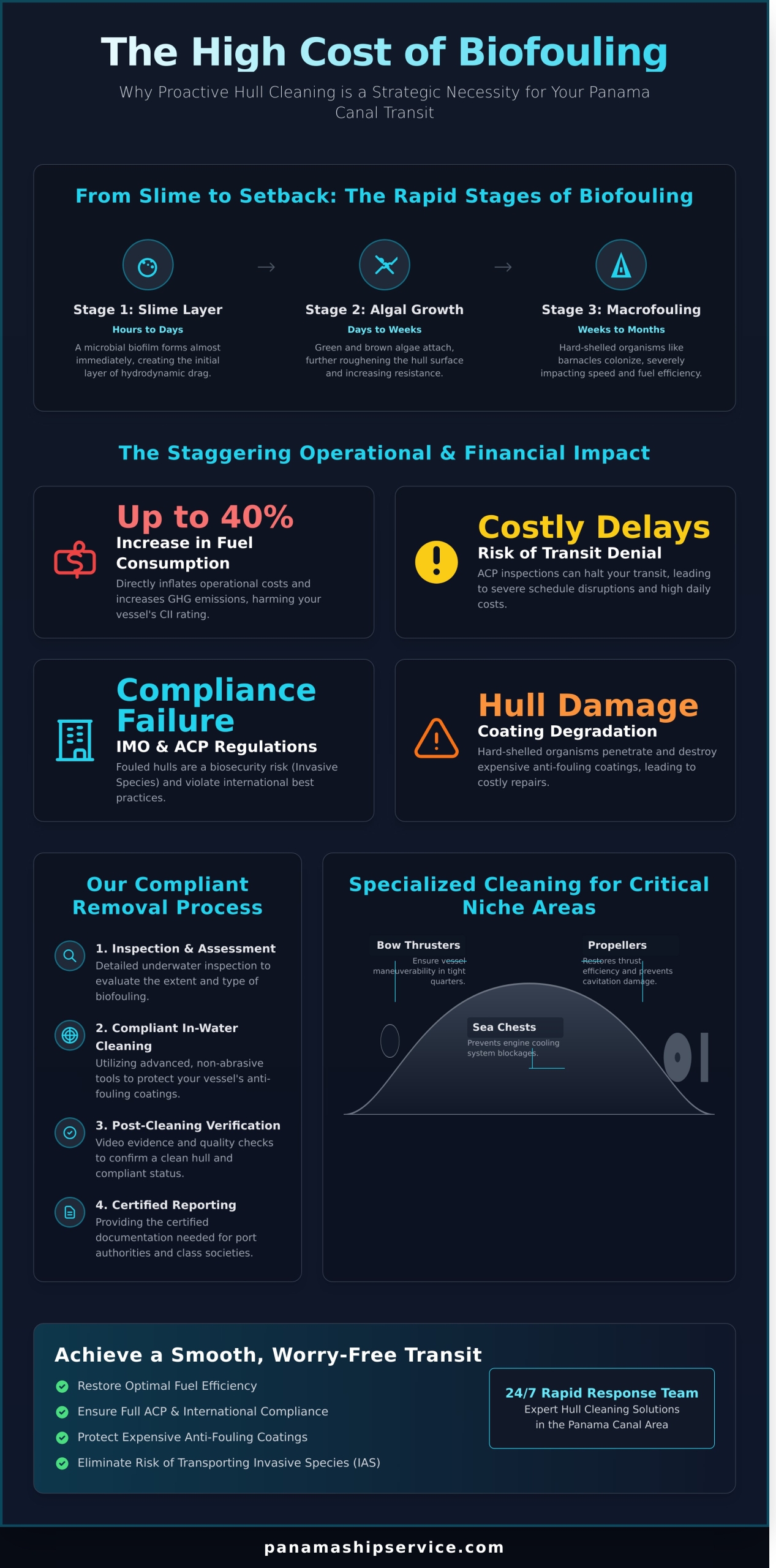
This guide is your essential resource for navigating these challenges. We will detail how expert in-water cleaning not only restores your vessel to optimal fuel efficiency but also protects your expensive anti-fouling coatings from damage. You will learn the critical steps to ensure full compliance with ACP and international regulations, eliminating the risk of transporting invasive aquatic species (IAS). Discover how to achieve a smooth, predictable transit and receive the certified documentation needed to satisfy port authorities and class societies, ensuring your passage through the Canal is both efficient and worry-free.
Key Takeaways
- Unmanaged marine growth can increase your vessel’s fuel consumption by up to 40%, directly impacting operational costs and transit efficiency.
- Learn why critical niche areas like sea chests, bow thrusters, and propellers require specialized cleaning to prevent performance degradation and regulatory issues.
- Effective biofouling removal services panama utilize a compliant, multi-stage process from inspection to reporting to ensure your vessel is operationally ready.
- Minimize costly delays by understanding how a 24/7 rapid-response team provides expert hull cleaning solutions tailored to the Panama Canal area.
Understanding Biofouling: A Critical Threat to Vessels in Panama
Biofouling is the progressive accumulation of microorganisms, plants, algae, and marine animals on a vessel’s hull and other submerged surfaces. For a deeper technical overview, understanding biofouling is the first step toward mitigation. This process begins with a simple slime layer and can quickly escalate to heavy macrofouling, including barnacles, tubeworms, and mollusks. For vessels operating in or transiting through Panama, this is not a minor issue-it is a critical operational threat. The region’s warm, nutrient-rich tropical waters create an ideal breeding ground, dramatically accelerating marine growth rates compared to colder climates.
The development of biofouling occurs in rapid stages, posing a constant challenge to vessel efficiency:
- Stage 1: Slime Layer (Hours to Days) – A microbial biofilm forms almost immediately upon immersion in seawater, increasing hydrodynamic drag.
- Stage 2: Algal Growth (Days to Weeks) – Green and brown algae attach, further roughening the hull surface.
- Stage 3: Macrofouling (Weeks to Months) – Hard-shelled organisms like barnacles and mussels colonize the surface, severely impacting fuel consumption, speed, and maneuverability.
Beyond the direct impact on vessel performance, a heavily fouled hull poses a significant environmental risk. It can act as a vector for transporting non-native Invasive Aquatic Species (IAS) across ecological boundaries, a major concern for the sensitive ecosystems connected by the Panama Canal.
The IMO GloFouling Project and Panama’s Role
Recognizing the global threat, the International Maritime Organization (IMO) established the GloFouling Partnerships project to protect marine biodiversity. Panama is a Lead Partnering Country in this initiative, underscoring its strategic commitment to managing biofouling. For vessel operators, this means that Panama is at the forefront of implementing international best practices and regulations, leading to heightened scrutiny on hull conditions for all transiting ships.
Panama Canal Authority (ACP) Biofouling Regulations
The Panama Canal Authority (ACP) is increasingly focused on the underwater condition of vessels seeking transit. Heavily fouled hulls are now viewed as a potential biosecurity risk and an operational hazard. This has led to stricter inspections and the potential for costly delays or even denial of transit for non-compliant vessels. Proactively engaging expert biofouling removal services in Panama is no longer just about fuel efficiency; it is an essential risk mitigation strategy to ensure smooth, uninterrupted passage through this critical global waterway.
The Operational & Financial Impact of Unmanaged Biofouling
Unmanaged biofouling is more than a cosmetic issue; it is a direct and costly threat to your vessel’s operational efficiency and financial performance. As marine organisms colonize a hull, they disrupt the smooth flow of water, creating significant hydrodynamic drag. This resistance forces engines to work harder to maintain speed, leading to a cascade of negative consequences that directly impact your voyage costs, schedule integrity, and regulatory compliance. Ignoring this issue is not a viable cost-saving measure-it is an expensive liability.
Fuel Consumption and Greenhouse Gas Emissions
The most immediate financial drain from hull fouling is a dramatic increase in fuel consumption. Even a light slime layer can increase fuel burn by over 10%, while heavy calcareous fouling from barnacles can skyrocket consumption by up to 40%. This directly inflates operational costs and increases harmful greenhouse gas (GHG) emissions like SOx and NOx. For modern operators, this has a critical impact on a vessel’s Carbon Intensity Indicator (CII) rating, jeopardizing its long-term commercial viability.
The Cost of Transit Delays and Non-Compliance
Port authorities, including the Panama Canal Authority (ACP), enforce strict biosecurity rules to prevent the transfer of invasive aquatic species. A vessel with excessive fouling risks being denied entry or ordered to undergo immediate cleaning, resulting in costly, unscheduled downtime. With vessel charter rates often exceeding tens of thousands of dollars per day, non-compliance is a significant financial risk. Adhering to international biofouling regulations is essential, and our expert biofouling removal services in Panama ensure your vessel remains compliant and on schedule.
Degradation of Hull Coatings and Structures
Beyond performance loss, biofouling inflicts long-term physical damage. Hard-shelled organisms like barnacles penetrate and destroy expensive anti-fouling coatings, exposing the steel hull to corrosive seawater. This growth also traps moisture and creates an environment where corrosion can accelerate while hidden from view. The high cost of premature dry-docking for extensive hull repairs and recoating far exceeds the investment in regular, professional in-water hull maintenance.
Our Compliant Biofouling Removal Process in Panama
Effective biofouling management is more than just cleaning; it is a systematic, multi-stage process designed to restore vessel efficiency while ensuring full compliance with local and international regulations. At Panama Ship Service, we execute a proven four-step methodology: inspection, planning, execution, and reporting. Understanding the significant operational and financial impact of unmanaged marine growth, our process utilizes advanced ROV and diver-operated equipment to deliver a precise, safe, and documented service. We prioritize the integrity of your hull coatings and employ capture and filtration systems where required to prevent the release of invasive species into Panama’s sensitive marine environment.
Step 1: Underwater Inspection and Assessment
Our process begins with a comprehensive underwater hull survey conducted by qualified technicians using high-definition cameras and Remotely Operated Vehicles (ROVs). This initial inspection allows us to accurately assess the type, severity, and specific locations of the biofouling. We provide the vessel’s master and owners with a detailed inspection report, complete with clear video evidence, establishing a transparent baseline before any cleaning work commences.
Step 2: Customized Cleaning Plan and Execution
Based on the inspection findings, we develop a customized cleaning strategy tailored to your vessel’s specific hull coating and the nature of the fouling. Our expert team selects the appropriate non-abrasive brush types and hydraulic pressure settings to remove all marine growth without damaging expensive anti-fouling systems. This meticulous approach is central to our professional biofouling removal services in Panama, as we systematically clean the entire hull from the waterline to the keel for optimal hydrodynamic performance.
Step 3: Post-Cleaning Verification and Reporting
Upon completion of the cleaning, we conduct a final video inspection to verify that all biofouling has been thoroughly removed and the hull surface meets the required standard. We then issue a formal cleaning report, including post-cleaning video evidence, which serves as an official record for your vessel’s logbook and for presentation to port authorities. This final step provides complete assurance that the job was performed to the highest professional and regulatory standards. Request a quote for your vessel’s biofouling removal.
Specialized Cleaning for Niche Areas and Propellers
A comprehensive underwater cleaning strategy must extend beyond the vessel’s flat hull surfaces. Niche areas, due to their complex geometries, lower light exposure, and varied water flow, are hotspots for aggressive and resilient marine growth. Neglecting these critical zones can severely compromise vessel safety, maneuverability, and operational efficiency. Our expert technicians understand that true performance optimization requires meticulous attention to these often-overlooked components.
We provide specialized cleaning for all underwater appendages, including:
- Sea Chests & Gratings: Preventing engine overheating.
- Bow & Stern Thrusters: Ensuring full maneuverability.
- Rudders & Stabilizer Fins: Maintaining steering and stability.
- Propellers & Nozzles: Maximizing thrust and fuel efficiency.
Blockages and fouling in these areas lead to tangible problems, from strained machinery to critical system failures. As a core component of our biofouling removal services in Panama, we meticulously clean these high-risk zones to restore design performance and mitigate operational risks.
Sea Chest and Grating Cleaning
A vessel’s sea chests are the lifeline for its engine cooling systems. When gratings become obstructed by barnacles, mussels, and other marine growth, water flow is dangerously restricted, placing the main engine at immediate risk of overheating. Our teams are trained to expertly clear all fouling from sea chest gratings and accessible internal surfaces, restoring full flow without compromising the integrity of internal machinery. This preventative service is essential for avoiding catastrophic engine damage and costly delays.
Propeller Polishing for Maximum Efficiency
Even a light layer of slime on a propeller can disrupt its hydrodynamic profile, dramatically increasing drag and forcing the engine to work harder. This directly translates to higher fuel consumption. We provide a multi-stage propeller polishing process designed to achieve a Rupert Scale ‘A’ finish. This mirror-like smoothness minimizes turbulence and maximizes thrust, delivering immediate and measurable fuel savings. Our approach to biofouling removal services in Panama ensures this critical component provides the power and efficiency it was designed for. A clean propeller is a direct investment in cost-conscious transit.
Why Panama Ship Service is Your Trusted Partner for Biofouling Control
In the high-stakes operational environment of the Panama Canal, every minute counts. Delays caused by excessive biofouling are not just an inconvenience; they are a direct threat to your schedule, fuel efficiency, and profitability. Panama Ship Service is the trusted authority for efficient biofouling removal services panama. We understand the unique pressures of this critical waterway and have built our reputation on providing rapid, reliable solutions that keep your vessel compliant and moving.
Our commitment is to minimize your vessel’s downtime. We operate 24/7, ready to deploy our teams at a moment’s notice to either the Pacific or Atlantic anchorages. Our experienced, certified divers are equipped with advanced, non-abrasive hull cleaning technology to ensure a thorough service that protects your hull coatings. This combination of constant availability, skilled personnel, and superior equipment means we execute every job with precision and speed, safeguarding both your vessel’s performance and your tight operational timeline.
Beyond efficiency, our operations are grounded in a core commitment to:
- Uncompromising Safety: Adhering to the strictest safety protocols to protect our team, your crew, and your valuable asset.
- Environmental Compliance: Utilizing methods that meet or exceed all local and international environmental regulations for biofouling management.
- Transparent Communication: Keeping your team informed with clear, constant updates from project initiation to completion.
Local Expertise, Global Standards
Navigating the regulatory landscape of the Panama Canal requires specialized knowledge. Our team possesses an in-depth understanding of all Panama Canal Authority (ACP) requirements and local port regulations. We benchmark our operations against global best practices, ensuring the service you receive is not only compliant locally but also meets the highest international maritime standards. This dual focus has made us the preferred partner for discerning ship owners and operators worldwide.
A One-Stop Solution for Underwater Services
Our expert biofouling removal services panama are a key component of our integrated underwater solutions. Streamline your port call by combining hull cleaning with other essential services like UWILD surveys, propeller polishing, and minor repairs. By consolidating these tasks with a single, reliable provider, you simplify logistics, reduce administrative burden, and ensure consistent quality across all underwater maintenance. Contact our expert team to schedule your service today.
Your Trusted Partner for Compliant Biofouling Removal in Panama
Navigating the Panama Canal demands peak vessel performance and strict regulatory compliance. As we’ve discussed, unmanaged biofouling presents a significant risk to your operational efficiency, fuel consumption, and can lead to costly delays. The solution is a proactive approach with a qualified partner. Panama Ship Service provides the expert biofouling removal services panama vessel operators need to protect their assets and ensure a smooth transit.
Our deep understanding of Panama Canal Authority (ACP) regulations, combined with our experienced, certified divers and advanced ROV technology, guarantees a compliant and thorough cleaning. We provide comprehensive video and written reports for your records, delivering the accountability and peace of mind you require. Don’t let biofouling compromise your schedule or your bottom line.
Ensure a compliant and efficient Canal transit. Get your biofouling removal quote today.
Put your vessel in our expert hands and navigate Panama with confidence.
Frequently Asked Questions
What is the difference between biofouling removal and standard hull cleaning?
Standard hull cleaning addresses light marine growth like slime and algae as part of routine maintenance. In contrast, biofouling removal is a more intensive, specialized service targeting heavy, calcified organisms such as barnacles, tubeworms, and mussels. This corrective procedure is essential for restoring vessel performance, improving fuel efficiency, and ensuring compliance with strict biosecurity regulations, which a simple cleaning cannot achieve. Our expert teams use advanced methods to resolve severe cases.
How long does a full biofouling removal service take for a typical vessel?
The operational time for a full biofouling removal depends on the vessel’s size, the severity of the fouling, and anchorage conditions. For a standard Panamax vessel with moderate to heavy growth, our qualified dive teams typically complete the service within 8 to 12 hours. We prioritize efficiency to minimize your vessel’s downtime at the Panama Canal, delivering a swift and thorough cleaning that restores hull integrity without unnecessary delays.
Is your biofouling removal process safe for all types of anti-fouling coatings?
Yes, our process is engineered to be safe for all anti-fouling systems. Our expert divers are trained to identify different coating types, from hard epoxies to delicate silicone-based paints. We utilize advanced, variable-pressure hydraulic brush systems and non-abrasive tools, adjusting our technique to effectively remove biofouling without damaging the underlying coating. This preserves the integrity and extends the life of your vessel’s protective paint system.
What documentation do you provide after the service is complete?
Upon completion, we provide a comprehensive documentation package for your records and for presentation to port authorities or charterers. This includes a detailed service report, high-resolution pre- and post-cleaning underwater video and photographic evidence, and a formal certificate of completion. This transparent reporting confirms the quality of our work and supplies the necessary proof of compliance for your vessel’s voyage and operational history, ensuring you have all required documentation.
Can biofouling removal be performed at both the Atlantic and Pacific anchorages in Panama?
Yes, our teams are fully operational and certified to provide expert biofouling removal services in Panama at both the Atlantic and Pacific anchorages. Whether your vessel is anchored at Cristobal on the Atlantic side or Balboa on the Pacific side, we have the logistical capability and qualified personnel to mobilize rapidly. Our complete coverage ensures your vessel receives timely and efficient service regardless of its location at the Panama Canal.
What are the main types of biofouling found on vessels in Panamanian waters?
In Panama’s tropical climate, vessels face a diverse range of aggressive biofouling. Hard fouling is most prevalent, including various species of barnacles, tubeworms, and mollusks like mussels. We also frequently manage soft fouling, such as heavy algal slime, hydroids, and sea squirts. Our extensive local experience ensures our cleaning methods are precisely targeted for maximum effectiveness against the specific marine growth affecting your vessel.