
A single bunkering operation can make or break your voyage’s profitability. Did you receive every metric ton of fuel you paid for? Is the quality up to spec, or are you unknowingly taking on contaminated bunkers that could damage your engine? For ship owners and charterers, these are not just risks-they are costly realities that lead to disputes, delays, and significant financial losses at one of the world’s most critical transit points. An expert bunker survey panama canal service is not a luxury; it is your essential tool for risk management.
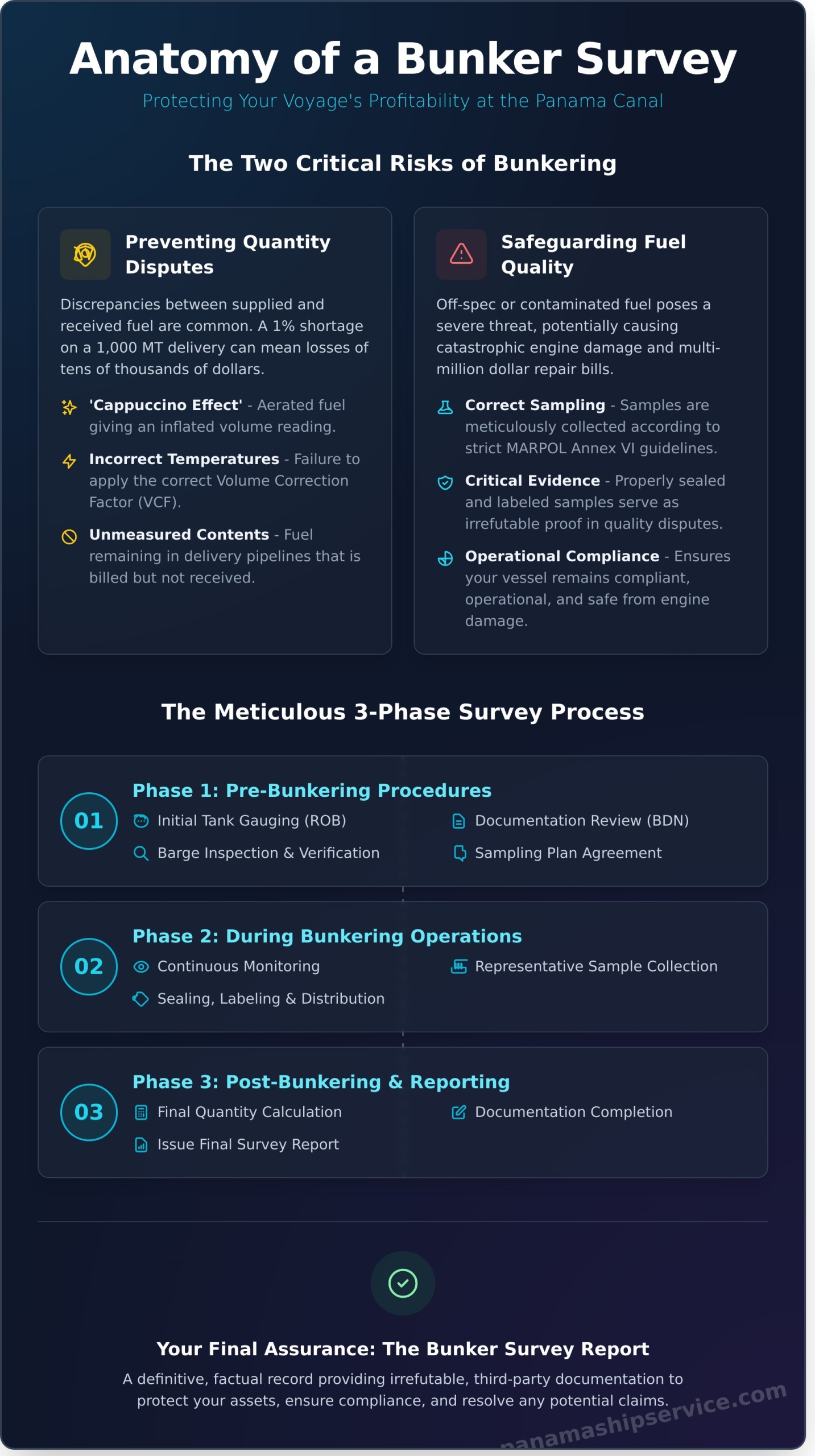
This guide details the critical steps of a professional bunker survey executed with precision. You will learn how our qualified surveyors meticulously verify fuel quantity and quality, minimize vessel downtime during operations, and provide the irrefutable, third-party documentation needed to protect your assets. Secure your investment and ensure a smooth, cost-effective transit by understanding how to prevent fuel disputes before they ever begin.
What is a Bunker Survey and Why is it Critical at the Panama Canal?
For any vessel, marine fuel-or bunkers-represents the single largest operational expense. A bunker survey is an independent, expert verification of the quantity and quality of fuel delivered to a ship. This process provides a precise, unbiased measurement to protect the vessel’s owner or charterer from significant financial loss. The term originates from the historical storage of coal, and understanding what is bunkering today is crucial for modern vessel management.
At the Panama Canal, one of the world’s most critical maritime chokepoints and a major bunkering hub, efficiency is paramount. Delays or disputes during refueling can jeopardize a vessel’s transit slot, leading to costly setbacks. A professional bunker survey Panama Canal service is not a luxury; it is an essential, cost-conscious risk management tool. Its two primary goals are to prevent costly quantity shortages and to safeguard against debilitating fuel quality issues.
Preventing Bunker Quantity Disputes
Discrepancies between the supplied and received fuel quantity are unfortunately common. Shortages can arise from several factors, including:
- The ‘Cappuccino Effect’: Air pumped into the fuel, causing it to foam and register an inflated volume.
- Incorrect Temperatures: Failure to apply the correct Volume Correction Factor (VCF) for the fuel’s temperature.
- Unmeasured Pipe Contents: Fuel remaining in the delivery barge’s pipelines that is billed but not delivered.
An independent surveyor provides accurate, unbiased tank measurements before and after delivery, ensuring you only pay for the fuel you receive. Even a 1% shortage on a 1,000-metric-ton delivery can result in losses of tens of thousands of dollars.
Safeguarding Against Fuel Quality Issues
Receiving off-spec or contaminated fuel poses a severe threat to vessel operations. Poor quality bunkers can cause catastrophic engine damage, leading to extensive downtime and multi-million dollar repair bills. Our qualified surveyors ensure that fuel sampling is performed correctly according to the strict guidelines of MARPOL Annex VI. This provides a representative sample of the entire delivery, which is then sealed and retained. In the event of a dispute, this certified sample is your critical evidence, protecting you from liability and ensuring your vessel remains compliant and operational.
The Complete Bunker Survey Process: A Step-by-Step Breakdown
A successful bunkering operation is not a single event but a meticulously executed, multi-phase process. For ship operators and charterers, understanding these steps is crucial for protecting their investment and ensuring operational readiness. A professional bunker survey Panama Canal follows a strict, internationally recognized protocol to guarantee accuracy and prevent costly disputes. Our qualified surveyors manage this entire process with precision, providing a clear and verifiable account of the fuel transfer from start to finish.
Phase 1: Pre-Bunkering Procedures
This foundational stage sets the standard for an accurate survey. Before any fuel is transferred, our expert surveyor boards the vessel to establish a precise baseline. Key actions include:
- Initial Tank Gauging: All relevant vessel tanks-including fuel oil, diesel oil, and sludge tanks-are carefully measured to determine the exact quantity of bunkers on board (ROB) before delivery.
- Documentation Review: The surveyor meets with the Chief Engineer to review the Bunker Delivery Note (BDN) and confirm the nominated quantity, fuel grade, and specifications.
- Barge Inspection: An initial inspection of the bunker barge and its equipment is conducted to verify its calibration records and ensure all systems are prepared for a secure transfer. This includes confirming that all procedures align with the official Panama Canal Vessel Requirements.
- Sampling Plan Agreement: The surveyor confirms the agreed-upon sampling method and location with both the vessel’s and the barge’s representatives to ensure compliance.
Phase 2: During Bunkering Operations
During the transfer, our surveyor provides critical oversight to maintain the integrity of the process. This active monitoring phase is essential for identifying any irregularities in real-time. The surveyor continuously monitors pumping rates, temperatures, and line connections for any signs of malpractice, such as the “cappuccino effect.” Representative fuel samples are collected at the point of custody transfer, typically the vessel’s manifold, ensuring they accurately reflect the delivered fuel’s quality. All samples are then properly sealed, labeled, and distributed to the vessel, the barge, and an independent laboratory.
Phase 3: Post-Bunkering and Reporting
Once pumping is complete, the surveyor finalizes the verification process. This includes a final measurement of all vessel and barge tanks to calculate the delivered quantity. Using internationally accepted ASTM tables and standards, the surveyor performs precise calculations, accounting for factors like temperature and density. All relevant documentation is then completed and signed by all parties. Finally, a detailed Bunker Survey Report is issued, providing the client with a definitive, factual record of the operation for their records and for resolving any potential claims.
Key Challenges and Considerations for Bunkering in Panama
Bunkering operations at the Panama Canal present a unique set of challenges not found in other major ports. The combination of high vessel traffic, strict transit schedules, and a dynamic operational environment demands local expertise. Navigating this landscape efficiently is critical to protecting your assets and avoiding costly delays. A comprehensive bunker survey panama canal is not just a measurement service; it’s a strategic tool for mitigating risk in this complex waterway.
Logistical and Operational Hurdles
Coordination is paramount. Bunkering can occur at designated anchorages in Balboa (Pacific side) or Cristobal (Atlantic side), each with distinct operational conditions. Operations are tightly managed around a vessel’s transit slot, leaving little room for error. Any delay, whether from weather or supplier inefficiency, can jeopardize the schedule. All activities must adhere to the strict Panama Canal Authority bunkering regulations, which dictate approved locations and procedures, making coordination with the ACP an essential, non-negotiable step.
Common Sources of Disputes in the Region
While most suppliers are reputable, certain tactics can lead to significant fuel discrepancies. Our surveyors are highly experienced in identifying and preventing common issues specific to the region, including:
- The “Cappuccino Effect”: The practice of introducing air into the delivery line, which inflates the volume reading on the flow meter.
- Excessive Tank Stripping: Aggressive stripping of barge tanks can introduce air and unpumpable quantities into the final delivery figures.
- Undeclared Line Contents: Failure to account for the volume of fuel already present in the delivery hose before pumping begins.
A vigilant surveyor provides on-the-ground oversight to counter these tactics. Meticulous documentation, including photographic evidence and detailed notes, forms the most robust defense in the event of a dispute.
Compliance with International Standards (ISO 8217)
Ensuring fuel quality is as important as verifying quantity. The international standard ISO 8217 defines the specifications for various grades of marine fuels. A key function of a bunker survey panama canal is to witness the sampling process and ensure the delivered fuel grade matches the specifications listed on the Bunker Delivery Note (BDN). This verification protects the vessel’s engines from off-spec fuel that could cause catastrophic damage. Ensure compliance with our expert surveyors. Get a quote.
Selecting Your Bunker Surveyor: Key Criteria for Reliability
When procuring fuel, the surveyor you choose is your first and most critical line of defense against financial loss. Opting for the cheapest service is a false economy; a low-cost survey that fails to identify a significant fuel shortage will cost you far more than the initial fee. A professional surveyor is not an expense but an investment in accuracy and accountability. Making an informed decision based on value and expertise is essential for protecting your assets.
Experience and Local Knowledge
A proven track record is vital, especially for a complex operation like a bunker survey panama canal. Your surveyor must possess intimate knowledge of local terminals, barge operators, and specific regional regulations. This on-the-ground expertise allows them to anticipate potential issues, recognize common tactics used to obscure shortages, and navigate logistical challenges efficiently, ensuring a smooth and accurate process.
Independence and Integrity
The surveyor’s absolute impartiality is non-negotiable. They must operate as a truly neutral third party, free from any conflicts of interest with suppliers or agents. Their sole obligation is to their client-to observe the facts, perform accurate calculations, and report the findings without bias. This integrity is the foundation of a trustworthy report and is crucial for its validity should a claim or dispute arise.
Reporting Quality and Detail
The final survey report is your primary evidence. A professional report is more than just a number; it is a clear, comprehensive, and timely document. It must include all raw measurements, detailed calculations, photographs, and a formal statement of facts outlining the entire bunkering operation. This level of detail provides an indisputable record, equipping you with the documentation needed to successfully defend your interests.
When selecting your trusted partner, demand a surveyor who demonstrates:
- Local Mastery: Deep familiarity with Panama Canal operations and suppliers.
- Unyielding Integrity: A commitment to unbiased, factual reporting on your behalf.
- Evidentiary-Grade Reports: Clear, detailed, and actionable documentation.
Panama Ship Service embodies these principles, delivering the expert oversight needed to ensure you receive every ton of fuel you pay for. Contact our qualified team to secure your next bunkering operation.
Beyond Bunker Surveys: Integrated Services for a Smooth Canal Transit
A successful Panama Canal transit requires more than just fuel accuracy. While a precise bunker survey panama canal is essential for cost control, it is only one component of a complex operational sequence. Coordinating multiple vendors for surveys, waste disposal, and technical support creates administrative burdens, communication delays, and increased risk of costly errors. Panama Ship Service eliminates these challenges by acting as your single, trusted partner on the ground.
We provide a comprehensive suite of services designed to work in concert, ensuring maximum efficiency for your vessel. By consolidating your needs with one expert provider, you streamline communication, reduce paperwork, and minimize port stay time. Our integrated approach means every service is scheduled and executed to support a timely and cost-effective transit.
Complementary Survey Services
Beyond fuel verification, our qualified surveyors protect your assets and contractual obligations with a range of critical assessments:
- On-Hire / Off-Hire Surveys: We provide a detailed, independent record of the vessel’s condition, including bunker and water levels, at the start or end of a charter period to prevent disputes.
- Draft Surveys: Our experts accurately calculate cargo weight by measuring the vessel’s displacement, a crucial step for verifying Bills of Lading and port documentation.
- Damage Surveys: In the unfortunate event of an incident, we assess and document all damage to the vessel or cargo, providing the impartial evidence required for insurance claims.
Operational Support Services
A smooth transit depends on operational readiness. We offer essential technical and compliance services to prepare your vessel for the journey ahead:
- MARPOL Disposal: Ensure full compliance with international regulations through our certified and efficient collection and disposal of sludge, bilge water, and other waste.
- Underwater Services: From hull cleaning to propeller polishing and in-water inspections, our dive teams improve your vessel’s fuel efficiency and performance.
- Emergency Repairs: Gain immediate access to qualified technicians for urgent mechanical or electrical repairs, ensuring minor issues don’t turn into major delays.
Stop juggling multiple contacts and schedules in a time-sensitive environment. From a detailed bunker survey panama canal to emergency technical support, our team provides a single, reliable point of contact for all your operational needs. Consolidate your vessel services in Panama. Contact us today.
Your Trusted Partner for Bunker Surveys at the Panama Canal
Navigating the complexities of bunkering at this critical global chokepoint demands precision and expert oversight. A professional survey is your most effective defense against costly fuel quantity discrepancies and off-spec quality disputes, directly safeguarding your vessel’s operational integrity and your bottom line. Therefore, choosing an experienced, independent partner for your bunker survey panama canal is not merely a procedural step-it is a fundamental business decision that protects your high-value assets and ensures a cost-effective transit.
Panama Ship Service is your expert on the ground, providing that essential certainty. Leveraging over 20+ years of dedicated experience at the Canal, our qualified surveyors deliver meticulously detailed and completely independent, unbiased reporting designed to protect your interests. We are available 24/7 to match your vessel’s unique schedule, providing the rapid, reliable solutions you need for a seamless and efficient operation.
Don’t leave your most significant operational expense to chance. Take control of your bunkering operations now. Request a Quote for Your Bunker Survey at the Panama Canal today.
Put your transit in our hands and sail with complete confidence.
Frequently Asked Questions
How long does a typical bunker survey take at the Panama Canal?
A typical bunker survey Panama Canal takes between 2 to 4 hours to complete. This timeframe can vary based on factors such as the vessel’s readiness, the accessibility of all sounding pipes, and the level of cooperation from the bunker barge crew. Our qualified surveyors are experts in efficiency, working diligently to complete the survey swiftly to minimize any potential delays to your vessel’s transit schedule and operations.
What happens if the surveyor finds a significant quantity difference?
If a significant discrepancy is discovered, our surveyor immediately notifies the Chief Engineer, the Master, and the bunker barge representative. All measurements and calculations are re-checked collaboratively to identify the source of the difference. A Letter of Protest is issued on the spot, and we provide all necessary documentation and expert support to help you formally dispute the delivery quantity, protecting your financial interests.
Can you perform bunker surveys on both the Atlantic and Pacific sides of the Canal?
Yes, absolutely. Our expert team is strategically located to provide comprehensive bunker survey services at both ends of the Panama Canal. We have full operational capacity at the Port of Balboa on the Pacific side and the Port of Cristobal on the Atlantic side. This ensures we can service your vessel reliably and efficiently, regardless of its entry or exit point, providing a seamless solution for your bunkering operations.
What international standards and calculation methods do your surveyors use?
Our surveyors adhere strictly to internationally recognized standards to ensure maximum accuracy and accountability. All calculations are performed using the latest API/ASTM petroleum measurement tables (e.g., ASTM D1250). We utilize calibrated equipment and proven methodologies for tank soundings, temperature readings, and density verification, ensuring every report is defensible and aligns with global best practices in the maritime industry.
What is the difference between a bunker survey and a draft survey?
A bunker survey exclusively measures the quantity of fuel oil on board a vessel before and after bunkering to verify the amount received from a supplier. Its purpose is to ensure fuel accuracy. In contrast, a draft survey calculates the weight of cargo loaded or discharged by measuring changes in the vessel’s displacement. While both are crucial quantity verification services, a bunker survey focuses on fuel, whereas a draft survey focuses on cargo.
How soon after the survey will I receive the final report?
We prioritize rapid and clear communication. A preliminary report detailing the key findings is provided on-site immediately upon completion of the survey. You will then receive the comprehensive, detailed final report electronically within 24 hours. This efficient turnaround ensures you have the official documentation needed for your records and for any necessary follow-up actions without delay, keeping your vessel’s administrative tasks on schedule.