
Did you know a single machinery deficiency can result in a Panama Canal disruption charge as high as $250,000? For vessel operators, the pressure to maintain a flawless transit schedule is constant. You already know that subtle vibrations or rising fuel costs are frequently the first indicators of significant mechanical misalignment. Failing to address these issues leads to premature bearing failure and the high risk of being denied entry by the Panama Canal Authority (ACP).
Securing expert marine engine alignment services is a strategic necessity for operating in this high-stakes maritime hub. This article explains how precision alignment prevents catastrophic failure and minimizes costly downtime during your Panama Canal transit. We’ll examine the technical advantages of laser-guided measurements, the impact on equipment lifespan, and the specific steps required to achieve vibration-free, OEM-standard performance before you reach the locks.
Key Takeaways
- Understand how precision alignment mitigates the risk of massive disruption charges and ensures your vessel meets strict Panama Canal Authority operational standards.
- Learn why modern laser-guided marine engine alignment services are the current industry gold standard for achieving 0.0001-inch measurement accuracy.
- Identify critical warning signs of misalignment, such as specific RPM vibration ranges or oil leaks, to prevent premature bearing and seal failure.
- Discover how to optimize your schedule by performing essential mechanical repairs at Balboa or Cristobal terminals during cargo operations or canal wait times.
- Explore the operational advantages of consolidating mechanical, underwater, and survey requirements to simplify technical documentation and reduce overhead.
What are Marine Engine Alignment Services and Why are They Critical?
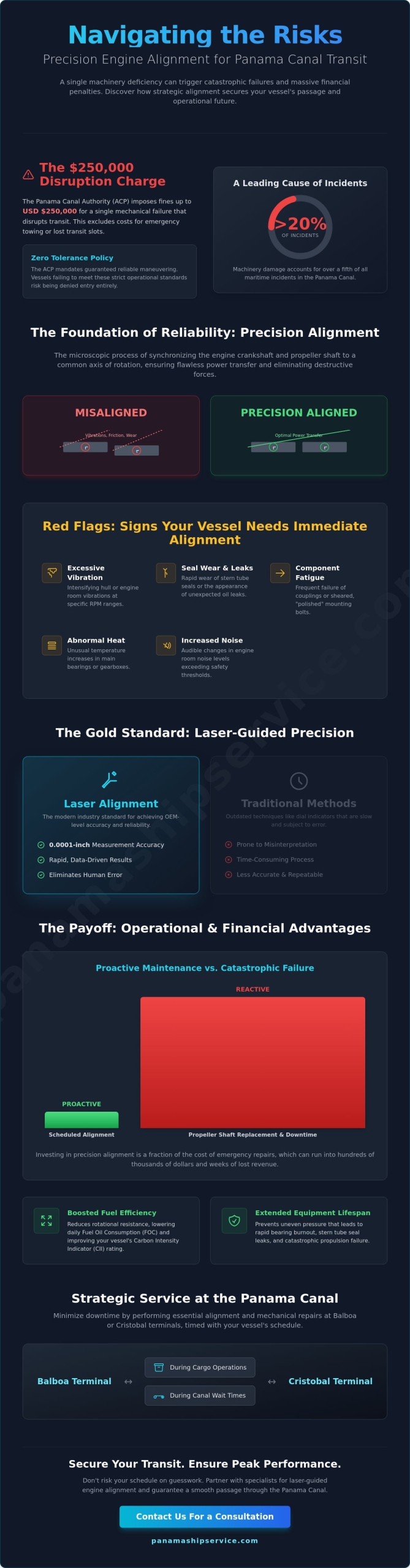
Marine engine alignment is the technical process of ensuring the engine crankshaft is positioned with absolute precision relative to the propeller shaft. While it sounds straightforward, the tolerance for error is microscopic. In the high-pressure environment of the Panama Canal, where machinery damage accounts for over 20% of all maritime incidents, these services are not optional. The Panama Canal Authority (ACP) maintains zero tolerance for vessels that cannot guarantee reliable maneuvering during transit. A single mechanical failure in the locks can trigger disruption charges as high as $250,000, excluding the astronomical costs of emergency towing and lost transit slots.
To understand the technical foundation of this process, one must ask: What is Shaft Alignment? At its core, it’s the synchronization of two or more rotating shafts to ensure they share a common axis of rotation during operation. The primary goals of professional marine engine alignment services are to reduce internal friction, eliminate destructive vibrations, and ensure optimal power transfer from the prime mover to the propeller. As we move through 2026, modern engine designs are becoming lighter and more efficient, making them far more sensitive to even minor deviations than the heavy iron blocks of the past.
The Link Between Alignment and Fuel Efficiency
Efficiency in the shipping industry is measured in grams of fuel per kilowatt-hour. Even a 1mm deviation in alignment significantly increases rotational resistance within the propulsion train. This friction forces the engine to work harder to maintain speed, which directly spikes your daily fuel oil consumption (FOC). By utilizing expert marine engine alignment services, operators can ensure their vessels run at peak thermodynamic efficiency. Precision alignment also plays a vital role in reducing a vessel’s Carbon Intensity Indicator (CII) by ensuring maximum thrust is generated for every ton of fuel consumed.
Preventing Catastrophic Propulsion Failure
Propulsion failure often starts at the bearings. When shafts don’t sit perfectly, they create uneven pressure points that lead to rapid bearing burnout and stern tube seal leaks. The financial disparity between proactive and reactive maintenance is staggering. Replacing a damaged propeller shaft is a logistical nightmare that can cost hundreds of thousands of dollars and weeks of unscheduled downtime. In contrast, a scheduled alignment check is a fraction of that investment. Because of these risks, many insurance providers now mandate alignment certification for aging vessels before they’ll underwrite transits through strategic hubs like Panama. Don’t wait for a breakdown in the locks to realize your shafts are out of true.
Signs Your Vessel Needs Immediate Engine Alignment
Identifying misalignment before it reaches a critical failure point is essential for maintaining your Panama Canal transit schedule. While some mechanical wear is expected over time, specific red flags indicate that your propulsion system is under undue stress. Ignoring these symptoms often results in the machinery failures that account for a significant portion of canal incidents. If your crew reports any of the following, it’s time to schedule professional marine engine alignment services:
- Excessive hull or engine room vibration that intensifies at specific RPM ranges.
- Rapid wear of stern tube seals or the appearance of unexpected oil leaks.
- Abnormal temperature increases in main bearings or gearboxes during routine monitoring.
- Frequent failure of flexible couplings or sheared, “polished” mounting bolts.
- Increased noise levels in the engine room that exceed standard crew safety thresholds.
Vibration Analysis: The First Warning Sign
Differentiating between normal engine harmonics and misalignment-induced vibration is a core skill for any chief engineer. Every engine has natural vibration patterns, but misalignment creates distinct, directional forces that don’t follow standard profiles. Modern predictive maintenance relies on sophisticated vibration monitoring tools to catch these deviations early. At Panama Ship Service, we use this diagnostic data to prioritize repairs during narrow transit windows, ensuring that minor tremors don’t turn into a total propulsion loss in the middle of the Culebra Cut.
Mechanical Wear and Component Fatigue
When you inspect your engine room, look closely at the coupling bolts. Shearing or “polishing” marks on the bolt shanks are clear indicators of component movement caused by an offset axis. This misalignment also places an excessive axial load on the main engine’s thrust bearing, leading to heat spikes and eventual metal-on-metal contact. Early adoption of laser alignment in shipbuilding has proven that data-driven adjustments significantly extend the life of these critical components by distributing loads evenly.
If vibration persists after a professional alignment, the root cause may lie outside the engine room. Fouled propellers or hull damage can mimic misalignment symptoms by creating uneven torque. This is why we recommend coordinating marine engine alignment services with professional underwater hull services to ensure the entire propulsion line is optimized. If you suspect your vessel is losing efficiency, a comprehensive mechanical survey is the most reliable way to secure your transit. Our team is ready to provide a detailed assessment to keep your operations on schedule.
Modern Precision Techniques: Laser Alignment vs. Traditional Methods
The transition from traditional piano wire and dial indicators to modern laser systems represents a significant leap in maritime engineering. While dial indicators remain a valid tool for certain older vessel types with flexible hulls, they often lack the repeatability required for high-performance 2026 machinery. Modern marine engine alignment services now rely almost exclusively on laser shaft alignment to meet OEM tolerances. These systems eliminate the risk of “sag” associated with long-distance mechanical measurements, ensuring the centerline of the engine remains perfectly collinear with the propeller shaft.
One critical hurdle that manual methods often miss is the “Soft Foot” condition. This occurs when one or more of the engine’s mounting feet don’t sit flat on the bedplate. If you tighten the mounting bolts on a soft foot, you’ll actually warp the engine frame, causing internal misalignment that no amount of external adjustment can fix. Identifying and correcting this before beginning the final alignment is a hallmark of professional service. Proper execution here covers the critical aspects of propulsion system installation, protecting the crankshaft from destructive torsional stress.
The Advantages of Laser Shaft Alignment
Precision is the primary benefit of modern technology. Laser systems can achieve measurement resolutions as small as 0.0001 inches, a level of accuracy impossible with manual tools. For operators in Panama, time is the most valuable commodity. We can typically complete a full alignment within a single 12-hour port stay, allowing you to maintain your transit slot without delay. Additionally, these systems generate comprehensive digital reports. These documents serve as vital proof for class approval and provide a baseline for your vessel’s long-term maintenance records.
Thermal Growth: The Tropical Factor
A common oversight in engine maintenance is failing to account for thermal expansion. Panama’s ambient sea temperatures, which frequently exceed 28°C (82°F), cause the engine bedplate and block to expand significantly during operation. An engine that appears perfectly aligned while “cold” in the shipyard will shift as it reaches working temperature at sea.
Expert marine engine alignment services calculate specific offsets to compensate for this growth. We align the engine to a “cold” state that anticipates the exact position the components will take when they are hot and under load. This ensures the propulsion line is optimized for actual working conditions, not just static measurements at the pier. Ignoring this tropical factor leads to increased vibration and bearing wear once the vessel begins its deep-sea voyage after transit.
Strategic Alignment Services at the Panama Canal (Balboa & Cristobal)
Panama serves as a strategic operational window for complex technical maintenance. Rather than scheduling costly, separate dry-docking periods, experienced operators utilize the mandatory waiting times before a canal transit to perform critical propulsion checks. Our marine engine alignment services are engineered to integrate seamlessly into these high-pressure logistics. By boarding technicians while your vessel is at anchorage or during active cargo operations, we eliminate the need for additional, unscheduled downtime. This proactive approach is frequently combined with marine surveys in Panama, providing a consolidated technical report that satisfies both class requirements and strict ACP safety protocols.
When the Panama Canal Authority flags a vessel for maneuvering deficiencies, the clock starts ticking immediately. A failed propulsion system in the locks isn’t just a repair issue; it’s a massive liability. We maintain a 24/7 emergency response capability at both canal entrances to handle these critical situations. Our teams are equipped to perform rapid diagnostics and adjustments, ensuring that a minor vibration issue doesn’t lead to a denied transit or a six-figure disruption fee. This localized expertise allows us to act as a dependable partner when timing and technical precision are equally vital.
Balboa Port: Pacific Side Technical Support
The Balboa anchorage is the primary staging area for southbound vessels and large tankers. Its proximity to our technical headquarters allows for rapid boarding of engineering teams, even on short notice. We specialize in supporting deep-draft vessels and VLCCs that require rigorous propulsion checks before entering the narrow canal channels. Coordinating these repairs with the Panama Canal Authority (ACP) is a logistical challenge we handle daily. We ensure that all work is performed within approved repair windows, maintaining your vessel’s “Canal-ready” status without compromising your scheduled transit time.
Cristobal Port: Atlantic Side Solutions
For northbound transits, the Cristobal terminal offers a strategic point for pre-entry alignment verification. Here, we integrate our alignment checks with broader mechanical ship repairs in Panama to address any issues identified during the voyage across the Caribbean. Our technicians have immediate access to specialized tooling and spare parts through local chandlers, which is vital for quick turnarounds. Whether it’s correcting a minor misalignment or performing a full propulsion survey, we ensure your ship enters the locks with maximum reliability. If you require immediate technical assistance to secure your transit, you can rely on our professional mechanical ship repair services to get the job done right.
Why Partner with Panama Ship Service for Engine Alignment?
Choosing the right partner for marine engine alignment services in Panama is a strategic decision that directly affects your operational bottom line. We present ourselves as a reliable, expert presence in a high-pressure environment where timing is everything. Our team understands the fiscal responsibility involved in managing a global fleet. We focus on tangible benefits: the reduction of overhead, the optimization of schedules, and the elimination of technical complications. By delegating your alignment needs to our seasoned veterans, you ensure your vessel remains “Canal-ready” throughout its transit.
Our technicians are highly trained and familiar with major OEM engine brands, including MAN, Wärtsilä, and WinGD. This technical depth allows us to deliver precision adjustments that align with original manufacturer specifications. We don’t just fix symptoms; we solve the underlying mechanical issues that cause vibration and excessive fuel consumption. Our commitment to efficiency means we prioritize your schedule, ensuring that maintenance work never becomes the cause of a missed transit slot. We act as a comprehensive service provider, handling complex tasks without unnecessary complication or delay.
A Comprehensive Approach to Ship Maintenance
We offer more than just isolated technical adjustments. Our mechanical ship repairs team collaborates directly with our alignment specialists to provide a unified solution for your propulsion train. This consolidation is a significant advantage for ship managers who need a single point of contact to handle multiple technical requirements in a single port stay. Whether you are dealing with a critical engine room repair or require underwater hull services to investigate persistent vibration, we manage the entire project from start to finish. This systematic approach also ensures full MARPOL compliance during all engine room activities, protecting your vessel from regulatory scrutiny while in Panamanian waters.
Request a Technical Consultation
Operational efficiency begins long before your vessel reaches the anchorage. To provide an accurate pre-arrival quote and prepare the necessary specialized tooling, we recommend sharing recent engine performance data and vibration reports with our engineering team. This proactive communication allows us to hit the deck running as soon as your vessel arrives. We maintain 24/7 availability for emergency breakdowns at the locks, providing a responsive lifeline for vessels identified with deficiencies by the ACP. Contact Panama Ship Service today for a comprehensive propulsion health check. We are ready to help you minimize vessel expenses and secure an on-time Panama Canal transit through expert marine engine alignment services.
Secure Your Transit with Precision Engineering
Maintaining operational reliability at the Panama Canal requires more than routine maintenance; it demands technical precision. Professional marine engine alignment services provide the critical foundation for vibration-free performance and long-term component health. By utilizing advanced laser technology and accounting for tropical thermal growth, you protect your vessel from the catastrophic failures that lead to denied transits and excessive disruption fees. You can delegate these technical complexities to a partner who understands the high-stakes environment of the Balboa and Cristobal terminals.
Panama Ship Service offers a comprehensive one-stop-shop for all your maritime needs, from class-approved technical surveys to mechanical repairs. Our 24/7 emergency response teams are always ready to ensure your propulsion system meets the strict requirements of the Panama Canal Authority. Don’t leave your schedule to chance when expert support is available at both canal entrances. Contact Panama Ship Service for expert marine engine alignment today and ensure your vessel operates at peak efficiency.
Frequently Asked Questions
How long does a typical marine engine alignment take in Panama?
A standard alignment typically takes 8 to 12 hours, though complex multi-engine setups may require more time. This timeframe is designed to fit within a single port stay or a standard canal waiting period. Our technicians prioritize efficiency to ensure you don’t miss your transit slot. We use modern laser systems to speed up the measurement process, providing immediate results without compromising on precision.
Can engine alignment be performed while the vessel is at anchor?
Yes, alignment can be performed at anchor, provided the sea state is calm enough to prevent excessive hull movement. This is a common practice at the Balboa and Cristobal anchorages while vessels stage for their Panama Canal transit. Performing the work at anchor allows you to complete essential maintenance without berthing. Our teams are fully equipped to board vessels at anchorage with all necessary laser diagnostic tools.
What is the difference between shaft alignment and bore alignment?
Shaft alignment focuses on the collinearity between the engine crankshaft and the propeller shaft to ensure smooth rotation. Bore alignment involves the internal alignment of the engine block or stern tube bores themselves. While both are critical for propulsion health, shaft alignment is the more frequent requirement for maintaining operational efficiency and preventing bearing wear during standard service intervals in the Panama Canal hub.
Is laser alignment required for older vessels with manual mounting?
Laser technology is highly recommended for older vessels because it provides a level of accuracy that manual dial indicators cannot match. Older hulls often have more flexibility, making precise measurement even more important to prevent stress. Professional marine engine alignment services use lasers to identify “soft foot” conditions and other structural issues that are common in aging vessels but difficult to detect with traditional methods.
How often should a vessel’s engine alignment be checked?
You should check your alignment every 12 to 24 months or whenever major propulsion components are serviced. It’s also vital to perform a check after any grounding or significant hull impact that might shift the engine bedplate. Regular inspections prevent minor deviations from turning into catastrophic failures, ensuring your vessel remains compliant with the Panama Canal Authority’s strict maneuvering and safety standards.
Can misalignment cause issues with the Panama Canal transit pilotage?
Yes, misalignment causes unpredictable engine response and excessive vibration, both of which impact maneuvering safety. The Panama Canal Authority (ACP) requires vessels to be in peak mechanical condition for pilotage through the locks. If a pilot identifies a lack of reliable propulsion control, they’ll likely deny transit. This results in disruption charges up to $250,000 and significant logistical delays for your entire voyage.
What happens if a vessel fails an alignment check during a survey?
If a vessel fails an alignment check, immediate corrective action is necessary to maintain class approval and transit eligibility. Our team provides 24/7 emergency response to rectify these issues at the Balboa or Cristobal terminals. We identify the root cause, perform the necessary adjustments, and re-verify the data to ensure the vessel meets all required safety tolerances before the Panama Canal Authority inspectors arrive.
Does Panama Ship Service provide class-approved alignment reports?
We provide comprehensive, digital alignment reports that meet the strict requirements of major classification societies. These documents include all measurement data, thermal growth compensations, and final adjustment figures for your records. Having class-approved marine engine alignment services documented in your technical file simplifies the survey process and provides a clear, professional history for your vessel’s propulsion system during its time in Panama.