
In the high-stakes world of maritime operations, vessel efficiency is paramount. Every component plays a role in performance, but none is as critical to propulsion as the propeller. Over time, marine biofouling creates a rough surface that increases drag and forces your engine to work harder, burning more fuel and slowing you down. This guide explains the process, benefits, and technical standards of professional propeller polishing, empowering you to make a cost-effective decision that reduces fuel consumption and maintains your vessel’s peak performance.
Why Propeller Polishing is a Critical Investment for Your Vessel
Viewing propeller polishing as a routine operational investment rather than an occasional repair is key to managing vessel efficiency. A perfectly smooth propeller surface is fundamental to achieving optimal hydrodynamic performance. This proactive maintenance task directly reduces drag, leading to significant and measurable savings on every voyage. It is an essential service for any cost-conscious ship operator focused on maintaining a competitive edge.
The Direct Impact on Fuel Consumption and Costs
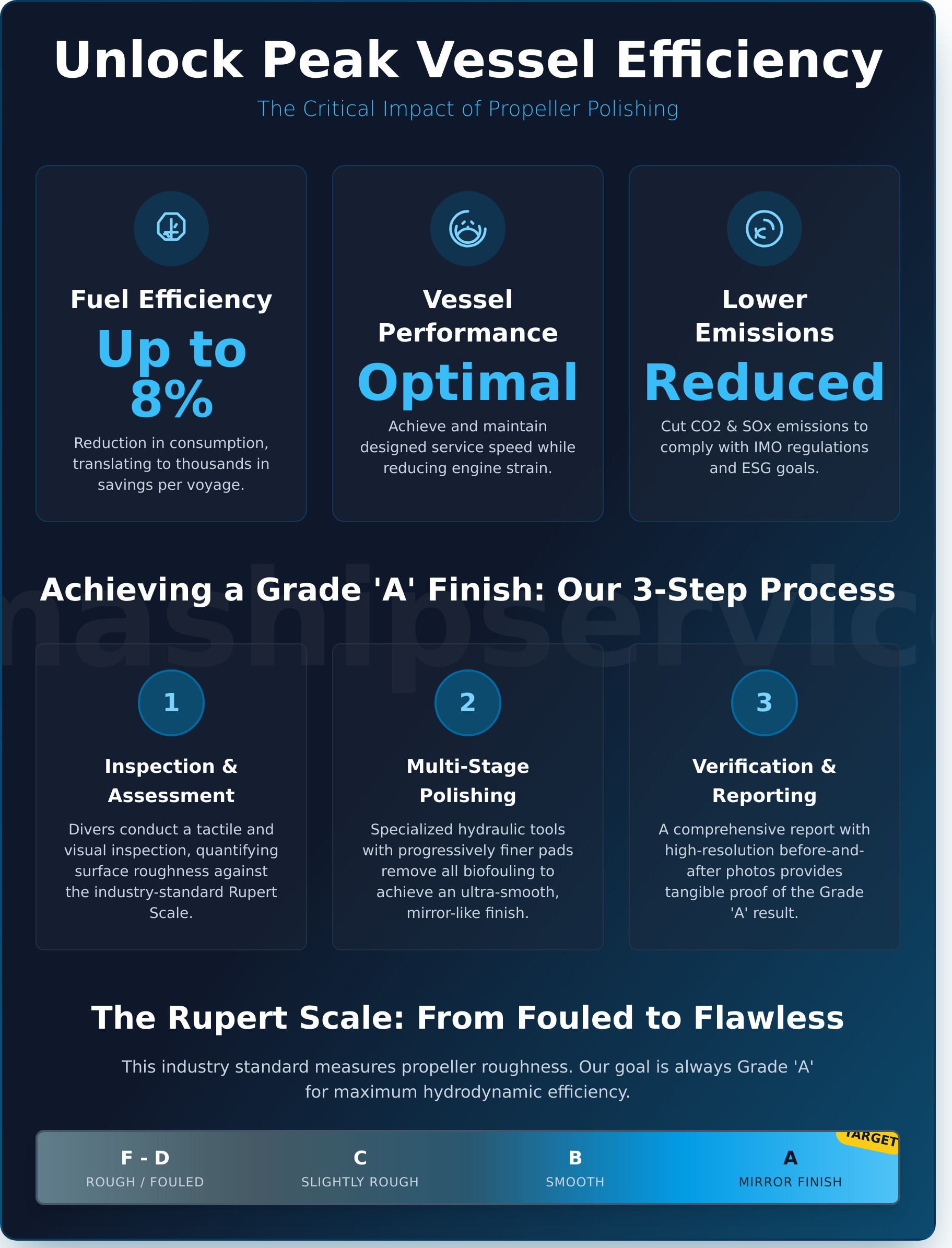
Even a thin layer of marine growth or calcareous deposits on propeller blades dramatically increases surface roughness. This friction creates significant drag, which in turn increases the engine load required to maintain speed. Professional underwater polishing can improve fuel efficiency by up to 8%, a figure that translates directly into thousands of dollars in savings per voyage. By restoring the propeller to a near-new condition, you immediately lower your operational expenditure.
This principle of restoring assets to a near-new condition to boost efficiency applies across scales, from industrial equipment to personal items. To see how professionals handle delicate restoration for things like footwear, check out Hustle Laundry.
Enhancing Vessel Performance and Maintaining Schedules
A fouled propeller doesn’t just burn more fuel; it directly compromises your vessel’s performance. The increased drag can lead to a noticeable loss of speed, making it difficult to maintain tight schedules. A clean, polished propeller allows the vessel to achieve and maintain its designed service speed with less engine strain, reducing the risk of mechanical wear and tear. For operators where “just-in-time” arrivals are crucial, maintaining optimal propulsion is essential to avoiding costly penalties and operational disruptions.
Reducing Emissions and Environmental Footprint
In an era of increasing environmental scrutiny, operational efficiency is directly linked to sustainability. Lowering fuel consumption through regular propeller polishing has the immediate benefit of cutting harmful CO2 and SOx emissions. This proactive step helps ensure your vessel complies with international environmental regulations, such as those set by the IMO. Furthermore, it demonstrates a commitment to sustainable shipping practices, aligning with corporate sustainability and ESG (Environmental, Social, and Governance) goals.
The Underwater Propeller Polishing Process Explained
Our highly skilled and certified divers execute propeller polishing using specialized hydraulic equipment designed for precision and efficiency. The entire process is completed in-water while your vessel is at anchorage or alongside, eliminating the need for costly and time-consuming dry-docking. Upon completion, we provide comprehensive reports, including detailed before-and-after photographs, to give you full transparency and verification of the work performed.
Step 1: Initial Inspection and Roughness Assessment
The process begins with a thorough underwater inspection. Our divers perform a detailed tactile and visual assessment of each propeller blade, identifying the extent and type of marine fouling. To quantify the surface condition, we assess it against the industry-standard Rupert Scale, which provides a clear metric for roughness. This initial assessment is crucial for determining the precise level of polishing required to restore the propeller to optimal condition.
Step 2: Multi-Stage Polishing for a Grade ‘A’ Finish
Using specialized polishing heads, our team begins the cleaning process. The first stage involves using coarse abrasive discs to carefully remove all hard fouling, such as barnacles and calcareous growth, without damaging the propeller itself. Subsequent stages use progressively finer pads to systematically smooth the blade surface, removing any remaining imperfections. The final buffing stage achieves a mirror-like, ultra-smooth finish, corresponding to a Rupert Grade ‘A’-the highest industry standard for smoothness.
Step 3: Post-Service Reporting and Verification
Transparency and accountability are paramount. After the polishing is complete, you will receive a comprehensive service report containing high-resolution underwater images that clearly show the “before” and “after” condition of your propeller. The report also includes our divers’ observations and confirmation that a Grade ‘A’ finish was achieved. This documentation is a vital record for your vessel’s maintenance logs and provides tangible proof of the value delivered. When you are ready to restore your vessel’s efficiency, Schedule your expert propeller polishing service in Panama.
Why Panama Ship Service is Your Trusted Partner at the Canal
The Panama Canal is one of the world’s most critical maritime chokepoints, a location where operational efficiency and timing are everything. Delays are not an option. We are experts in providing fast, reliable, and class-approved underwater services without disrupting your transit schedule. Our strategic location allows us to service vessels at both the Pacific and Atlantic anchorages, providing unmatched flexibility and responsiveness.
Minimize Delays During Your Canal Transit
We understand the immense pressure of maintaining a strict transit schedule. Our team coordinates seamlessly with your vessel’s agent to perform all services within your allotted time at anchorage. Our rapid response team is available 24/7 to handle both planned maintenance and urgent, last-minute service requests. By choosing Panama Ship Service, you avoid the risk of costly downtime and ensure your vessel proceeds through the canal without delay.
Integrated Underwater Services: Your One-Stop Solution
Maximize your vessel’s efficiency by bundling services. Propeller polishing is most effective when combined with a full underwater hull cleaning, removing all biofouling to drastically reduce drag. As a one-stop provider, we also offer class-approved in-water surveys (UWILD) and a wide range of underwater repairs. Consolidating your underwater service needs with Panama Ship Service simplifies logistics, reduces costs, and ensures you receive consistently high-quality work from a single, trusted provider.
Frequently Asked Questions about Propeller Polishing
What is the Rupert Scale for propeller polishing?
The Rupert Scale is an industry-standard visual comparator scale used to measure the surface roughness of a propeller. It ranges from Grade ‘A’ (very smooth, mirror-like finish) to Grade ‘F’ (very rough and heavily fouled). Our goal is always to achieve a Grade ‘A’ or ‘B’ finish to ensure maximum efficiency.
How often should a ship’s propeller be polished?
The ideal frequency depends on the vessel’s trading routes, anti-fouling system, and operational profile. However, for most vessels, polishing every 6 to 12 months is recommended to maintain optimal fuel efficiency and prevent the buildup of hard calcareous fouling that can damage the propeller surface.
Can propeller polishing be done at the same time as underwater hull cleaning?
Yes, absolutely. It is highly recommended to perform both services during the same operation. A clean hull and a polished propeller work together to provide the maximum possible reduction in hydrodynamic drag, leading to the greatest fuel savings.
How long does a typical propeller polishing service take?
A standard propeller polishing for a commercial vessel can typically be completed by a team of divers in 4 to 8 hours, depending on the size of the propeller and the initial level of fouling. We work efficiently to ensure the service is completed well within your vessel’s scheduled time at anchorage.
Is your service approved by major classification societies?
Yes, our underwater procedures and diver qualifications meet the stringent standards required by all major classification societies, including DNV, ABS, Lloyd’s Register, and Bureau Veritas. We can perform these services in lieu of dry-docking in accordance with class requirements.
The principle of using specialized deep cleaning to restore an asset’s value and performance applies across many industries. While our focus is on maritime vessels, you can see how similar challenges with tough grime are tackled in a different context when you check out Do Pure Cleaning.
Don’t let an inefficient propeller drain your profits and delay your schedule. Investing in professional, regular polishing is one of the most cost-effective measures you can take to enhance vessel performance and reduce your environmental impact. Our expert team is ready to deliver a class-approved, Grade ‘A’ finish at the Panama Canal, ensuring your vessel operates at its peak. Request a competitive quote for propeller polishing services.