
A single mechanical failure in the Canal’s narrow reaches can trigger a disruption charge of up to $250,000, according to current ACP advisories. When your vessel’s steerage is compromised, the threat isn’t just the fine; it’s the cascading cost of emergency dry-docking and lost transit slots. You likely already recognize that maintaining technical compliance under the OP Notice to Shipping N-1-2026 is non-negotiable for a smooth passage. Securing expert ship rudder repair Panama during your scheduled wait time is the most efficient way to mitigate these risks and protect your bottom line.
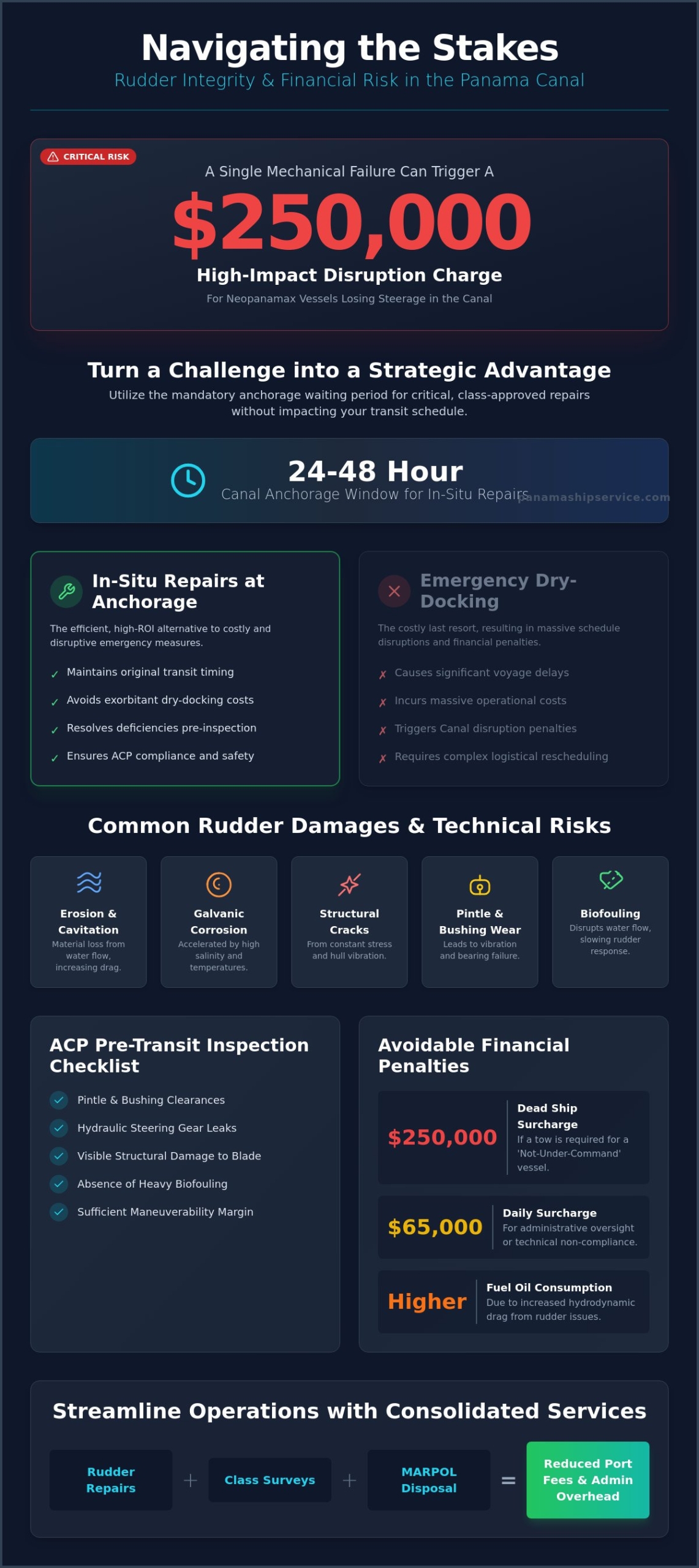
In this article, you’ll learn how to coordinate class-approved rudder repairs that ensure full maneuverability while keeping your transit timing intact. We’ll explore how afloat repair solutions can significantly reduce maintenance overhead compared to traditional dry-docking. You’ll also discover how consolidating mechanical services with underwater inspections can streamline your port stay and reduce administrative burdens. By the end, you’ll have a clear roadmap for managing critical rudder issues without the logistical nightmare of a service interruption.
Key Takeaways
- Recognize how maintaining rudder integrity helps you avoid the severe financial penalties associated with ACP technical deficiencies.
- Compare the significant cost savings of in-situ ship rudder repair Panama against the overhead of unplanned dry-docking.
- Master the logistical strategy of performing technical work during the 48-hour anchorage window to ensure zero impact on your transit slot.
- Identify the most vulnerable rudder components, including pintle areas and leading edges, to prioritize preventative maintenance in tropical waters.
- Learn how consolidating mechanical repairs with underwater services reduces administrative overhead and overall port expenses.
The Critical Role of Rudder Integrity in Panama Canal Transits
For any vessel operator, Rudder Integrity represents the mechanical and structural readiness of every component within the steering system. In the high-stakes environment of the Panama Canal, this integrity is the foundation of a successful transit. It isn’t just about the ability to turn; it’s about the reliability of the entire assembly, from the pintles and bushings to the hydraulic actuators. The Panama Canal Authority (ACP) views steerage as its primary technical priority because the waterway’s configuration leaves no room for mechanical hesitation.
The risks of a rudder failure are most acute in the Culebra Cut or during delicate lock maneuvers. These areas are characterized by narrow channels and heavy traffic where a loss of control can lead to groundings or collisions. Beyond the immediate safety concerns, a poorly maintained rudder creates significant financial drag. Structural deformities or surface irregularities increase hydrodynamic resistance. This resistance forces the main engine to consume more fuel to maintain transit speed, directly impacting your fuel oil consumption (FOC) and operational margins. Owners who prioritize ship rudder repair Panama before their scheduled arrival avoid the logistical bottlenecks of failed inspections.
Steerage Requirements for Safe Lock Passage
Navigating Neo-Panamax vessels through the newer locks requires extreme precision, as these massive ships often have only a few feet of clearance on either side. If a vessel experiences a ‘not-under-command’ (NUC) status due to steering failure, the ACP will immediately suspend the transit. This results in emergency tug assistance fees and potential fines for canal blockage. Maneuverability margin is the calculated surplus of steering force available to counteract external environmental pressures like wind and current during transit. Without this margin, a vessel cannot safely hold its line in the locks.
ACP Safety Inspections and Technical Compliance
ACP inspectors are trained to identify specific rudder-related deficiencies during pre-transit boardings. They look for excessive pintle clearance, leaking hydraulic seals, or visible structural cracks that could compromise control. Proactive mechanical ship repairs in Panama allow operators to rectify these issues at anchorage, preventing a transit denial before it happens. Biofouling also plays a critical role; heavy marine growth on the rudder surface disrupts laminar flow and increases response time. This delay makes the ship feel sluggish to the pilot, which is a frequent cause for technical rejection. Maintaining a clean, structurally sound rudder is essential for meeting the strict 2026 technical standards.
Common Rudder Damages and Technical Repair Standards
Ship rudder assemblies endure constant mechanical and environmental stress. In the tropical waters surrounding the Panama Canal, high salinity levels and water temperatures often exceeding 28°C significantly accelerate electrochemical corrosion. These conditions make regular technical assessments vital for any vessel scheduled for transit. Proactive maintenance ensures that minor pitting doesn’t evolve into a structural failure that could halt your canal passage.
Erosion and cavitation represent the most common structural threats. Cavitation occurs when high-velocity water flow creates low-pressure zones, causing vapor bubbles to implode against the rudder surface. This pitting usually targets the leading edge and pintle areas. If left unaddressed, this erosion can compromise the plate thickness of the rudder blade. Coordinating a ship rudder repair Panama while at anchorage allows for the installation of doubler plates or sacrificial anodes to halt this degradation before the ACP denies transit.
Structural cracks are another frequent issue, often caused by fatigue from propeller wash vibration. These cracks typically appear in the rudder horn or along the internal diaphragms of the blade. Mechanical failures in the steering gear linkages or pintle bushings are equally problematic. They manifest as sluggish steering response or excessive hydraulic pressure during maneuvers. Identifying these symptoms early prevents the need for emergency intervention in the middle of the Culebra Cut.
Pintle and Bushing Wear Analysis
Measuring ‘rudder drop’ and pintle clearance is a critical diagnostic task that divers perform without dry-docking. Major classification societies like ABS, DNV, and LR establish strict maximum allowable tolerances for these clearances. Usually, these limits range from 1.5mm to 5mm, depending on the shaft’s diameter. If clearances exceed these Technical Repair Standards, the vessel faces a high risk of bearing failure. Superintendents must watch for hydraulic oil contamination or metallic grinding sounds during steering tests as indicators of wear.
Underwater Welding and Steel Fabrication
Modern technical solutions allow for significant repairs to be completed afloat. For minor structural cracks, class-approved wet welding is an efficient option. When more complex marine steel fabrication is required, we utilize cofferdams. These structures create a dry environment around the repair site, ensuring high-quality welds that maintain the vessel’s class status. If your vessel’s steering feels unresponsive, scheduling a technical survey is the most cost-effective way to ensure your ship rudder repair Panama is completed to class standards before your transit slot.
In-Situ vs. Dry Dock Rudder Repairs: A Cost-Benefit Analysis
Shipowners in 2026 face a stark financial choice when steering deficiencies arise. A traditional dry dock repair for a Post-Panamax vessel can cost between $600,000 and $1,200,000 once you factor in dock rental and mechanical labor. In contrast, performing a ship rudder repair Panama while the vessel remains afloat typically reduces the total maintenance bill by 40% to 60%. This fiscal efficiency is why in-situ repairs have become the strategic standard for vessels transiting the Canal.
The ‘Zero-Downtime’ advantage is the most compelling reason to choose in-water services. A single day of downtime for a vessel in the Panama area costs between $50,000 and $150,000 depending on the market and vessel class. By completing repairs during a scheduled cargo operation or the mandatory 24 to 48-hour wait for a transit slot, you eliminate off-hire days entirely. Technical limitations do exist; while pintle replacements and blade patching are manageable in-water, a complete rudder stock replacement still requires a shipyard. However, for the majority of wear-related issues, in-situ methods meet all Panama Canal Authority regulations for technical readiness.
The ROI of In-Water Rudder Maintenance
Calculating the return on investment for in-water maintenance requires looking beyond the service invoice. In 2026, high bunker prices make the fuel cost of deviating to a regional shipyard a significant overhead. Avoiding this deviation, combined with the elimination of shipyard wait times, often means a pintle clearance adjustment pays for itself before the ship even exits the Canal. If you don’t address these issues proactively, you risk the $250,000 disruption charge levied by the ACP for mechanical failures during transit.
Class Approval for Underwater Repairs
Panama Ship Service streamlines the certification process by coordinating directly with class surveyors from ABS, DNV, and Lloyd’s Register. We use high-definition video inspections to provide surveyors with real-time, clear visuals of the rudder’s condition. This transparency is vital for securing repair permits and ensuring the work is recognized as a permanent repair rather than a temporary fix. Our documentation package includes pre- and post-repair measurements, welding certificates, and NDT test results. This rigorous approach ensures your ship rudder repair Panama maintains your vessel’s structural integrity and insurance compliance without the need for a follow-up dry dock session.
Logistical Strategy: Scheduling Repairs During Canal Wait Times
The 24 to 48-hour anchorage window prior to Canal entry is often viewed as lost time. For proactive operators, this period is a strategic maintenance opportunity. By scheduling a ship rudder repair Panama during this unavoidable wait, you transform a logistical bottleneck into a high-ROI maintenance window. This approach ensures your vessel meets the strict technical standards of the OP Notice to Shipping N-1-2026 without adding a single hour to your voyage timeline.
Successful execution requires a 24/7 mobilization promise. Our technical teams are ready to board your vessel at anchorage immediately upon arrival, often completing critical repairs before the pilot is even assigned. Coordination with your ship agent and the Panama Canal Authority (ACP) is vital to ensure that ongoing mechanical work doesn’t interfere with your assigned transit slot. We manage these communications directly, providing the ACP with the technical assurances they require to authorize your passage.
Balboa and Cristobal Service Hubs
Choosing the correct side of the Isthmus for your repair depends on your vessel’s route and technical needs. Cristobal, on the Atlantic side, serves as a primary hub for vessels needing final rudder checks before entering the Gatun Locks. Balboa, on the Pacific side, offers more extensive facilities for heavy mechanical repairs and spare parts sourcing. While underwater visibility can vary seasonally, our divers are experienced in managing the local currents at both Balboa and Cristobal anchorages to ensure precise inspections. If you have concerns about your steering performance, contact us for a pre-arrival consultation to determine the best service location.
The Coordination Process with Panama Ship Service
Our systematic approach to ship rudder repair Panama is designed for speed and technical accuracy. We follow a three-step protocol to ensure your vessel remains on schedule:
- Step 1: Pre-arrival technical consultation. We review your vessel’s latest performance data and class reports to perform a preliminary damage assessment before the ship reaches Panamanian waters.
- Step 2: Technician and diver deployment. As soon as the vessel drops anchor at the designated point, our team mobilizes with all necessary equipment, including welding units and NDT tools.
- Step 3: Execution and steerage test. Following the repair, we conduct a comprehensive steerage test in the presence of the superintendent. We provide the necessary documentation for transit clearance immediately upon completion.
Panama Ship Service: Your Partner for Rudder & Mechanical Excellence
Panama Ship Service operates as a strategic technical partner for vessel owners navigating the complexities of the Canal. We don’t just fix parts; we provide a comprehensive operational shield against transit delays. By combining specialized ship rudder repair Panama with our extensive underwater hull services, we ensure your vessel’s entire propulsion and steering system is optimized for the locks. Our deep local knowledge allows us to navigate the evolving regulatory landscape, ensuring every repair meets the specific criteria set by the ACP for 2026.
Our expertise extends beyond simple blade patching to complex mechanical engine repairs. This total technical capability means you don’t need to coordinate with multiple vendors while your ship is at anchorage. We provide class-approved reporting and high-definition underwater video verification for every project. This transparency gives your superintendent and class surveyors immediate confidence in the structural integrity of the work performed. Delegating these technical complexities to a single, seasoned partner simplifies your entire Canal operation.
The One-Stop-Shop Advantage
Integrating multiple requirements into a single attendance reduces port fees and administrative overhead significantly. For instance, you can combine a rudder inspection with MARPOL disposal in Panama to consolidate service barge movements and logistics. This simplified billing model removes the friction of managing disparate technical providers during a time-sensitive transit window. Regular fleet partners and emergency cases receive priority scheduling, ensuring their transit slots remain protected regardless of the repair’s complexity.
Quality Assurance and 24/7 Response
Reliability is built on meticulous documentation and immediate responsiveness. Every ship rudder repair Panama concludes with a detailed post-repair report featuring high-resolution before and after photos along with precise clearance measurements. We maintain strict compliance with major classification societies like ABS, Lloyd’s Register, and DNV. You have direct access to our technical managers for real-time updates, ensuring you’re never in the dark about your vessel’s status. Our 24/7 operational availability in both Balboa and Cristobal means we’re ready to mobilize the moment your ship reaches the anchorage.
Secure Your Transit with Expert Technical Support
Maintaining rudder integrity is the most effective way to avoid the steep financial penalties of the ACP disruption charge. By choosing in-situ ship rudder repair Panama, you eliminate the need for costly dry-docking and keep your vessel’s schedule on track. You’ve seen how utilizing the anchorage window at Balboa or Cristobal allows for class-approved mechanical work without impacting your transit timing. This strategic approach transforms unavoidable wait times into high-ROI maintenance opportunities.
Panama Ship Service provides a consolidated technical solution that simplifies your port stay. We offer 24/7 emergency response with class-approved diving and mechanical teams ready to board at a moment’s notice. Our one-stop-shop model integrates repairs with marine surveys and MARPOL disposal to reduce your administrative overhead and port fees. Don’t let steering deficiencies compromise your Canal passage. Request a technical quote for rudder repair in Panama today to ensure your vessel’s maneuverability remains at peak performance. We look forward to supporting your fleet’s operational success in Panamanian waters.
Frequently Asked Questions
Can a ship’s rudder be repaired while the vessel is at anchor in Panama?
Yes, the majority of rudder repairs are completed at the Balboa or Cristobal anchorages while the vessel remains afloat. This in-situ approach allows technical teams to address structural cracks or mechanical wear without the logistical burden of dry-docking. It’s a standard procedure for ships waiting for their transit slot to ensure they meet maneuverability standards.
How long does a typical in-situ rudder pintle clearance measurement take?
A standard pintle clearance measurement typically takes between 2 and 4 hours to complete. Our divers use calibrated gauges to measure the ‘rudder drop’ and lateral clearances in real-time. These measurements are essential for verifying compliance with the 2026 ACP technical requirements before your vessel enters the lock system.
Is it possible to weld a rudder blade underwater at the Panama Canal?
Yes, we perform class-approved underwater welding for rudder blades using either wet welding techniques or dry-environment cofferdams. This service is critical for addressing cavitation pitting or stress-induced cracks on the blade surface. It ensures the rudder maintains its structural integrity without the vessel having to deviate to a regional shipyard.
Will rudder repair during my wait time affect my Panama Canal transit slot?
No, a properly coordinated ship rudder repair Panama is designed to fit within your existing 24 to 48-hour anchorage window. We work closely with ship agents and the ACP to ensure all technical work is finished before the pilot boards. This proactive scheduling helps you avoid the $250,000 disruption charge for mechanical failure during transit.
What are the most common rudder deficiencies that cause transit delays?
The most frequent deficiencies include excessive pintle clearance, hydraulic seal leaks, and heavy biofouling that slows steering response. These issues are often flagged during pre-transit inspections under the OP Notice to Shipping N-1-2026. Addressing these defects at anchorage prevents costly transit denials and the need for emergency tug assistance.
Do I need class approval for an underwater rudder repair in Panama?
Yes, all structural and mechanical repairs to the steering system must be authorized by a class surveyor. We facilitate this by providing high-definition video feeds and detailed technical reports to surveyors from ABS, DNV, or Lloyd’s Register. This process ensures the repair is recognized as permanent and compliant with international maritime safety standards.
What is the difference between rudder cleaning and rudder repair?
Rudder cleaning is a maintenance task focused on removing marine growth to reduce hydrodynamic drag and improve fuel efficiency. In contrast, ship rudder repair Panama involves restoring the mechanical or structural functionality of the steering gear. Repairs include tasks like welding doubler plates or replacing worn bushings to ensure safe maneuverability through the Canal.
Can Panama Ship Service source spare parts for rudder steering gear locally?
Yes, we maintain a robust local supply chain to source critical spare parts like hydraulic seals, bearings, and specialized fasteners. Our facilities in Balboa and Cristobal are equipped to handle urgent technical requirements for various vessel classes. This local capability reduces the need for expensive air-freight and ensures repairs are completed within your scheduled stay.