
A single day of delay at the Panama Canal can cost a Neopanamax vessel upwards of $65,000 in lost charter hire and rescheduling fees. When a hull defect is identified, the immediate instinct is to fear an emergency dry-docking that disrupts your entire operational schedule. You don’t have to choose between regulatory compliance and your bottom line. An expert underwater hull plate repair provides a permanent, class-approved solution that keeps your vessel in the water and on its way to the locks.
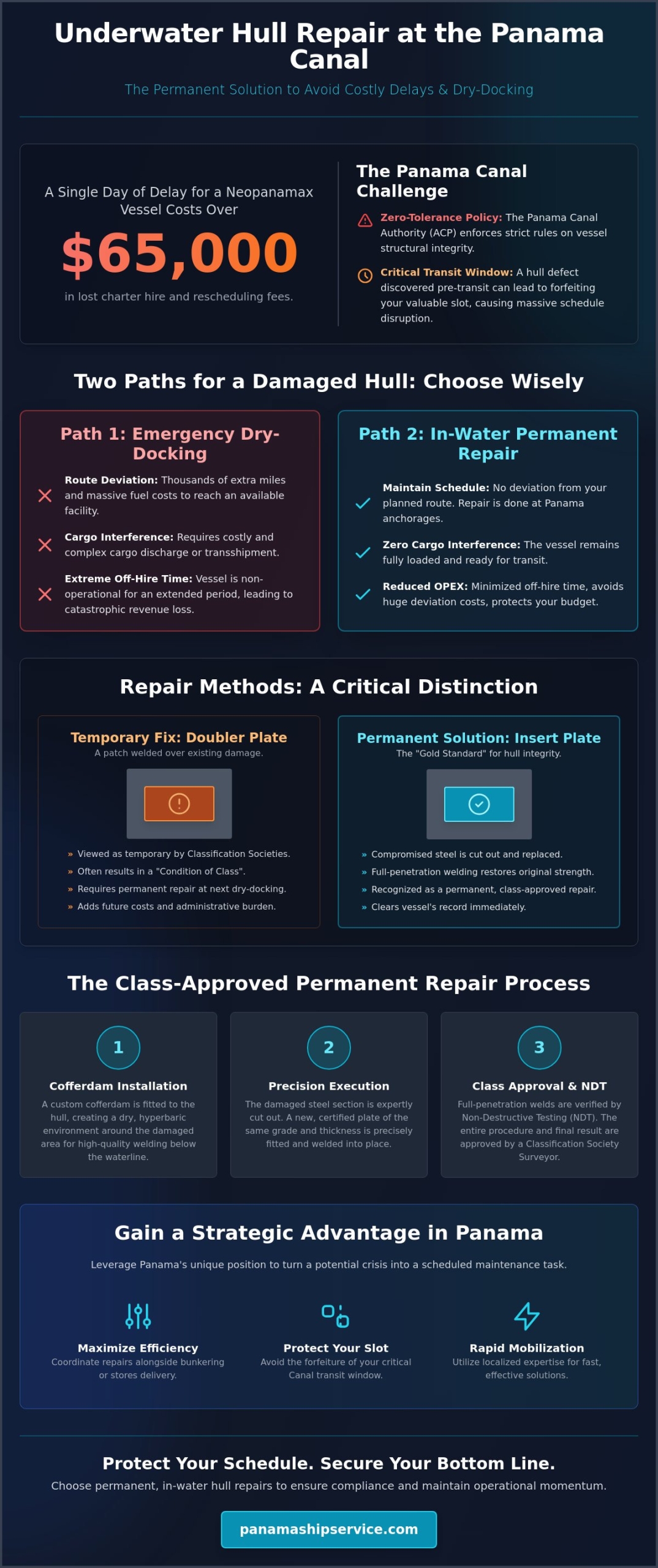
We understand the intense pressure of meeting the Panama Canal Authority’s zero-tolerance policy for mechanical and structural failures. You need a reliable partner who can execute complex technical tasks with precision and speed. Discover how permanent underwater repairs can eliminate off-hire time and significantly reduce your operating expenses. This article examines the specialized techniques used to meet the latest ACP Notice to Shipping requirements, ensuring your vessel remains compliant without deviating from its strategic transit window. By delegating these technical complexities to seasoned professionals, you can protect your schedule and your budget.
Key Takeaways
- Distinguish between temporary doubler plates and permanent insert plates to ensure long-term compliance with international maritime regulations.
- Learn how a class-approved underwater hull plate repair utilizes full-penetration welding and NDT testing to restore vessel structural integrity.
- Explore the critical role of classification society surveyors in approving repair procedures and final weld quality while the vessel remains in the water.
- Maximize operational efficiency by coordinating complex steel repairs alongside bunkering or stores delivery at Balboa and Cristobal anchorages.
- Reduce total OPEX by leveraging localized technical expertise and rapid mobilization to avoid the forfeiture of strategic Panama Canal transit slots.
The Necessity of Underwater Hull Plate Repair in Modern Shipping
Maintaining structural integrity is a constant challenge for ship owners and operators. Underwater hull plate repair has evolved from a temporary “emergency patch” into a sophisticated, class-approved engineering solution. This process involves the precision removal of damaged steel sections below the waterline and their replacement with new, certified plates. It’s a critical component of modern underwater ship husbandry, allowing vessels to address serious defects without the prohibitive costs of emergency dry-docking.
The Panama Canal serves as a strategic crossroads where timing is everything. Scheduling these repairs during a scheduled layover or while waiting for a transit slot transforms a potential crisis into a manageable maintenance task. It’s about maintaining momentum. When a vessel discovers a defect just before entering the locks, the ability to perform a permanent repair at a Balboa or Cristobal anchorage can save the voyage from total disruption. You don’t have to sacrifice your schedule to ensure your vessel’s safety.
Common Causes of Hull Plate Failure
Damage rarely happens at a convenient time. Impact damage from groundings or minor collisions in crowded waterways is a primary trigger for immediate intervention. Beyond physical trauma, localized corrosion poses a silent threat. Microbial Induced Corrosion (MIC) and pitting often occur in stagnant areas like ballast tanks or behind internal structures, eventually compromising the hull’s thickness. Additionally, mechanical wear on seachest gratings and overboard discharge areas can lead to thinning steel that fails to meet classification society safety standards.
The Economic Case for In-Water Steel Work
The financial argument for avoiding a dry-dock is undeniable. Consider the following factors that impact your bottom line:
- Elimination of Deviation: Turning a ship away from its planned route to reach the nearest available dry-dock can add thousands of miles and massive fuel costs.
- Zero Cargo Interference: Dry-docking often requires discharging or transshipping cargo, which is a logistical nightmare. In-water underwater hull plate repair allows the ship to remain loaded.
- Minimized Off-Hire Time: A single day of delay for a Neopanamax vessel can exceed $65,000 in lost revenue. Performing repairs during bunkering or crew changes at Panama anchorages keeps the vessel on its commercial schedule.
By choosing an in-water solution, operators effectively reduce their OPEX while satisfying the strict requirements of classification societies. It’s a pragmatic approach to high-stakes maritime maintenance. Delegating these repairs to experts in Panama ensures that technical issues don’t become financial disasters.
Permanent vs. Temporary Repairs: Insert Plates and Cofferdams
Choosing the right repair method is the difference between a minor operational hurdle and a recurring technical headache. Many operators initially consider doubler plates because they’re perceived as faster. However, doubler plates are merely patches welded over existing damage. Most classification societies view these as temporary measures. They often come with a “Condition of Class,” requiring you to perform a permanent repair at the next scheduled dry-docking. This adds future costs and administrative burdens that sophisticated owners prefer to avoid. In contrast, underwater hull plate repair using an insert plate is recognized as a permanent fix that clears your vessel’s record immediately.
The gold standard for a permanent underwater hull plate repair is the insert plate. This method involves cutting out the compromised steel and replacing it with a new plate of the same grade and thickness. By using full-penetration welding, the new section becomes a seamless part of the hull’s structure. This approach satisfies regulatory bodies and eliminates the need for future remedial work. Ensuring your vessel meets international safety standards is essential for Minimizing Transit Delays and maintaining a clean record with port state control.
The Cofferdam Advantage
Executing a permanent weld underwater requires a dry environment. We achieve this through advanced cofferdam technology. These custom-built structures are tailored to the specific curvature of your vessel’s hull. Once positioned, they’re secured using magnetic or mechanical lashings to create a watertight seal. By dewatering the interior of the cofferdam, we create a dry habitat that allows our diver-welders to perform high-quality surface welding while the ship remains afloat at anchorage. This precision ensures the weld meets the same rigorous standards as those performed in a shipyard.
Welding Standards and Plate Selection
Integrity depends on the quality of materials and the skill of the technician. We match the original hull specifications exactly, whether your vessel requires Grade A or high-tensile AH36 steel. Our teams utilize full-penetration welding techniques, ensuring a proper crown on the weld for maximum strength. Every diver-welder must hold current AWS or Class-level certifications to perform structural work. If you need technical guidance on selecting the right steel grade for your vessel, Panama Ship Service provides expert consultations and rapid mobilization.
Precision edge preparation and fit-up are critical. In an underwater environment, there’s no room for error. The alignment of the insert plate must be perfect to prevent stress concentrations that could lead to future cracking. By maintaining these high standards, we provide solutions that protect your asset’s long-term value and operational readiness. You don’t have to settle for temporary patches when permanent solutions are available at the Panama Canal.
Class Approval and NDT: Ensuring Structural Integrity
A successful underwater hull plate repair is only as good as the certification behind it. We coordinate directly with major classification societies, including ABS, Lloyd’s Register, and DNV, to ensure every step of the process meets international maritime standards. This collaboration starts long before the first diver enters the water. We submit detailed welding procedures and material certifications for pre-repair approval. A Class Surveyor oversees the operation, conducting a visual inspection of the fit-up and the final weld. This rigorous oversight transforms a technical task into a certified permanent solution.
Documentation is the final, critical step. Once the repair is complete and verified, we issue a comprehensive report. This document includes NDT results, material certificates, and the surveyor’s endorsement. It’s the evidence you need to remove a “Condition of Class” from your vessel’s record. By maintaining a transparent and documented workflow, we protect your ship’s regulatory standing and its commercial value. You can’t afford to have lingering technical questions during a high-stakes transit.
NDT Methods for Underwater Steel Work
Ensuring the repair is flawless before the cofferdam is removed requires specialized Non-Destructive Testing (NDT). Magnetic Particle Inspection (MPI) is our primary tool for detecting surface and near-surface flaws in the weld. It ensures that no microscopic cracks remain that could compromise the hull under pressure. We also utilize Ultrasonic Testing (UT) to verify the thickness and internal integrity of the new plate. To guarantee an absolute watertight seal, we perform Vacuum Box Testing. This method creates a pressure differential across the weld, revealing even the smallest leaks while the work area is still dry.
Regulatory Compliance at the Panama Canal
Operating within the Panama Canal jurisdiction requires strict adherence to Panama Canal Authority (ACP) safety and environmental requirements. We manage the environmental risks associated with steel cutting and welding to prevent any pollutants from entering the canal waters. Our team ensures that all activities at the Balboa or Cristobal anchorages comply with local port state control and ACP Notice to Shipping regulations. For more information on navigating these requirements, see our guide on Marine Surveys in Panama. We handle the technical bureaucracy so you can focus on your transit schedule.
Performing an underwater hull plate repair at a Panama anchorage is a strategic choice. It allows for high-level technical work to proceed without the vessel ever leaving its commercial path. By combining class-approved procedures with localized knowledge of ACP protocols, we ensure your vessel remains both seaworthy and compliant. This proactive approach to maintenance keeps your operations moving and your costs under control.
Minimizing Transit Delays: Logistical Planning in Panama
In the high-stakes environment of the Panama Canal, time is your most valuable asset. A delay doesn’t just affect one voyage; it cascades through your entire fleet’s schedule. Executing an underwater hull plate repair requires more than just technical skill. It demands flawless logistical coordination. We strategically mobilize our technical teams to meet your vessel at either the Balboa or Cristobal anchorages, ensuring that technical interventions happen during natural idle periods. This proactive planning prevents the forfeiture of transit slots, which is critical given the high costs of rescheduling in the updated LoTSA 2.0 system.
Efficiency is achieved by performing hull repairs while the vessel undergoes other essential activities. Whether you’re bunkering, receiving ship supplies, or conducting crew changes, our dive teams work in tandem with these operations. This approach eliminates the need for dedicated repair time, keeping your transit window intact. For a deeper look at how we manage these complex tasks, see our guide on Mechanical Ship Repairs at the Panama Canal. Our project management focuses on consolidating steel fabrication, diving, and survey services through a single provider to ensure accountability and speed.
Emergency response isn’t just a service; it’s a necessity in an industry where a single mechanical issue during transit can result in a $15,000 fine. We maintain a state of constant readiness to respond to urgent structural issues discovered during pre-arrival inspections. This rapid mobilization capability is designed to address defects within the 48-hour environmental clearance window mandated by ACP regulations. By acting quickly, we help you avoid the $52,000 to $65,000 daily costs associated with Neopanamax delays. You don’t have to let a structural defect derail your commercial commitments.
Balboa vs. Cristobal: Choosing the Right Repair Site
Choosing the right repair site depends on several environmental and logistical factors. Balboa, on the Pacific side, often offers different sea conditions and visibility compared to the Atlantic entrance at Cristobal. We evaluate current swell and turbidity to ensure optimal conditions for precision underwater welding. Logistically, the transport of heavy steel insert plates and specialized cofferdams is managed efficiently at both locations, but specific vessel drafts or cargo requirements might make one anchorage more favorable than the other.
The One-Stop-Shop Model
Managing multiple vendors during a canal transit creates unnecessary administrative friction. Our “One-Stop-Shop” model is a method to consolidate MARPOL disposal, technical repairs, and ship supplies into a single point of contact to eliminate multiple mobilization fees. By integrating Underwater Hull Services with other logistical needs, we streamline communication between the ship’s master, the agent, and the repair team. This consolidation reduces overhead and ensures that every service provider is aligned with the vessel’s departure time.
If you’re facing a tight transit schedule and need immediate technical support, contact Panama Ship Service to coordinate your repair and logistics today.
Panama Ship Service: Your Partner for Permanent Hull Repairs
Navigating the technical requirements of the Panama Canal Authority requires a partner with deep local roots and specialized engineering expertise. Panama Ship Service delivers comprehensive solutions for underwater hull plate repair, focusing on permanent, class-approved outcomes. We don’t just provide a patch. We provide a restoration of structural integrity that allows your vessel to continue its commercial operations without the shadow of a future dry-docking requirement. Our teams are equipped for complex steel fabrication and precision welding across all vessel categories, from Neopanamax container ships to VLCCs.
Rapid mobilization is a cornerstone of our service. We recognize that in the maritime industry, a delayed response is a costly response. Our certified diver-welders are available at both Balboa and Cristobal anchorages, ready to execute repairs within the tight windows dictated by canal transit schedules. We provide end-to-end technical support, managing the entire lifecycle of the repair from the initial damage assessment through to the final certification by classification society surveyors. This comprehensive approach ensures that technical issues don’t escalate into operational disasters.
Why Technical Managers Trust Us
Technical managers operate under intense pressure to maintain high vessel availability while controlling OPEX. We’ve built a proven track record of successful underwater inserts on tankers, bulkers, and container ships. Our team understands the specific operational pressures of the Panama Canal, including the 48-hour environmental clearance notice and the strict zero-tolerance policy for mechanical failures. We prioritize transparency. Every project includes detailed technical reporting, providing owners and insurers with the data they need for risk management and claims processing. By delegating these complex tasks to us, you simplify your own operations and ensure compliance with the latest ACP Notice to Shipping N-1-2026. Timing is everything. Reliability is non-negotiable.
Get a Technical Assessment Today
Don’t let a structural defect compromise your next transit. Our technical team is ready to provide immediate support for emergency hull damage or assist in planning long-term maintenance. We offer comprehensive quotes that reflect the realities of anchorage repairs, helping you avoid the unexpected fees associated with emergency dry-docking. Whether you need an immediate intervention or a strategic survey, we are your reliable partner in the heart of the world’s most critical maritime hub. Take a proactive step toward vessel safety and schedule efficiency.
Contact Panama Ship Service for Underwater Hull Plate Repair to secure your transit and protect your vessel’s structural integrity.
Securing Your Vessel’s Operational Future at the Panama Canal
You’ve seen how a permanent underwater hull plate repair using insert plates and cofferdam technology eliminates the need for future remedial work. By choosing a class-approved solution, you protect your vessel’s structural integrity while maintaining a clean record with classification societies. This strategic approach allows you to bypass the logistical and financial burdens of emergency dry-docking, ensuring your ship remains in the water and on its commercial path.
Our team provides 24/7 emergency mobilization at both Balboa and Cristobal anchorages to meet the urgent needs of the maritime industry. We deploy certified AWS and Class diver-welders who are experts in complex steel fabrication and precision welding. This ensures your repairs meet the highest standards without disrupting your strategic Panama Canal transit window. You can delegate these technical complexities to a partner with deep local knowledge and a commitment to operational efficiency.
Request a Technical Quote for Underwater Hull Repairs to ensure your next transit is safe and on schedule. We are ready to support your fleet with reliable, permanent solutions that keep your operations moving forward.
Frequently Asked Questions
Is underwater hull plate repair considered a permanent fix by classification societies?
Yes, an underwater hull plate repair utilizing an insert plate is recognized as a permanent solution. Unlike doubler plates, which are temporary patches, an insert plate uses full-penetration welding to restore the hull’s original structural integrity. Classification societies like ABS and DNV approve these as final repairs, provided they’re performed within a dry environment and pass all required NDT inspections.
How long does a typical underwater insert plate repair take at the Panama Canal?
A typical insert repair takes between 24 and 72 hours, depending on the complexity and size of the damage. This timeframe includes the installation of the cofferdam, the cutting and fitting of the new steel, the welding process, and the final NDT testing. Our technical teams coordinate with your transit schedule to maximize efficiency during your stay at the Balboa or Cristobal anchorages.
Can hull repairs be performed while the vessel is loading or discharging cargo?
Yes, repairs can proceed while the vessel is conducting parallel operations at the anchorage. This includes loading or discharging cargo, bunkering, and receiving ship supplies. Performing these tasks simultaneously ensures that your underwater hull plate repair doesn’t cause additional off-hire time or delay your scheduled Panama Canal transit window.
What is the difference between a cofferdam and a habitat for underwater welding?
A cofferdam is an external structure that creates a dry workspace against the hull, while a habitat is an enclosure used for hyperbaric welding. For hull plate inserts, we primarily use custom-built cofferdams to dewater the repair site. This allows our divers to perform high-quality surface welding while the vessel remains afloat, meeting the same standards as a shipyard repair.
Do I need to empty the internal tanks before an underwater hull repair?
You must typically empty and gas-free any tanks adjacent to the repair area. This is a critical safety requirement for hot work to prevent the ignition of residual vapors or liquids. Additionally, emptying the tanks prevents the “heat sink” effect, where the internal liquid absorbs heat from the weld, potentially compromising the quality of the steel fusion.
What certifications should I look for in an underwater welding contractor?
Look for contractors whose divers hold AWS D3.6M certifications or specific Class-approved welding qualifications. The company should also have documented procedures approved by major classification societies like Lloyd’s Register or Bureau Veritas. These certifications ensure that the technicians possess the specialized skills required for structural steel work in a high-pressure marine environment.
Can you repair a cracked hull plate underwater, or does it have to be a full insert?
While small fractures can sometimes be gouged and welded, classification societies generally mandate a full insert for a permanent repair. An insert plate removes the entire affected area, preventing the crack from propagating in the future. This method restores the full strength of the hull and is the only way to avoid recurring “Conditions of Class” on your vessel’s record.