
The IMO estimates that biofouling adds US$11 billion a year in excess fuel costs across the shipping industry. For an individual vessel, the financial impact of vessel biofouling is harder to pin down because fuel use also shifts with speed, weather, loading, and route conditions.
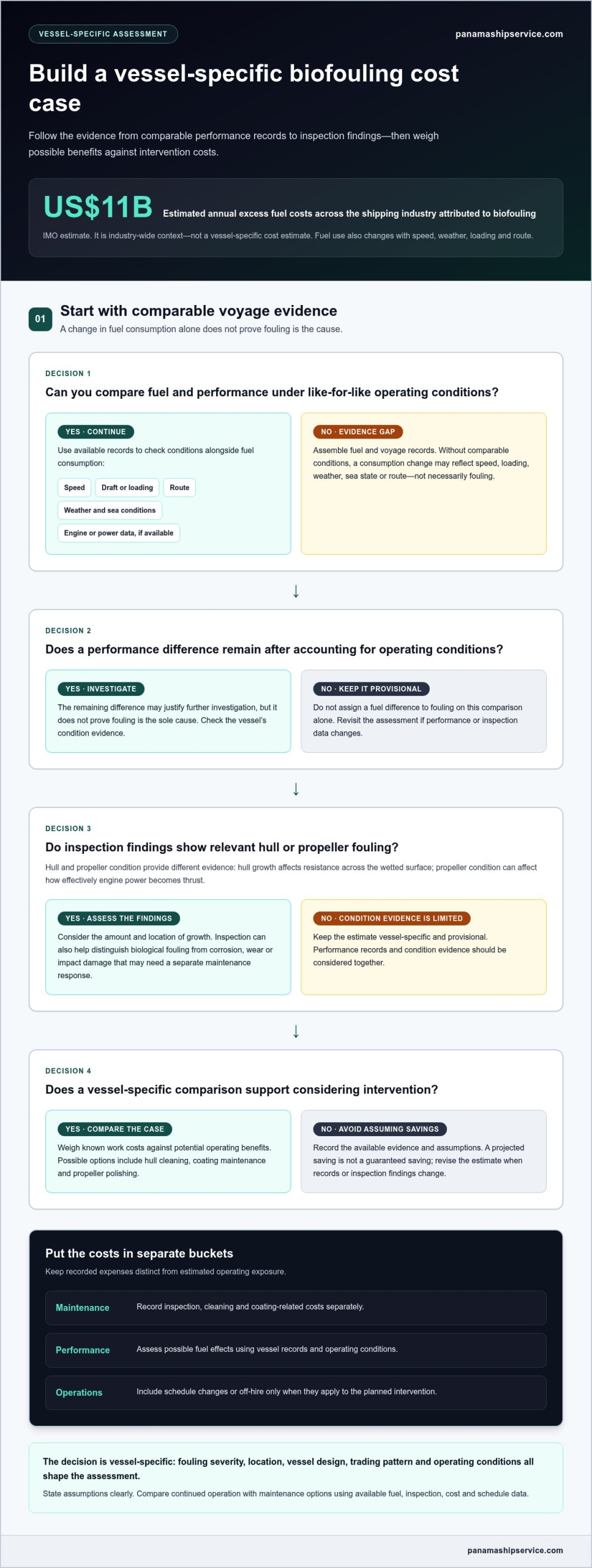
That uncertainty doesn’t make the cost negligible. It means vessel-specific evidence matters. Hull growth and propeller fouling can increase resistance and fuel demand, influencing when inspection or cleaning makes operational sense. A generic estimate may not reflect your vessel’s hull condition, trading pattern, or maintenance windows.
This guide explains how fouling can affect operating costs and how to compare intervention costs with potential performance benefits. You’ll learn which fuel and voyage records can help separate fouling effects from other variables, what inspection findings add to the decision, and how to weigh cleaning or maintenance against your vessel’s schedule. Underwater hull inspection, cleaning, and propeller polishing provide practical inputs for that assessment, helping you plan work around operations rather than assumptions.
Key Takeaways
- Trace the financial impact of vessel biofouling across fuel use, maintenance needs, and possible operational disruption.
- Compare vessel performance against a suitable baseline, accounting for route, speed, loading, and other factors that affect fuel use.
- Build a vessel-specific cost assessment using available fuel, inspection, cleaning, coating, downtime, and schedule data.
- Use hull inspection findings to decide whether cleaning or other maintenance is economically justified.
- Consider underwater inspections, hull cleaning, and propeller polishing alongside vessel itineraries and Panama Canal operations.
How Vessel Biofouling Creates Financial Exposure
Vessel biofouling is the accumulation of organisms on submerged surfaces, including the hull, sea chests, and propeller. It differs from routine wear, corrosion, or impact damage: those involve material deterioration or physical harm, while fouling is biological growth. These conditions can coexist, so inspection can help distinguish growth from defects that need a separate maintenance response.
The financial impact of vessel biofouling isn’t limited to a cleaning invoice. Growth can roughen the hull and increase resistance through the water, requiring more propulsion effort to maintain performance. The Biofouling on marine vessels overview describes this connection between marine growth, drag, and fuel consumption. The effect depends on the amount and location of fouling and the vessel’s operating conditions.
Biofouling affects vessel economics through connected performance and maintenance costs. Inspection, cleaning, and coating work have direct expenses. Fuel exposure may accumulate during operation, while scheduling work can involve disruption or off-hire in some circumstances. These are possible costs, not automatic consequences of every fouling finding.
From hull growth to operational consequences
Fouling varies. A slime layer can change surface texture; algae and larger organisms can add more substantial growth. Their effects aren’t equal, and location matters: growth on the propeller can affect propulsion differently from growth across other hull areas. As roughness and obstruction increase, drag may rise, requiring more power to maintain performance under comparable conditions.
Other factors also affect observed performance. Speed, loading, weather, sea state, and route can all shift fuel use. A change in consumption alone doesn’t prove fouling is the cause. Compare like-for-like voyages where possible, and assess performance records alongside hull-condition evidence.
Direct costs and costs that are easy to overlook
Separate known maintenance expenses from estimated operating exposure. Record inspection, cleaning, and coating-related costs in their own categories, then assess possible fuel effects using vessel records. This makes assumptions visible and helps prevent a projected saving from being treated as guaranteed.
- Maintenance: Record inspection findings and the work considered, such as cleaning or coating maintenance.
- Performance: Track fuel use alongside speed, loading, route, and weather conditions.
- Operations: Include schedule changes or off-hire only when they apply to the planned intervention.
Severity, vessel design, trading pattern, time between inspections, and operating conditions all shape the exposure. A lightly fouled vessel on one route may not face the same consequences as a vessel with heavier growth operating at different speeds or loads. Treat any estimate as vessel-specific: state its assumptions, use available records, and revise it when inspection or performance data changes. This gives decision-makers a clearer basis for comparing continued operation with maintenance options.
How Biofouling Affects Fuel Use, Performance, and Emissions
Biofouling can affect fuel use by changing the resistance a vessel must overcome. Growth on the hull increases surface roughness, while organisms projecting from the surface can add further resistance. At comparable speed and loading, the propulsion system may need to deliver more power to maintain the vessel’s operating profile. The fuel effect depends on the extent and location of growth, vessel design, operating speed, and time since the last inspection or maintenance intervention.
A reliable performance comparison requires consistent operating conditions and measurement methods, because changes in speed, draft, weather, or route can obscure the effect of fouling.
Why fouling can change propulsion requirements
Hull and propeller condition are related, but they affect performance in different ways. Hull fouling affects resistance across the vessel’s wetted surface. Fouling or surface condition at the propeller can affect how effectively engine power is converted into thrust. A hull inspection and propeller assessment therefore provide different evidence; one shouldn’t automatically stand in for the other.
There’s no universal penalty to apply across a fleet. A thin slime layer, heavier growth, and fouling concentrated around propulsion components can have different effects. Vessel form, speed, loading, and operating profile also matter. Treat any percentage used in a forecast as an estimate tied to its source, assumptions, and specific vessel conditions, not as a fixed rule.
Fuel and emissions estimates: what the evidence can support
Start with measured records. Useful comparison inputs include fuel consumption, speed, draft or loading, route, weather and sea conditions, and available engine or power data. If performance changes after accounting for conditions such as speed and loading, the remaining difference may justify further investigation. It still doesn’t prove that fouling is the sole cause.
Separate observed results from modelled scenarios. A measured comparison uses the vessel’s records across defined periods or voyages. A modelled estimate applies assumptions, such as a projected change in resistance or fuel use, to forecast possible exposure. Label assumptions clearly, and don’t present a scenario as a measured saving.
- Measured: Record actual fuel use and operating conditions for the comparison period.
- Adjusted: Account for differences in speed, draft, weather, route, and engine load where data allows.
- Estimated: State the model inputs and uncertainties when direct comparisons aren’t possible.
When fuel consumption rises under otherwise comparable conditions, associated emissions may rise as well. The relationship depends on fuel type and the amount consumed, so an emissions estimate should use the relevant fuel data and a stated calculation method. When assessing the financial impact of vessel biofouling, separate recorded performance from assumptions and show how each conclusion was reached.
Underwater hull inspection and propeller polishing can add condition evidence to performance records. Consider underwater hull inspection and propeller services as part of a vessel-specific assessment, coordinated with operational requirements.
How to Estimate the Financial Impact of Biofouling on a Vessel
A useful estimate is built from the vessel’s own records, not a fleet-wide fuel penalty. The aim is to identify a performance change that may be associated with fouling, show what evidence supports that link, and compare realistic maintenance options. Keep measured costs separate from projected effects so decision-makers can see which parts of the calculation are supported by records and which depend on assumptions.
Build a reliable vessel performance baseline
Assemble records from comparable operating periods. Include fuel consumption, speed, draft or loading, route, weather, engine data, and hull condition where available. Add inspection dates, findings, cleaning history, and coating work. If the route, machinery, or operating profile changed, flag that before comparing periods. Gaps don’t make analysis impossible, but they should be visible and lower confidence in the conclusion.
- Establish a baseline: Select a period with representative operating and performance records.
- Identify a deviation: Compare later observations, accounting for changes in speed, weather, loading, route, or machinery.
- Estimate exposure: Use the observed difference and relevant fuel data, stating which factors are measured and which are assumed.
- Compare scenarios: Assess continued operation, inspection, and potential maintenance using costs and schedule effects supported by records.
An underwater inspection adds direct evidence about hull condition before a maintenance decision. It can also help distinguish visible fouling from other condition issues that may affect performance.
Compare intervention scenarios without false precision
Build a separate estimate for each realistic option. Include inspection and cleaning expenses when known, coating costs when applicable, and downtime or schedule effects when supported by the vessel’s plan. If a possible fuel improvement is modelled rather than measured, label it as a scenario. Use a range when uncertain inputs materially change the result instead of presenting a single precise-looking figure.
Use this comparison template to document the basis for each estimate:
Input: Fuel use, speed, draft, weather, engine condition, hull findings, service expense, or schedule effect.
Uncertainty: Note missing data, changing conditions, assumptions, and whether the value is measured or modelled.
Decision relevance: Explain how the input affects the comparison between operating as-is and each intervention scenario.
For example, if fuel use rises but the vessel also changes speed or loading, don’t attribute the full difference to biofouling. Compare like conditions where records allow, or show multiple cases with clear assumptions. This makes the financial impact of vessel biofouling more useful for planning: the estimate can be updated as inspection findings, operating data, and maintenance decisions become available.
When Inspection or Cleaning May Make Financial Sense
Inspection is an evidence-gathering step, not an automatic instruction to clean. It helps establish whether growth is present, where it is located, and whether the hull or propeller has other condition issues relevant to maintenance. Pair those findings with performance records and the vessel’s operating plan to judge whether intervention is likely to address the suspected cause of increased resistance or fuel use.
A practical decision compares the expected value of acting with the full operational cost of the work. The financial impact of vessel biofouling depends on the vessel’s condition and trading profile, so a finding that supports maintenance on one ship may not justify the same response on another.
Consider timing as well as condition. If the vessel has a suitable planned operational window, inspection or maintenance may fit more readily into its schedule. If work would require a dedicated change to the itinerary, include that consequence in the comparison rather than treating the service expense as the only cost.
Signals that justify closer hull-condition assessment
Consider inspection when fuel or speed trends change without an obvious explanation, but don’t treat those trends as proof of fouling. First review changes in loading, route, weather, machinery condition, and recent maintenance. Then assess inspection findings alongside that context. A survey can help distinguish biological growth from coating deterioration or physical damage, which may require a different maintenance response.
Balance cleaning, coating, and operational considerations
Cleaning decisions should account for the type and extent of growth, hull and coating condition, vessel requirements, and applicable environmental controls. A method suitable for one surface or condition may not be appropriate for another. Include the work’s service expense and likely schedule effect in the comparison, but don’t assume a fixed payback period or guaranteed fuel reduction. If the vessel’s schedule is tight, evaluate whether work can be coordinated with planned operations.
Assess hull and propeller condition separately. Propeller polishing may be relevant when inspection identifies a propeller condition concern, while hull findings inform decisions about the broader wetted surface. Panama Ship Service provides underwater hull inspections and propeller polishing to support condition assessment and performance planning.
For example, an unexplained performance change combined with visible hull growth may support further assessment, while a similar change after machinery work calls for a broader review before attributing the difference to fouling. Use inspection findings to define a proportionate response, then compare the expected operational benefit with costs and schedule effects supported by vessel records.
- Inspect first: Use condition findings to identify the likely issue and define the scope of any response.
- Compare options: Weigh continued operation, inspection, and appropriate maintenance against performance evidence and actual scheduling needs.
- Review coating condition: Factor coating state into the cleaning decision rather than assuming all surfaces can be treated alike.
For a vessel operating around Panama, planning an assessment alongside its itinerary can make the maintenance decision more practical. Arrange underwater hull inspection and cleaning to support informed maintenance planning around vessel operations.
Managing Biofouling Costs Around Panama Canal Operations
For vessels operating around the Panama Canal, underwater maintenance planning has to fit the vessel’s itinerary as well as its condition. Assess inspection and potential work early rather than assuming they can be accommodated at a particular point in the schedule. The financial impact of vessel biofouling is easier to evaluate when condition evidence, performance records, and likely service needs are considered together.
Panama Ship Service provides underwater hull inspections, hull cleaning, and propeller polishing for vessels operating at the Panama Canal. These services support maintenance planning by helping operators understand hull and propeller condition and consider relevant work alongside vessel movements. Assess timing, transit access, and operational requirements against current vessel plans and applicable Panama Canal Authority guidance.
Coordinate hull assessment with vessel schedules
Start with the practical details: vessel location, itinerary, intended service, and available condition records. Inspection dates, previous cleaning history, hull or propeller concerns, and recent performance observations can help clarify the scope of the assessment. Share schedule constraints early so underwater service requirements can be planned alongside other tasks.
Coordination doesn’t guarantee a particular service window or transit outcome. It gives the operator and service team relevant information to plan around, identify constraints, and make decisions with fewer avoidable assumptions. Include schedule changes in the financial assessment only when there is evidence that they affect the vessel’s operations.
- Vessel information: Provide location, itinerary, and relevant timing constraints.
- Condition records: Include inspection findings, maintenance history, and known hull or propeller concerns.
- Performance context: Share observations that may help interpret condition, without treating them as proof of fouling-related effects.
Use inspection findings to plan the next action
An inspection documents observed condition; it doesn’t by itself quantify fuel savings or establish that cleaning will produce a specific financial return. Use the findings to determine whether fouling is present, where it is located, and whether the condition warrants cleaning or further assessment. Keep technical observations distinct from commercial estimates, which depend on vessel performance data, service expenses, and operational assumptions.
When a broader view of vessel condition is useful, marine surveys in Panama can provide context beyond hull growth. Combining relevant survey findings with underwater inspection records helps operators distinguish biofouling from damage or other condition concerns before deciding on a response.
To plan the next step, organize the vessel’s location and schedule, requested underwater service, and available condition records. Arrange an underwater hull inspection or cleaning around the vessel’s operational requirements, then use the findings to inform maintenance planning.
Make Biofouling Decisions Part of Voyage Planning
Make hull condition a regular input to operational planning, not a question raised only after performance changes become difficult to explain. Set a review point around the vessel’s maintenance cycle, keep condition records with performance data, and revisit assumptions as routes, schedules, and operating patterns change. This creates a more useful basis for assessing the financial impact of vessel biofouling over time.
For vessels operating near the Panama Canal, underwater work can be considered alongside itinerary planning. Panama Ship Service supports vessel operators with hull inspection and cleaning, propeller polishing, and marine surveys. Inspection findings inform maintenance decisions, while survey capabilities help assess broader vessel condition when needed. Keep technical observations separate from projected savings, and use vessel-specific records to guide the next decision.
Plan a practical next step. Share the vessel’s schedule, service needs, and available condition information to coordinate relevant work. Coordinate underwater hull inspection or cleaning support with Panama Ship Service and move forward with clearer information for maintenance planning.
Frequently Asked Questions
Does biofouling always increase a vessel’s fuel consumption?
Biofouling can increase fuel consumption, but an increase isn’t inevitable or easy to detect in every operating period. The effect depends on the amount and location of growth, vessel characteristics, and how the ship is operated. A short-term fuel change, for example, may be difficult to distinguish from normal voyage variation. Use hull-condition evidence alongside performance records before attributing a change to fouling.
How can a ship operator calculate the cost of vessel biofouling?
Estimate the cost by comparing fuel use under reasonably comparable conditions, then value any supported excess consumption using the vessel’s actual fuel price. Add relevant inspection, cleaning, coating, and schedule expenses from vessel records. Keep observed costs separate from projected savings. The financial impact of vessel biofouling is more credible when the calculation states its period, assumptions, and data gaps rather than presenting one figure as certain.
Can hull cleaning reduce a vessel’s operating costs?
It can, if inspection shows fouling that is affecting performance and the potential operating benefit justifies the work. The outcome depends on vessel condition, fuel use, operating profile, and whether the cleaning method suits the hull and coating. A vessel with little growth, for example, may have a different cost-benefit case from one with substantial fouling. Compare the expected effect with documented service and schedule costs, without assuming guaranteed savings.
How often should a vessel’s hull be inspected for biofouling?
There isn’t one inspection interval that suits every vessel. Set a review frequency based on trading pattern, operating environment, hull condition, coating and maintenance history, and applicable management requirements. Shorten the interval if records or previous inspections indicate changing conditions; a vessel with stable findings may follow its established maintenance planning cycle. Record inspection dates and results so future checks are based on the vessel’s history, not an arbitrary fleet-wide schedule.
Does biofouling affect a vessel’s emissions as well as fuel use?
It can. If fouling increases propulsion demand and the vessel burns more fuel to maintain comparable operation, emissions associated with that fuel use may also rise. The amount depends on fuel consumed and the calculation method. For a vessel-level estimate, use actual fuel records and document the applicable emissions factor or reporting method. Keep calculated emissions distinct from direct measurements, and don’t treat an assumed fuel penalty as a verified result.
Can biofouling costs be separated from weather and vessel operating conditions?
They can sometimes be estimated more reliably, but rarely isolated with certainty from a single voyage. Compare periods with similar routes, speeds, drafts, and loading, and review weather and engine records for material differences. A fuel increase during rougher conditions, for instance, shouldn’t be assigned wholly to hull growth. If voyages aren’t comparable, identify the confounding factors and use the estimate as a range or planning scenario.
Does cleaning a fouled hull always make financial sense?
No. Cleaning is more likely to be justified when condition evidence supports a performance concern and the expected benefit outweighs service expense, schedule effects, and coating considerations. If fouling is minor or the vessel’s operating pattern limits potential fuel savings, the financial case may be weaker. Inspection helps define the condition before action. Include only costs and operational consequences relevant to that vessel, and don’t assume cleaning guarantees a particular payback.