
Did you know that sourcing fresh provisions for vessel crew in Panama costs approximately 12% less than in other regional ports, yet many operators still lose these savings to spoilage and delivery delays? Managing victualling during a high-stakes Panama Canal transit is a complex logistical challenge where timing is everything. You’re likely aware that a single break in the cold chain or a delivery that misses a transit window doesn’t just waste budget; it directly impacts crew morale and operational readiness.
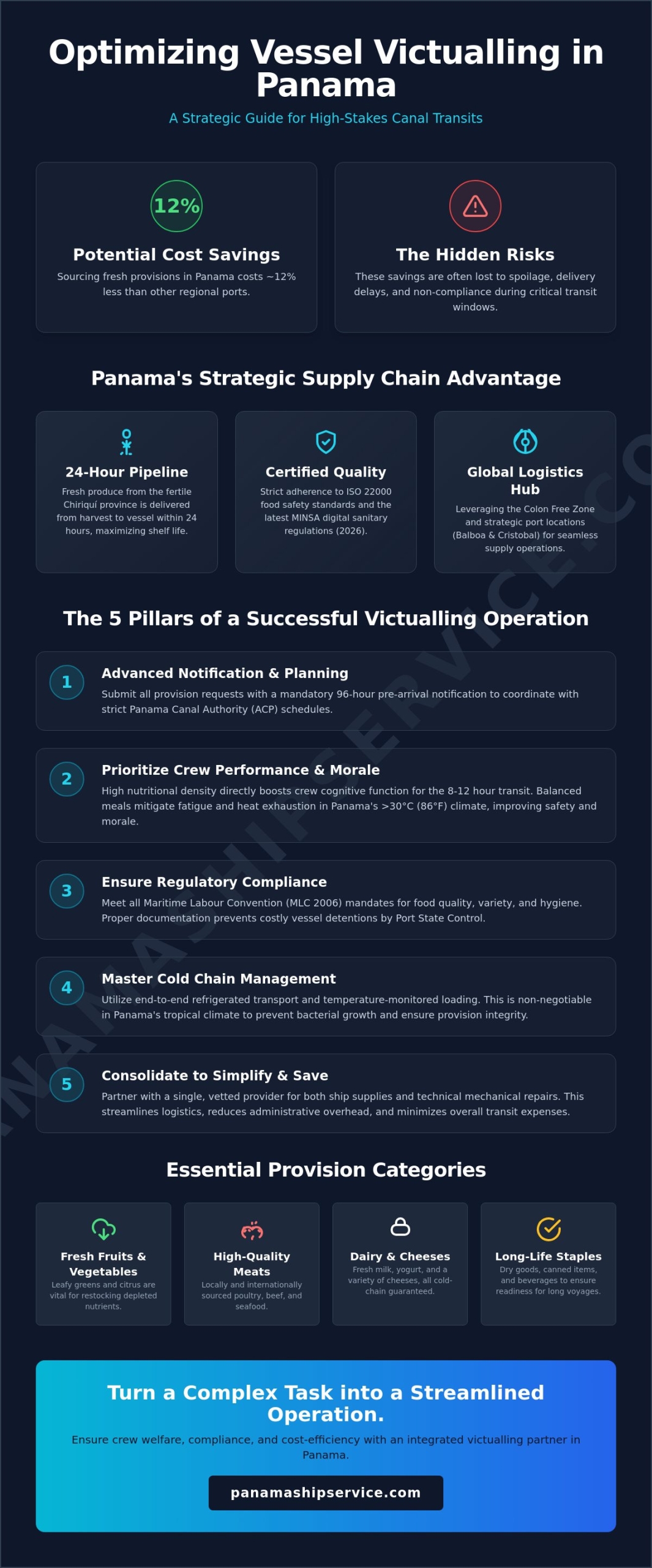
We understand the pressure of coordinating supplies with strict Canal schedules and the latest 2026 health regulations. This guide provides a comprehensive roadmap to optimizing your victualling strategy. You’ll learn how to secure high-quality, locally sourced food that meets the newest MINSA digital sanitary standards while ensuring seamless delivery. We’ll cover everything from the 96-hour pre-arrival notification requirements to leveraging the Chiriquí province’s 24-hour harvest-to-vessel pipeline. By the end of this article, you’ll have the knowledge to turn a complex supply task into a streamlined, cost-effective operation that prioritizes crew welfare.
Key Takeaways
- Recognize the direct link between nutritional density and crew cognitive performance during high-pressure Canal transits.
- Utilize Panama’s logistics hub to source high-quality provisions that comply with ISO 22000 food safety standards.
- Streamline the delivery of fresh provisions for vessel crew by synchronizing logistics with Panama Canal Authority transit schedules.
- Prioritize essential provision categories and long-life staples to ensure crew health remains consistent during long-haul voyages.
- Simplify operations by partnering with a single provider for both ship supplies and technical mechanical repairs to minimize transit expenses.
The Critical Role of Fresh Provisions for Vessel Crew Welfare
Fresh provisions for vessel crew are perishable food items, including fruits, vegetables, dairy, and meats, that are essential for maintaining maritime health. In the high-stakes environment of the Panama Canal, where precision is mandatory, nutritional density directly impacts crew cognitive function and physical stamina. The Critical Role of Fresh Provisions extends beyond basic sustenance; it’s a strategic component of vessel safety. High-quality meals serve as a primary driver for crew morale during long-haul voyages. They aren’t just calories. They’re a vital tool for retention and mental well-being in an isolated workplace. Perishables like leafy greens and citrus fruits are often the first to deplete during a voyage, making Panama a critical restocking point for maintaining peak performance. Beyond performance, maintaining these standards is a matter of regulatory necessity under the Maritime Labour Convention (MLC 2006).
Nutritional Standards and Maritime Safety
Fatigue-related navigational errors are a constant threat in narrow transit lanes. Consistent Vitamin C intake and balanced micronutrients are proven to mitigate these risks. Crews working in the high-heat environment of the Panama Canal, where temperatures regularly exceed 30°C (86°F), require specific macronutrient balancing to maintain electrolyte levels and prevent heat exhaustion. Fresh produce significantly reduces the long-term health risks associated with a diet heavy in processed ship stores, such as hypertension or cardiovascular issues. Providing high-quality fresh provisions for vessel crew ensures your team remains alert during the critical 8 to 12 hours required for a canal transit. A well-fed crew is a safer crew, especially when navigating the complex lock systems of the Isthmus.
MLC 2006 Compliance for Shipowners
The Maritime Labour Convention (MLC 2006) establishes clear shipowner obligations regarding food and catering. It’s a legal mandate. Shipowners must provide food and drinking water free of charge to seafarers. Variety is essential. Modern crews are culturally diverse; victualling must account for specific dietary requirements and religious restrictions. Port State Control officers look for specific documentation during inspections. You must maintain records of food quality, storage temperatures, and galley hygiene. Failure to meet these standards can lead to vessel detention. This causes expensive delays in your transit schedule and impacts your overall operational efficiency. Reliable provisioning isn’t just about food; it’s about staying compliant and keeping the vessel moving forward without administrative friction.
Sourcing and Quality Standards for Maritime Provisions in Panama
Panama’s strategic location creates a robust supply chain that few global ports can match. By leveraging the proximity of the Colon Free Zone and the fertile highlands of the Chiriquí province, suppliers deliver a mix of premium international brands and local produce harvested within 24 hours of delivery. This speed is vital for maximizing the shelf life of fresh provisions for vessel crew, particularly for delicate leafy greens and tropical fruits like papaya and pineapple. To maintain these standards, strict adherence to ISO 22000 food safety protocols is non-negotiable. These standards ensure that every item, from dairy to poultry, undergoes rigorous quality checks before it ever reaches the pier. This systematic approach eliminates the risk of foodborne illnesses that can compromise an entire crew during a transit.
Cold Chain Management in Tropical Climates
In Panama, tropical humidity and heat can compromise perishables in minutes. Effective cold chain management requires refrigerated transport at every stage of the journey. Suppliers must utilize temperature-controlled vehicles for all transit points to the pier to ensure thermal integrity. During the loading process at Balboa or Cristobal, temperature monitoring protocols are strictly enforced. Frozen goods undergo mandatory pre-cooling to prevent surface thawing during the transfer to launch boats. This precision prevents bacterial growth and ensures that the provisions arrive on board in peak condition, ready for long-term storage in the ship’s cold rooms.
Verifying Supplier Credentials
Vessel operators must look beyond price when selecting a victualling partner. Memberships in the International Shipsuppliers & Services Association (ISSA) and the International Marine Purchasers’ Association (IMPA) are essential benchmarks of professional maritime supply standards. In the Republic of Panama, suppliers must also hold valid local sanitary permits and comply with the 2026 MINSA digital sanitary registration requirements. These regulations mandate digital allergen disclosure and a 48-hour pre-arrival notification for imported goods. Traceability is the final pillar of a reliable supply chain. Every batch of food must be traceable back to its origin, providing an extra layer of security for the ship’s cook and the crew. Managing these complex logistics requires a partner who understands the intersection of maritime law and local agricultural cycles. For those seeking comprehensive support beyond victualling, our team provides integrated ship supplies and agency services to keep your operations running smoothly.
Sourcing seasonal Panamanian fruits is another tactical advantage. Local produce like melons, citrus, and bananas are naturally adapted to the climate and often possess a higher resilience during storage compared to imported varieties. By prioritizing these seasonal items, shipowners can reduce waste and provide the crew with high-quality fresh provisions for vessel crew that stay fresh longer. This focus on quality and compliance ensures that your vessel remains operational and your crew remains healthy throughout the voyage.
Optimizing Provision Logistics During Panama Canal Transits
Executing a successful delivery of fresh provisions for vessel crew requires precise synchronization with the Panama Canal Authority (ACP) transit schedules. Because canal slots are fluid and subject to change, your supplier must monitor the Vessel Universal Measurement and Pre-Arrival (VUMPA) system in real-time. A delivery that arrives too early risks spoilage in the tropical heat, while a late delivery can miss the transit window entirely. Effective logistics management bridges this gap by ensuring the supply chain remains as agile as the vessel’s schedule. This coordination is the difference between a seamless restock and a logistical bottleneck that increases operational overhead.
Anchorage delivery via launch boat is the standard for vessels transiting without docking, yet it demands higher coordination than pier-side delivery. Launch operations require careful handling to maintain the cold chain during the transfer from the pier to the vessel at anchor. Beyond the food itself, managing packaging waste is a critical component of the process. Suppliers should minimize secondary packaging and utilize returnable crates where possible to ensure the vessel remains in strict compliance with MARPOL Annex V regulations. This proactive waste management prevents the accumulation of plastic and cardboard on board, which is often difficult to dispose of during long-haul voyages.
Balboa vs. Cristobal: Delivery Points
Balboa on the Pacific side and Cristobal on the Atlantic side offer distinct logistical environments. Balboa often involves high-traffic launch operations at the Pacific Anchorage, where timing must account for both tide and canal slot priority. Cristobal provides closer proximity to the Colon Free Zone, allowing for faster turnaround on imported specialty items. Last-minute changes to provision orders are common in maritime operations. A reliable partner handles these adjustments by maintaining buffer stocks and flexible transport routes. Weather conditions, particularly during the rainy season, can impact launch boat schedules. Factoring in these environmental variables is essential for maintaining a reliable supply line.
Consolidated Service Efficiency
Minimizing vessel downtime is a priority for every ship manager. One of the most effective ways to achieve this is by combining food supplies with other essential ship supplies panama canal. This “one-stop-shop” model reduces administrative overhead by using a single agent for both technical and provision needs. It simplifies the billing process and reduces the number of launch boat trips required, which directly lowers costs. Consolidating technical requirements with victualling ensures a single point of contact, which eliminates communication gaps and prevents costly transit delays. By delegating these complexities to an integrated partner, you can focus on the core navigation and safety of the vessel.
Essential Provision Categories for Long-Haul Maritime Voyages
A balanced provision list is the backbone of maritime endurance. It requires a calculated mix of fresh, frozen, and dry stores to sustain the crew until the next port call, ensuring that nutritional needs are met without compromise. When ordering fresh provisions for vessel crew, you must prioritize durability alongside variety. Long-life vegetables like potatoes, onions, and carrots are non-negotiable for extended voyages because they resist spoilage and provide the necessary bulk for daily meal planning. We also recognize the cultural diversity of modern crews. A standard list isn’t enough; it must include specialized staples such as Basmati rice, lentils, and specific Asian spices to maintain crew morale. Bonded stores complete the victualling process by providing tobacco, alcohol, and comfort items that are essential for well-being during long periods at sea. Managing these categories requires a systematic approach to ensure nothing is overlooked before the vessel leaves the Panama hub.
Fresh Produce and Dairy Requirements
Selecting the right ripeness levels is a technical skill that prevents unnecessary waste. We provide fruits at varying stages of maturity so they become edible in a staggered sequence throughout the voyage. This ensures that the crew has access to ripe fruit on day one and day fifteen. Dairy selection depends entirely on your storage capacity. While fresh milk is ideal for immediate consumption, ultra-pasteurized (UHT) dairy is the industry standard for long-haul stability. For leafy greens, storage is everything. They must be kept in shipboard walk-in coolers away from ethylene-producing fruits like bananas to prevent premature wilting. Proper ventilation and humidity control in the galley stores are critical to maximizing the lifespan of fresh provisions for vessel crew. Avoid the risk of low-quality supplies by partnering with a veteran provider. Secure your ship supplies today to ensure your crew remains mission-ready.
Protein and Frozen Goods
Protein management requires strict adherence to dietary certifications and space optimization. We ensure that Halal or Kosher meats are clearly labeled and separated to meet specific crew requirements and international standards. Vacuum-packing is our preferred technique for all frozen goods because it maximizes freezer space and serves as a primary defense against freezer burn. This preserves the texture and nutritional value of poultry, beef, and seafood over several weeks. Effective inventory management follows a first-in, first-out (FIFO) protocol to ensure that the oldest stock is consumed first. This reduces the risk of expired products being buried deep in the freezer. By maintaining a meticulous inventory of frozen stores, the ship’s cook can plan menus that remain diverse and nutritious until the next restocking opportunity.
Panama Ship Service: Your Integrated Partner for Vessel Supplies and Repairs
Panama Ship Service functions as a strategic operational partner for global vessel operators. Our “one-stop-shop” model is specifically designed to minimize transit expenses and administrative delays. By consolidating your requirements, you eliminate the friction of managing multiple vendors in a time-sensitive environment. Beyond the delivery of high-quality fresh provisions for vessel crew, we provide expert mechanical ship repairs to keep your vessel operational and compliant. Our local expertise ensures that every delivery and service adheres strictly to Panama Canal Authority (ACP) regulations. We maintain 24/7 availability to respond to the urgent needs of vessels, recognizing that canal schedules don’t wait for logistical oversights.
Efficiency in the maritime sector is measured by the reduction of downtime. When you delegate the complexity of supply and technical maintenance to a single entity, you gain a significant competitive advantage. We handle the paperwork, the logistics, and the technical execution so your crew can focus on safe passage. Reliability is our core value, backed by years of experience navigating the unique demands of the Panama maritime sector. This integrated approach allows you to optimize your budget while ensuring that your vessel meets all safety and sanitation requirements before entering the locks.
Technical and Operational Synergy
Technical and operational synergy is the cornerstone of our service delivery. We coordinate underwater hull services alongside your provision delivery to maximize the time spent at anchor. This integrated approach allows for marine surveys panama to assess vessel condition while the galley is being restocked. Simultaneous execution prevents the need for multiple launch trips and reduces the overall cost of the port call. Our team provides professional reliability that only a veteran local partner can offer. We ensure that your technical and victualling needs are met with precision, preventing the communication gaps that often lead to transit delays.
Contact Us for a Comprehensive Quote
Securing a reliable supply chain for your next transit is straightforward. You can submit your provision list directly to our team for a rapid, competitive quote that reflects current market conditions in Panama. We provide customized supply solutions tailored to the specific needs of tankers, bulkers, and container vessels. Whether you require a full restock of fresh provisions for vessel crew or urgent technical assistance, our responders are ready. Contact us today for immediate assistance and let us simplify your Panama Canal operations through our comprehensive service network.
Optimize Your Operations for the Panama Canal
Securing high-quality fresh provisions for vessel crew isn’t just about nutrition; it’s a strategic move to ensure maritime safety and operational continuity. By synchronizing your supply chain with the Panama Canal’s strict transit windows and adhering to ISO 22000 standards, you eliminate the risks of spoilage and administrative delays. We’ve shown that consolidating your victualling with technical services like mechanical repairs and underwater hull maintenance directly reduces overhead and simplifies communication. This integrated approach ensures your vessel remains compliant with the latest 2026 health regulations while maintaining peak crew performance.
Panama Ship Service provides the professional reliability you need in this high-pressure hub. Our operations fully comply with ISSA and IMPA standards, and our team is ready with 24/7 emergency response capabilities to handle last-minute changes. Don’t let logistical friction impact your transit schedule. Streamline your vessel operations; contact Panama Ship Service for fresh provisions and technical support today. We look forward to supporting your successful passage through the Isthmus.
Frequently Asked Questions
How far in advance should I order fresh provisions for a Panama Canal transit?
It’s recommended to place your order for fresh provisions for vessel crew at least 72 to 96 hours before your scheduled arrival in Panama. This lead time allows for the procurement of specific items and ensures compliance with the 48-hour customs manifest requirement. Early ordering also helps avoid rush fees and guarantees the availability of premium local produce harvested from the Chiriquí highlands.
Can you deliver provisions to vessels at the Pacific and Atlantic anchorages?
We provide comprehensive delivery services to vessels at both the Pacific and Atlantic anchorages, including Balboa and Cristobal. Our logistics team utilizes specialized launch boats to reach vessels at anchor, ensuring that supplies are delivered directly to the ship’s side. This capability allows for restocking without the need for the vessel to dock, saving significant time and port expenses during a canal transit.
Do you provide specialized food items for different crew nationalities?
Our supply chain includes a wide variety of specialized food items to accommodate the diverse nationalities of modern maritime teams. We stock essential staples for Asian, Indian, and European cuisines, including specific grains, spices, and proteins. Providing familiar and high-quality fresh provisions for vessel crew is a critical factor in maintaining morale and ensuring the physical well-being of seafarers during long-haul voyages.
What quality certifications do your food suppliers hold?
Our suppliers hold rigorous quality certifications, including ISO 22000 food safety management standards. We also operate in full alignment with the International Shipsuppliers & Services Association (ISSA) and the International Marine Purchasers’ Association (IMPA) guidelines. These certifications guarantee that all products undergo strict quality control and traceability checks, ensuring that only the highest grade of food enters your vessel’s galley.
How do you ensure the cold chain is not broken during delivery in Panama’s heat?
We maintain the cold chain through the use of temperature-controlled refrigerated trucks for all transit points from the warehouse to the pier. During the loading process, we follow strict temperature monitoring protocols to prevent thermal shock in Panama’s tropical climate. Frozen goods are pre-cooled and transferred in insulated containers to ensure they remain at the required temperature until they are safely stored in the ship’s freezers.
Can I combine provision delivery with MARPOL disposal or mechanical repairs?
You can easily combine provision delivery with other essential maritime services like MARPOL disposal and mechanical ship repairs. This integrated service model minimizes vessel downtime by allowing multiple operations to occur simultaneously while the vessel is at anchor. Consolidating these tasks under a single partner reduces administrative friction and lowers the overall cost of your port call at the Panama Canal.
What happens if my canal transit slot is delayed at the last minute?
If your canal transit slot is delayed, our team adjusts the delivery schedule in real-time to match the new arrival window. We maintain constant communication with the Panama Canal Authority to monitor slot changes and ensure that your provisions aren’t left on the pier. Our flexible logistics infrastructure allows us to hold orders in temperature-controlled storage until the vessel is ready to receive them.
Are your provision services compliant with MLC 2006 standards?
All of our provisioning services are fully compliant with the Maritime Labour Convention (MLC 2006) standards regarding food and catering. We ensure that the variety, quality, and nutritional value of the food meet the requirements set by the Panama Maritime Authority. This compliance helps shipowners fulfill their legal obligations to provide healthy, free food and water to their crews while avoiding potential inspection delays.