
An injector can deliver fuel yet still produce a poor spray pattern. Fuel injector testing and repair checks whether injectors seal correctly, respond electrically, deliver consistent flow, and atomize fuel evenly. The results help distinguish deposits or worn seals from electrical faults and other damage.
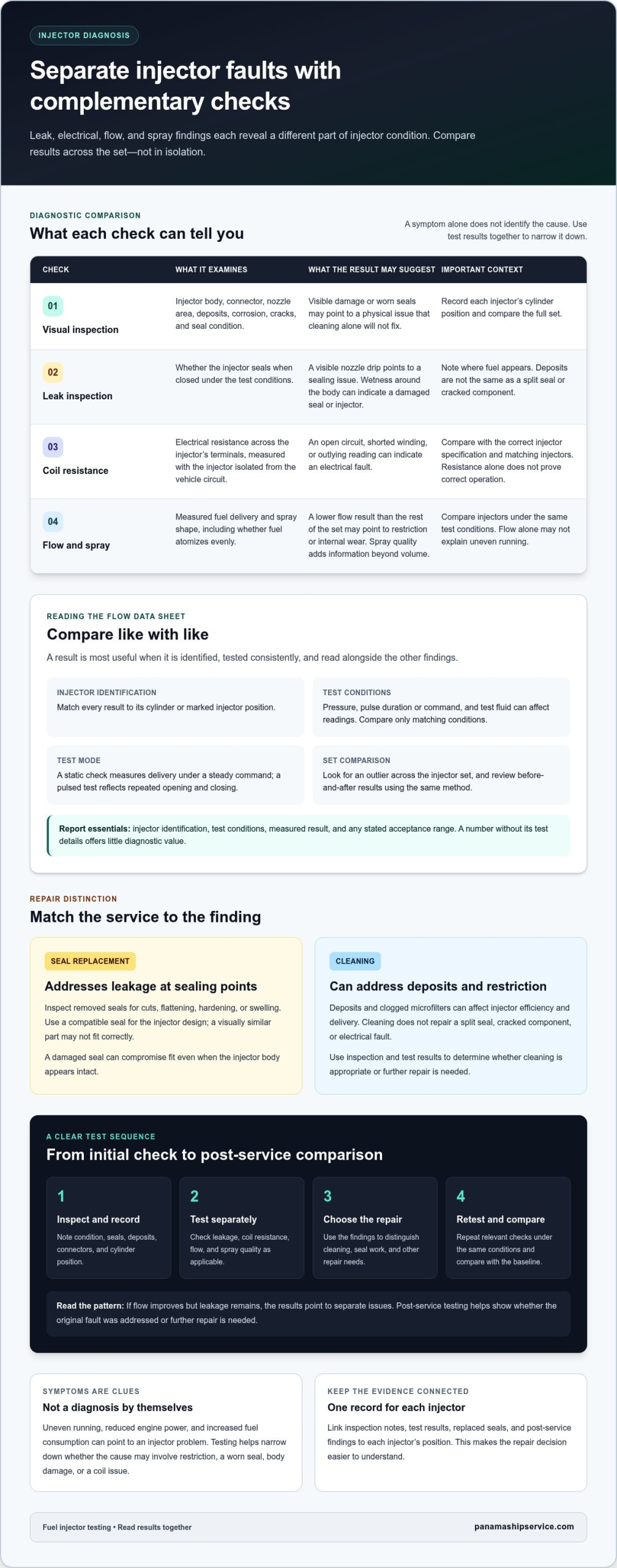
Uneven running, reduced engine power, or increased fuel consumption can point to an injector problem, but symptoms alone don’t identify the cause. A structured assessment compares leak checks, coil resistance, flow data, and spray patterns to build a clearer picture of injector condition.
This guide explains what each test reveals, how deposits and clogged microfilters affect performance, and when cleaning, seal replacement, or further repair may be appropriate. You’ll also learn why spray quality matters alongside flow volume, and what post-service testing can show about injector operation.
Key Takeaways
- Compare leak-check results with coil resistance readings to help separate sealing problems from electrical faults.
- Read flow data across injectors to spot delivery differences, then consider how seal condition affects performance.
- Learn how deposits and restricted microfilters can reduce injector efficiency and what cleaning can address.
- Assess spray shape as well as fuel volume, since atomization quality helps explain how an injector performs in operation.
- Recognize common warning signs, including uneven running, reduced power, and higher fuel consumption, and use testing to narrow down the cause.
Leak inspection and coil resistance testing
A useful injector inspection separates three possible faults: leakage, electrical failure, and restricted delivery. Fuel injector testing and repair should begin with the injector’s condition and test results, not the assumption that cleaning will solve every symptom. Uneven running may result from a clogged injector, damaged body, worn seal, or coil problem.
Start with a visual inspection. Look for cracks, corrosion, damaged connectors, distorted seals, and deposits around the nozzle. Record which injector came from each cylinder, so later test results can be linked to vehicle symptoms. Inspect the full set and compare each injector’s condition rather than assessing one in isolation.
A controlled leak inspection checks whether an injector seals when closed. The test setup applies the specified conditions, then technicians look for fuel escaping through the nozzle or around a sealing surface. A visible drip points to a sealing issue; wetness around the body can indicate a damaged seal or injector. The location matters: cleaning deposits won’t fix a split seal or cracked component.
Coil resistance testing assesses the injector’s electrical winding. With the injector isolated from the vehicle circuit, a meter measures resistance across its terminals. Compare the reading with the specification for that injector type and with readings from injectors of the same design. An open circuit, shorted winding, or outlying reading can indicate an electrical fault. Resistance alone doesn’t prove the injector opens and closes correctly, so interpret it alongside operational testing.
- Inspect: Note damage, connector condition, deposits, and seal wear.
- Test for leakage: Observe whether fuel escapes from the nozzle or sealing areas under test conditions.
- Measure coil resistance: Compare readings with the correct specification and matching injectors.
- Record findings: Link each result to the injector’s cylinder position and observed condition.
Professional testing costs depend on the number and type of injectors, the tests required, and whether cleaning or replacement parts are needed; pricing is provided after a quote request. Choose a shop that explains its leak and electrical test process, records findings by injector, and distinguishes cleaning from repair or replacement. A clear report lets you understand why a proposed step follows from the test results.
After cleaning or repair, repeat operational testing to assess whether the injector functions as expected. Compare the post-service results with the initial inspection, including leakage and electrical readings. This helps determine whether the original fault has been addressed or whether damage calls for a different solution.
Flow data sheets and seal replacement
A flow data sheet makes injector test results easier to compare. It should identify each injector, record test conditions, and show measured delivery for the test performed. Matching conditions matter: different pressure, pulse duration, or test fluid can change the reading and make comparisons unreliable. Keep the original and post-service records together.
Read the sheet across the injector set, not as isolated figures. If one injector delivers less than the others under the same conditions, the difference can point to restriction or internal wear. If readings are similar but the engine still runs unevenly, flow alone may not explain the fault. Consider the sheet alongside leak and electrical findings.
Check how the report identifies the test mode. A static check assesses delivery under a steady command, while a pulsed test reflects repeated opening and closing. The method should suit the injector design. Look for the measured result, test conditions, and any stated acceptance range. Without those details, a number on its own offers little diagnostic value.
- Injector identification: Match each result to its cylinder or marked position.
- Test conditions: Compare readings only when pressure, command, and fluid conditions match.
- Flow comparison: Look for an outlier within the set, not just a single reading.
- Service comparison: Review before-and-after results using the same test method.
Seal replacement addresses leakage at sealing points, not restricted internal flow. Depending on the injector design, service may involve replacing an O-ring or another specified seal. Inspect the old seal for cuts, flattening, hardening, or swelling, then fit a compatible replacement without twisting or pinching it. A damaged seal can compromise the fit even when the injector body appears intact.
Use the injector’s design and service procedure to determine which seals require replacement. Injector types can use different dimensions and materials, so a visually similar seal may still fit incorrectly. Keep removed parts with their injector and record which seals were replaced. This helps link the repair to the final test sheet.
After assembly, repeat the leak and flow checks under the same conditions as the initial test. Compare each injector’s updated result with its baseline and note any remaining outlier. If flow improves but leakage remains, the findings point to separate issues. A clear record helps determine whether further cleaning, seal work, or another repair step is appropriate.
The service provider claims customers commonly experience a 10 to 15% improvement in gas mileage after ultrasonic injector cleaning and flow testing. That reported outcome is useful context, but it does not establish what happened in a particular vehicle or injector set. Keep the claim separate from the recorded test results: the flow sheet documents measured delivery under stated conditions, while the mileage figure describes a commonly reported customer experience. When reviewing a service, use the individual before-and-after readings and leak findings to judge whether the work addressed the identified issue. A favorable general outcome cannot replace a clear record of the tests performed or confirm that every injector responded alike.
Injector deposits and clogged microfilters
Deposits can narrow injector passages, while a clogged microfilter restricts fuel before it reaches the nozzle. Service should distinguish removable buildup from parts that need replacement.
Cleaning, Rebuilding, or Replacement
Cleaning uses specialized equipment to remove deposits and help restore injector efficiency, but it won’t fix broken components. Rebuilding involves servicing replaceable parts, such as seals or microfilters, when the injector design allows access. Replacement is appropriate when an injector is damaged or still malfunctions after service.
Choose among these options by matching test findings to the fault. Deposits with otherwise sound components, for example, support cleaning; a damaged body may require replacement. A clogged internal microfilter may call for rebuilding if it can be accessed and replaced. Testing after the work shows whether injector operation improved.
Symptoms of a Clogged Injector
A clogged or malfunctioning injector can reduce engine power, increase fuel consumption, and cause uneven running. These symptoms suggest a possible delivery problem, but don’t identify deposits as the cause. Restriction, electrical faults, or physical damage can produce overlapping effects.
Compare the affected cylinder’s performance with the rest of the engine, then use inspection and flow testing to narrow down the cause. For example, low delivery paired with visible deposits supports cleaning as a next step. If the injector remains faulty after cleaning, further repair or replacement may be needed.
Cleaning Without Removal
Some cleaning methods work with injectors installed in the engine. They circulate cleaning solution through the fuel system and can address deposits along the fuel path. This approach doesn’t provide the same direct inspection of each injector as removal and bench testing.
When a microfilter is clogged, access matters: an installed-system treatment doesn’t let a technician remove and inspect the filter directly. Removing injectors allows closer examination, targeted cleaning, and comparison of individual flow results. The right method depends on whether the goal is routine deposit treatment or diagnosis of a specific injector fault.
Cleaning and Service Timing
Many automotive OEMs recommend cleaning fuel injectors every 60-90 thousand miles for top performance and emissions. Treat that interval as a maintenance reference, then consider the vehicle’s service history and symptoms. Poor running or reduced power may call for diagnosis before the next scheduled cleaning point.
Service should follow evidence, not mileage alone. If testing shows restricted flow or deposits, specialized cleaning can address the buildup; if it shows damage, cleaning alone won’t resolve the issue. Keep test results and service records together so future checks can compare injector condition and guide maintenance decisions.
Injector spray pattern and fuel atomization
A fuel injector can deliver the expected volume yet still spray poorly. Testing the pattern adds evidence about how fuel leaves the nozzle, complementing flow measurements and helping explain uneven engine running. Fuel injectors spray millions of times over a vehicle’s life, according to VAC, making consistent operation central to combustion performance.
Atomization breaks liquid fuel into smaller droplets. A distorted, uneven, or interrupted spray can change how fuel mixes with air in the combustion chamber. A visible stream instead of a fine, consistent spray may point to deposits, nozzle damage, or another injector fault. Pattern quality matters alongside total flow because volume alone doesn’t show how fuel exits.
To assess spray, technicians operate the injector on suitable test equipment and observe its discharge under controlled conditions. They compare the shape, distribution, and consistency with the injector’s design and other matching units. For example, one injector producing a narrow stream while the others form a consistent mist warrants closer inspection. The test should also note drips after the injector closes.
Interpret the observation alongside supporting results. A poor pattern paired with low flow can indicate restriction; leakage after closure points to a sealing problem. A uniform pattern with a flow difference calls for examining the flow data and test conditions. This comparison helps distinguish a nozzle issue from a fault elsewhere in the injector.
- Pattern: Look for an even, consistent discharge rather than a concentrated stream.
- Coverage: Compare distribution with matching injectors tested under the same conditions.
- Closure: Observe whether fuel continues to drip after the injector stops operating.
- Context: Read spray observations alongside flow and electrical results.
Cleaning can remove deposits that interfere with nozzle discharge. After cleaning, repeat the spray observation and compare it with the initial result. If the pattern remains irregular or the nozzle shows damage, cleaning alone may not address the cause. A post-service check also confirms whether the injector opens, closes, and sprays consistently on the test equipment.
Proper injector function helps maintain lower vehicle emissions. Spray quality contributes to fuel-air mixing, while uneven discharge can disrupt combustion. For example, a cylinder with a visibly inconsistent spray may run differently from cylinders receiving a more uniform mixture. Pattern testing adds useful diagnostic detail beyond checking whether fuel reaches the engine.
The cost of injector cleaning or repair depends on injector type, the number serviced, test findings, and required parts. Request a quote based on these case-specific factors.
What are the symptoms of a bad or clogged fuel injector?
A clogged or malfunctioning fuel injector can reduce engine power, increase fuel consumption, and cause uneven running. These signs point to disrupted fuel delivery, but don’t identify the fault by themselves. Deposits, electrical trouble, leakage, or physical damage can affect how an injector supplies fuel.
Reduced power may become noticeable when the engine struggles to respond under load. For example, a vehicle that feels weaker during acceleration may have an injector delivering less fuel than required. Compare that observation with injector flow results and the condition of other cylinders. Differences between injectors can help narrow the investigation.
Higher fuel consumption is another useful clue, especially when it appears alongside uneven engine operation. An injector that fails to deliver fuel properly can disturb combustion, while leakage can contribute to excess delivery. Symptoms alone can’t distinguish these conditions. A leak inspection and flow comparison help establish whether delivery is inconsistent.
Uneven running feels like irregular engine operation rather than a steady idle or response. Note when it occurs, such as at idle or during acceleration, and whether it changes with engine load. These observations help connect the complaint to test results. Record the affected cylinder if diagnostic information identifies one, then compare its injector with the rest.
- Reduced power: Record when the engine feels weak, such as under load or during acceleration.
- Higher fuel consumption: Note the change and whether uneven running occurs at the same time.
- Uneven operation: Track the conditions, including idle, acceleration, and load.
- Injector comparison: Relate symptoms to flow, leak, and electrical test findings.
Use a stepwise diagnosis rather than replacing an injector based only on symptoms. First, document the operating condition and any affected cylinder. Next, inspect injectors for deposits or visible damage, then compare electrical and flow results. Poor flow with deposits suggests a different repair path from a leak or electrical fault.
Cleaning can address deposits, but it won’t correct a damaged injector or failed coil. If an injector still malfunctions after cleaning, repair or replacement may be appropriate. Post-service testing shows whether it operates consistently and whether the original flow or leakage concern remains. This evidence-based sequence helps avoid treating every power or fuel-use complaint as the same fault.
For vessel machinery concerns that extend beyond an individual injector, discuss mechanical ship repairs as part of the broader repair assessment.
Fuel injector service can include inspecting injectors for clogging or damage. This inspection keeps attention on the injector itself and on the two concerns named: clogging and damage. An inspection is an assessment, not a statement that either condition is present, and symptoms alone should not be treated as proof of either one. When discussing service, ask whether the injector will be inspected for clogging or damage, and make sure the reported concern is part of that assessment. Keeping the service question focused on those findings helps distinguish a proposed inspection from a conclusion about what caused the symptoms.
Panama Ship Service: Mechanical Ship Repairs
Panama Ship Service provides Mechanical Ship Repairs for vessel machinery issues beyond an individual injector. If test findings point to a broader engine problem, or injector symptoms occur alongside other mechanical concerns, this service can help assess the repair needs.
For vessels needing a wider operational assessment, Panama Ship Service also offers Marine Surveys and Underwater Hull Services. These address separate vessel needs, while injector test results help clarify whether the concern is limited to fuel delivery or part of a wider mechanical issue.
Share the machinery concern and available test findings with Panama Ship Service to guide the next discussion. Visit panamashipservice.com to get in touch.
Turn test findings into a clear maintenance decision
Use fuel injector testing and repair findings to decide whether the next step concerns the injector itself or a wider vessel machinery assessment. A consistent record of symptoms and test results helps frame that discussion and connect the technical issue with broader maintenance priorities.
Panama Ship Service’s Mechanical Ship Repairs are relevant when vessel machinery needs attention beyond an individual injector. Underwater Hull Services and MARPOL Disposal address separate vessel requirements, not injector faults, but can support other operational needs through one service relationship.
Keep the diagnostic results available when discussing the vessel’s repair needs. Contact Panama Ship Service today to discuss the next step for your vessel.
Frequently Asked Questions
How do mechanics test fuel injectors with a multimeter or scan tool?
A multimeter checks an injector’s coil resistance, while a scan tool helps assess related engine data. With the injector electrically isolated, a mechanic measures across its terminals and compares the reading with the specification for that injector. A scan tool can retrieve diagnostic trouble codes, review cylinder misfire data, and run injector balance or command tests when supported. For example, a cylinder-specific misfire alongside an electrical code helps focus further diagnosis.
How much does fuel injector cleaning or repair cost?
Cleaning or repair costs depend on the work and any replacement parts needed. Request a quote based on the required service.
How do you test fuel injectors at home?
Inspect each injector for cracks, corrosion, damaged connectors, deposits, and worn seals, and record its position. A leak check looks for fuel escaping under test conditions, while a meter measures resistance across the isolated injector’s terminals. Compare readings with the correct specification and matching injectors.