
A single oversight in your MARPOL logbook can turn a scheduled 12 hour transit into a 48 hour anchorage delay. Managing garbage disposal for ships at the Panama Canal is often the most frustrating part of a transit for any Master or vessel operator. You already know that strict environmental regulations and differing facilities at the Balboa and Cristobal entrances create a logistical minefield. Misjudging your timing means you lose your slot, and in this industry, timing is everything. We believe your transit should be handled with precision and zero friction.
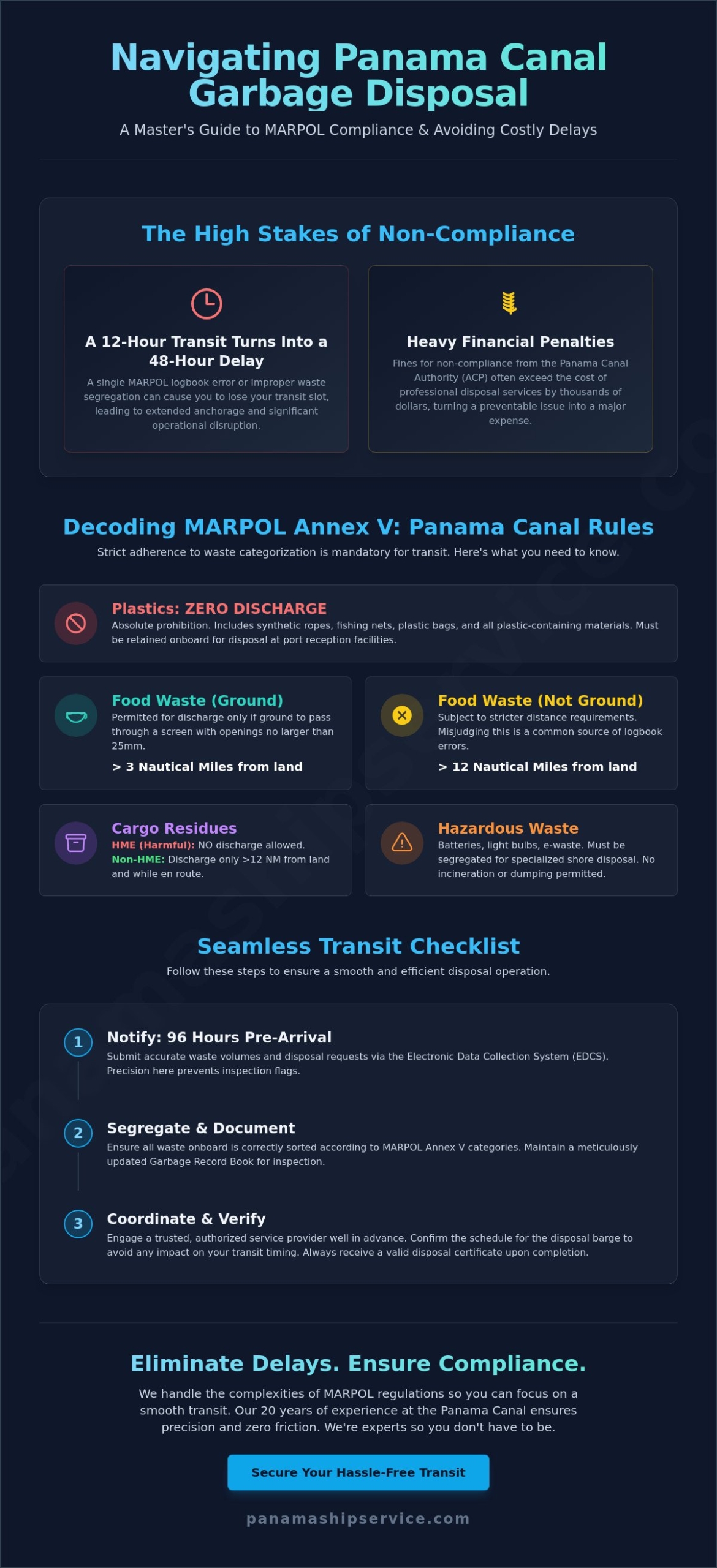
This guide will help you master the logistics and regulatory requirements for ship garbage disposal to ensure a seamless, delay-free transit. We have spent 20 years acting as a trusted partner at the Panama Canal, and we know exactly what inspectors look for during a MARPOL audit. We’re experts so you don’t have to be. We’ll break down the specific requirements for both the Pacific and Atlantic sides, the documentation needed for valid disposal certificates, and the exact steps to coordinate offloading without impacting your schedule.
Key Takeaways
- Understand the strict Panama Canal Authority (ACP) requirements and MARPOL Annex V amendments to prevent costly transit delays.
- Learn the precise categorization of ship-generated waste to ensure your vessel meets all environmental and safety standards.
- Compare the logistical advantages of Balboa versus Cristobal to optimize your garbage disposal for ships panama canal.
- Use our operational checklist to streamline pre-arrival notifications and prepare your crew for seamless waste transfers.
- Discover how expert maritime solutions can minimize vessel expenses and take the frustration out of complex regulatory compliance.
The Regulatory Landscape: Why Garbage Disposal Matters for Canal Transits
Managing ship-generated waste is a critical operational requirement for any vessel transiting the Isthmus. The Panama Canal Authority (ACP) maintains strict oversight of all materials onboard to protect the delicate freshwater ecosystem of Gatun Lake, which serves as the primary water source for the local population. For operators, garbage disposal for ships panama canal is not just a logistical task; it’s a legal mandate that requires precision. Failure to comply with international standards, specifically MARPOL Annex V, results in immediate transit delays and heavy financial penalties. Panama has aligned its local maritime laws with these global environmental protocols to ensure the Canal remains a leader in sustainable shipping. We understand that for ship owners, timing is everything. Mismanaging your waste stream leads to unnecessary friction with port authorities and costly off-hire periods.
The Role of the Panama Canal Authority (ACP)
The ACP acts as the primary enforcement body for environmental safety within Canal waters. Under current regulations, any unauthorized discharge of solid waste, food scraps, or plastics into the waterway is strictly prohibited. The ACP requires all vessels to submit accurate data through the Electronic Data Collection System (EDCS) at least 96 hours before arrival. If your declared waste volumes don’t match what is found during a boarding inspection, you face significant fines. These penalties often exceed the cost of professional disposal services by several thousand dollars. We ensure your documentation is precise and your waste is handled by authorized barges to avoid these avoidable expenses.
Operational Efficiency and Transit Timing
Proper waste planning is essential for maintaining your scheduled transit slot. If a vessel is flagged for sanitation issues or excessive waste buildup that poses a health risk, the ACP can delay its entry until the situation is rectified. This causes a ripple effect, leading to missed windows and increased fuel consumption while waiting at anchor. By utilizing a “one-stop-shop” for technical needs, you streamline your port call. It’s highly efficient to coordinate your garbage disposal for ships panama canal alongside your mechanical ship repairs panama schedule. This integrated approach minimizes vessel downtime and ensures your ship is fully compliant and ready for its transit without interruptions. We are experts so you don’t have to be, providing rapid response services that keep your vessel moving on schedule.
Deep Dive into MARPOL Annex V: What Can and Cannot Be Disposed
MARPOL Annex V, updated significantly with the 2017 amendments, eliminated almost all garbage discharge into the sea. For crews managing garbage disposal for ships panama canal, these rules aren’t suggestions; they’re operational mandates. The current regulatory framework focuses on a total prohibition of most waste streams to protect marine ecosystems. You’re required to retain most garbage on board for delivery to port reception facilities.
The International Maritime Organization regulations dictate a strict zero-discharge policy for plastics. This includes synthetic ropes, fishing nets, and plastic garbage bags. There’s no exception for distance from land or water depth. If it contains plastic, it stays on the ship until you reach a qualified service provider at the Canal.
Cargo residues and wash water present a specific challenge for bulk carriers. Since 2017, shippers must declare whether cargo is Harmful to the Marine Environment (HME). If the residue is HME, you can’t discharge it into the sea. Even for non-HME residues, discharge is only permitted if the ship is en route and more than 12 nautical miles from the nearest land.
Category-Specific Disposal Rules
Food waste is one of the few categories with specific discharge allowances, but the requirements are precise. You can only discharge food waste if it’s ground to pass through a screen with openings no larger than 25mm. Even then, the vessel must be more than 3 nautical miles from land. If the food waste isn’t comminuted, the distance requirement increases to 12 nautical miles.
Hazardous ship-generated waste requires specialized handling. You can’t incinerate or dump batteries, light bulbs, or electronic components. These items must be segregated and documented for shore-side disposal. Similarly, cooking oil is strictly prohibited from sea discharge. Cleaning agents used in cargo holds or on deck can only be washed overboard if they aren’t classified as harmful substances. We are experts so you don’t have to be, ensuring every waste category meets these technical thresholds before your transit begins.
The Garbage Management Plan (GMP)
A Garbage Management Plan is a mandatory document under MARPOL Annex V for vessels over 100 gross tons. This ship-specific plan outlines exactly how your crew collects, stores, and processes every kilogram of waste. It’s a living document that must be understood by every person on board.
Accuracy in the Garbage Record Book is vital for a smooth Panama Canal entry. Every discharge to a shore facility or a completed incineration must be logged with the date, time, and vessel position. For ships over 400 gross tons, these records must be kept for two years. Mismanaging these entries can lead to delays or heavy fines during port state control inspections. If you need to clear your decks before entering the locks, our team provides efficient MARPOL disposal solutions that keep your vessel compliant and your schedule intact.
Logistics at the Canal: Balboa vs. Cristobal Reception Facilities
Logistics at the Panama Canal aren’t uniform across both entrances. The Pacific and Atlantic sides operate under different physical and infrastructure constraints. Effectively managing garbage disposal for ships panama canal requires a clear understanding of these local differences to avoid costly transit delays. While the goal remains MARPOL compliance, the method of execution changes based on your vessel’s position.
Efficiency depends on choosing the right side for the right task. The Pacific entrance is generally more service-heavy for technical needs, while the Atlantic side serves as a critical staging area for vessels awaiting their northbound slot. Weather also dictates the pace of operations. Panama’s rainy season, which typically lasts from May to December, brings over 100 inches of rainfall annually. Heavy swells at the anchorages can suspend barge operations for several hours to ensure crew safety. Compliance with International Maritime Organization regulations remains mandatory even when tropical weather complicates the schedule.
Port of Balboa (Pacific Entrance)
The Pacific side is the primary hub for technical and operational services. Garbage collection here relies heavily on specialized barge services for vessels at the Pacific anchorage. This setup is advantageous for ship owners because it allows for consolidated service delivery. You can coordinate your waste removal alongside bunker surveys, draft surveys, or technical inspections without moving the vessel.
Because Balboa is situated near major repair hubs, it’s the preferred location for vessels requiring extensive maintenance. We coordinate these disposals to ensure they don’t interfere with your repair timeline. Our 20 years of experience helps us navigate the high traffic at the Pacific entrance, ensuring your waste is offloaded before your scheduled pilot time.
Port of Cristobal (Atlantic Entrance)
Operational Checklist: How to Coordinate Your Disposal Service
Efficiency during a canal transit isn’t accidental; it’s the result of precise coordination. For garbage disposal for ships panama canal, timing determines whether you maintain your schedule or face costly setbacks. The process requires a seamless link between the vessel, the local agent, and the service provider. You don’t have time for miscommunication when the vessel is at the anchorage or preparing for transit. We are experts so you don’t have to be, ensuring every bag is accounted for before you enter the locks.
Step-by-Step Coordination for the Chief Officer
The Chief Officer must lead the preparation process to ensure a rapid turnaround. Start by quantifying all waste volumes at least 48 hours before your Estimated Time of Arrival (ETA). This data allows the provider to dispatch the appropriate equipment, whether it’s a specialized barge for offshore collection or a truck for shoreside pickup at the terminal. Rapid response depends on accurate data provided well in advance.
- Segregate strictly: Group waste by MARPOL Annex V categories. Ensure plastics, food waste, and operational waste are in separate, heavy-duty bags. Mixing categories can lead to the entire load being rejected or reclassified as hazardous.
- Label everything: Clearly mark bags with their contents. This speeds up the offloading process and ensures the crew and service provider are aligned on safety protocols.
- Verify credentials: Confirm the provider holds valid Panama Canal Authority (ACP) licenses. Using an uncertified provider can lead to legal complications and environmental fines.
Documentation and Certification
Your paper trail is as important as the physical removal of waste. Once the transfer is complete, you must receive a Safe Disposal Certificate or a formal Garbage Receipt. Port State Control (PSC) inspectors prioritize these documents during audits. If your records don’t match your Garbage Record Book (GRB) entries, you risk detention. The numbers must be exact; reconcile the volume discharged with the remaining onboard totals immediately after the service is performed.
Request digital copies of all receipts for your shore-based technical management. This ensures the head office has real-time compliance data and can update environmental management systems without delay. We provide garbage disposal for ships panama canal that prioritizes this level of transparency, giving you peace of mind during inspections. Our team manages the logistics so your crew can focus on the transit. Put your transit in our hands and avoid the frustration of administrative errors.
Don’t risk delays or compliance failures at the locks. Contact Panama Ship Service today for expert MARPOL disposal solutions.
Panama Ship Service: Your Trusted Partner for MARPOL Compliance
Panama Ship Service brings a 20-year history of technical excellence to every vessel crossing the Isthmus. We understand that the Canal is a high-stakes environment where misjudging your timing leads to massive financial losses. By operating as experts so you don’t have to be, we take the burden of MARPOL compliance off your shoulders. This allows your crew to focus on safe navigation while we handle the regulatory heavy lifting. Our team is available 24/7 to manage urgent requirements and scheduled transits with equal precision. Integrating garbage disposal for ships panama canal with critical maintenance like underwater hull services and mechanical repairs ensures your vessel remains compliant and operational without multiple, conflicting appointments. We treat every transit as a priority, ensuring that your ship meets all local and international standards before it reaches the locks. Our staff is trained to navigate the specific bureaucratic and operational hurdles found in Panama, providing a calm and expert presence in a stressful environment. We focus on tangible benefits like minimizing vessel expenses and ensuring timely, cost-effective solutions for every ship owner.
Comprehensive Disposal Solutions
Managing maritime waste requires a coordinated logistics strategy that respects your arrival window. We provide specialized handling for slops, sludge, and solid waste in a single, streamlined operation. This efficiency is vital for maintaining tight schedules at the locks. Our commitment to the environment means we use certified recycling and waste treatment facilities for all collected materials. We offer transparent pricing structures that help owners and charterers manage their budgets without hidden fees, ensuring garbage disposal for ships panama canal is handled correctly for all vessel sizes.
The One-Stop-Shop Advantage
The administrative burden on ship owners is heavy. We act as your single point of contact, consolidating marine surveys panama with waste removal and technical support. This one-stop-shop approach eliminates the need to coordinate between multiple vendors and reduces paperwork. You receive constant daily communication from a partner who understands the local landscape. Contact Panama Ship Service today to schedule your MARPOL services and ensure your next transit is handled by the Canal’s most reliable team.
Streamline Your Vessel Transit with Expert Waste Coordination
Maintaining strict adherence to MARPOL Annex V is essential for every successful transit through the Panama Canal. Failure to coordinate waste offloading at the Balboa or Cristobal reception facilities can lead to immediate ACP penalties and significant operational delays. By leveraging a structured operational checklist and understanding local logistics, you protect your vessel’s schedule and the local marine environment. Efficient waste management isn’t just a regulatory hurdle; it’s a critical component of maritime safety and cost control in this high-stakes waterway.
Panama Ship Service has served as a trusted partner at the Panama Canal for over 20 years. We provide fully MARPOL-compliant and ACP-authorized garbage disposal for ships panama canal services, backed by 24/7 operational support for all vessel types. Our team handles the technical regulatory requirements and constant communication so you don’t have to. We act as your reliable one-stop-shop, ensuring that every disposal is handled with the urgency your schedule demands. Put your transit in our hands and ensure your ship remains compliant, efficient, and on time.
Get an expert quote for MARPOL-compliant disposal and ship services to secure your next transit. We look forward to providing the professional support your fleet deserves.
Frequently Asked Questions
Is garbage disposal mandatory for all ships transiting the Panama Canal?
Garbage disposal isn’t mandatory for every transit, but compliance with MARPOL Annex V and Panama Canal Authority (ACP) OP Notice N-1-2024 is strictly enforced. Ships must demonstrate they’ve sufficient storage capacity for the duration of the transit. If your storage exceeds 80% capacity, the ACP may require discharge before entry to prevent illegal dumping. We ensure your vessel meets these technical standards to avoid transit delays.
How much lead time is required to schedule a disposal service in Balboa?
You should provide at least 24 to 48 hours of lead time to schedule a garbage disposal for ships panama canal in Balboa. This window allows our team to coordinate with the terminal and secure the necessary barge or truck logistics. For urgent requests, we provide a rapid response service, but booking 2 days in advance guarantees your slot during peak transit windows. Efficiency’s critical when your schedule’s tight.
Can I dispose of oily sludge and solid garbage at the same time?
You can dispose of oily sludge and solid garbage during the same service call, though they’re handled as separate MARPOL categories. Oily waste falls under Annex I, while solid garbage is Annex V. We deploy specialized equipment for each waste stream simultaneously to minimize your time at anchor. This integrated approach reduces your vessel expenses by consolidating logistics into a single, coordinated operation. We’re experts so you don’t have to be.
What documentation will my vessel receive after the disposal is complete?
Your vessel will receive a formal Garbage Receipt and a MARPOL Disposal Certificate immediately after the operation’s finalized. These documents include the date, volume in cubic meters, and the specific category of waste removed. You must keep these records in your Garbage Record Book for 2 years to satisfy Port State Control inspections. We provide these digital and physical copies to ensure your compliance’s fully documented and legally sound.
Does Panama Ship Service provide disposal for cruise ships and navy vessels?
Panama Ship Service provides specialized disposal solutions for cruise ships and navy vessels. These larger operations often involve 50 or more cubic meters of waste and require high-capacity barges. We understand the unique security protocols required for naval assets and the high-volume requirements of passenger liners. Our team manages the entire process so your crew can focus on the technical aspects of the transit. Put your transit in our hands.
What happens if my vessel is found in violation of MARPOL Annex V at the Canal?
Violations of MARPOL Annex V at the Canal result in heavy fines and potential vessel detention by the Panama Canal Authority. Fines for illegal discharge can exceed 100,000 USD depending on the severity of the environmental impact. Beyond financial penalties, a violation triggers an immediate 100% inspection of all shipboard records. We act as your expert partner to ensure all garbage disposal for ships panama canal follows every legal requirement.
Are disposal services available 24/7 during the transit?
Disposal services are available 24 hours a day, 7 days a week, throughout the entire year. Shipping doesn’t stop, and neither do we. Whether your vessel arrives at the Atlantic or Pacific entrance at 03:00, our teams are ready to respond. This constant availability ensures that your transit schedule remains unaffected by waste management needs. We minimize your vessel expenses by providing timely and cost-effective solutions around the clock.
Can food waste be discharged into the Canal if it is ground to less than 25mm?
You can’t discharge food waste into Panama Canal waters, even if it’s ground to less than 25mm. While MARPOL allows this in some open sea areas, the Panama Canal is a restricted no-discharge zone under ACP regulations. All food waste must be retained on board or discharged at a port reception facility. We provide the necessary equipment to remove these organic wastes safely while you’re at anchor or awaiting transit.