
A single centimeter of draft can be the difference between a profitable transit and a costly delay at the Neopanamax locks. You already know that asking how deep is panama canal isn’t a simple question with a static answer. It’s a dynamic calculation that fluctuates based on the 2026 hydrological forecasts and daily ACP Advisory to Shipping notices. Relying on general web searches instead of live operational data leads to load restrictions that immediately eat into your margins.
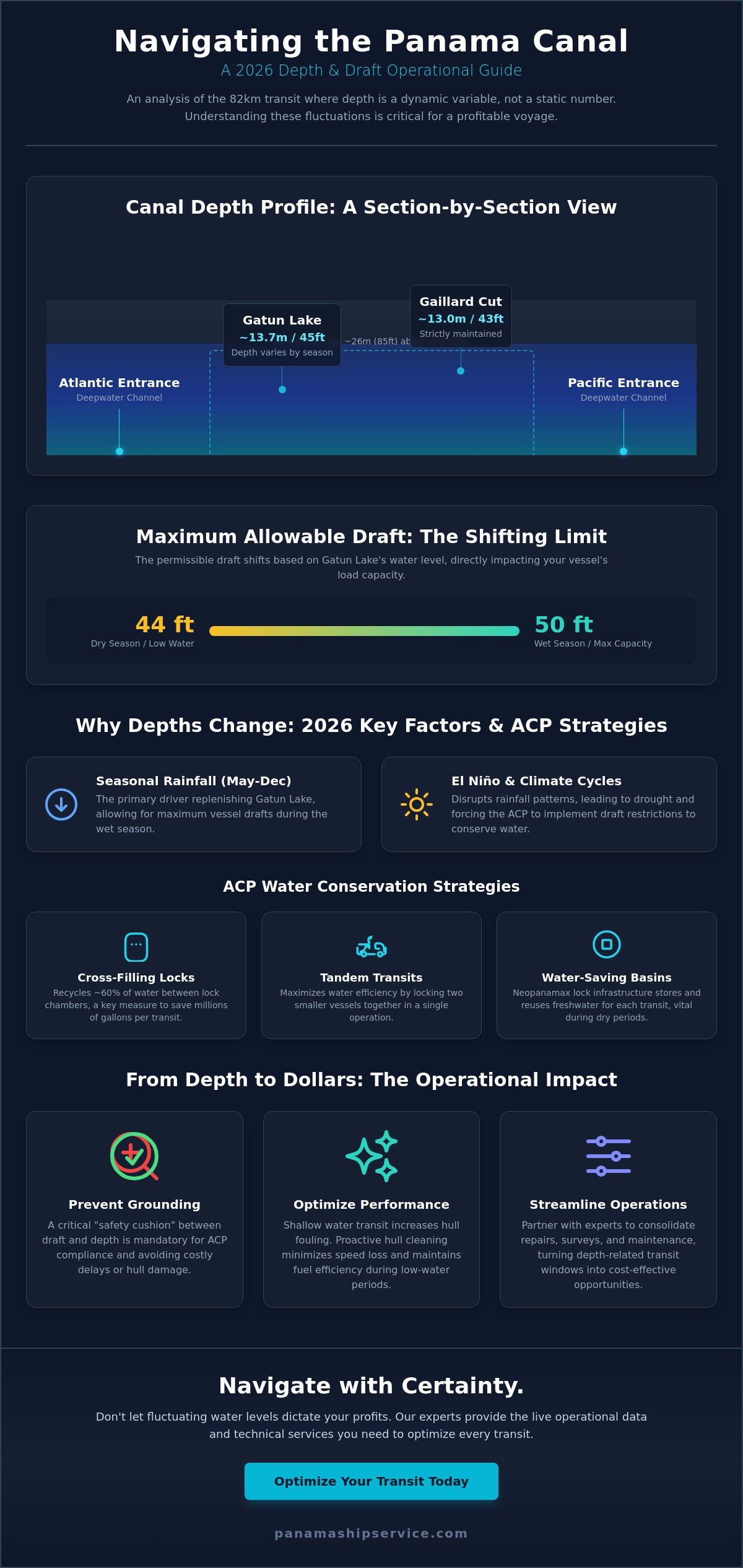
We understand the frustration of navigating inconsistent data when your vessel’s schedule is on the line. This guide provides the precise 2026 depth measurements for the Atlantic and Pacific entrances, the Culebra Cut, and Gatun Lake. You’ll learn exactly how these levels dictate your maximum allowable draft, which can shift from 44 feet to 50 feet depending on seasonal rainfall. We’ll also show you how to synchronize mandatory transit windows with expert underwater hull cleaning and repairs to maximize your time in Panamanian waters. We are experts so you don’t have to be.
Key Takeaways
- Understand why depth varies across the 82 km transit and how the Gaillard Cut’s average depth dictates precise operational planning.
- Learn how deep is panama canal water during seasonal rainfall shifts and how El Niño cycles directly impact your 2026 transit schedule.
- Identify the critical “safety cushion” required between maximum draft and total depth to prevent grounding and ensure daily ACP compliance.
- Discover the link between shallow water transit and hull fouling to minimize speed loss and optimize vessel performance during low-water periods.
- Partner with technical experts to consolidate repairs and surveys, turning depth-related challenges into streamlined, cost-effective operations.
Understanding Panama Canal Depth: A Section-by-Section Breakdown
Determining how deep is panama canal isn’t as simple as citing a single figure. The 82-kilometer (50-mile) transit consists of distinct segments, each with unique bathymetric profiles and maintenance requirements. For ship owners and operators, understanding these variations is essential for accurate load planning and safety. Depth isn’t uniform across the waterway; it’s a managed variable that responds to seasonal rainfall and industrial dredging. Miscalculating these depths leads to costly delays and potential groundings.
- The Gaillard (Culebra) Cut maintains a depth of approximately 13 meters (43 feet).
- Gatun Lake fluctuates around 13.7 meters (45 feet) depending on the water reservoir levels.
- Lock chambers are engineered with specific usable depths that act as the final gatekeeper for vessel size.
The Atlantic and Pacific Entrance Channels
Entrance channels represent the transition from open sea to the restricted waterway. These deepwater-to-deepwater measurements are significantly deeper than the inner channels to accommodate vessels at anchorage. The Panama Canal Authority (ACP) maintains rigorous dredging schedules here. This prevents siltation from reducing the available draft. If a vessel miscalculates its draft at the Pacific or Atlantic entrance, it risks being held at sea, incurring massive demurrage costs. Entrance depths are the first hurdle in a successful transit and are critical for vessels waiting for their scheduled slot.
Gatun Lake: The Heart of the Canal’s Water System
Gatun Lake is the canal’s central reservoir, sitting 26 meters above sea level. This elevation necessitates the lock system to lift and lower ships. The lake’s floor topography is irregular, requiring constant monitoring. While the navigable depth is roughly 13.7 meters, this can change based on the time of year. This Panama Canal overview illustrates how the lake’s water levels are the lifeblood of the entire operation. Modern NeoPanamax requirements have forced the ACP to deepen these channels to ensure that how deep is panama canal remains sufficient for the world’s largest container ships. We monitor these levels daily so our clients don’t have to worry about draft restrictions during the dry season.
The Gaillard Cut, a 12.6-kilometer stretch carved through the Continental Divide, remains one of the most challenging sections. Its depth of 13 meters is strictly maintained through continuous maintenance. Any deviation in a vessel’s calculated draft here can lead to grounding or transit suspension. Lock chambers also have fixed usable depths. These engineering limits dictate exactly which ships can pass. When timing is everything and costs increase, relying on precise depth data is the only way to protect your bottom line. We are experts in these technical requirements so you don’t have to be.
Factors Influencing Water Depth: Why the Numbers Change in 2026
The question of how deep is panama canal isn’t answered by a static number because the entire system depends on a freshwater reservoir. Gatun Lake serves as the primary water source for the locks. Its levels fluctuate according to the seasonal rainfall patterns that typically run from May to December. During a standard wet season, the lake reaches its maximum capacity, allowing for the deepest vessel drafts. However, the El Niño-Southern Oscillation (ENSO) often disrupts these cycles, leading to multi-year periods of reduced depth that require strict management.
For 2026, the Panama Canal Authority (ACP) is implementing aggressive water conservation strategies to mitigate these cycles. These include:
- Cross-filling locks: This process recycles water between lock chambers, saving approximately 60% of the water required for a single transit.
- Tandem transits: Locking two smaller vessels together to maximize water efficiency.
- Water-saving basins: Utilizing the Neopanamax lock infrastructure to store and reuse freshwater.
The 2026 outlook indicates a period of stabilization as the ACP adjusts to new climate realities. While rainfall remains the primary driver, technical interventions now play a larger role in determining the daily allowable draft than they did a decade ago.
Climate Change and Freshwater Scarcity
Drought-induced draft restrictions are becoming more frequent. The historic 2023 drought forced the ACP to limit transits significantly, a challenge that has reshaped operational planning for 2026. To prevent a repeat, the Indio River Reservoir project is a top priority for infrastructure stabilization. This project aims to divert additional freshwater into Gatun Lake to maintain consistent depths during the dry season. Operational draft refers to the maximum depth a vessel can submerge in the water while safely transiting the canal based on current Gatun Lake levels.
The Role of Dredging and Infrastructure Maintenance
Continuous maintenance is required to keep the channel navigable. Understanding how deep is panama canal requires looking at the technical maintenance of the Culebra Cut. This 12.6-kilometer stretch is the narrowest part of the canal and is prone to heavy sedimentation. Dredging teams work 24 hours a day to maintain a minimum depth of 13 meters in this critical area. Panama Ship Service offers specialized maritime support to help operators stay informed of real-time depth changes during these maintenance windows.
Bottom-suction dredgers are the primary tools used for this task. These vessels operate without disrupting the transit schedule, sucking up silt and tropical debris from the canal floor. It’s a difficult environment. The surrounding tropical rainforest causes constant soil erosion, meaning the canal would naturally fill with sediment within a few years if dredging stopped. By 2026, the ACP plans to have integrated newer, more efficient dredging technology to handle the increased traffic from larger Neopanamax vessels.
Draft Restrictions and Navigation for Modern Vessels
Understanding how deep is panama canal requires looking beyond the physical bottom of the channel. For a mariner, the critical measurement is the allowable draft. The Panama Canal Authority (ACP) maintains a mandatory “safety cushion” known as under-keel clearance (UKC). This gap prevents the hull from touching the channel bed during transit. The ACP communicates these limits through daily “Advisories to Shipping,” which adjust based on the water levels of Gatun Lake. If you miscalculate your draft, you risk heavy fines or being denied entry until the vessel is light-loaded.
The financial impact of depth constraints is immediate and severe. When drought conditions force the ACP to reduce draft limits, every inch lost equates to lost cargo. For a large container ship, a one-foot reduction in draft can mean leaving 300 to 400 containers behind. Operators must also navigate the shift from salt water to Tropical Fresh Water (TFW). Because fresh water is less dense than sea water, your ship will sit deeper in the water once it enters the canal. Failing to account for this change can lead to an accidental violation of the maximum allowable draft.
Panamax vs. NeoPanamax: Depth Requirements
The 2016 expansion significantly changed the depth landscape. The original Panamax locks typically allow for a maximum draft of 39.5 feet (12.04 meters). The NeoPanamax locks are designed for much deeper vessels, offering a maximum draft of up to 50 feet (15.24 meters) when Gatun Lake is at its design level of 88.5 feet. However, NeoPanamax ships are far more sensitive to water level fluctuations. A minor drop in lake depth can trigger immediate draft restrictions for these larger hulls. Utilizing professional marine surveys in Panama is the only way to verify your actual draft and ensure compliance before you reach the locks.
Calculating Your Safe Transit Draft
Determining your safe transit draft involves a specific formula for under-keel clearance. You must account for the “squat effect,” where a vessel’s draft increases as it moves through narrow or shallow channels. The ACP generally requires a minimum UKC of 1.5 feet, but this can vary based on the specific section of the transit. Precise bunker surveys are a necessary step before entering the locks. We’ve seen cases where unexpected fuel weight pushed a ship over its declared draft. To maintain safety and efficiency, you should consider the following factors:
- Vessel Speed: Higher speeds increase the squat effect in the Culebra Cut.
- Water Density: The transition to TFW must be calculated based on current lake salinity.
- Trim and List: An unevenly loaded ship can exceed draft limits on one side even if the mean draft is acceptable.
We are experts in these technicalities so you don’t have to be. Knowing exactly how deep is panama canal on the day of your transit allows you to maximize your cargo without compromising safety. Put your transit in our hands to ensure every calculation is accurate and every regulation is met.
How Depth Affects Vessel Maintenance and Underwater Services
Understanding how deep is Panama Canal isn’t just a navigation task; it’s a maintenance priority. In 2024, draft restrictions reached as low as 44 feet due to Gatun Lake levels. When the keel sits closer to the canal bed, the risk of suction and debris ingestion increases. A vessel operating with heavy biofouling effectively draws more water, reducing the safety margin between the hull and the canal floor. We are experts so you don’t have to be, ensuring your vessel meets strict transit tolerances through proactive technical care.
The Necessity of Underwater Hull Cleaning
Biofouling increases vessel weight and drag, which directly impacts draft calculations. When every inch of clearance matters, a fouled hull can be the difference between a smooth transit and a rejected entry. Utilizing underwater hull services while at anchorage allows owners to optimize their vessel’s displacement before reaching the locks. Maintaining a clean hull can save 5-10% in fuel costs during a transit, providing a significant ROI while waiting for a scheduled slot. Our teams provide rapid response cleaning to ensure your vessel remains within the required draft limits set by the ACP.
Propeller Polishing and Mechanical Readiness
Shallow water navigation creates unique mechanical risks. Low water levels increase the concentration of silt and suspended solids, which can erode propeller surfaces and clog sea chests. Knowing how deep is Panama Canal during your specific transit window helps determine if your propulsion system is at risk of “squat” effects that pull the stern closer to the bottom. Addressing rudder and propeller damage caused by low-water-level navigation is critical for maintaining maneuverability in the tight confines of the Culebra Cut.
- Silt ingestion can lead to overheating in cooling systems during slow-speed lock maneuvers.
- Propeller roughness increases vibration, leading to potential seal failures in shallow transits.
- Mechanical ship repairs in Panama are best performed during canal waits to maximize operational uptime.
We recommend that operators schedule mechanical ship repairs in Panama while anchored at Balboa or Cristobal. This synchronization ensures that any damage sustained from previous shallow-water passages is rectified before the next leg of the journey. Our 20 years of experience shows that vessels with polished propellers and clear intakes navigate the canal’s depth challenges with 15% fewer mechanical incidents. Put your transit in our hands and minimize your vessel expenses through expert technical oversight.
Don’t let draft restrictions delay your schedule. Contact Panama Ship Service today for a comprehensive technical assessment before your next transit.
Navigating the Canal with Panama Ship Service: Your Technical Partner
Panama Ship Service has managed technical maritime operations for over 20 years. Knowing how deep is panama canal during your specific transit window is only half the battle. You need a partner who understands how those fluctuating depths affect your hull, your engine performance, and your schedule. Our team consolidates every technical requirement into a single, streamlined operation. We act as the vital link between your vessel, your agency, and the ACP to prevent the delays that often plague unprepared transits.
While official reports tell you how deep is panama canal, our experts tell you how that depth affects your specific cargo load. We provide constant, daily communication to ensure your vessel stays within safe draft limits. Our goal is to position your vessel for a safe and cost-effective transit by handling the technical burdens so your crew can focus on navigation. We are experts so you don’t have to be.
One-Stop-Shop for Canal Transit Services
We provide a comprehensive suite of services designed to keep your vessel moving. Our local knowledge prevents the common frustrations of changing ACP regulations and technical requirements. We offer everything from MARPOL disposal in Panama to critical emergency fixes. Our presence at the canal ensures you don’t waste time searching for multiple vendors.
- 24/7 Availability: Our teams provide mechanical ship repairs at any hour to protect your transit slot.
- Regulatory Compliance: We ensure all disposals and surveys meet strict international and local standards.
- Technical Surveys: We conduct bunker and draft surveys with precision to minimize vessel expenses.
- Resource Management: We coordinate repairs and disposals simultaneously to reduce your time at anchor.
Put Your Transit in Expert Hands
Think of us as the “Master Key” to the Panama Canal’s technical challenges. Miscalculating a draft or missing a disposal window can cost thousands in fines and lost time. We eliminate these risks through proactive management and rapid response. We’ve spent two decades refining our processes to ensure your vessel experiences zero unnecessary friction while crossing the isthmus.
Contact our team today for a tailored quote on technical surveys, disposals, or emergency repairs. We provide the reliability you need in a high-stakes environment. Get a Quote for Your Panama Canal Vessel Services and ensure your next transit is handled with professional precision.
Secure Your 2026 Transit with Technical Precision
Navigating the Neopanamax locks and Gatun Lake requires more than just basic charts. Understanding how deep is panama canal involves monitoring seasonal rainfall and precise draft restrictions that change throughout the year. Success in 2026 depends on real-time data and technical readiness. Whether you’re managing a deep-draft container ship or a bulk carrier, the margin for error is thin. Panama Ship Service leverages over 20 years of maritime expertise to guide your vessel through these complexities. We provide Class-approved underwater and marine surveys to verify your vessel’s condition before and during transit. If mechanical failures threaten your schedule, our teams deliver a 24/7 emergency mechanical repair response. We handle the technical details so your crew can focus on safe navigation. Efficiency is the priority in these waters; don’t leave your schedule to chance. Contact Panama Ship Service for Expert Technical Support During Your Transit and ensure your vessel moves through the canal without unnecessary delays. We look forward to being your trusted partner on the water.
Frequently Asked Questions
What is the maximum draft for a NeoPanamax vessel in the Panama Canal?
The maximum allowable draft for a NeoPanamax vessel is 15.24 meters, which is 50 feet, in Tropical Fresh Water. This limit depends on the water levels of Gatun Lake and seasonal rainfall patterns. During the 2024 drought, the Panama Canal Authority restricted this to 13.41 meters to maintain safe navigation. We monitor these daily advisories to ensure your vessel meets compliance before arrival.
How does the water level of Gatun Lake affect canal depth?
Gatun Lake levels dictate the available depth because the canal operates as a freshwater bridge between two oceans. When levels drop below the 25.9 meter baseline, the Panama Canal Authority issues draft restrictions in 15 centimeter increments. Understanding how deep is panama canal during dry seasons is vital for cargo planning. Low rainfall directly reduces the maximum permissible draft for all transiting ships.
Is the Panama Canal deep enough for the largest aircraft carriers?
The Panama Canal isn’t deep or wide enough for the largest modern aircraft carriers like the Gerald R. Ford class. These vessels have a beam of 78 meters, far exceeding the 51.25 meter limit of the NeoPanamax locks. While older Midway class carriers transited previously, current supercarriers must sail around Cape Horn. Their 12 meter draft isn’t the only issue; physical dimensions remain the primary barrier.
What happens if a ship exceeds the draft limit during transit?
If a ship exceeds the published draft limit, it must offload cargo or fuel before entering the canal. The Panama Canal Authority conducts precise draft surveys at the anchorage to verify compliance. Ships found over the limit face immediate delays or must pay for lightering services to transfer cargo to another vessel. We help you avoid these costly setbacks through accurate pre arrival calculations and surveys.
How often is the Panama Canal dredged to maintain its depth?
The Panama Canal Authority performs dredging operations 24 hours a day, 365 days a year to maintain its operational depth. A fleet of cuttersuction and clamshell dredges removes 5 million cubic meters of sediment annually from the navigation channels. This constant maintenance prevents siltation from narrowing the path through the Culebra Cut. Without this round the clock effort, the canal would quickly become impassable for deep draft vessels.
What is the difference between Tropical Fresh Water (TFW) draft and Sea Water draft?
Tropical Fresh Water draft is deeper than Sea Water draft because fresh water is less dense than salt water. A ship entering Gatun Lake will sink approximately 18 to 25 centimeters deeper into the water column. This phenomenon, known as freshwater allowance, is critical for mariners to calculate. Knowing how deep is panama canal in fresh water ensures your hull clears the lock sills safely without grounding.
Can underwater repairs be performed while a ship is waiting for canal transit?
You can perform underwater repairs at the Pacific or Atlantic anchorages while waiting for your scheduled transit slot. Certified divers conduct hull cleaning, propeller polishing, and class approved inspections without disrupting your timeline. We coordinate these technical services to maximize your vessel’s efficiency. Completing repairs during wait times reduces fuel consumption and prevents potential transit delays due to mechanical issues or biofouling.
Does the depth of the Panama Canal vary between the Atlantic and Pacific sides?
The depth varies between the two sides due to a 6 meter tidal range on the Pacific side compared to just 0.5 meters on the Atlantic side. While the locks regulate the internal channel depth, the approach channels must account for these massive tidal fluctuations. Engineers designed the Pacific entrance deeper to accommodate the low tide cycles. This ensures constant access for NeoPanamax ships regardless of the lunar cycle or sea level changes.