
A single inch of water in the Panama Canal represents approximately 100 tons of cargo capacity for a Neopanamax vessel; making depth the most expensive variable in your transit plan. If you are asking how deep is the panama canal, you aren’t just looking for a static number. You’re looking for the operational limit that prevents a costly light-loading scenario or a prohibited transit. In 2026, the answer depends entirely on whether you are navigating the original 1914 locks or the expanded 2016 Culebra Cut sections.
We understand that conflicting data between channel depth and maximum authorized draft can lead to dangerous uncertainty during seasonal fluctuations. You need reliable figures to minimize vessel expenses and avoid the frustration of last-minute offloading. This technical guide delivers the exact depth specifications for every canal section and explains how dynamic water levels in Gatun Lake impact your specific hull clearance. We will compare Panamax versus Neopanamax requirements and detail how underwater maintenance keeps these vital lanes open. We are the experts so you don’t have to be; let’s get your transit figures right.
Key Takeaways
- Distinguish between total channel depth and maximum allowable draft to ensure safe, efficient navigation across the entire 80-kilometer transit route.
- Compare the technical specifications of Panamax and Neopanamax locks to understand how the expansion project increased depth capacity for larger vessels.
- Identify how deep is the panama canal in critical segments like Gatun Lake and the Culebra Cut, where dynamic water levels dictate seasonal transit limits.
- Account for the impact of freshwater buoyancy and the rainy season to maintain optimal draft and minimize operational expenses during your transit.
- Leverage underwater inspections (UWILD) and hull maintenance to identify draft-limiting damage and ensure your vessel meets strict canal specifications.
Understanding Panama Canal Depth: More Than Just a Single Number
Knowing how deep is the panama canal is the first step in a successful transit. For mariners and charterers, depth isn’t a static figure but a dynamic variable managed by the Panama Canal Authority (ACP). The 80-kilometer route traverses varying elevations and water types, meaning the available water under your keel changes constantly from the Atlantic to the Pacific. We track these daily fluctuations to ensure your vessel remains compliant and efficient.
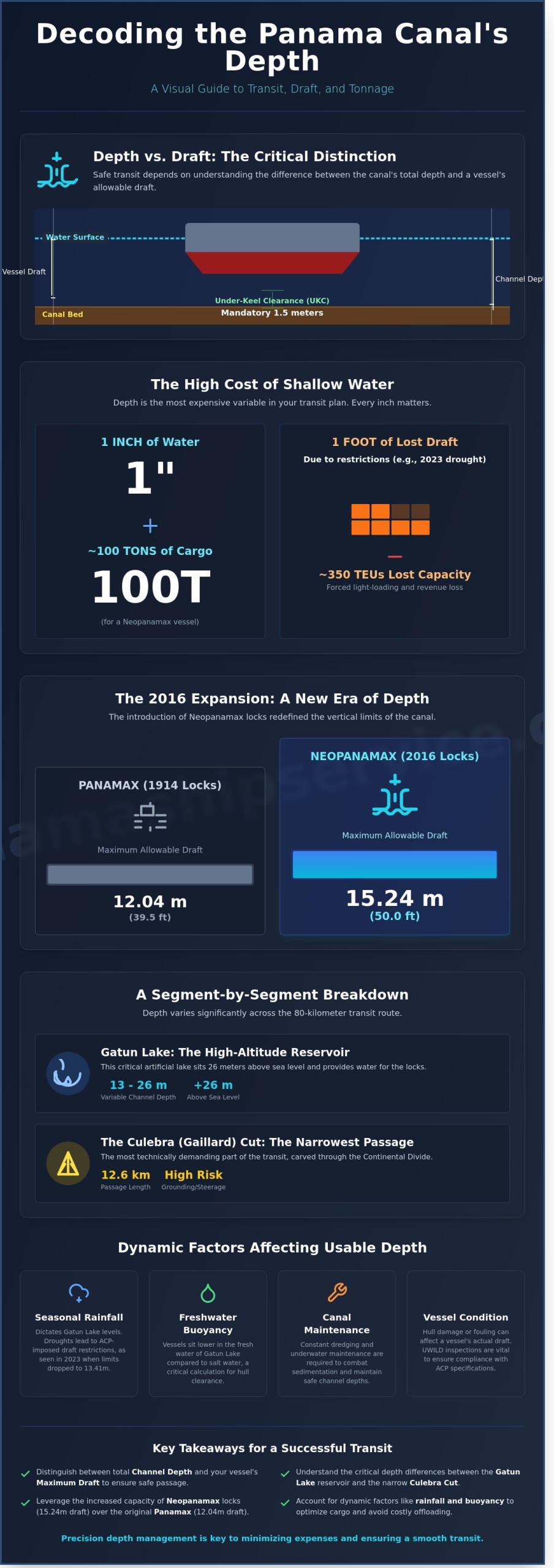
The ACP issues daily advisories to shipping to account for seasonal rainfall and lake levels. The 2016 Panama Canal expansion project redefined these vertical limits by introducing the Neopanamax locks. This massive engineering undertaking increased the maximum allowable draft from 12.04 meters to 15.24 meters, allowing for much larger vessel classes to pass through the Isthmus. Our team monitors these specific ACP requirements so you don’t have to worry about last-minute surprises at the locks.
Depth management relies on the water levels of Gatun Lake, which sits 26 meters above sea level. When the lake level drops below its 24-meter threshold, the ACP must implement draft restrictions to protect the waterway’s integrity. This precision ensures that even the largest ships can navigate the narrowest sections, like the Culebra Cut, without risk of grounding.
The Difference Between Depth and Draft
It’s vital to distinguish between total channel depth and maximum allowable draft. Channel depth measures the distance from the water surface to the dredged bed. In contrast, draft is the depth of the hull below the waterline. To ensure safety, the ACP mandates a strict under-keel clearance (UKC). This 1.5-meter safety margin protects the hull from the canal bed while maintaining steerage in narrow channels. If your vessel exceeds these limits, you face delays or forced cargo offloading.
Why Depth is the Lifeblood of Global Trade
Draft capacity is the primary driver of shipping economics. For every foot of draft lost to restrictions, a Neopanamax vessel loses the capacity for roughly 350 TEUs. During the 2023 drought, draft limits were reduced to 13.41 meters, forcing many carriers to reduce their loads significantly. This volatility proves why understanding how deep is the panama canal is essential for accurate load planning and cost control.
Historical data shows that depth has always been the canal’s biggest challenge. From the failed French sea-level attempts in the 1880s to the modern lock system, the goal has always been to provide enough water for the world’s largest fleets. We provide the technical expertise to navigate these shifting limits without sacrificing your bottom line. Put your transit in our hands and let our 20 years of experience work for you.
Sectional Depth Breakdown: From Gatun Lake to the Culebra Cut
The Panama Canal isn’t a uniform trench cut through the isthmus. It’s a complex hydraulic system where floor elevations shift significantly across its 80 kilometer length. Understanding how deep is the panama canal requires a segment by segment analysis of the artificial waterway. The Canal Authority (ACP) maintains specific depth targets to ensure safe passage, but these are constantly challenged by geological shifts and sedimentation. The artificial nature of the canal means that the floor isn’t a straight line; it’s a series of steps managed by locks and reservoirs.
Gatun Lake: The High-Altitude Reservoir
Gatun Lake acts as the critical bridge between the Atlantic and Pacific oceans, sitting approximately 26 meters above sea level. The depth within the lake’s navigation channels typically ranges from 13 to 26 meters. This variance depends on the specific lane and the seasonal water levels. Because the lake bottom follows the original topography of the Chagres River valley, deep-draft vessels must adhere to strictly defined paths to avoid underwater peaks. During periods of low rainfall, the ACP implements Panama Canal draft restrictions to prevent groundings. We monitor these changes daily to help our clients optimize their cargo loads and avoid costly delays.
The Culebra (Gaillard) Cut: The Narrowest Passage
The Culebra Cut represents the most technically demanding portion of the canal transit. This 12.6 kilometer stretch through the Continental Divide maintains a standardized depth of 13 meters (43 feet) for the original Panamax locks. The area is geologically unstable. This instability forces the ACP into a perpetual cycle of maintenance. For the 2026 fiscal year, the dredging schedule includes the removal of over 1.2 million cubic meters of material to ensure the Cut’s efficiency. This constant work prevents the floor from rising due to tectonic pressure and underwater landslides that could otherwise compromise the channel’s draft.
The Ocean Entrances and Approach Channels
Approach channels at Balboa on the Pacific side and Cristóbal on the Atlantic side are engineered to be deeper than the interior lake. These entrances often reach depths of 15.5 meters. The extra depth accounts for tidal influences and heavy siltation. The Pacific entrance is particularly volatile; it experiences tidal swings of up to 6 meters. This requires deeper dredging to ensure keel clearance during the lowest tides of the month. Siltation from coastal currents means these channels require quarterly hydrographic surveys to confirm navigable depths. We are experts in these local conditions so you don’t have to be; our team ensures your vessel meets all technical requirements before entering these critical approach zones.
Neopanamax vs. Panamax: How the Expansion Changed Depth
The 2016 expansion transformed the waterway’s capacity and technical requirements. Before June 26, 2016, the canal relied entirely on the original 1914 locks. The “Third Set of Locks” project introduced the Cocoli and Agua Clara complexes, which operate on a different scale. These new locks don’t just move more ships; they handle significantly heavier, deeper vessels. When mariners ask how deep is the panama canal, they must first identify which set of locks their vessel will utilize. The engineering shift from the century-old gravity system to modern water-saving basins changed the fundamental math of every transit.
Panamax Lock Dimensions and Depth
The original Panamax locks have a fixed depth of approximately 12.56 meters. For decades, this served as the global bottleneck for ship construction. Vessels using these locks are currently restricted to a maximum draft of 12.04 meters (39.5 feet) in Tropical Fresh Water. While these dimensions limit capacity to roughly 5,000 TEUs, the Panamax route remains a critical asset. According to the Panama Canal Authority, these locks still handle a large volume of regional trade, smaller bulk carriers, and specialized tankers. We see many operators continue to favor this route for its cost-efficiency on shorter runs where massive Neopanamax scale isn’t required.
Neopanamax: A New Era of Deep-Draft Shipping
The Neopanamax locks represent a massive engineering leap. Each lock chamber is 18.3 meters (60 feet) deep. This increased vertical clearance allows for a maximum allowable draft of 15.2 meters (50 feet) as of 2026. This depth accommodates massive container ships carrying up to 14,000 TEUs. To maintain this depth without exhausting the local water supply, engineers implemented nine water-saving basins. These basins recycle 60% of the water used during each lockage. It’s a precise balance; the basins ensure that how deep is the panama canal stays consistent even during periods of lower rainfall.
For 2026, mariners should plan for these specific constraints:
- Neopanamax Max Draft: 15.24 meters (50.0 feet) based on Gatun Lake levels.
- Panamax Max Draft: 12.04 meters (39.5 feet) for the original lock set.
- Chamber Depth: 18.3 meters in Neopanamax locks vs. 12.56 meters in Panamax locks.
Miscalculating your draft by even a few centimeters leads to delays or cargo offloading. We are experts so you don’t have to be. Our team monitors daily draft adjustments from the ACP to ensure your vessel meets every technical requirement before it reaches the breakwater. Timing is everything in this industry. Put your transit in our hands to avoid the frustration of depth-related transit denials.
Variable Factors Affecting Usable Depth and Draft
Determining how deep is the Panama Canal at any given moment involves more than measuring the distance to the channel floor. The canal operates as a freshwater bridge, meaning its usable depth fluctuates based on complex hydrological cycles and vessel physics. For ship owners, the physical depth of the trench is secondary to the maximum authorized draft published by the Panama Canal Authority (ACP). This figure changes based on the water volume available in Gatun Lake, which serves as the primary reservoir for the entire lock system.
The ACP manages these fluctuations through a tiered Draft Adjustment system. When water levels drop, the ACP issues technical advisories to shipping, often weeks in advance. During the severe drought of 2023, the maximum authorized draft for Neopanamax vessels was reduced from 50 feet to 44 feet. These adjustments directly impact cargo capacity; a single foot of draft reduction can force a container ship to leave 300 to 500 containers behind. We monitor these technical updates daily to ensure our clients don’t face unexpected loading restrictions.
Seasonality and the Hydrological Cycle
The dry season, typically running from January to May, creates the most significant challenges for canal operations. Without consistent rainfall, the evaporation rates and lockage outflows can outpace the inflow from the watershed. In May 2024, Gatun Lake levels reached critical lows near 80 feet, well below the optimum 85-foot operating level. To combat this long-term volatility, the ACP is moving forward with the $1.2 billion Indio River Reservoir project. This initiative aims to stabilize the water supply and provide more consistent depth guarantees regardless of El Niño cycles or shifting weather patterns.
Freshwater vs. Saltwater Buoyancy (TPC)
Ship masters must account for the transition from the high-density saltwater of the Atlantic or Pacific to the low-density Tropical Fresh Water (TFW) of Gatun Lake. Saltwater has a density of approximately 1.025, while the canal’s freshwater is roughly 0.9954. Because freshwater is less dense, ships sink deeper into the water column upon entering the canal. This physical reality is calculated using the Tons Per Centimeter (TPC) immersion factor.
- The TFW Adjustment: Vessels are permitted a deeper draft in saltwater approaches so that they “settle” into the authorized freshwater draft once inside the locks.
- Draft Surveys: Accurate readings at the sea-level entries are vital to avoid grounding in the lake channels.
- Weight Distribution: Proper trim is essential to maintain under-keel clearance when the vessel’s buoyancy changes.
Understanding how deep is the Panama Canal requires precise technical data and real-time monitoring of lake elevations. Miscalculating your TFW adjustment can lead to costly delays or forced offloading at the terminal. We provide the expert technical support you need to maximize your cargo intake without risking transit safety.
Don’t risk your transit on outdated depth charts. Contact Panama Ship Service today for expert draft surveys and technical transit support.
Why Precision Depth Matters for Ship Repairs and Services
Operating a vessel at the limits of the Panama Canal’s draft requires more than just navigational skill. It demands technical perfection. When water levels in Gatun Lake fluctuated significantly in 2024, reaching lows of 79 feet, the margin for error for deep-draft vessels vanished. Every centimeter of hull clearance became a critical calculation for ship owners. If your vessel’s hull is compromised by growth or mechanical issues, the theoretical answer to how deep is the panama canal becomes irrelevant because your effective draft has changed.
Maximizing Draft Through Hull Maintenance
Biofouling is a silent profit killer. Marine growth increases hydrodynamic drag and adds physical weight, which can increase a vessel’s effective draft by 2% to 5%. For a Neo-Panamax ship targeting the maximum 15.24-meter draft, this slight increase can result in a transit denial or mandatory cargo offloading. Professional underwater hull cleaning in Panama is the only way to ensure your vessel sits exactly where the load line says it should.
- Propeller Polishing: Maintaining a smooth propeller surface ensures maximum thrust-to-power ratios, which is vital for maintaining steerage in the narrow reaches of the Culebra Cut.
- UWILD Inspections: Underwater Inspections in Lieu of Drydocking (UWILD) identify draft-limiting damage or hull indentations that might not be visible from the surface.
- Drag Reduction: A clean hull allows for more predictable handling when navigating tight lock chambers with minimal under-keel clearance.
Surveys and Compliance for Deep-Draft Vessels
Compliance is not optional at the Canal. The Panama Canal Authority (ACP) maintains strict oversight of vessel dimensions and environmental impact. We conduct rigorous marine surveys in Panama to verify draft marks and ensure that displacement calculations are 100% accurate before you arrive at the locks. Miscalculating your weight leads to fines and indefinite delays.
Mechanical readiness is equally important. If your vessel experiences steering gear failure or propulsion issues while investigating how deep is the panama canal, you need immediate intervention. We provide emergency mechanical ship repairs at the Panama Canal to rectify depth-related incidents or engine room failures. Furthermore, we ensure all MARPOL requirements are met during your stop, preventing environmental holds that can cost owners upwards of $50,000 per day in lost time.
Your Trusted Partner at the Panama Canal
Panama Ship Service has spent 20 years acting as the primary technical resource for owners and charterers. We understand that in the shipping industry, timing isn’t just important; it’s everything. Misjudge your draft or your arrival time, and you lose your slot. We offer a “one-stop-shop” advantage, managing everything from technical surveys to MARPOL disposals and urgent mechanical repairs.
Our team provides constant daily communication and rapid response times. We are experts so you don’t have to be. Don’t leave your transit to chance or rely on outdated depth data. Put your vessel in the hands of a partner that understands the technical and operational realities of the Canal. Contact Panama Ship Service today for a consultation and ensure your next transit is efficient, compliant, and cost-effective.
Secure Your 2026 Transit with Precision Maritime Data
Mastering the complexities of the waterway requires more than a standard nautical chart. As we approach 2026, mariners must account for the 15.24 meter maximum draft in the Neopanamax locks while monitoring the constant seasonal fluctuations of Gatun Lake. Precision isn’t optional when a single inch of draft determines your cargo capacity and safety. You need to know exactly how deep is the panama canal during your specific transit window to prevent groundings or rejected entries. Miscalculating these variables leads to expensive delays that your bottom line can’t afford.
Panama Ship Service brings 20 years of maritime expertise directly to your vessel. We provide Class-approved surveys and certified MARPOL disposals that ensure your ship meets every strict regulatory standard. If technical issues arise, our 24/7 rapid response team handles emergency repairs to keep your schedule on track. We’re the experts so you don’t have to be. Put your transit in our hands and focus on your next port of call. We look forward to ensuring your voyage is both safe and profitable.
Contact Panama Ship Service for Expert Technical Support During Your Transit
Frequently Asked Questions
What is the maximum depth of the Panama Canal?
The maximum depth of the Panama Canal reaches 18.3 meters (60 feet) within the Neopanamax lock chambers during optimal water conditions. This measurement is the technical limit for how deep is the panama canal when considering its deepest structural points. However, the operational draft for vessels is lower, usually capped at 15.24 meters (50 feet) to ensure a safety margin between the keel and the canal floor.
Does the depth of the Panama Canal change with the tides?
Tidal changes only affect the canal’s entrance channels at the Pacific and Atlantic oceans, as the interior waterway consists of freshwater lakes. The Pacific entrance experiences significant tidal swings of up to 6.1 meters (20 feet), while the Atlantic side varies by only 0.6 meters (2 feet). Once a ship clears the initial locks, its transit depth depends entirely on the freshwater levels of Gatun Lake rather than oceanic tides.
What is the deepest part of the Panama Canal?
The deepest navigational sections are located within the Culebra Cut and the Gatun Lake access channels, which are kept at a minimum depth of 15.2 meters (50 feet). When calculating how deep is the panama canal for transit planning, mariners focus on these high-traffic corridors. The Panama Canal Authority uses 24-hour monitoring to ensure these specific zones remain clear of siltation that could compromise the 15.24-meter maximum draft limit.
Can a submarine transit the Panama Canal based on its depth?
Submarines can transit the canal, but they’re required to stay on the surface for the entire duration of the passage. The average channel depth of 15.2 meters doesn’t provide enough clearance for submerged operations, and ACP safety regulations mandate a visible profile for all vessels. Submarines must also provide specific stability data to the Canal Authority at least 96 hours before their scheduled arrival to ensure safe passage through the locks.
How often is the Panama Canal dredged to maintain its depth?
Dredging operations occur 24 hours a day, 365 days a year to prevent sediment buildup from reducing the waterway’s depth. The ACP dredging division removes roughly 5 million cubic meters of material annually using a specialized fleet of cutter suction and backhoe dredgers. This aggressive maintenance schedule is vital for keeping the Culebra Cut and Gatún Lake channels at their required 15.2-meter depth for the 2026 shipping season.
What happens if a ship’s draft exceeds the current canal limit?
Ships with a draft exceeding the daily limit must either offload cargo at local terminals or wait for water levels to increase. If a vessel arrives at the locks deeper than the announced limit, it’s denied entry to prevent grounding. Many operators use the Panama Canal Railway to move excess containers across the isthmus, allowing the lightened ship to transit safely while maintaining its tight 2026 delivery schedule.
Is the new set of locks deeper than the original ones?
The Neopanamax locks are 5.5 meters (18 feet) deeper than the original Panamax locks, allowing for much larger vessels. The new locks have a chamber depth of 18.3 meters, whereas the original locks are limited to 12.8 meters. This extra depth supports a maximum vessel draft of 15.24 meters, which is a significant increase from the 12.04-meter limit found in the older 1914 infrastructure that still serves smaller ships.
How do water-saving basins affect the depth in the Neopanamax locks?
Water-saving basins allow the Neopanamax locks to maintain operational depth while recycling 60% of the water used during each transit. Each lock chamber uses three lateral basins to store water during the lowering process, which is then reused to fill the chamber for the next ship. This system ensures the canal stays deep enough for heavy vessels even during dry seasons, reducing the total draw from Gatun Lake by 7% per transit.