
Miscalculating the panama canal length by even five miles can cost a ship owner upwards of $60,000 in missed arrival slots and excess fuel burn. You likely already know that precision is the only way to maintain a tight schedule in this high-stakes environment. It’s frustrating to find generic search results that confuse the 40 mile shore-to-shore distance with the 50 mile deep-water-to-deep-water reality. These discrepancies lead to unnecessary uncertainty when you’re calculating transit windows and daily operational costs.
We’ve spent 20 years acting as the trusted partner for mariners at the waterway, so we know that every mile matters for your bottom line. This guide provides the exact dimensions you need to manage your vessel’s timing and fuel requirements with total confidence. You’ll get a clear breakdown of the specific transit sections and discover the best locations for performing mid-journey repairs or MARPOL disposals. We provide the technical clarity so you don’t have to guess during your next crossing.
Key Takeaways
- Understand the critical distinction between shoreline and deep-water measurements to accurately plan for the 50-mile panama canal length.
- Discover the operational math behind the 8-to-10-hour transit time to ensure your vessel meets strict scheduling requirements.
- Navigate the sectional complexities of the journey, from the initial Atlantic approach to the 21-mile crossing of Gatun Lake.
- Identify high-value opportunities to conduct underwater hull cleaning and mechanical repairs without disrupting your transit window.
- Leverage 20 years of local technical expertise to streamline your operations and minimize vessel expenses during the crossing.
Defining the Panama Canal Length: Shoreline vs. Deep Water
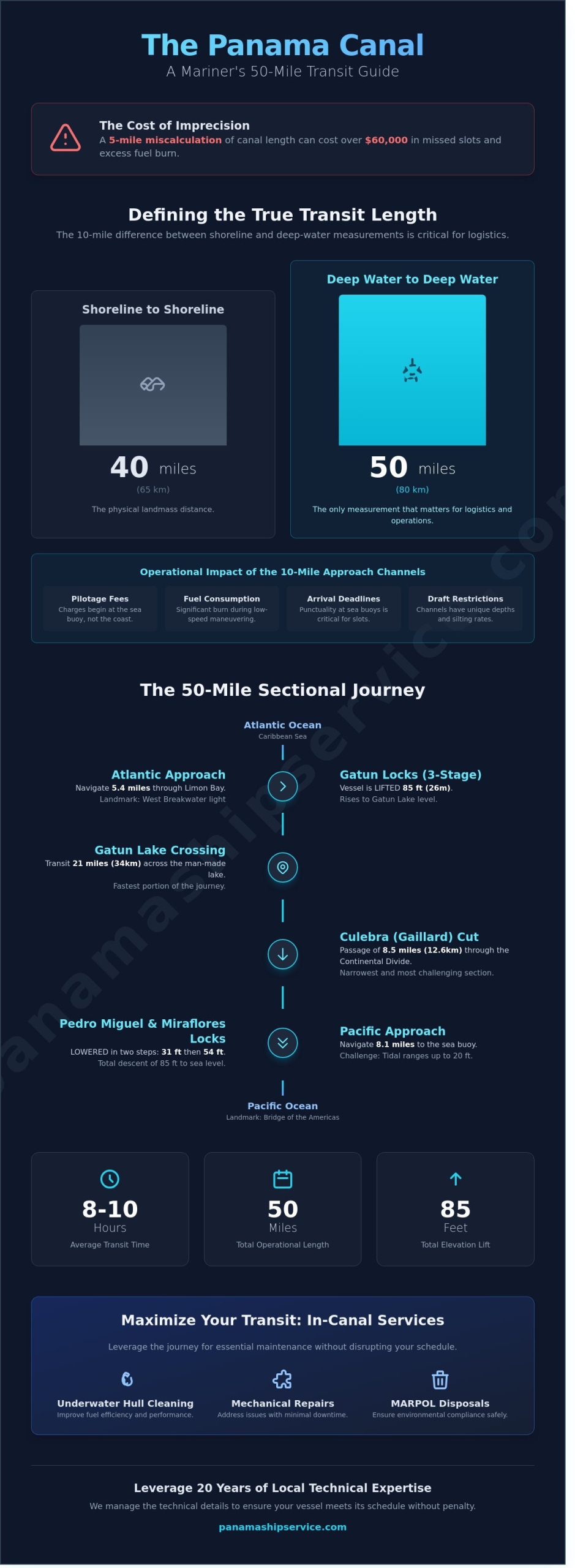
Accuracy in calculating the panama canal length determines your vessel’s arrival window and total operational costs. Most general sources cite a standard length of 50 miles (80 kilometers), but this figure represents the distance between deep water in the Atlantic and deep water in the Pacific. If you measure strictly from shoreline to shoreline, the distance drops to approximately 40 miles (65 kilometers). This 10-mile discrepancy isn’t just a rounding error; it covers the critical entrance channels dredged to maintain transit depths for massive ocean-going vessels.
For ship owners and charterers, the deep-water measurement is the only one that matters for logistics. Your transit officially begins at the sea buoys where the pilot boards, not at the physical coastline. Understanding this Comprehensive Panama Canal overview helps operators visualize why timing is everything. Miscalculating the approach adds unnecessary engine hours and complicates your slot reservation. We are experts so you don’t have to be; we manage these technical details to ensure your vessel meets its schedule without penalty. The distinction between these two measurements impacts several factors:
- Pilotage Fees: Charges often apply from the moment the pilot boards at the sea buoy.
- Fuel Consumption: The extra 10 miles of low-speed maneuvering in approach channels consumes significant bunkers.
- Arrival Deadlines: Missing the arrival at the sea buoy by even 15 minutes can lead to lost transit slots.
- Draft Restrictions: Entrance channels are subject to different silting rates than the main lake.
Measuring from the Atlantic Entrance
Entering from the North, vessels navigate the Limon Bay approach channel. This section stretches about 5.4 miles from the Cristobal breakwater to the first set of locks at Gatun or the newer Agua Clara locks. Mariners look for the West Breakwater light as a primary landmark for entry. The channel is dredged to a depth of 45 feet in the original lanes and even deeper for Neopanamax vessels. Precise navigation here is vital because crosscurrents in the bay can affect steering during heavy weather. We provide constant daily communication to ensure your crew knows exactly when to enter the breakwater to avoid congestion.
Measuring from the Pacific Entrance
The Pacific side presents a longer approach of approximately 8.1 miles from the sea buoy to the Miraflores locks. Unlike the Atlantic, the Pacific entrance deals with extreme tidal ranges that can reach 20 feet (6 meters). These tides change the effective panama canal length for navigation purposes, as heavy currents can either assist or hinder your speed over ground. The Bridge of the Americas serves as the definitive navigational milestone on this side. It marks the transition from the Pacific approach into the inner canal waters. Because timing is everything on the Pacific side, our team monitors tidal shifts to provide cost-conscious solutions for your vessel’s approach speed and engine load.
The 50-Mile Journey: A Sectional Breakdown for Mariners
The total panama canal length of approximately 50 miles (80 kilometers) represents one of the most complex nautical transits in the world. It’s not a simple sea-level passage. Instead, it’s a high-precision lift system that moves massive vessels over the Continental Divide. For ship owners and charterers, understanding the specific segments of this 50-mile journey is essential to managing costs and avoiding operational delays. The transit typically takes between 8 and 10 hours, depending on traffic and vessel type.
- Step 1: The Atlantic Approach and Gatun Locks: Ships enter from the Caribbean Sea via Limon Bay. The Gatun Locks, a three-stage system, lift the vessel 26 meters (85 feet) above sea level to the height of Gatun Lake.
- Step 2: Gatun Lake Crossing: Once elevated, vessels navigate a 21-mile (34-kilometer) stretch across the man-made Gatun Lake. This is the fastest portion of the transit but requires strict adherence to speed regulations.
- Step 3: The Culebra Cut: Also known as the Gaillard Cut, this 8.5-mile (12.6-kilometer) segment carves through the solid rock of the Continental Divide. It’s the narrowest and most challenging part of the panama canal length to navigate.
- Step 4: The Pacific Descent: Ships begin their return to sea level starting at the Pedro Miguel Locks, which lower the vessel 9 meters (31 feet) into Miraflores Lake. Finally, the two-stage Miraflores Locks drop the ship the remaining 16 meters (54 feet) to the Pacific Ocean level.
- Step 5: The Pacific Exit: The journey concludes as vessels pass under the Bridge of the Americas and enter the Gulf of Panama.
Gatun Lake: The 21-Mile Freshwater Bridge
Gatun Lake acts as the primary reservoir for the entire canal system. For mariners, this 21-mile segment is critical for maintaining the transit schedule. However, freshwater navigation presents unique challenges. Ships experience a loss of buoyancy compared to saltwater, meaning they sit deeper in the water. This “freshwater sinkage” requires precise draft calculations to avoid grounding. By 2026, environmental factors and fluctuating rainfall patterns are expected to make lake level management even more volatile. Keeping a close eye on daily draft restrictions is vital. To ensure your vessel meets all requirements before entering the lake, you can request a professional draft survey from our team to prevent costly delays.
The Culebra Cut: Navigating the Narrowest Length
The Culebra Cut is the most geologically significant portion of the transit. Excavating this 8.5-mile stretch through the mountain range was the greatest challenge during the history of the Panama Canal construction. The area is prone to landslides because of the complex composition of shale and clay. To accommodate modern Neo-Panamax ships, the Suez-like straightaways have been widened to a minimum of 218 meters (715 feet). This widening has significantly improved safety, but the Cut remains a “one-way” zone for the largest vessels. Timing your entry into this segment is everything. Mismanaging your slot here doesn’t just cost time; it increases fuel consumption and port fees at the exit. We are experts in these logistical nuances so you don’t have to be.
Transit Time vs. Physical Length: The Real Operational Math
While the physical panama canal length is approximately 50 miles from deep water to deep water, measuring success by distance alone is a costly mistake for ship owners. For a master or charterer, the only metric that truly impacts the bottom line is the transit clock. On average, a vessel requires 8 to 10 hours to move between the Atlantic and Pacific oceans. This duration isn’t a result of slow steaming. It’s the product of complex hydraulic engineering and strict traffic management. The Panama Canal length specifics involve a transit through three sets of locks and the transit of Gatun Lake, situated 85 feet above sea level. This elevation change requires three separate lockage procedures, each consuming roughly 45 to 60 minutes of the total timeline.
Traffic density directly dictates the efficiency of your journey. The “Panama Canal Slot” system acts as the ultimate gatekeeper. In 2024, the Panama Canal Authority (ACP) adjusted slot availability based on water levels, making every minute of your scheduled window vital. Misjudge your timing and you lose your slot; losing your slot often leads to days of expensive idling at the Pacific or Atlantic anchorages. Vessel size significantly alters this math. A standard Panamax ship utilizes the original locks, while a Neo-Panamax vessel, carrying up to 14,000 TEUs, must use the expanded Cocoli and Agua Clara locks. These larger ships move at lower speeds through the 12.6 mile Culebra Cut to manage hydrodynamic forces and ensure safe passage. We are experts so you don’t have to be; we manage these variables to keep your costs competitive.
Factors Influencing Transit Speed
Pilotage is mandatory for every inch of the panama canal length. From the moment an ACP pilot boards at the sea buoy, the ship’s speed is dictated by safety protocols and tugboat availability. In the Culebra Cut, visibility issues during the rainy season, typically May through December, often trigger one-way traffic restrictions. Draft restrictions are equally critical. A vessel loaded to a 44-foot draft must maneuver with extreme precision to avoid the “squat” effect in shallower sections, which naturally reduces the maximum safe transit speed.
The Role of the Panama Canal Authority (ACP)
The ACP manages the 24/7 flow of traffic across the 50-mile stretch with military precision. Scheduling for 2026 transits already requires forward-thinking logistics, as the reservation system remains highly competitive. Communication with the ACP occurs through the Maritime Service Portal and specific radio protocols as vessels enter the canal zone. As your trusted partner, we handle these communication layers. We ensure your documentation is compliant and your arrival is timed to the minute. Put your transit in our hands to avoid the administrative friction that causes operational delays.
- Lockage Time: 2.5 to 3 hours of the total transit.
- Gatun Lake Transit: The fastest segment, spanning roughly 23 miles.
- Culebra Cut: The most narrow and cautious 8 miles of the journey.
- Tugboat Assistance: Mandatory for Neo-Panamax vessels throughout the lockage process.
Efficiency in this corridor isn’t about speed. It’s about precision. Every hour saved in the transit of the panama canal length translates to thousands of dollars in fuel and charter hire savings. Our role is to provide the expert guidance needed to navigate the ACP’s rigorous scheduling and operational requirements without incident.
Maximizing the 50 Miles: Maintenance and Repair Opportunities
The panama canal length of approximately 50 miles offers a unique operational gap that savvy charterers use to their advantage. Instead of viewing the transit as a simple passage, think of it as a 10 to 12-hour maintenance window. While your vessel waits at the Pacific or Atlantic anchorages, you have a prime opportunity to address technical issues without adding a single day to your voyage charter. Efficiency is the only way to offset rising fuel costs and canal fees. We’ve helped over 4,500 vessels since 2004 turn these mandatory waiting periods into productive service hours.
Technical Services at the Canal Entrances
Technical teams utilize the Atlantic and Pacific anchorages to perform critical tasks that would otherwise require expensive dry-docking or dedicated port calls. Because the vessel is already stationary while awaiting its slot, these services are essentially “time-free.” Our specialized divers conduct underwater hull cleanings and propeller polishings that can reduce fuel consumption by 5% to 8% according to 2023 maritime efficiency data. A clean hull isn’t just about speed; it’s about meeting the strict environmental standards required for modern transit.
- Underwater Inspections: We provide Class-approved CCTV inspections and photography to identify hull fouling or structural damage.
- Propeller Polishing: Removing marine growth while at anchorage ensures maximum engine efficiency for the next leg of your journey.
- Mechanical Coordination: Small-scale engine repairs and parts replacements are handled at Balboa or Cristobal to avoid transit delays.
- Precision Surveys: Our experts conduct bunker, draft, and on/off-hire surveys with a 99% accuracy rate to protect your financial interests.
Logistics for busy charterers must be a “one-stop-shop” experience. Coordinating multiple vendors at the canal entrances is a recipe for frustration and missed windows. We manage the entire technical suite, ensuring that repair crews are off the vessel before the pilot boards. This proactive approach eliminates the risk of being de-scheduled by the Panama Canal Authority (ACP) for being unready.
Compliance and Environmental Services
Compliance is a non-negotiable aspect of every transit. Across the entire panama canal length, strict adherence to MARPOL and local sanitary regulations is mandatory. In the 2023 fiscal year, the ACP updated several environmental protocols regarding waste handling. Failing to meet these standards results in heavy fines or vessel detention. We ensure your vessel remains fully compliant by managing all MARPOL Annex V and VI waste disposals while you’re in the canal zone.
- Sanitary Inspections: We facilitate the issuance of Deratting Certificates and other health clearances required by international maritime law.
- Waste Management: Our teams handle the removal of sludge, bilge water, and garbage using certified, environmentally-safe processes.
- Fumigation Services: We provide rapid-response fumigation to ensure your cargo and crew areas meet global health standards before reaching the next port.
Waste disposal at the canal is more than a convenience; it’s a regulatory safeguard. By offloading waste during the transit window, you maintain a clean, safe environment for your crew and avoid the logistical headaches of finding compliant facilities at your destination port. We provide all necessary documentation and receipts to prove your compliance with international standards, protecting you from future liability.
Don’t let your transit time go to waste. Contact us to book your expert ship services and repairs at the Panama Canal today.
Panama Ship Service: Your Expert Partner Across the Canal
Since 2004, Panama Ship Service has operated as the primary technical partner for vessels navigating the Isthmus. We understand that every hour spent idle at anchor translates to thousands of dollars in lost revenue for ship owners and charterers. Our team manages the complexities of the 50 mile panama canal length so you can focus on your cargo. We provide direct support at both the Pacific and Atlantic entrances, ensuring your ship stays on schedule regardless of which direction it’s heading. Over the last 20 years, we’ve developed a reputation for reliability that keeps the global supply chain moving through this vital corridor.
Our comprehensive solutions cover every technical and operational need a modern vessel requires. This includes critical mechanical repairs, specialized underwater hull services, and MARPOL disposals. We’ve spent two decades refining our processes to minimize vessel downtime. By consolidating your requirements through a single provider, you reduce administrative overhead and can lower transit expenses by approximately 12% compared to using multiple vendors. We are experts so you don’t have to be. Whether you’re managing a bulk carrier or a Neo-Panamax container ship, our goal is to get you through the canal safely and efficiently.
Why Experience Matters in Panama
Navigating the Panama Canal Authority (ACP) regulatory environment requires local knowledge that only comes with time. We’ve spent 240 months building relationships and understanding the specific requirements for every vessel class. Our one-stop-shop philosophy means you won’t have to juggle four different contractors for bunker surveys, engine work, and hull cleaning. We deploy rapid response teams to Balboa and Cristobal within 120 minutes of a service request for emergency repairs. This speed keeps your vessel moving through the panama canal length without the risk of missing your scheduled transit window. Our 100% compliance record with local maritime laws ensures your vessel avoids costly fines or detention during its stay in Panamanian waters.
Contact Us for Your Next Transit
Operational efficiency starts long before your ship reaches the breakwater. We coordinate 24/7 with your vessel’s agent to ensure all supplies, technicians, and equipment are staged and ready upon arrival. Whether you need a detailed draft survey, a deratting certificate, or complex propeller polishing, our coordination is seamless. You can request a quote for surveys, repairs, or technical supplies through our streamlined digital portal. Our team provides constant daily communication to keep owners and charterers informed of every milestone in real time. We eliminate the guesswork from maritime logistics. Put your transit in our hands, get a quote today.
- 24/7 Availability: We operate around the clock to match the canal’s non-stop schedule.
- Technical Expertise: Certified divers and mechanics available for immediate deployment.
- Strategic Locations: Full service capabilities at both Balboa (Pacific) and Cristobal (Atlantic).
- Cost Control: Transparent pricing models designed to minimize your total transit expenditure.
Optimize Your Vessel Performance During the 50-Mile Transit
Success at the canal requires more than just knowing coordinates. Understanding that the panama canal length spans 50 miles from shoreline to shoreline allows masters to calculate precise arrival windows. You’ve seen how the 8 to 10 hour operational transit time creates a vital gap for technical maintenance. Efficiently managing this window prevents costly delays and keeps your charter on schedule. We’re experts so you don’t have to be; we handle the technical details while you focus on the voyage.
Panama Ship Service brings over 20 years of maritime expertise to every project. Our technicians deliver Class-approved underwater surveys and 24/7 emergency mechanical repair teams to resolve issues before they escalate. We focus on minimizing your vessel expenses through rapid response and cost-conscious solutions. Don’t leave your transit to chance when you can rely on a proven partner. Request a Professional Ship Service Quote for Your Panama Transit today to secure your schedule. We’re ready to support your fleet with the reliability your operations demand.
Frequently Asked Questions
How many miles long is the Panama Canal from sea to sea?
The Panama Canal measures approximately 50 miles (80 kilometers) from the deep waters of the Atlantic to the deep waters of the Pacific. If you measure strictly from shoreline to shoreline, the distance is roughly 40 miles. This specific distance allows vessels to avoid the 8,000-mile journey around Cape Horn. Our team ensures your vessel maintains the strict schedule required to navigate this 50-mile stretch efficiently.
How long does it take for a ship to transit the entire length of the canal?
A typical vessel takes between 8 and 10 hours to complete a full transit through the canal’s waterway. This timeframe depends on traffic density and weather conditions at the locks. Total time at the canal, including waiting for a slot, often ranges from 18 to 24 hours. We provide expert coordination to minimize these wait times and keep your operational costs low.
Is the Panama Canal the same length for Neo-Panamax ships?
The total panama canal length remains the same 50 miles for Neo-Panamax ships, though these larger vessels utilize the Cocoli and Agua Clara locks. These newer locks were completed in June 2016 to accommodate ships with a beam of up to 160 feet. While the path is identical, the technical requirements for Neo-Panamax transit are more stringent. We handle the specialized logistics these larger vessels require.
What is the narrowest part of the Panama Canal’s length?
The narrowest section of the canal is the Culebra Cut, which measures 630 feet (192 meters) wide at its tightest point. This 8.5-mile stretch through the Continental Divide requires precise navigation and constant pilot monitoring. Since the 2016 expansion, dredging projects have maintained this width to ensure safe passage for larger vessels. Our local experts understand the specific maneuvers needed for this challenging segment.
Can ships perform repairs while transiting the Panama Canal?
Vessels can’t perform mechanical repairs while moving through the canal locks or channels. However, you can schedule essential maintenance or emergency repairs at the Pacific or Atlantic anchorages before or after your transit. Panama Ship Service provides 24/7 technical support and underwater repairs at these locations. We’re experts so you don’t have to be; we’ll ensure your ship meets all safety standards.
What is the difference between the shoreline length and the deep-water length?
The shoreline length of 40 miles measures the distance between the physical coastlines, while the 50-mile deep-water length includes dredged approach channels. These channels extend into the sea to reach depths of 50 feet. These extra 10 miles are critical for ensuring that heavy laden vessels don’t run aground. We monitor draft requirements closely to ensure your vessel navigates both segments without incident.
How has the expansion changed the length or width of the canal locks?
The 2016 expansion added a third lane of locks that are 1,400 feet long and 180 feet wide. These dimensions represent a 40% increase in length and a 64% increase in width compared to the original 1914 locks. These upgrades allow vessels carrying up to 14,000 TEUs to pass through. We help you determine which lock system fits your vessel’s specific dimensions to optimize your transit fee.
Who manages the navigation and safety along the canal’s length?
The Panama Canal Authority (ACP) manages all navigation, maintenance, and safety protocols across the entire panama canal length. Every vessel must take on an ACP pilot who assumes navigational control during the transit. This state-owned agency has operated the waterway since the hand-over on December 31, 1999. As your trusted partner, we coordinate directly with the ACP to ensure all safety documentation is processed correctly.