
In the high-stakes world of global shipping, a single meter determines whether your vessel clears the locks or faces a logistical nightmare. Many ship owners and charterers struggle to find a straight answer when asking how long was the panama canal because general sources often confuse shoreline distance with the actual navigable channel length. You know that precision is the only way to minimize vessel expenses and avoid the frustration of missed transit windows. We are experts so you don’t have to be, and we’ve compiled the exact data required for professional operational planning.
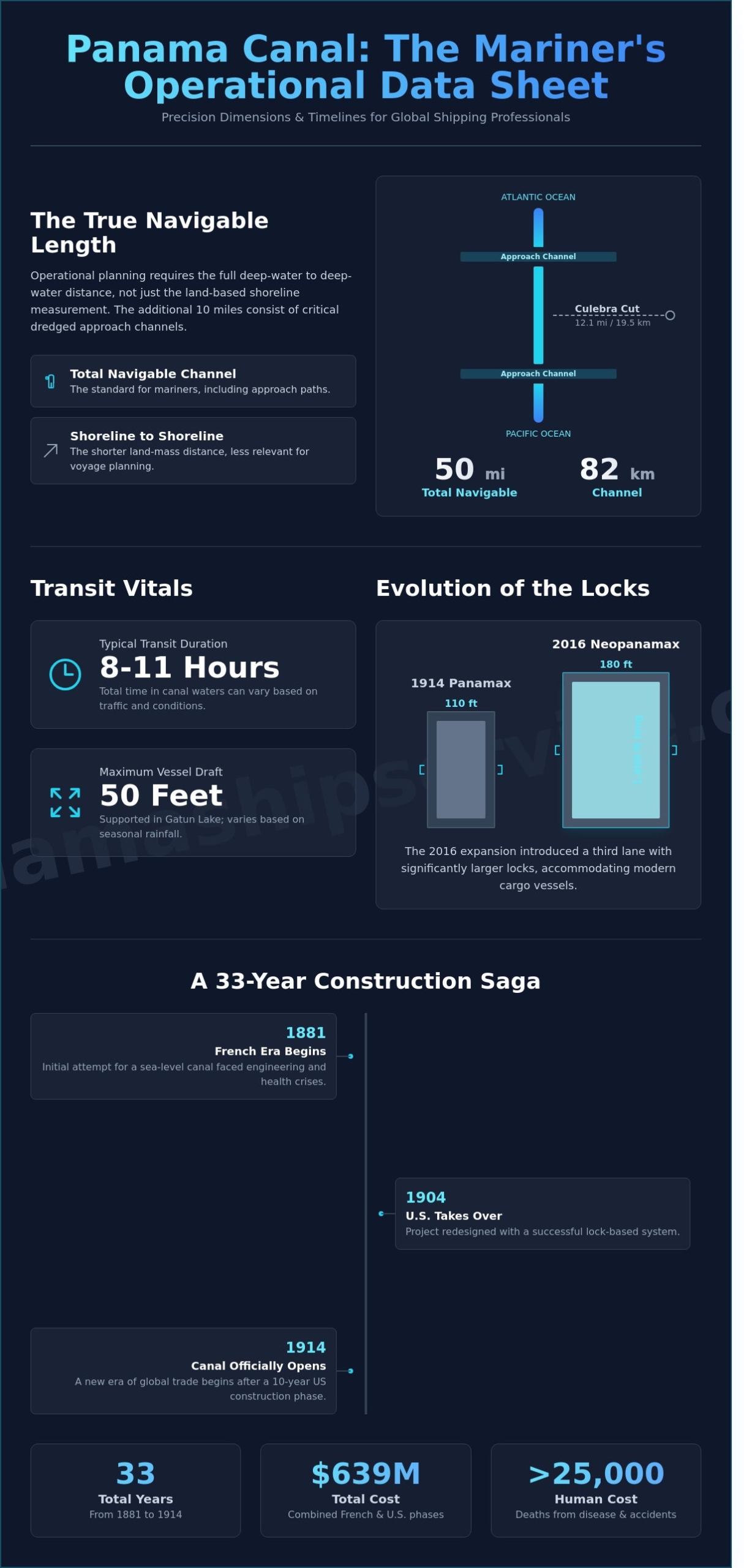
This article provides a definitive maritime perspective on the canal’s dimensions, from its 82 kilometer channel span to its 10 year construction timeline. You’ll gain a clear understanding of the physical lengths, the 1904 to 1914 building phase, and the current 8 to 11 hour transit duration. We’ll also examine the critical differences between the original 1914 locks and the 2016 expansion to ensure your operational knowledge is current, accurate, and ready for your next voyage through this vital waterway.
Key Takeaways
- Distinguish between the shoreline-to-shoreline length and the total channel distance to accurately plan your vessel’s passage through the waterway.
- Gain historical perspective on how long was the panama canal in development, spanning a 33-year construction timeline marked by significant engineering and health hurdles.
- Identify the critical factors that influence the 8-to-10-hour transit duration and learn how to manage “total time in canal waters” effectively.
- Understand how the canal’s unique dimensions and tropical environment accelerate biofouling, necessitating proactive technical surveys and hull maintenance.
- Discover how to optimize your transit and reduce operational costs by leveraging expert local partners for consolidated maritime and agency services.
The Physical Length of the Panama Canal: Miles and Kilometers
Ship operators and logistics managers often ask exactly how long was the panama canal when calculating transit times and fuel consumption. The total length of the waterway is approximately 50 miles (80 kilometers) when measuring from deep water in the Atlantic to deep water in the Pacific. This measurement is the standard for mariners because it encompasses the entire navigable channel, including the dredged approach paths that lead vessels safely into the lock systems. If you measure strictly from shoreline to shoreline, the distance is shorter, totaling about 40 miles (64 kilometers).
Since its opening in 1914, the canal’s footprint has evolved. The original construction focused on a channel that could handle the vessels of the early 20th century. Today, the 2026 operational standards reflect a much more complex infrastructure. The expansion project, completed in 2016, added a third lane of locks, which changed the functional boundaries of the transit zone. Modern vessels now navigate a sophisticated network of deepened channels and widened turns designed to accommodate Neopanamax dimensions. Efficiency is the priority here; every mile of the 50-mile span is engineered to minimize transit bottlenecks.
Shoreline vs. Deep Water Measurements
Understanding the distinction between shoreline and deep water measurements is vital for accurate voyage planning. The 10-mile difference consists of the approach channels in the Limon Bay on the Atlantic side and the Bay of Panama on the Pacific side. A key component of this journey is the 12.1-mile (19.5 km) Culebra Cut. This segment is the narrowest part of the Panama Canal and cuts directly through the Continental Divide. Maintaining the required depth across this stretch involves continuous dredging operations. By 2026, these efforts have become more technologically advanced to ensure that the 50-mile path remains open to the world’s largest container ships without interruption.
The Breadth and Depth: Beyond Linear Length
Linear length tells only half the story for a successful transit. The breadth and depth of the channel dictate which ships can pass and what cargo loads they can carry. While the original locks were 110 feet wide, the newer Neopanamax locks are 180 feet wide and 1,400 feet long. Depth is equally critical. In Gatun Lake, the water level must be maintained to support a maximum draft of up to 50 feet, though this varies based on seasonal rainfall. These precise dimensions are why we emphasize the importance of professional marine surveys in Panama. We provide the technical expertise to verify your vessel’s compliance with these strict 2026 requirements. Miscalculating these figures can lead to draft restrictions or significant delays. We are experts in these maritime standards so you don’t have to be.
- Total Navigable Length: 50 miles (80 km)
- Shoreline to Shoreline: 40 miles (64 km)
- Culebra Cut Length: 12.1 miles (19.5 km)
- Neopanamax Lock Width: 180 feet (54.8 meters)
How Long Did the Panama Canal Take to Build? A 33-Year Timeline
Completing the canal was not a single event; it was a grueling 33-year saga of human endurance and engineering evolution. While many researchers ask how long was the Panama Canal in terms of its 50-mile physical footprint, the temporal length of the project is just as significant. The construction spanned from the first French arrival in 1881 to the official American opening in 1914. This period saw the project survive bankruptcy, tropical disease, and massive engineering failures that forced a complete redesign of the original concept.
The total cost of this three-decade effort was staggering. Between the French and American phases, the project cost approximately $639 million. More importantly, the human cost included over 25,000 recorded deaths. Most of these fatalities resulted from yellow fever and malaria, which decimated the workforce until medical breakthroughs allowed for large-scale mosquito control. The transition from a failed sea-level plan to a successful lock-based system eventually made the crossing possible.
The French Era (1881–1899)
Ferdinand de Lesseps, who led the Suez Canal project, arrived in 1881 with a flawed plan for a sea-level waterway. He ignored the rugged Panamanian geography and the volatile Chagres River. Over nearly 20 years, the French excavated 70,000,000 cubic yards of earth, yet they only finished a small fraction of the required work. The “Panama Scandal” followed, involving a total financial collapse in 1889 that halted progress and ruined thousands of investors. By 1899, the French effort ended in a complete administrative and physical stalemate.
The American Era (1904–1914)
The United States took control in 1904, immediately shifting the strategy from a sea-level ditch to a high-elevation lock system. This 10-year period focused on sanitation first to eliminate the mosquito-borne illnesses that crippled previous attempts. The U.S. construction of the Panama Canal involved massive milestones like the creation of Gatun Lake and the Gatun Dam. Engineers moved another 232,000,000 cubic yards of soil during this phase. The official opening on August 15, 1914, marked the dawn of modern global trade.
Managing a transit through this historic waterway requires the same precision used to build it. To ensure your vessel meets all modern requirements without delay, you can put your transit in our hands for expert coordination.
- 1881: First French excavation begins.
- 1904: United States officially resumes construction.
- 1913: The Gamboa dike is blown up, connecting the Atlantic and Pacific waters.
- 1914: The SS Ancon completes the first official transit.
Transit Duration: How Long Does It Take to Cross the Canal?
Vessels typically spend between 8 to 10 hours actively moving through the 50-mile waterway. While the physical distance answers how long was the Panama Canal in terms of miles, the operational duration is what dictates your bottom line. We distinguish between actual transit time and Total Time in Canal Waters (TTW). TTW includes the time spent at anchorages, pilot boarding, and queuing. In a standard operational cycle, TTW often averages 24 to 30 hours. If you mismanage your scheduling at the Balboa or Cristobal anchorages, these hours quickly turn into days of expensive idle time.
The 2016 expansion significantly streamlined traffic for larger Neopanamax ships. These vessels now utilize a dedicated lane that moves with high precision. For a deeper look at the technical specifications, these Panama Canal facts and figures provide authoritative data on the canal’s depth and lock dimensions. Our role is to ensure your vessel doesn’t become a statistic in the daily congestion reports. Efficiency isn’t just about speed; it’s about hitting your scheduled slot without fail.
The Lockage Process and Speed Constraints
The transit is a controlled sequence of lifts and descents. A vessel entering from the Atlantic side spends approximately 2 to 3 hours in the three chambers of the Gatun Locks. Following this, the ship crosses Gatun Lake and enters the Gaillard Cut. This 8.5-mile stretch is the narrowest part of the journey. Speed limits here are strictly enforced, usually ranging between 6 to 12 knots. These limits prevent bank erosion and protect the hull from the “squat effect” in shallow waters. Canal pilots take full command during this phase, supported by high-powered tugboats that maintain a steady transit rhythm through the Pedro Miguel and Miraflores locks.
Managing Congestion and Waiting Times
Traffic volume isn’t static. Seasonal variations, particularly the dry season from December to April, often lead to water conservation measures that can limit daily transits. Mechanical issues within the 50-mile channel cause immediate bottlenecks. A single engine failure or steering malfunction can halt the entire convoy. We’ve seen how proactive mechanical ship repairs in Panama prevent transit denials and keep vessels in the rotation. If your ship shows signs of technical fatigue, address it at the anchorage. Waiting for a breakdown inside the locks is a recipe for massive fines and reputational damage. We provide the technical support needed to ensure your vessel meets the Canal Authority’s rigorous safety standards before the pilot even steps on board.
Operational Impact: Why Dimensions Matter for Technical Services
The physical scale of the canal dictates every technical decision made by a vessel’s crew. At roughly 50 miles from deep water to deep water, the transit exposes ships to a unique combination of salt and fresh water environments. This transition, combined with tropical water temperatures averaging 28°C, creates a breeding ground for biofouling. When operators ask how long was the panama canal in terms of exposure time, they must account for the 8 to 10 hours spent at slow speeds where hull fouling accelerates. This biological buildup increases drag and reduces fuel efficiency for the subsequent transoceanic leg.
Physical constraints also extend to the lock chambers. With only 2 feet of clearance on either side for some Panamax vessels, mechanical precision is mandatory. Any failure in propulsion or steering during the transit results in immediate “vessel-caused delays.” The Panama Canal Authority (ACP) imposes steep fines for these interruptions, often exceeding $5,000 per hour depending on the vessel size and the nature of the blockage. Regular inspections of rudders and propellers are not just recommended; they are a financial necessity.
Draft management is another critical factor driven by the canal’s dimensions. During the dry season, Gatun Lake levels can drop significantly. In early 2024, the ACP restricted Neo-Panamax drafts to 44 feet, down from the standard 50 feet. Precise draft surveys are required to ensure compliance and avoid the costly requirement of offloading cargo before entry.
Underwater Maintenance in Canal Waters
Smart operators utilize the time at anchorage to perform essential underwater hull services. Cleaning the hull before or after the transit can improve fuel economy by as much as 10% for the next voyage. We provide Class-approved UWILD surveys that meet regulatory requirements without disrupting your schedule. It’s an efficient way to turn a mandatory waiting period into a productive maintenance window.
Compliance and Environmental Standards
The ACP maintains rigorous standards for environmental protection. Vessels must have a clear plan for MARPOL disposal in Panama to prevent contamination of the local ecosystem. Beyond waste, ships must pass sanitary inspections and provide valid fumigation certificates. Knowing how long was the panama canal stretch helps in calculating the exact volumes of waste and gray water that must be managed to avoid penalties during the 50-mile crossing.
Don’t risk expensive delays or ACP fines. Contact Panama Ship Service today to coordinate your technical interventions and ensure a seamless transit.
Maximizing Efficiency During Your Panama Canal Transit
The physical footprint of the waterway is static, but the operational efficiency of your crossing varies wildly. While researchers might ask how long was the panama canal in terms of its 50-mile span, ship owners care about the 8 to 12 hour transit window. Panama Ship Service reduces your operational length by consolidating all technical and agency services into a single point of contact. This one-stop-shop model reduces vessel expenses by up to 18% by eliminating overlapping agency fees and redundant logistics chains. We provide comprehensive pre-transit checklists to ensure your vessel is 100% ACP-compliant before the pilot boards. If your steering gear or mooring winches fail a last-minute inspection, your transit is canceled immediately. We prevent those setbacks through proactive technical audits.
Coordinating Supplies and Repairs
Timing is the most critical factor in maritime logistics. We coordinate ship supplies at the Panama Canal to coincide exactly with your vessel arrival at the anchorage. Our technical teams at Balboa and Cristobal ports handle emergency repairs, hull cleanings, and MARPOL disposals without extending your stay. You receive constant daily communication from our operations desk. This proactive reporting keeps your crew and charterers informed every hour. We don’t just deliver parts; we deliver precision. By managing provisions and technical repairs simultaneously, we ensure your vessel doesn’t spend a single unnecessary hour at anchor.
The Expert Advantage
The administrative side of a transit is notoriously difficult and frustrating for those unfamiliar with local regulations. We are experts so you don’t have to be. With over 20 years of local experience, we navigate the ACP bureaucracy with absolute precision. Our team manages bunker surveys, draft surveys, and deratting certificates to ensure no paperwork holds you back. When you consider how long was the panama canal historically versus the speed of modern global commerce, the difference is professional management. We handle the friction of the port authorities so your crew can focus on safe navigation. Trust Panama Ship Service for your next transit to ensure a cost-conscious, rapid crossing every time.
Secure Your Vessel’s Efficiency in the Canal
Navigating the 50-mile stretch between the Atlantic and Pacific requires more than just knowing how long was the panama canal during its 33-year construction era. Today, success is measured by the 8 to 10 hours it takes to complete a transit and the technical precision of your vessel. Compliance with ACP regulations is mandatory; failing to meet these standards results in expensive idling time. We eliminate that risk by acting as your expert partner on the ground. Understanding these dimensions and timelines is the first step toward a profitable voyage.
Panama Ship Service provides a one-stop-shop for all ACP compliance needs, backed by 20+ years of maritime expertise. Our team offers a 24/7 emergency repair response to ensure your schedule remains intact. We manage the complex operational requirements so you don’t have to worry about technical delays. Don’t leave your transit to chance when you can rely on proven local solutions that prioritize your bottom line. Get a Quote for Your Panama Canal Transit Services and experience a seamless crossing. We look forward to supporting your fleet’s success in Panama.
Frequently Asked Questions
Exactly how long is the Panama Canal in miles?
The Panama Canal is exactly 50 miles long when measured from deep water in the Atlantic Ocean to deep water in the Pacific Ocean. If you measure strictly from shoreline to shoreline, the distance is approximately 40 miles. Understanding how long was the panama canal during its initial design helps logistics managers calculate fuel consumption and transit times accurately. Our team ensures your vessel navigates every mile of this 50 mile stretch with maximum efficiency.
How long does it take for a ship to go through the Panama Canal locks?
A ship typically spends 2 to 3 hours transiting the specific lock chambers during a trip. The total time for a complete canal transit averages between 8 and 10 hours depending on traffic density and weather conditions. This duration includes the passage through Gatun Lake and the Culebra Cut. We provide constant daily communication throughout this window to keep your schedule on track. Efficiency is vital to avoiding unnecessary port fees and delays.
How many years did it take to build the Panama Canal?
It took 10 years for the United States to complete the canal construction between 1904 and 1914. This followed a failed French attempt that lasted 8 years starting in 1881. The American project required the excavation of 200 million cubic yards of material and a workforce of over 40,000 people. We understand the historical complexity of this waterway; that’s why we offer expert technical services to modern vessels navigating these historic channels.
What is the longest ship allowed in the Panama Canal as of 2026?
As of 2026, the maximum length for vessels transiting the Neopanamax locks is 1,215 feet. This limit applies to large container ships and tankers that meet specific maneuverability and visibility criteria set by the authorities. Ships must also adhere to a maximum beam width of 168 feet. We provide precise draft surveys and technical inspections to ensure your vessel meets all Panama Canal Authority requirements before arrival. Our goal is a smooth, compliant transit.
How long was the Panama Canal expansion project?
The Panama Canal expansion project lasted 9 years, beginning in September 2007 and finishing in June 2016. This 5.25 billion dollar project added a third lane of traffic through the construction of two massive lock complexes. Knowing how long was the panama canal expansion helps ship owners appreciate the increased capacity for larger vessel classes. We’ve been a trusted partner throughout these infrastructure changes, offering specialized repairs and MARPOL disposals for the newer, larger fleet.
Can ships transit the Panama Canal at night?
Ships transit the Panama Canal 24 hours a day, 365 days a year without exception. The canal uses high mast lighting at all lock structures and sophisticated navigational aids along the channel to facilitate safe nighttime passage. This continuous operation is essential for maintaining the flow of 14,000 vessels annually. We offer rapid response services at any hour to ensure your vessel doesn’t face downtime. Put your transit in our hands for reliable night or day service.
Is the Panama Canal longer than the Suez Canal?
No, the Panama Canal is significantly shorter than the Suez Canal. The Panama Canal measures 50 miles, while the Suez Canal in Egypt spans approximately 120 miles. Despite being shorter, the Panama Canal is often considered more complex due to its lock system that lifts ships 85 feet above sea level. We are experts in these specific operational challenges so you don’t have to be. Our services focus on the unique technical needs of the Panama transit.
What happens if a ship breaks down during the 50-mile transit?
If a vessel suffers a mechanical failure, the Panama Canal Authority immediately deploys tugboats to move the ship to a safe anchorage or a tie up station. This prevents the channel from being blocked for other traffic. Owners face significant costs for emergency towage and potential administrative fines. We provide 24/7 technical support and emergency repairs to resolve these issues quickly. Our team minimizes your vessel expenses through expert, rapid intervention during such critical events.