
Nearly 12% of vessels experience secondary downtime within just 90 days of leaving a repair yard due to overlooked technical failures. For a fleet manager, this statistic represents more than just a mechanical error; it is a significant financial drain and a logistical nightmare. You understand that in the high-stakes environment of the Panama Canal, there’s no room for error. Every minute of delay risks your transit window and increases the threat of non-compliance with the latest ACP Vessel Requirements for 2026.
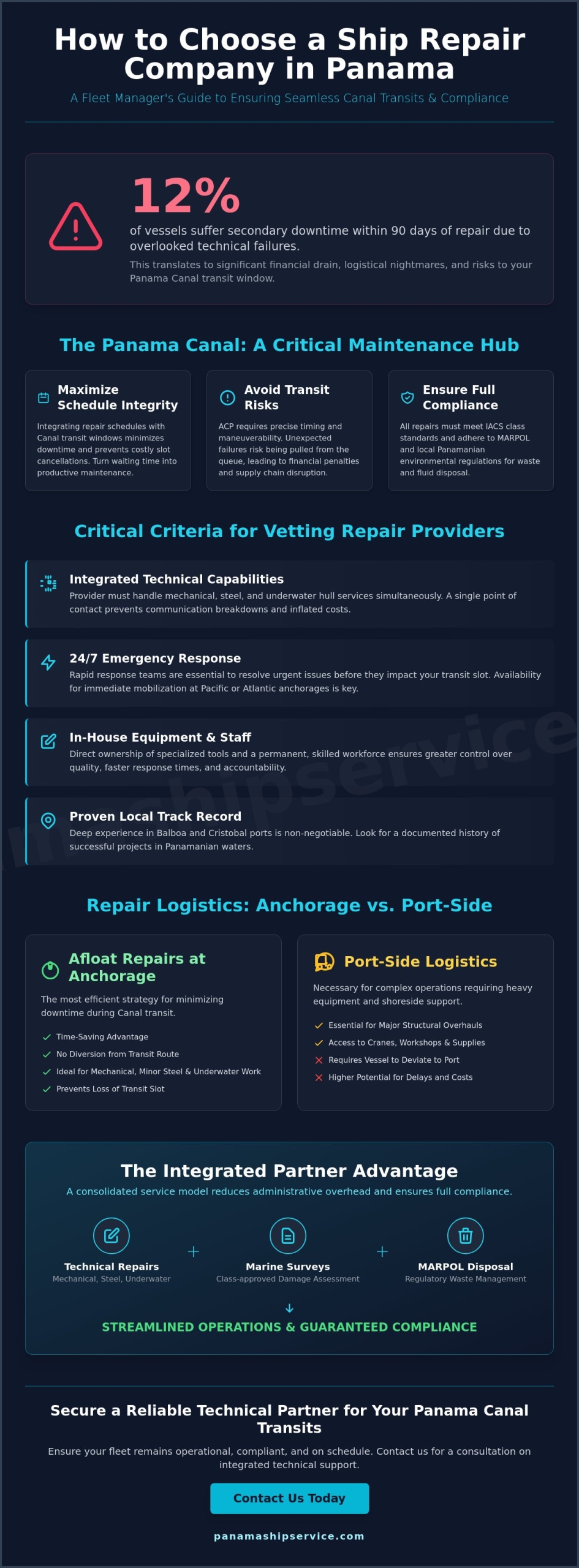
Finding a partner that balances technical proficiency with a sense of urgency is vital for your vessel’s performance. This guide provides a clear framework for how to choose a ship repair company panama that ensures your ship remains operational and fully compliant with MARPOL standards. We will examine critical selection criteria, including local technical capabilities for mechanical ship repairs and underwater hull services, to help you secure a reliable partner for long-term technical support and seamless canal transits.
Key Takeaways
- Understand why integrating repair schedules with Canal transit windows is the most effective strategy to minimize vessel downtime and avoid slot cancellations.
- Identify the specific technical benchmarks for how to choose a ship repair company panama that can handle mechanical, steel, and underwater hull services simultaneously.
- Learn to distinguish between the time-saving advantages of afloat repairs at anchorage and the necessity of port-side logistics for major structural overhauls.
- Recognize the importance of rapid emergency response capabilities for resolving urgent technical issues before they impact your scheduled transit window.
- Discover how a consolidated service model—combining repairs, marine surveys, and MARPOL disposal—reduces administrative overhead and ensures full regulatory compliance.
The Strategic Role of Ship Repair Companies in the Panama Canal Hub
The Panama Canal acts as the central heartbeat of international maritime logistics. For fleet managers, this geographic bottleneck is more than a transit point; it’s a critical window for operational maintenance. When you’re determining how to choose a ship repair company panama, you must view the decision through the lens of schedule integrity. The ability to mobilize technical teams while a vessel is at anchorage can mean the difference between a seamless transit and a costly delay.
Unexpected mechanical failures during the approach to the Canal are high-pressure scenarios. The Panama Canal Authority (ACP) operates on precision timing. Any vessel that cannot maintain its speed or maneuverability risks being pulled from the transit queue. This leads to immediate financial penalties and the loss of a pre-booked slot. Local expertise is essential here because these providers understand the specific mechanical and safety standards required by the ACP. They don’t just fix the machine; they ensure the vessel meets the criteria to move through the locks without incident.
A frequent dilemma for managers is whether to perform local repairs or carry a defect to a later port. In Panama, the cost-benefit analysis often favors immediate action. Carrying a defect increases the risk of a total breakdown at sea or a refusal of entry at the next destination. By utilizing the time spent in the Canal’s waters for essential maintenance, you optimize the vessel’s schedule and reduce the overall overhead associated with dedicated repair stops. It’s about turning waiting time into productive maintenance time.
Minimizing Vessel Downtime at the Canal
The financial impact of a missed transit window is staggering. Beyond the direct fees, the ripple effect on downstream logistics can disrupt entire supply chains. Rapid response teams are designed to prevent these outcomes. By initiating mechanical ship repairs immediately upon arrival at the Pacific or Atlantic anchorage, technical partners ensure that minor hydraulic or engine issues are resolved before the pilot boards. This proactive approach maintains your position in the queue and keeps the ship on its commercial schedule.
Compliance and Regulatory Standards
Regulatory adherence is non-negotiable in the Panamanian maritime sector. All repair work must satisfy IACS standards to ensure the vessel remains in class. Additionally, technical partners must navigate complex local environmental laws and MARPOL regulations, particularly regarding fluid containment and waste disposal. Reliable providers utilize class-approved marine surveys to provide a transparent, accurate assessment of damage. This level of documentation is critical for insurance claims and provides the shipowner with confidence that the technical integrity of the vessel is fully restored.
Critical Criteria for Vetting Repair Providers in Panama
Selecting a technical partner in a high-traffic zone requires a structured vetting process. When considering how to choose a ship repair company panama, you must evaluate their ability to operate as a single point of contact for mechanical, steel, and underwater requirements. Relying on multiple subcontractors often leads to communication breakdowns and inflated costs. A provider with in-house equipment and permanent staff offers greater control over quality and response times, which is vital when a transit slot is at stake.
A proven track record in the Balboa and Cristobal port areas is a non-negotiable requirement. These locations present unique logistical challenges, from restricted access to specific tidal considerations. When determining how to choose a ship repair company panama, prioritize those with deep roots in the local maritime community. Transparency in quoting and real-time project management updates are equally critical. You need to know the exact status of a repair to make informed decisions about your vessel’s schedule. Key vetting indicators include:
- Technical versatility across mechanical and steel disciplines.
- Availability of emergency response teams for urgent transit issues.
- Direct ownership of specialized tools and repair equipment.
- A documented history of successful projects in Panamanian waters.
Certifications and Class Approvals
Documentation is the foundation of maritime safety. Demand proof of Class approval for any specialized welding or structural fabrication. This ensures that the repairs meet the rigorous standards necessary for continued operation. This is especially true for underwater hull services, where certified divers must perform inspections and repairs in accordance with Panama Canal Authority regulations. In 2026, verify that your provider carries comprehensive insurance and liability coverage to protect your assets during high-stakes work. If you require immediate assistance, seeking technical expertise in Panama from a vetted provider is the most efficient path forward.
Operational Infrastructure and Location
Mobility defines efficiency in the Canal hub. A repair company must have the infrastructure to reach various anchorage points quickly via launch. Proximity to Balboa on the Pacific side and Cristobal on the Atlantic side reduces mobilization time and costs. Evaluate the provider’s logistics chain as well. A company with established relationships for sourcing marine spare parts can significantly reduce the duration of a repair. This operational depth ensures that your vessel doesn’t sit idle while waiting for a critical component to arrive from overseas.
Evaluating Technical Capabilities: Mechanical to Underwater
Technical proficiency is the baseline for any successful repair operation in the Canal zone. While vetting for certifications is essential, you must also scrutinize the specific technical depth of a provider’s team. A company’s ability to execute complex mechanical ship repairs while simultaneously managing underwater interventions is a key indicator of its operational maturity. When you’re determining how to choose a ship repair company panama, look for a partner that offers a comprehensive technical suite, ranging from engine room overhauls to precision steel fabrication.
Specialized services like tank cleaning, sandblasting, and A/C system maintenance often separate veteran providers from smaller shops. These tasks require specific equipment and safety protocols, particularly when working in the confined spaces of a commercial vessel. A provider that handles these niche services in-house reduces the risk of project delays and ensures that all work aligns with the ship’s broader maintenance schedule. It’s about finding a technical partner that can address every facet of the vessel’s needs during its stay in Panamanian waters.
High-quality steel fabrication and welding are equally critical for hull repairs and structural modifications. Whether you’re dealing with impact damage or routine wear, the integrity of the weld determines the vessel’s long-term safety. You don’t want to discover a failure mid-ocean. Verifying the proficiency of the welding team and their adherence to Class-approved procedures is a vital step in the selection process.
Mechanical and Engine Room Repairs
Marine diesel engines are the heart of your vessel, and diagnosing problems in a high-traffic zone requires both experience and speed. Common issues with auxiliaries or hydraulic systems can quickly escalate if not addressed by experts. Precision is especially critical for rudder and propeller repairs; any misalignment can compromise Canal safety and lead to a failed inspection by the ACP. To better understand how to manage these risks, consult our guide on mechanical ship repairs in Panama for specific downtime mitigation strategies. Effective how to choose a ship repair company panama involves verifying that the technical team has direct experience with your specific engine make and model.
Underwater Hull Maintenance and Surveys
Underwater hull cleaning is a high-yield maintenance task that significantly improves fuel efficiency, which is vital before embarking on long trans-Pacific voyages. Biofouling increases drag, forcing engines to work harder and consume more fuel. Regular propeller polishing is another small investment that yields measurable savings during transit. For vessels approaching their survey deadlines, UWILD (Underwater Inspection in Lieu of Drydocking) surveys are indispensable. These class-approved inspections allow you to satisfy regulatory requirements without the time and expense of drydocking. Ensure your chosen partner uses high-resolution video equipment and provides detailed reports that meet the stringent standards of international classification societies.
Anchorage Repairs vs. Port-Side Logistics: Which is Best?
The choice between executing repairs at anchorage or moving to a port-side berth is a strategic decision that directly impacts your bottom line. Afloat repairs at anchorage are the preferred option for managers looking to avoid heavy port fees and minimize time spent out of the transit queue. This approach allows technical teams to work while the vessel waits for its Canal slot. However, the scope of work is often limited by the lack of shore-based infrastructure. Part of how to choose a ship repair company panama involves identifying which environment best suits your vessel’s specific technical needs and transit schedule.
Coordination with the Panama Canal Authority is a prerequisite for any maintenance performed in Canal waters. You must obtain specific repair permits for anchorage work, especially if the scope involves “hot work” or immobilizing the main engine. A competent technical partner handles these administrative hurdles, ensuring that all activities remain compliant with local regulations. This window also provides an ideal opportunity to manage crew changes and ship supply deliveries without adding extra stops to the voyage. Integrating these logistics into the repair window maximizes operational efficiency.
If your vessel requires heavy steel work, major engine overhauls, or structural modifications, port-side logistics become necessary. While this involves higher costs, the access to shore power and heavy lifting equipment ensures that complex tasks are completed safely and to Class standards. When determining how to choose a ship repair company panama, evaluate whether the provider has the logistical reach to support you in both environments. Contact our team today to coordinate your next repair in Panama and ensure a seamless transition through the Canal.
The Logistics of Afloat Repairs
Mobilizing personnel and specialized tools to a vessel at anchorage requires a robust launch service infrastructure. Technical teams must be able to reach vessels at both the Pacific and Atlantic entries quickly to maximize the available repair time. Safety is the primary concern during these operations. Strict protocols for hot work and confined space entry must be followed to prevent accidents in a remote anchorage setting. Furthermore, managing waste and MARPOL disposal is essential to remain compliant with international environmental standards while the ship is stationary.
Port-Side Repair Advantages
Port-side facilities offer a controlled environment that is essential for large-scale fabrication. Access to heavy machinery and shore power allows for more intensive repair schedules that anchorage launches cannot support. This setting also simplifies the delivery of large spare parts and heavy machinery components. Many managers use this time to combine technical repairs with comprehensive marine surveys and inspections. Conducting these activities at a berth ensures that surveyors have the stable environment and access needed for a thorough assessment of the vessel’s condition.
Panama Ship Service: Your Integrated Technical Partner
Deciding how to choose a ship repair company panama often comes down to finding a partner that simplifies your operations. Panama Ship Service operates as an integrated technical partner, offering a consolidated model that eliminates the need for multiple vendors. We provide repairs, surveys, and disposal services through a single, professional point of contact. This approach reduces administrative friction and ensures that your vessel’s technical needs are managed with a unified strategy. Our deep roots in the Panama Canal maritime community allow us to navigate local logistics with an efficiency that newer entrants cannot match.
Our commitment to safety and rapid turnaround is foundational to our service. We understand that for ship managers, every hour at anchorage is a cost center. We prioritize proactive project management and direct communication to keep you informed at every stage of the repair process. By delegating the complexity of Canal-side repairs to our experienced team, you can focus on the broader commercial objectives of your fleet. We don’t just provide labor; we provide the technical expertise necessary to maintain schedule integrity in one of the world’s most demanding maritime hubs.
A Comprehensive Range of Solutions
Our service portfolio covers the full spectrum of technical requirements. From complex mechanical overhauls to specialized underwater hull cleaning and propeller polishing, we deliver results that improve vessel performance. We also provide integrated MARPOL-compliant disposal and pest control services, ensuring your vessel meets all environmental and health standards before transit. Consolidating these services at the Canal significantly minimizes your overhead and prevents the logistical delays associated with coordinating multiple service providers. This one-stop-shop model is a critical factor when determining how to choose a ship repair company panama for long-term support.
Requesting a Technical Assessment
Streamlining your technical stop begins with a precise assessment. To provide an accurate and fast repair quote, we require specific data including the vessel’s current position, class status, and a detailed scope of the required work. Our teams are available 24/7 for emergency technical support in both Balboa and Cristobal, ensuring we can respond to urgent issues whenever they arise. If you’re ready to secure a reliable technical partner, contact our office today to coordinate your next Panama Canal technical stop and ensure your vessel remains fully operational.
Securing Your Vessel’s Performance in the Panama Canal Hub
Optimizing vessel performance in one of the world’s busiest maritime corridors requires more than just technical labor; it demands a strategic partnership. You’ve learned that the secret to minimizing downtime lies in the seamless integration of repairs with your transit schedule. From vetting Class-approved technical teams to choosing between afloat maintenance at anchorage and intensive port-side logistics, every decision must prioritize schedule integrity and regulatory compliance. Understanding how to choose a ship repair company panama empowers you to mitigate risks before they impact your fleet’s commercial commitments.
Panama Ship Service provides the expertise you need to navigate these complexities. As a true one-stop-shop, we consolidate mechanical repairs, underwater hull services, Class-approved marine surveys, and MARPOL-compliant disposal into a single, efficient operation. Our 24/7 emergency response teams in Balboa and Cristobal ensure that your vessel remains compliant and ready for transit without unnecessary delays. Contact Panama Ship Service for a comprehensive repair quote and experience the reliability of an established maritime partner. We look forward to supporting your fleet’s continued success through the Canal.
Frequently Asked Questions
How do I verify the qualifications of a ship repair company in Panama?
Request documentation including valid business licenses from the Panama Maritime Authority and current liability insurance certificates. Reliable providers will also supply proof of IACS (International Association of Classification Societies) approvals for specialized welding and structural work. Reviewing their project history within the Balboa and Cristobal hubs confirms their technical proficiency and deep local experience with commercial vessels.
Can major mechanical repairs be performed while anchored at the Panama Canal?
Yes, many mechanical repairs are executed at anchorage to avoid port fees, provided they don’t compromise the vessel’s ability to transit safely. However, immobilizing a main engine or performing hot work requires specific permits from the Panama Canal Authority. For heavy fabrication or tasks requiring shore power, moving to a port-side berth is usually the more efficient and safer technical choice.
What certifications are required for underwater ship repairs in Panama?
Technical teams performing underwater hull services must be certified by major classification societies like ABS, Lloyd’s Register, or DNV. These certifications ensure that inspections and repairs meet international safety standards. Additionally, the company must be an authorized service provider recognized by the Panama Maritime Authority. This oversight guarantees that underwater interventions, such as propeller polishing or hull cleaning, are performed by qualified professionals.
How does the Panama Canal Authority (ACP) regulate ship repairs?
The ACP regulates repairs through strict vessel requirements and mandatory permits for any work performed within Canal waters. They prioritize transit-readiness and safety; any repair that affects maneuverability must be reported and approved. Adherence to OP NOTICE TO SHIPPING N-1-2026 is essential for all vessels. Choosing a partner who understands these regulations is a vital part of how to choose a ship repair company panama.
What is the typical lead time for mobilizing a repair crew in Balboa?
Mobilization in Balboa is often rapid due to the concentration of technical resources near the Pacific entrance. Crews can typically reach vessels at anchorage within a few hours once the scope of work is defined and permits are secured. Lead times vary depending on the availability of specialized spare parts or the complexity of the required equipment. Proactive communication with your technical partner helps ensure the fastest possible response.
Are emergency ship repair services available 24/7 in Panama?
Yes, reputable technical partners provide 24/7 emergency response to accommodate the around-the-clock nature of Canal transits. This availability is critical for resolving unexpected mechanical failures that could result in missed transit slots or financial penalties. When determining how to choose a ship repair company panama, prioritize providers that maintain permanent, ready-to-deploy teams capable of responding to urgent technical issues at any hour.
How can I ensure MARPOL compliance during ship repairs in Panama?
Ensure compliance by partnering with providers that offer integrated MARPOL disposal services and follow strict fluid containment protocols. Technical teams should provide documented evidence of legal waste disposal through authorized channels. This transparency protects ship managers from environmental fines and ensures all repair activities align with international maritime laws. Using a single partner for both repairs and disposal simplifies the tracking of all regulated materials.