
Did you know that 12% of all Panama Canal transit delays recorded in the first half of 2026 were caused by entirely preventable equipment and gear issues? You already know that every hour spent idling at the Pacific or Atlantic entrance eats directly into your profit margins. With auction prices for transit slots surging to an average of $385,000 this year, a single mechanical oversight or a documentation error isn’t just an inconvenience; it’s a financial disaster. Understanding how to ensure smooth canal transit is no longer just about navigation. It’s about rigorous pre-transit technical preparation and absolute regulatory compliance.
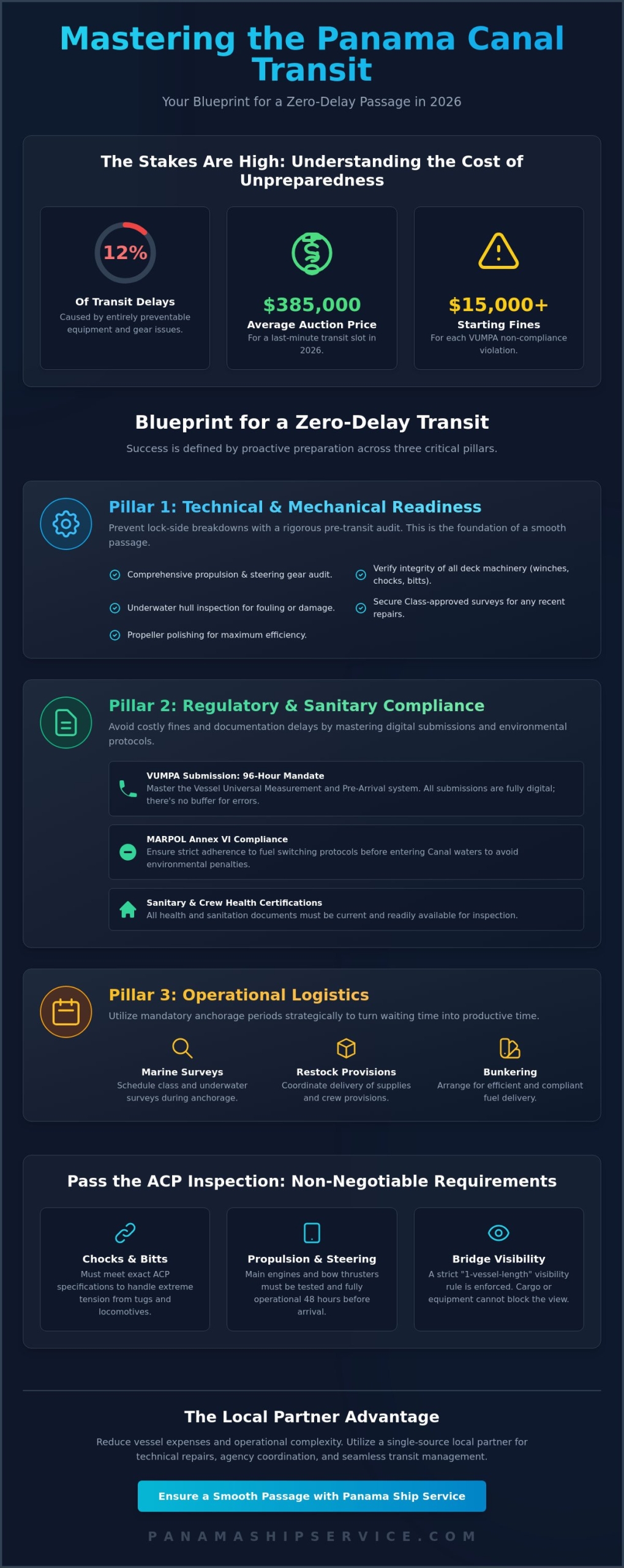
We understand the pressure of managing tight schedules while avoiding VUMPA non-compliance fines that now start at $15,000 per violation. This guide provides the exact blueprint to master the technical, regulatory, and operational requirements needed to avoid costly delays and ensure a seamless Panama Canal passage. We’ll preview the mandatory 96-hour VUMPA submission process, the latest MARPOL fuel switching protocols, and the specific equipment inspections required to achieve a zero-delay transit in today’s high-stakes maritime environment.
Key Takeaways
- Define success as zero non-operational delays by aligning your vessel with current ACP draft requirements and mechanical reliability standards.
- Prevent lock-side breakdowns by conducting comprehensive mechanical audits and underwater hull integrity checks before reaching the Canal entrance.
- Avoid $15,000+ fines by mastering MARPOL Annex compliance and ensuring all sanitary and crew health certifications are current.
- Discover how to ensure smooth canal transit by strategically scheduling marine surveys and restocking provisions during mandatory anchorage periods.
- Reduce vessel expenses and operational complexity by utilizing a single-source local partner for technical repairs and agency coordination.
Defining a Smooth Panama Canal Transit in 2026
In 2026, a smooth transit isn’t just a goal; it’s a financial necessity. With 6,288 transits recorded in the first half of fiscal year 2026, the waterway is busier and more regulated than ever. A “smooth” passage is defined by zero non-operational delays. This means moving from the Pacific to the Atlantic without being pulled aside for technical deficiencies or documentation errors. For a comprehensive Panama Canal overview, one must understand that this 82-kilometer shortcut relies on absolute precision. Success is measured by your vessel’s strict adherence to ACP draft requirements, mechanical reliability, and MARPOL environmental standards.
The 2026 operational landscape has stabilized in terms of water levels, but technical scrutiny has intensified. The Vessel Universal Measurement and Pre-Arrival (VUMPA) system is now fully digital, meaning there’s no longer a manual review buffer for errors. Mastering how to ensure smooth canal transit requires a proactive approach to this digital documentation. Timing is everything. If you misjudge your arrival or fail the initial ACP inspection, you lose your slot. In April 2026, last-minute auction prices surged to an average of $385,000. Missing that window doesn’t just delay your cargo; it can effectively wipe out the voyage’s profit in a single afternoon.
The Cost of Transit Delays
Delays are expensive, and the math is brutal. Daily hire rates for Neopanamax vessels remain high, but the real sting comes from ACP penalties and unplanned service fees. If your vessel suffers a mechanical failure within the locks, the Canal Authority mandates tug assistance. These aren’t standard rates; they’re emergency interventions that cost thousands. Beyond the immediate invoice, there’s the reputational damage. Charterers in 2026 track vessel performance with granular data. A delay in Panama can trigger late-delivery clauses and sour long-term contracts. Understanding how to ensure smooth canal transit is your primary defense against these cascading costs.
ACP Technical Requirements Overview
The Panama Canal Authority (ACP) acts as the ultimate gatekeeper. Their vetting process is rigorous and leaves no room for “good enough.” Inspectors focus on propulsion reliability and specific deck hardware that must withstand the immense tension of the transit process. Key requirements include:
- Chocks and Bitts: Must meet exact specifications to handle the locomotive “mules” or tug lines without failure.
- Propulsion and Steering: Main engines and bow thrusters must be tested and fully operational 48 hours before arrival.
- Visibility Rules: The ACP enforces a “1-vessel-length” visibility rule from the bridge. If cargo or equipment blocks this view, you’re not transiting.
ACP compliance is the non-negotiable baseline for any successful 2026 transit.
Technical Readiness: Mechanical and Underwater Integrity
Technical readiness is the backbone of operational success at the Canal. While some guides focus on recreational fenders or hand-lines, commercial maritime operators must prioritize heavy-duty mechanical systems to survive the scrutiny of an ACP inspection. To master how to ensure smooth canal transit, your technical team must execute a rigorous five-step audit before your vessel reaches the breakwaters. Failure to do so often results in the 12% of preventable delays caused by equipment gear issues seen in early 2026.
- Step 1: Conduct a comprehensive mechanical audit of propulsion and steering gear, ensuring all systems respond instantly to bridge commands.
- Step 2: Schedule an underwater hull inspection while at anchorage to identify fouling or structural damage that could impede speed.
- Step 3: Perform propeller polishing to ensure maximum thrust and fuel efficiency during the high-tension lock entries.
- Step 4: Verify the integrity of all deck machinery, specifically the winches, chocks, and bitts used for locomotive towing.
- Step 5: Secure Class-approved surveys for any recent repairs to satisfy ACP inspectors immediately upon their arrival.
Adhering to these steps ensures your vessel meets the official transit regulations regarding vessel classifications and technical fitness. Don’t let a minor mechanical oversight turn into a $385,000 auction loss.
Propulsion and Steering Reliability
The locks leave no room for error. Rudder and propeller inspections are non-negotiable because any loss of maneuverability inside the chamber is an immediate emergency. We often see vessels struggle with A/C and engine cooling issues during the slow-speed transit; the lack of standard water flow can lead to rapid overheating. If you identify vibration or response lag, you must arrange for mechanical ship repairs panama before your scheduled slot. We are experts so you don’t have to be, ensuring your propulsion system handles the unique stresses of the Canal’s fresh-water sections.
The Impact of Hull Fouling on Transit Speed
Biofouling is a silent transit killer. Heavy growth increases drag, which forces engines to work harder and can prevent a vessel from maintaining the required transit speeds. ACP pilots may deny transit if a ship cannot safely keep pace with the convoy. Utilizing professional underwater hull services for a pre-transit cleaning is a cost-effective way to optimize performance. A clean hull and polished propeller can reduce fuel consumption by up to 10% during the passage. If you need to verify your vessel’s condition, consider a rapid response underwater inspection to guarantee your hull is ready for the voyage.
Regulatory and Sanitary Compliance: MARPOL and Beyond
Mechanical perfection won’t save your voyage if your paperwork or environmental protocols fail. ACP inspectors prioritize MARPOL compliance and vessel hygiene just as much as engine reliability. To understand how to ensure smooth canal transit, you must treat regulatory documentation as a critical path item. The ACP Vessel Requirements specify that all international oil pollution prevention certificates must be current and accessible. Any discrepancy in your Electronic Cargo Record Book can trigger an immediate inspection hold and a fine starting at $15,000.
Documenting compliance requires a proactive approach. You must present a valid International Oil Pollution Prevention (IOPP) certificate and ensure your Panama Canal Shipboard Oil Pollution Emergency Plan (PCSOPEP) is authorized by the ACP. In 2026, the 0.50% m/m global sulphur limit is strictly enforced in Canal waters. Vessels must switch to marine distillate fuels for all engines upon arrival at the Pacific or Atlantic anchorages. Discharging residues from Exhaust Gas Cleaning Systems (scrubbers) is prohibited. We manage these complexities so you don’t have to, ensuring your vessel is ready for the boarding officer’s scrutiny.
MARPOL Disposal at the Canal
Your mandatory wait time at the anchorage is the most efficient window to handle sludge, bilge water, and garbage disposal. Consolidating these services with your technical stop prevents the need for additional port calls later in the voyage. It’s vital that all disposals are handled by MARPOL-compliant facilities that provide the necessary receipts for your record books. For a detailed breakdown of Annex I through V requirements, consult our MARPOL disposal panama guide. We provide the equipment and certified personnel to handle these disposals quickly and safely.
Sanitary Inspections and Pest Control
A “clean bill of health” is a literal requirement for transit. You must maintain a valid Ship Sanitation Control Exemption Certificate (or Deratting Certificate) to avoid quarantine delays. Pre-transit fumigation is a critical step if your vessel has recently visited ports with high pest activity. If an inspector finds evidence of infestation, your transit will be suspended until a certified local provider performs a full treatment. We coordinate these sanitary clearances alongside crew change logistics and ship garbage disposal, ensuring your vessel remains in full compliance with local environmental laws. Timing is everything; don’t let a pest control oversight derail a multi-million dollar schedule.
Operational Logistics: Surveys, Supplies, and Bunkering
Operational logistics at the Panama Canal is a high-speed game of coordination. While your vessel waits at the Pacific or Atlantic anchorage, you have a narrow window to execute essential tasks without extending your port time. Mastering how to ensure smooth canal transit requires more than just following a schedule. It demands the simultaneous management of marine surveys, provision restocking, and fuel quality verification. In the first half of 2026, the Canal handled over 250 million PC/UMS tons. This volume means that berth space and service boat availability are at a premium. Proactive scheduling is your only defense against logistical bottlenecks.
Constant daily communication with your local agent is the foundation of this process. The Panama Canal Authority (ACP) requires every vessel to be represented by a licensed agent to manage documentation and financial transactions. Your agent acts as the bridge between your vessel and the local service providers. They ensure that your 48-hour customs manifest for duty-free stores is finalized on time to avoid the $500 per line item fines. By consolidating your logistics, you eliminate the need for costly voyage deviations or extra stops after your transit is complete.
Accurate Marine Surveys
Precision in measurement is vital for both safety and financial transparency. Draft surveys are essential for maximizing your cargo load while staying within the strict ACP limits; for Panamax vessels, this means staying under the 12.04-meter draft in Tropical Fresh Water. Bunker surveys are equally critical. They protect the owner’s interest during fuel transfers by verifying the exact quantity and quality of fuel received. If you are considering a vessel acquisition or charter change at the Canal, pre-purchase inspections provide a clear technical snapshot in a neutral environment. For a deeper look at these requirements, read our guide on marine surveys panama.
Efficient Ship Supply Management
Sourcing provisions and marine spare parts at the Canal entrance is a strategic move. Instead of making separate stops, you can restock while your vessel is already stationary for its transit slot. It is best practice to order ship provisions 72 to 96 hours before arrival. This lead time ensures availability and prevents the rush fees associated with last-minute deliveries. You can effectively consolidate supply delivery with your mechanical repair windows to minimize deck activity. Our ship supplies panama canal guide provides specific sourcing tips to help you manage these needs. If you need to restock before your next leg, contact our supply team to coordinate a delivery that fits your transit window.
The Local Partner Advantage: Panama Ship Service
The Panama Canal remains a difficult and frustrating environment for those without deep local knowledge. Managing multiple vendors for repairs, surveys, and disposals while under the pressure of a strict transit window is a recipe for operational failure. Our “One-Stop-Shop” model was designed specifically to minimize vessel expenses by consolidating these essential services. Instead of coordinating with four different agencies, you work with one trusted partner. With 20 years of expertise navigating these waters, we understand that timing is everything. We coordinate your mechanical repairs, underwater hull cleanings, and MARPOL disposals into a single efficient window at the anchorage.
Put your transit in expert hands. We provide constant daily communication and a rapid response to any technical or regulatory challenge that arises. Your primary strategy for how to ensure smooth canal transit should always include a local partner who can anticipate ACP demands before they become obstacles. We’ve spent two decades refining our processes to match the evolving demands of the Panama Canal Authority. This proactive approach ensures your vessel doesn’t just arrive; it transits without delay.
Why Expertise Matters at the Canal
We are experts so you don’t have to be. Simplifying the complex technical requirements of the ACP is our core mission. For example, in February 2026, a container vessel arriving at the Pacific entrance identified a critical fault in its auxiliary propulsion system. A 48-hour delay seemed inevitable, which would have cost the charterer hundreds of thousands in lost time and auction fees. Our technical team boarded the vessel within two hours of arrival, performed the necessary mechanical repair at the anchorage, and secured the required survey. The vessel made its scheduled slot without a single minute of non-operational downtime. This is the value of a partner who understands 2026 standards and has the resources to act immediately.
Get a Comprehensive Transit Quote
Every vessel has unique requirements based on its size, cargo, and technical condition. We don’t believe in generic solutions. Knowing how to ensure smooth canal transit means requesting a tailored service package that addresses your specific needs, from crew changes to complex underwater services. We focus on cost-conscious operations through transparent pricing and efficient resource allocation. Don’t leave your voyage to chance in one of the world’s most demanding maritime corridors. Contact Panama Ship Service for a smooth transit evaluation. We’ll provide the expert guidance and technical support needed to protect your schedule and your bottom line.
Secure Your Vessel’s Passage Through the Panama Canal
Winning your transit slot is only half the battle; defending it requires total technical and regulatory precision. Timing is everything. By prioritizing mechanical audits and underwater integrity, you eliminate the equipment gear issues that caused 12% of delays in early 2026. Simultaneously, proactive MARPOL documentation and strategic survey scheduling during your anchorage window transform a potentially frustrating wait into a productive technical stop. Understanding how to ensure smooth canal transit ultimately comes down to one factor: moving from a reactive to a proactive operational stance before you reach the breakwaters.
Panama Ship Service stands as your trusted partner at the Canal, offering 20+ years of maritime expertise to navigate these high-stakes requirements. We provide full MARPOL and ACP compliance support alongside 24/7 emergency mechanical and underwater repair teams to keep your vessel moving. Our “One-Stop-Shop” model ensures that every survey, disposal, and repair is handled with the efficiency your schedule demands. Streamline your next Panama Canal transit with our expert technical services. We are experts so you don’t have to be. Put your vessel in capable hands and experience a seamless passage.
Frequently Asked Questions
What are the primary reasons for transit delays in the Panama Canal?
Preventable gear failures and documentation errors in the VUMPA package are the leading causes of delays. In the first half of 2026, equipment issues accounted for 12% of all recorded transit interruptions. Accuracy in your 96-hour pre-arrival submission is also critical. We are experts so you don’t have to be, ensuring both your technical and administrative preparations are flawless before the pilot boards.
Is underwater hull cleaning mandatory before transiting the Canal?
Cleaning isn’t a legal requirement, but it’s a functional necessity for maintaining required transit speeds. ACP pilots can deny transit if a heavily fouled hull prevents your vessel from keeping pace with the convoy. Performing a cleaning at the anchorage is a proactive strategy for how to ensure smooth canal transit while optimizing your fuel efficiency for the next leg of the voyage.
How can I ensure my vessel is MARPOL compliant for a Panama transit?
You must switch to marine distillate fuels with a 0.50% sulphur limit immediately upon arrival at the Pacific or Atlantic anchorages. Vessels must also present a valid International Oil Pollution Prevention certificate and an ACP-authorized PCSOPEP. Remember that discharging any residues from Exhaust Gas Cleaning Systems is strictly prohibited within Canal waters to avoid fines exceeding $15,000.
What documents are required for a sanitary inspection at the Panama Canal?
The primary requirements are a valid Ship Sanitation Control Exemption Certificate and a completed Maritime Declaration of Health. These must be submitted through the VUMPA portal 96 hours before your arrival. Inspectors also check crew vaccination records and the vessel’s garbage management plan. Missing or expired certificates can lead to quarantine holds that disrupt your entire schedule.
Can mechanical repairs be performed while the vessel is waiting for its transit slot?
Yes, the mandatory wait time at the anchorage is the best window for mechanical repairs. Our 24/7 teams perform engine, rudder, and deck machinery fixes while you wait for your slot. Addressing these issues early prevents lock-side breakdowns, which often lead to mandatory tug assistance and expensive emergency penalties from the Canal Authority.
What is the difference between a Draft Survey and a Bunker Survey?
A Draft Survey determines the exact weight of cargo by measuring water displacement, which is vital for meeting the 12.04-meter Panamax draft limit. A Bunker Survey focuses on the quantity and quality of fuel during bunkering operations. Both surveys are essential for operational transparency and help owners avoid the costs associated with cargo disputes or off-specification fuel.
How long does a typical Panama Canal transit take for a commercial vessel in 2026?
The actual transit through the locks and Gatun Lake typically takes between 8 and 10 hours. However, your total time in Panama waters depends on your slot arrival and current traffic levels, which averaged 37 daily transits in March 2026. Coordinating your surveys and supplies during the anchorage period is how to ensure smooth canal transit without extending your total port stay.
Why should I use a local ship service provider instead of a general agent?
Local providers like Panama Ship Service offer specialized technical expertise that general agents lack. We act as a “one-stop-shop,” consolidating repairs, MARPOL disposals, and surveys into a single efficient window. With 20 years of experience, we provide on-site solutions and rapid response teams that understand the specific technical demands of the Panama Canal Authority.