
A single millimeter of surface roughness on your propeller blades can slash your vessel’s fuel efficiency by up to 8% before you even reach the Panama Canal locks. Knowing how to maintain propeller efficiency is no longer just a routine task; it’s a critical financial strategy for operators facing record-high transit fees and strict environmental regulations. You understand that every minute of delay or extra ton of fuel burned impacts your bottom line, especially when mechanical inefficiencies lead to vibration issues that threaten engine health.
Discover the technical strategies and maintenance protocols required to optimize propeller performance and reduce fuel consumption during your next transit. This guide provides a professional roadmap to achieving smooth, vibration-free operation and extending your intervals between dry-docking. We’ll explore the latest in underwater hull services, robotic polishing standards, and the mechanical ship repairs necessary to ensure your vessel operates with the precision required for a successful, cost-effective voyage.
Key Takeaways
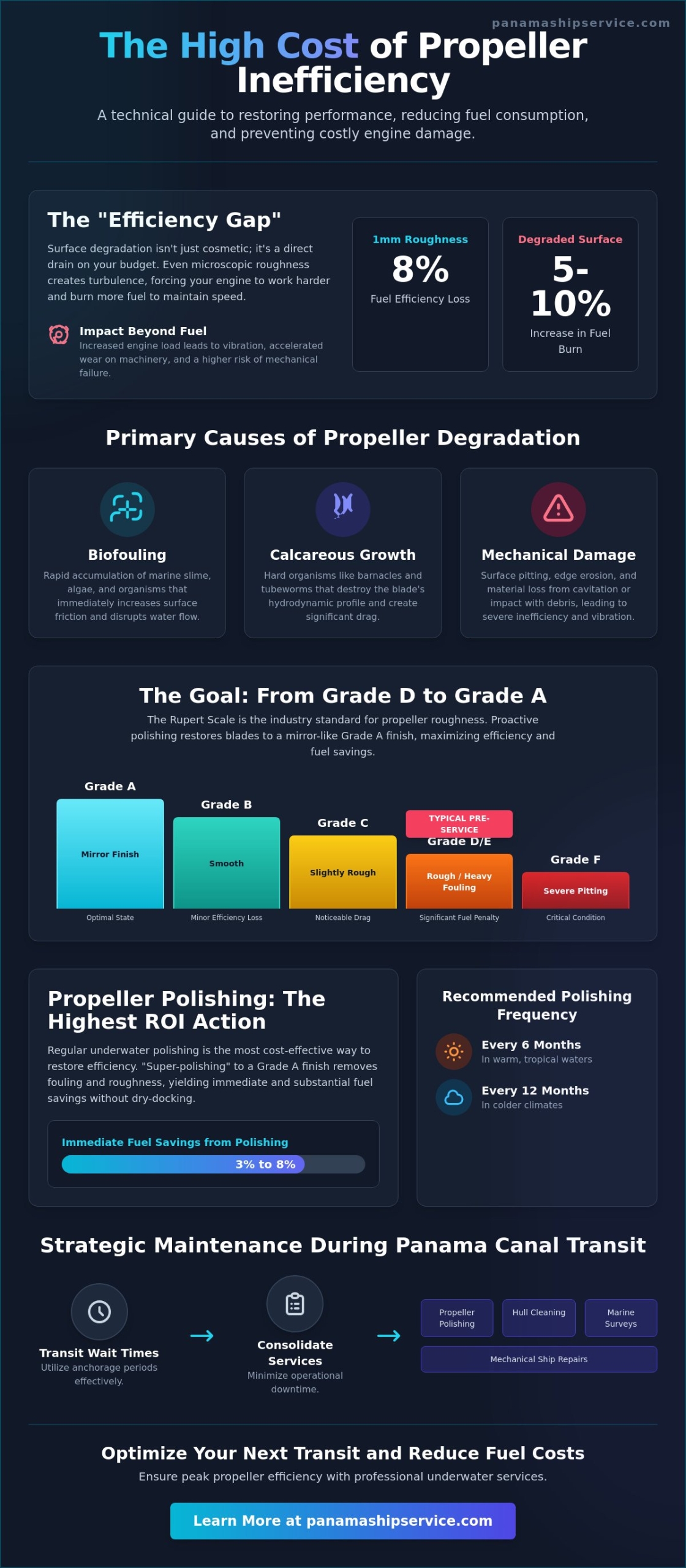
- Identify the technical “Efficiency Gap” where surface degradation triggers a 5-10% increase in total fuel consumption.
- Learn how to maintain propeller efficiency by restoring blade surfaces from Rupert Grade D/E to Grade A through high-ROI polishing.
- Recognize how biofouling on the propeller hub and roots disrupts the flow field, necessitating proactive underwater hull services.
- Detect early signs of cavitation and mechanical blade damage, such as edge erosion or bent tips, to avoid engine health complications.
- Optimize your operational schedule by consolidating marine surveys and mechanical ship repairs during Panama Canal transit wait times.
The Science of Propeller Efficiency: Why Performance Drops
Propeller efficiency is technically defined as the ratio of thrust power produced to the torque power supplied. In an ideal environment, your propulsion system converts engine energy into forward movement with minimal loss. However, real-world conditions create an “Efficiency Gap” where surface degradation leads to a 5-10% increase in fuel consumption. This loss isn’t just a theoretical number; it’s a direct drain on your operational budget. Understanding The Science of Propeller Efficiency is vital for any operator looking to stabilize overhead costs and improve vessel performance.
The primary enemies of your vessel’s performance are constant and aggressive. They include:
- Biofouling: The rapid accumulation of slime and algae that increases surface friction immediately.
- Calcareous growth: Hard organisms such as tubeworms and barnacles that destroy the blade’s hydrodynamic profile.
- Mechanical erosion: Surface pitting and material loss caused by cavitation or impact with marine debris.
Understanding Hydrodynamic Drag and Surface Roughness
Even microscopic changes in blade texture matter. Surface roughness disrupts the laminar flow of water across the propeller, creating turbulence that increases frictional drag. When water can’t flow smoothly over the blade, the engine must work harder to push the vessel through the water. This creates a measurable fuel penalty that grows as the surface condition worsens. When turbulence replaces laminar flow, the pressure distribution across the blade becomes uneven. This instability reduces the effective thrust produced per revolution, meaning the propeller must spin faster to achieve the same speed. The Rupert Scale is the industry standard for measuring propeller surface finish and quantifying these roughness levels.
The Impact of Propeller Degradation on Engine Load
Inefficient propellers force engines to operate at higher torque levels to maintain designated transit speeds. This increased load doesn’t just spike fuel costs; it significantly impacts the health of your machinery. Constant high-torque operation accelerates wear on bearings, seals, and internal engine components, leading to shorter maintenance intervals. Mastering how to maintain propeller efficiency is therefore a fundamental part of effective vessel management.
It’s also a critical element of mechanical ship repairs, as maintaining a clean surface prevents the vibration issues that often lead to costly mechanical failures. By addressing efficiency early, you protect your engine’s longevity and ensure your vessel is ready for the high-stakes environment of a Panama Canal transit. Proactive management ensures that you aren’t just reacting to problems but actively preventing them before they manifest as engine vibration or excessive fuel bills.
Propeller Polishing: The Highest ROI Maintenance Action
Propeller polishing is the most cost-effective maintenance action a vessel operator can take to restore propulsion efficiency. It’s a targeted intervention that yields immediate results without the need for dry-docking. By removing rough oxides and early-stage biofouling, you restore the blade’s hydrodynamic profile to its design state. Real-world data indicates that regular polishing provides fuel savings ranging from 3% to 8%, depending on the initial state of the metal. This isn’t just about cleaning; it’s about precision. The “Super-Polishing” technique aims for a mirror-like finish, reducing frictional resistance to its absolute minimum and ensuring maximum water flow across the blades.
The Rupert Scale and Grading Standards
The maritime industry uses the Rupert Scale to quantify surface roughness. This scale features grades ranging from A to F, where Grade A represents a mirror-smooth finish and Grade F indicates severe pitting or heavy calcareous growth. Most commercial vessels operate at Grade D or E before a scheduled cleaning. Professional divers use tactile comparators underwater to physically match the blade’s texture against these standards. Achieving a Grade A finish is the primary goal for ocean-going vessels, as even slight deviations from this standard increase drag and fuel consumption.
Frequency and Timing of Polishing Services
Environmental conditions dictate your maintenance schedule. In warmer tropical waters, biofouling occurs rapidly, often necessitating polishing every 6 months. In colder climates, a 12-month interval might suffice. This service is a core component of professional underwater hull services, as it addresses the most sensitive part of the propulsion chain. According to the ABS guide to ship energy efficiency, managing the condition of the propeller is a primary pillar of energy management and carbon intensity reduction.
The process is essentially self-financing. The reduction in fuel consumption during a single long-haul voyage often covers the entire cost of the dive team. If you’re planning a transit, scheduling a professional inspection is the best way to determine how to maintain propeller efficiency for the remainder of your route. For operators looking to optimize their schedules, integrating these services with your canal transit agency requirements ensures your vessel remains productive while waiting for its slot. You don’t have to sacrifice time to gain efficiency; you simply need to coordinate your maintenance with your operational stops.
Biofouling Control and Underwater Hull Cleaning
Biofouling is a relentless biological process that begins the moment a vessel enters the water. It progresses from a microscopic slime layer to heavy calcareous growth like barnacles and tubeworms. While many operators focus on the broad surfaces of the hull, fouling on the propeller hub and roots is equally damaging. These areas are critical because they dictate the flow field entering the blades. When these sections are compromised, the resulting turbulence creates a performance gap that even the most powerful engines cannot overcome. Effective management of this growth is a cornerstone of vessel husbandry.
Successful strategies for how to maintain propeller efficiency must address the synergy between the hull and the propulsion system. A clean propeller pushing against a fouled hull is inefficient, just as a clean hull with a fouled propeller wastes energy. Specialized multi-stage cleaning tools are essential for this task. Unlike the manual scrapers often used on smaller vessels, professional hydraulic systems remove growth without gouging the sensitive bronze or nickel-aluminum-bronze alloys. This precision ensures that the metal remains smooth, preventing the rapid re-colonization that occurs on scratched surfaces.
Micro-Fouling vs. Macro-Fouling
Micro-fouling, or the “invisible” slime layer, can increase drag coefficients by significant margins before any hard growth is visible to the naked eye. This slime creates a rough boundary layer that disrupts laminar flow across the blades. If left unchecked, it provides the foundation for macro-fouling, where barnacles create massive turbulence and increase cavitation risks. Regular marine surveys in Panama are the most reliable way to detect these early stages of colonization. As noted in the IMO Ship Energy Efficiency Management Plan, proactive propeller cleaning and polishing are recognized as primary methods for increasing fuel efficiency and reducing emissions across the global fleet.
In-Water Cleaning Technologies
Modern underwater maintenance utilizes advanced hydraulic brush systems that provide consistent pressure across the blade surface. These systems are designed to be thorough yet non-destructive. Beyond performance, environmental compliance is a major operational factor. Capturing the removed debris is necessary to prevent the spread of invasive species and to meet strict international standards. For vessels operating in the region, coordinating these services with MARPOL disposal panama protocols ensures that all biological waste is handled according to legal requirements. This integrated approach protects your vessel’s efficiency while maintaining total regulatory compliance during your stay in port.
Addressing Mechanical Issues: Cavitation and Blade Damage
Mechanical integrity is the foundation of sustained propulsion performance. While polishing and cleaning address surface finish, physical defects require direct structural intervention. Nicks, bent tips, and edge erosion are common results of contact with marine debris or seabed groundings. These defects don’t just affect vessel safety; they create significant hydrodynamic drag. When a blade is bent or chipped, the pressure distribution across the propeller becomes asymmetric. This leads to chronic vibration that can damage the entire drive train, including shafts, bearings, and seals. Addressing these issues is a priority for any operator focused on how to maintain propeller efficiency over the long term.
Cavitation is a silent efficiency killer that physically “eats” your propeller’s metal. It occurs when surface imperfections or excessive speeds create localized low-pressure zones. Water vaporizes into microscopic bubbles that implode with enough force to pit the metal surface. Over time, this creates a sponge-like texture on the blade that destroys the hydrodynamic profile. If left unaddressed, the erosion can become so severe that the blade loses structural integrity, necessitating a full replacement rather than a simple repair. Determining when to use underwater welding or grinding is a decision that impacts both your current fuel bill and your future dry-docking costs.
The Cavitation Cycle: Causes and Prevention
Surface imperfections, even small ones, trigger the low-pressure bubbles that fuel the cavitation cycle. These implosions cause localized stress that exceeds the yield strength of the propeller alloy. Once the metal starts to pit, the rougher surface creates even more turbulence, which in turn accelerates the cavitation. It’s a self-reinforcing cycle of degradation. Professional mechanical ship repairs panama are necessary to grind out these cavitation pits and restore the smooth finish required to break the cycle and protect the blade’s surface.
Edge Restoration and Balancing
The leading edge of the blade is the most critical area for efficiency. It’s the first part of the propeller to meet the water flow, and any deformation here causes immediate performance loss. Technicians use specialized templates and grinding tools to restore the original hydrodynamic profile of a damaged blade. Beyond the shape, balancing is vital. An unbalanced propeller creates centrifugal forces that lead to vibration and premature wear on the stern tube. Static balancing can address weight distribution, but dynamic balancing is often required to ensure smooth rotation at high RPMs. Ensuring your vessel is properly balanced is a key step in optimizing your transit performance. If you suspect mechanical damage or excessive vibration, you should schedule a professional mechanical survey to assess the condition of your propulsion system before your next voyage.
Strategic Maintenance at the Panama Canal: Minimizing Downtime
The Panama Canal is more than a transit point; it’s a strategic hub for operational optimization. For vessel operators, the wait times associated with canal transits provide a unique window to address propulsion performance without adding days to the voyage. Understanding how to maintain propeller efficiency while at anchor allows you to transform idle time into a high-return maintenance period. Consolidating services like marine surveys, mechanical repairs, and hull cleaning at this single location reduces the logistical complexity of managing multiple vendors across different ports. This approach ensures your vessel leaves the canal in better condition than when it arrived.
Panama Ship Service streamlines this process by acting as a comprehensive “One-Stop-Shop” for international operators. Whether your vessel is stationed at the Pacific entrance in Balboa or the Atlantic side in Cristobal, the availability of specialized technical teams ensures that maintenance doesn’t interfere with your transit slot. By delegating these technical tasks to a localized expert, you simplify your own operations and ensure your vessel is in peak condition for the next leg of its journey. This level of coordination is vital in an industry where timing and cost management are the primary drivers of profitability.
Executing Maintenance Without Affecting Schedule
Coordination with the Panama Canal Authority (ACP) is essential for conducting in-water services safely and legally. Most underwater inspections and cleaning tasks can be performed while the vessel is at anchor, meaning your propulsion system is serviced while you wait for your scheduled transit. Proactive maintenance at the canal prevents the need for emergency repairs at the next port, where facilities might be limited or costs significantly higher. This forward-thinking approach ensures that your vessel maintains its schedule while achieving the fuel savings required to remain competitive in today’s high-cost environment.
Integrating Supplies and Compliance
Efficiency isn’t just about the propeller; it’s about the entire supply chain. You can easily combine propeller polishing with the delivery of critical ship supplies panama canal, ensuring your vessel is fully provisioned and technically sound in one stop. All underwater hull services and mechanical ship repairs performed here meet strict Class Approval standards and environmental regulations, protecting your vessel’s compliance status. This integration reduces the administrative burden on your crew and shore-based management teams.
Partnering with a reliable technical provider at this strategic global hub offers long-term value that extends beyond a single transit. It provides a consistent point of contact for how to maintain propeller efficiency across your entire fleet. By centralizing these critical tasks, you reduce overhead, minimize the risk of mechanical failure, and ensure that every voyage is as fuel-efficient as possible. This reliable presence in Panama allows you to focus on your core business while we handle the technical complexities of your vessel’s underwater maintenance.
Secure Your Vessel’s Performance for the Next Voyage
Maintaining peak propulsion performance requires a disciplined approach to both surface finish and structural integrity. Polishing blades to Rupert Grade A and resolving cavitation damage are essential strategies for any operator facing high fuel costs. By utilizing transit wait times for Class-approved underwater inspections and mechanical ship repairs, you transform idle hours into a distinct operational advantage. Integrating these professional protocols is the most effective way to understand how to maintain propeller efficiency while protecting your engine’s long-term health.
Panama Ship Service provides 24/7 technical support at both the Pacific and Atlantic entrances to ensure your vessel meets its performance targets without schedule disruption. Our teams specialize in high-precision polishing and comprehensive underwater hull services that meet the highest industry standards. Request a technical consultation for your propeller maintenance in Panama to optimize your fleet’s efficiency. Proactive care ensures your vessel remains a reliable, cost-effective asset throughout its service life.
Frequently Asked Questions
How much fuel can I really save with propeller polishing?
Regular polishing typically yields immediate fuel savings between 3% and 8%. These results depend on the initial level of surface roughness and the specific vessel type. By restoring the blade to a mirror-smooth finish, you reduce the torque required to maintain your target speed. This reduction in engine load translates directly into lower daily fuel consumption and a smaller carbon footprint for your fleet.
Can propeller polishing be performed while the ship is loaded?
Yes, propeller polishing is standard practice for vessels at full load or in ballast. Underwater technical teams perform these services while the ship is at anchor or alongside a berth during cargo operations. This allows you to maintain your operational schedule without the need for de-ballasting or dry-docking. It’s a highly efficient way to manage performance during a standard port call or canal wait.
What is the difference between propeller cleaning and propeller polishing?
Propeller cleaning focuses on the removal of soft slime and hard calcareous growth to prevent drag. Polishing goes a step further by using specialized abrasive discs to restore the metal surface to a specific smoothness, typically Rupert Grade A. While cleaning restores the flow field, polishing optimizes hydrodynamic performance by reducing microscopic frictional resistance. Both are essential components of how to maintain propeller efficiency.
How do I know if my propeller is inefficient without dry-docking?
Operators can detect inefficiency by monitoring increases in fuel consumption relative to vessel speed and engine RPM. If you notice a drop in speed for the same power output, surface degradation is likely the cause. Increased hull vibration or shuddering during transit also indicates potential fouling or mechanical imbalance. A professional underwater inspection with high-definition video provides the definitive proof needed to schedule maintenance.
Does biofouling affect all types of propellers equally?
Biofouling affects all propellers, but the impact varies based on the blade’s alloy composition and the vessel’s operating speed. Nickel-aluminum-bronze alloys are common in commercial shipping and are highly susceptible to both slime and hard growth in tropical waters. Commercial propellers require manual intervention to clear the hub and blade roots where growth is most persistent and most disruptive to the flow field.
Is underwater propeller repair as effective as dry-dock repair?
Underwater repairs are highly effective for addressing leading-edge damage, nicks, and cavitation pitting. Using specialized underwater tools, technicians can grind and profile blades to restore their original hydrodynamic shape without the expense of dry-docking. While major structural cracks might eventually require a yard visit, most efficiency-related mechanical issues can be resolved in-water to maintain class approval and total operational safety.
How often should I schedule a Rupert Scale inspection?
You should schedule a Rupert Scale inspection every 6 to 12 months as part of your routine underwater hull services. Vessels operating frequently in warm, high-fouling regions like the Panama Canal may require more frequent checks to prevent Grade D or E degradation. Regular inspections allow you to catch surface roughness early, ensuring that polishing remains a minor maintenance task rather than a major restoration project.
Can cavitation damage be permanently repaired underwater?
Cavitation damage can be managed and repaired underwater through precise grinding and profiling techniques. Technicians remove the pitted material and reshape the blade to a smooth finish, which helps break the cavitation cycle. This prevents the damage from spreading and restores the propeller’s performance. Consistent monitoring is necessary to ensure the underlying cause is addressed. This is a critical part of how to maintain propeller efficiency.