
Since January 1, 2026, the Panama Canal Authority’s machine-validated VUMPA system automatically rejects any incomplete pre-arrival package, turning a minor technical oversight into a costly transit delay. You know that timing at the Canal is everything and that learning how to prepare for underwater survey requirements is the only way to protect your schedule. Misjudging your vessel-side readiness doesn’t just risk non-compliance with Unified Requirement Z3; it threatens your standing in the Canal’s mandatory risk-based inspection model. We understand the pressure to maintain a 36-month survey interval while avoiding the pitfalls of a difficult and frustrating port environment.
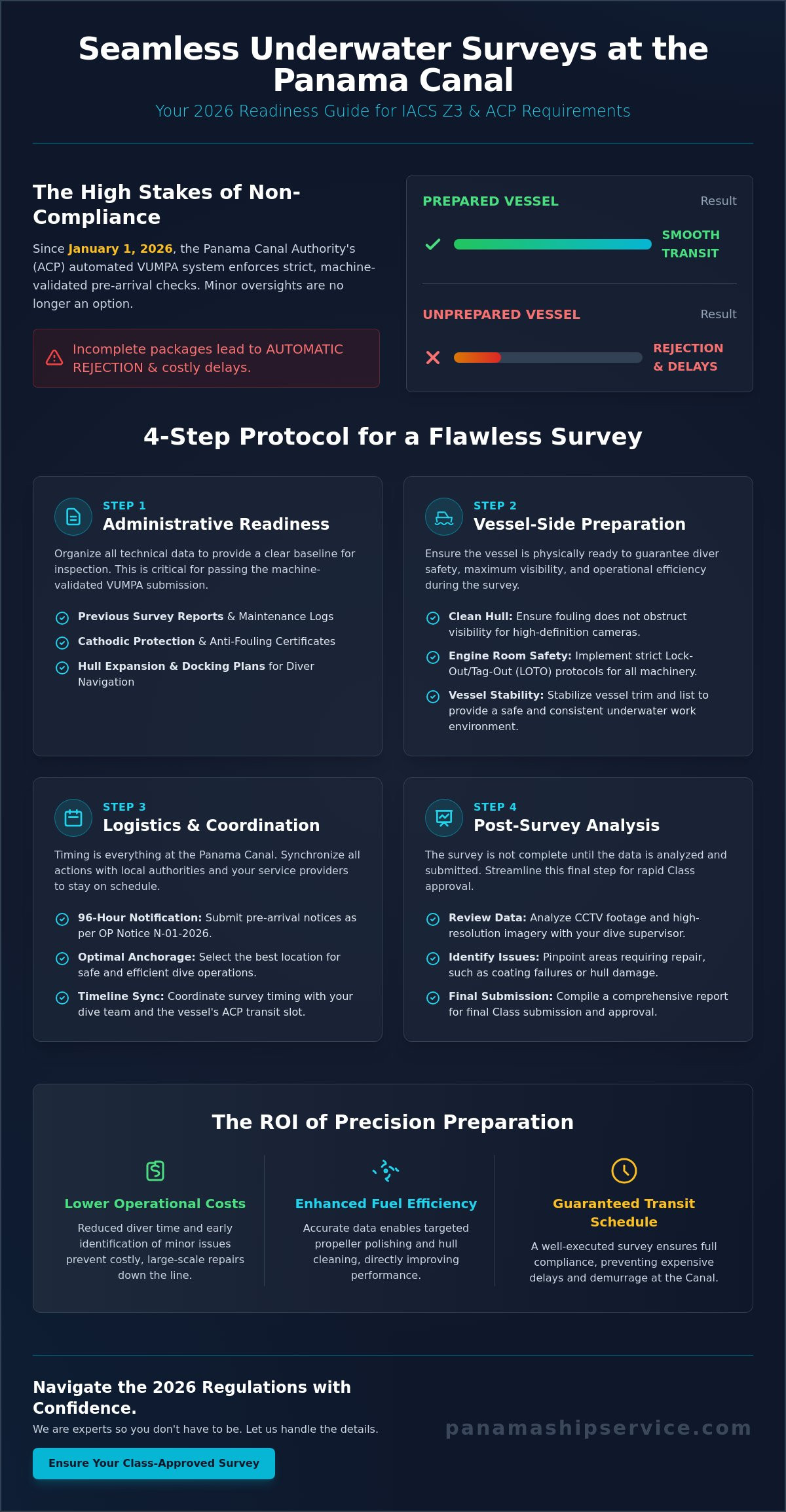
This professional guide provides the technical roadmap you need to ensure a seamless, class-approved inspection every time. You’ll master the essential vessel-side preparations, from hull cleaning standards to the specific 96-hour pre-arrival notifications required by OP Notice N-01-2026. We are experts so you don’t have to be. By following these steps, you’ll guarantee safety, satisfy IACS standards, and keep your transit on track without the headache of unexpected delays. Let’s look at the specific crew actions and documentation needed to satisfy the latest 2026 maritime regulations.
Key Takeaways
- Understand the impact of IACS Unified Requirement Z3 and why precise preparation is your first line of defense against costly transit delays.
- Organize essential technical documentation, including hull expansion and docking plans, to provide your dive team with an accurate baseline for inspection.
- Master how to prepare for underwater survey operations by implementing strict engine room LOTO protocols and stabilizing vessel trim for maximum visibility.
- Navigate Panama Canal logistics by selecting the optimal anchorage and synchronizing your survey timeline with the latest ACP transit requirements.
- Streamline your final Class submission by learning how to effectively analyze post-survey CCTV data and high-resolution imagery with your dive supervisor.
Understanding Underwater Surveys: Why Preparation is Critical for Commercial Vessels
An Underwater survey, specifically an Underwater Inspection in Lieu of Drydocking (UWILD), is a sophisticated technical operation. It serves as the primary alternative to expensive drydocking, allowing ship owners to maintain class compliance while the vessel remains afloat. According to IACS Unified Requirement Z3, vessels must undergo two examinations of the ship’s bottom within every five-year special survey period. Understanding how to prepare for underwater survey protocols is no longer just a recommendation; it’s a financial necessity. Since the Panama Canal Authority (ACP) launched its risk-based vessel inspection model on January 1, 2026, the stakes have never been higher. A poorly prepared vessel risks failing its machine-validated VUMPA submission, leading to immediate transit rejection and mounting demurrage costs.
Modern marine inspections rely on high-definition CCTV and real-time surface monitoring. This technology allows class surveyors to witness the hull’s condition from the surface with total clarity. However, technology alone cannot overcome poor preparation. If your hull is fouled or your engine room isn’t ready, the survey will stall. We provide a comprehensive one-stop-shop approach at the Panama Canal to eliminate these friction points. We are experts so you don’t have to be. By synchronizing dive teams with your vessel’s arrival, we minimize downtime and ensure your transit remains on schedule.
Types of Underwater Inspections
- Class Approval Surveys (UWILD): Mandatory inspections required by IACS to verify structural integrity and seaworthiness without drydocking.
- Pre-purchase Condition Surveys: Detailed assessments used during asset valuation to identify hidden hull defects or coating failures.
- Post-damage Assessments: Rapid response inspections following groundings or collisions to determine if a vessel is fit to continue its voyage.
The ROI of a Well-Prepared Survey
Precision pays. When your crew is prepared, divers spend less time in the water, which directly lowers your operational expenses. Accurate hull data gathered during a survey allows for better fuel efficiency through targeted propeller polishing. Identifying the need for specialized underwater hull services early prevents minor fouling from becoming a critical engine strain. In the high-pressure environment of the Panama Canal, where costs continually increase, a well-executed survey is your best defense against unexpected repairs and transit delays. We ensure your data is class-ready the first time.
Essential Documentation and Technical Data for a Class-Approved Survey
Administrative readiness is the backbone of a successful inspection. Even if your hull is pristine, a lack of organized technical data can halt a class surveyor’s approval immediately. Knowing how to prepare for underwater survey documentation starts with gathering your vessel’s historical data to provide a baseline for the new inspection. You must have previous survey reports and internal maintenance logs ready for review. Classification societies like ABS, DNV, or Lloyd’s Register require these records to track the progression of hull wear, coating degradation, or previous repairs. If you need help coordinating these requirements, our team at panamashipservice.com can streamline the process for you.
Beyond history, you must provide current certificates for cathodic protection systems and anti-fouling coatings. Since the Panama Canal Authority updated its vessel requirements in OP Notice No. N-01-2026 on January 1, 2026, all technical submissions must be precise. Incomplete documentation can lead to a rejection of your machine-validated VUMPA package. We are experts so you don’t have to be. We ensure every certificate and report meets the rigorous standards of both the IACS and the local authorities.
Technical Schematics for Divers
Divers cannot navigate your hull effectively without accurate maps. You must provide a shell expansion plan and a docking plan before the dive team enters the water. These schematics are vital for locating specific welds, sea chests, and sacrificial anodes. Without them, divers waste precious bottom time searching for components, which increases your operational costs. Historical data for rudder and propeller clearances is also mandatory. Class surveyors use these previous measurements to determine if current wear rates fall within acceptable safety margins or if immediate intervention is required.
Regulatory and Safety Paperwork
Diving operations in Panama Canal waters are strictly regulated and require specific work permits. You must ensure your marine surveys in Panama align with the latest ACP safety protocols. This includes establishing a clear communication protocol between the bridge and the dive supervisor. A dedicated VHF channel or hardwired intercom system must be tested before the survey begins. Under the 2026 risk-based vessel inspection model, any failure in safety communication can result in an immediate suspension of the survey and a downgrade of your vessel’s risk rating. We manage these logistics proactively to keep your transit on schedule and your crew safe.
Physical Preparation of the Vessel: Steps for the Crew and Engine Room
While the dive team performs the technical inspection, the success of the operation rests entirely on the vessel’s crew. A professional diver’s efficiency is limited by how well the ship is prepared before they enter the water. Learning how to prepare for underwater survey maneuvers means shifting the focus from the deck to the engine room. Since the implementation of the Panama Canal’s new vessel inspection model on January 1, 2026, any safety lapse during a survey can trigger an immediate suspension of transit privileges. We are experts so you don’t have to be. We help you manage these critical vessel-side steps to ensure your ship remains compliant and your schedule stays intact.
The crew must also address internal maintenance that impacts external visibility. Cleaning the internal sides of sea chests and strainers is a vital step often overlooked. If internal fouling is heavy, it can obscure the diver’s view of the external gratings, leading to an inconclusive report. Briefing the entire crew on the specific dive schedule is equally important. Accidental discharge of gray water or the sudden movement of machinery can create life-threatening conditions for the dive team. We recommend a formal safety meeting 2 hours before the divers arrive to confirm that all personnel are aware of the restricted zones.
Engine Room and Machinery Lock-Out
Safety starts with a strict Lock-Out/Tag-Out (LOTO) procedure. The Chief Engineer must personally verify that the main engine, steering gear, and all thrusters are physically locked out. Securing the propeller and rudder is non-negotiable; even a minor oscillation can be fatal for a diver working in close proximity. All overboard discharges within the survey area must be disabled to prevent turbulence and maintain visibility. Additionally, the bridge must switch off the echo sounder and any other hull-mounted electronics. The ultrasonic pulses from transducers can cause physical distress or injury to divers, even in shallow anchorage waters.
Draft and Hull Accessibility
Achieving the correct draft and trim is essential for a complete class examination. You must adjust the vessel’s ballast to ensure the boot-top area is sufficiently submerged while remaining accessible for the divers. The vessel must be completely “dead in the water” and properly anchored at the designated site, whether in Balboa or Cristobal. We ensure the ship remains stable and does not drift during the operation. Furthermore, the crew must clear any debris or discharge near the hull. High water clarity is a requirement for the machine-validated VUMPA system, and any localized turbidity caused by vessel discharge can lead to a rejected survey report.
Coordinating Logistics for Underwater Surveys at the Panama Canal
Logistics at the Panama Canal demand more than just technical skill; they require local intelligence and precise synchronization. When determining how to prepare for underwater survey schedules, you must account for the strict transit windows dictated by the Panama Canal Authority (ACP). Since the January 1, 2026, update to the machine-validated VUMPA system, coordination between the local agent, the dive team, and the vessel’s bridge must be flawless. Misjudging your arrival at the anchorage leads to missed survey slots and, consequently, forfeited transit bookings. We are experts so you don’t have to be. We manage the delicate timing between your vessel’s arrival and the dive team’s deployment to ensure no minute is wasted at the locks.
Effective communication is the glue that holds these operations together. Your local agent must act as the primary liaison, ensuring that the ACP is notified of the dive schedule and that the vessel is positioned correctly. Under the 2026 risk-based vessel inspection model, the ACP requires constant updates on any activity that could affect the vessel’s readiness for transit. We provide constant daily communication, so you always know the status of your survey and your transit slot. By managing these moving parts, we transform a potentially difficult and frustrating process into a routine operational success.
Anchorage Selection and ACP Coordination
Choosing the right location is your first strategic decision. While Cristobal offers convenience for Atlantic entries, Balboa on the Pacific side is frequently preferred for underwater work. The water visibility in Balboa is generally superior, which is a critical factor for the high-resolution CCTV footage required by Class. You must notify the ACP of your intent to conduct diving operations at least 96 hours in advance as part of your pre-arrival package. Coordinating with a trusted partner at the Panama Canal allows you to offload the burden of logistical permits and regulatory compliance to seasoned veterans.
Weather and Water Conditions
Environmental variables in the Canal are often unpredictable and can dictate the survey’s success. The seasonal rains, particularly during the peak months between May and December, can significantly reduce water clarity due to sediment runoff. This turbidity makes it difficult for divers to capture the clear imagery needed for IACS-compliant reports. Additionally, certain anchorage zones experience strong tidal currents that can limit a diver’s bottom time or pose safety risks. Planning for 24/7 operations is the only way to meet tight transit windows during high-traffic periods. We monitor these conditions in real-time to advise you on the best window for your survey. To ensure your vessel meets all local requirements without delay, contact Panama Ship Service to coordinate your next inspection.
Post-Survey Procedures: Analyzing Data and Planning Repairs
The survey is only successful once the data is translated into actionable maintenance. Once the divers exit the water, you must immediately review the CCTV footage and high-resolution photos with the dive supervisor. This real-time debriefing is the best time to clarify any anomalies before the dive team leaves the site. Since the Panama Canal Authority implemented its fully machine-validated VUMPA system on January 1, 2026, your digital records must be flawless. We are experts so you don’t have to be. We ensure your final report is formatted correctly for Class submission, satisfying the strict 36-month inspection interval requirements set by IACS. Learning how to prepare for underwater survey outcomes allows you to turn a regulatory requirement into a competitive advantage.
Your preparation doesn’t end with the dive; it shifts toward risk management. If the inspection identifies structural defects, such as cracks or heavy fouling, you must develop an immediate action plan. We help you leverage these findings to schedule necessary mechanical ship repairs during your same port call. This efficiency prevents you from facing the high costs of a second mobilization or, worse, a transit refusal under the ACP’s 2026 risk-based vessel inspection model. When you master how to prepare for underwater survey procedures, you ensure that the transition from inspection to repair is seamless and cost-effective.
From Inspection to Action
You must differentiate between minor ‘monitor’ items and major ‘immediate repair’ findings. For example, light slime might only require monitoring, while calcareous growth demands an immediate hull cleaning or propeller polishing. Accurate biofouling assessments allow you to optimize your vessel’s performance immediately. By addressing these issues now, you significantly reduce the scope and cost of your next scheduled dry-docking. Using the survey data to pinpoint exact areas of coating failure allows for surgical repair rather than broad, expensive overhauls.
Maintaining Compliance and Efficiency
Efficiency is maintained through meticulous record-keeping. You must update your vessel’s planned maintenance system (PMS) with the new digital survey records to provide a clear audit trail for future inspections. This data is also vital for calculating the potential fuel savings resulting from recommended hull services. Beyond performance, ensuring all MARPOL-related findings are addressed is essential for maintaining environmental compliance in Canal waters. We act as your trusted partner at the Panama Canal to ensure that every post-survey action aligns with local regulations and international safety standards. Our goal is to keep your vessel moving without the headache of non-compliance.
Maximize Operational Efficiency for Your Next Canal Transit
Mastering how to prepare for underwater survey requirements is the difference between a seamless transit and a costly delay. By organizing your technical documentation according to the January 1, 2026, ACP updates and enforcing strict engine room LOTO protocols, you protect both your crew and your schedule. These proactive steps ensure that your vessel remains compliant with IACS standards and maintains its standing in the Canal’s risk-based inspection model. You’ve learned that physical readiness and logistical synchronization are the keys to avoiding the automatic rejection of machine-validated VUMPA packages.
We are experts so you don’t have to be. With over 20 years of experience as a trusted partner at the Panama Canal, we provide a one-stop-shop for surveys, mechanical repairs, and MARPOL disposals. Our IACS Class-approved dive teams deliver the high-resolution data needed to satisfy global classification societies while minimizing your time in the water. Put your transit in our hands and avoid the frustration of regulatory rejections. Request a comprehensive underwater survey quote from Panama Ship Service today. We are ready to help you navigate these complex requirements with confidence and reliability.
Frequently Asked Questions
How long does a standard underwater ship survey take?
A standard underwater survey for a Panamax-sized vessel typically takes 4 to 6 hours to complete. This timeline assumes the hull is relatively clean and the crew is fully briefed on how to prepare for underwater survey protocols. Excessive biofouling or poor water visibility can extend the operation to 8 hours or more. Efficiency is improved when all sea chests and gratings are accessible from the start.
What is a UWILD survey and is it mandatory?
A UWILD survey stands for Underwater Inspection in Lieu of Drydocking and is mandatory for vessels wishing to extend their drydocking interval. According to IACS requirements, this inspection ensures the ship’s bottom remains structurally sound and seaworthy. It must be conducted by a class-approved service provider to be recognized by classification societies like ABS, DNV, or Lloyd’s Register.
Can an underwater survey be conducted while the ship is loading or discharging cargo?
Surveys can be conducted during cargo operations, provided the vessel remains stable and “dead in the water.” The Chief Officer must ensure that the draft and trim do not change significantly during the divers’ bottom time. Strict LOTO procedures must still be enforced for all thrusters and overboard discharges to ensure the safety of the dive team throughout the loading process.
What are the specific safety requirements for diving at the Panama Canal?
Safety requirements include a mandatory VUMPA pre-arrival package submitted at least 96 hours before arrival. The Panama Canal Authority (ACP) requires a dedicated VHF communication channel between the bridge and the dive supervisor. All machinery, including the echo sounder and steering gear, must be physically locked out to prevent accidental movement during the 24/7 diving window.
How often should a commercial vessel undergo an underwater inspection?
Commercial vessels must undergo a bottom examination twice every five years as part of the special survey period. IACS Unified Requirement Z3 mandates that the interval between these two inspections must not exceed 36 months. For ships 15 years or older, classification societies often require more frequent physical inspections or even mandatory drydocking for ESP-category vessels.
What happens if the survey reveals significant damage to the hull?
If significant damage like hull cracks or indentation is discovered, the class surveyor must be notified immediately to determine seaworthiness. We provide a solution-focused approach to manage these findings by coordinating rapid mechanical repairs at the anchorage. This proactive response prevents the ACP from refusing your transit under the 2026 risk-based vessel inspection model.
Do I need to be present during the underwater survey?
You do not need to be physically present, but your Chief Engineer or a designated representative must monitor the real-time CCTV feed. This ensures that any areas of concern are inspected thoroughly while the divers are still in position. We provide constant daily communication and digital records; this gives you a full audit trail for your internal maintenance logs and Class submissions.
How does water visibility in Panama affect the quality of the survey?
Water visibility in Panama varies by location and season, directly impacting the clarity of high-resolution survey photos. Balboa on the Pacific side generally offers better visibility compared to the sediment-heavy waters of Cristobal. Seasonal rains between May and December can reduce visibility to less than 1 meter, making how to prepare for underwater survey steps even more critical for a successful inspection.