
A single bunkering operation can make or break your voyage’s profitability. The financial sting of short-delivered fuel, the operational nightmare of off-spec bunkers damaging your engines, and the costly delays from a protracted claim are all too common in the shipping industry. These are not just unavoidable risks; they are preventable failures in process. For ship operators and charterers, understanding how to prevent bunker fuel disputes is not just best practice-it is an essential strategy for protecting your bottom line and maintaining schedule integrity.
This definitive guide provides the solution. We will detail the proactive steps and systematic procedures required for every bunkering operation, from nomination to completion. You will master a clear, repeatable process that ensures you receive the correct quantity and quality of fuel every time. Implementing these expert protocols will give you confidence in your operations, create a solid evidentiary trail to resolve any potential claim quickly, and ultimately minimize financial risk while safeguarding your valuable vessel assets.
Key Takeaways
- The most critical actions to prevent disputes happen before the barge arrives; your pre-bunkering due diligence is the foundation of a successful operation.
- Mastering on-site verification techniques, from precise measurements to correct sampling, is fundamental to how to prevent bunker fuel disputes over both quantity and quality.
- Your post-bunkering protocol, including immediate documentation of discrepancies and proper handling of the Bunker Delivery Note (BDN), is your primary defense in a potential claim.
- Leveraging modern technology and independent surveyors significantly reduces human error and enhances transparency, strengthening your position against potential claims.
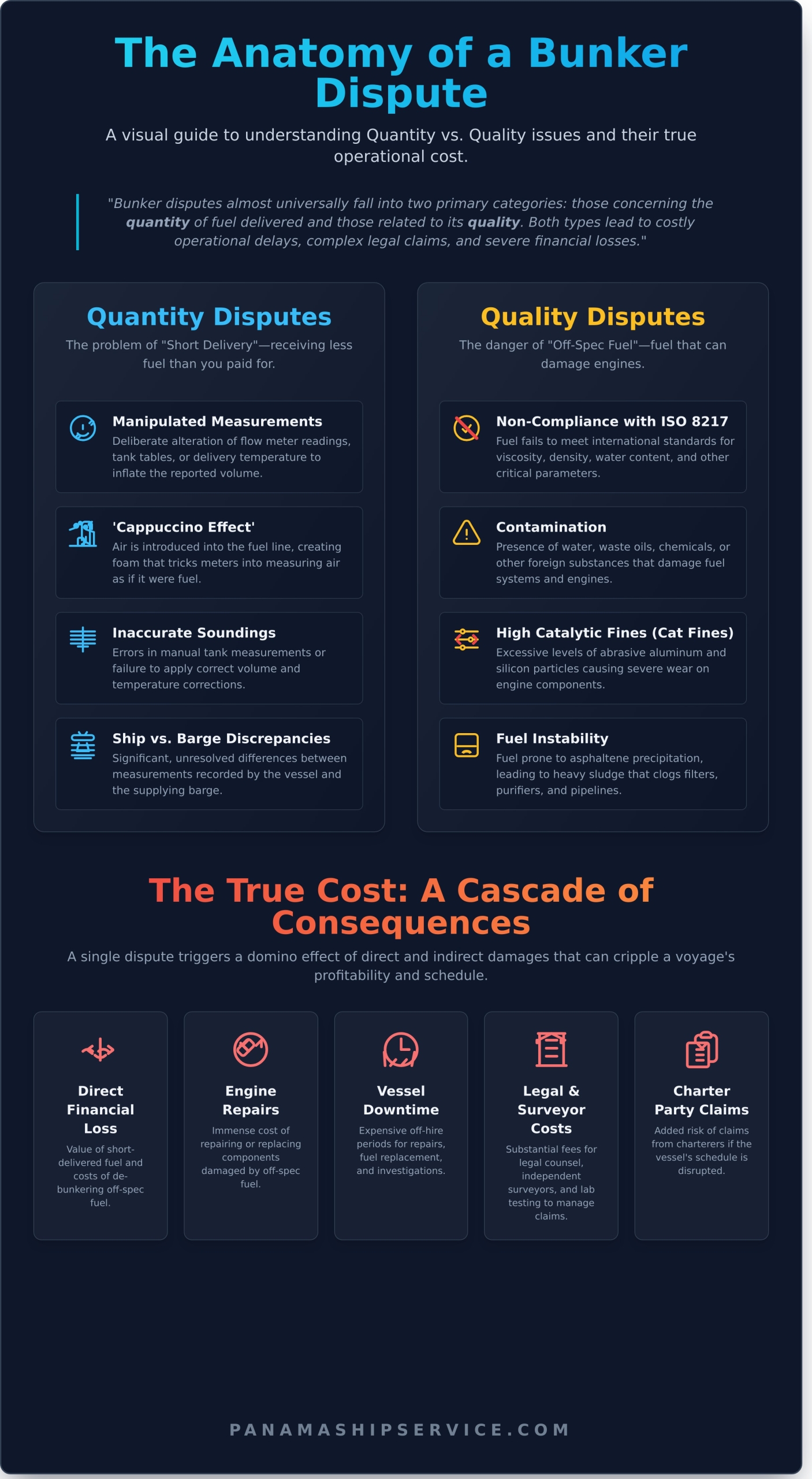
The Anatomy of a Bunker Dispute: Quality vs. Quantity
In the high-stakes world of maritime operations, bunker fuel represents a vessel’s largest operational expense. Consequently, any discrepancy in its delivery can trigger significant conflict. Bunker disputes almost universally fall into two primary categories: those concerning the quantity of fuel delivered and those related to its quality. Both types lead to costly operational delays, complex legal claims, and severe financial losses. Proactive prevention is always more cost-effective than reactive litigation. Understanding these core issues is the first step for ship owners and charterers learning how to prevent bunker fuel disputes through a systematic and vigilant approach to bunkering operations.
Common Causes of Quantity Disputes
A quantity dispute, or “short delivery,” occurs when the amount of fuel paid for is not what was actually received. These discrepancies are often difficult to prove after the fact and can stem from several sources:
- Manipulated Measurements: Deliberate alteration of flow meter readings, tank tables, or delivery temperature to inflate the reported volume.
- The ‘Cappuccino Effect’: Air is introduced into the fuel delivery line, creating foam or froth that tricks meters into measuring air as if it were fuel.
- Inaccurate Soundings: Errors in manual tank measurements or failure to apply correct volume and temperature corrections, leading to a miscalculation of the delivered quantity.
- Ship vs. Barge Discrepancies: A significant and unresolved difference between the measurements recorded by the receiving vessel and the supplying barge.
Key Drivers of Quality Disputes
Quality disputes arise when the delivered marine fuel fails to meet the required specifications for the vessel’s engines. Off-spec bunker fuel, which is a specific type of heavy fuel oil, can cause catastrophic engine damage. Key drivers include:
- Non-Compliance with ISO 8217: The fuel does not meet the internationally recognized standards for marine fuels regarding viscosity, density, water content, and other critical parameters.
- Contamination: The presence of water, waste lubrication oils, chemicals, or other foreign substances that can damage fuel systems and engines.
- High Catalytic Fines (Cat Fines): Excessive levels of abrasive aluminum and silicon particles that cause severe wear on cylinder liners, piston rings, and fuel injectors.
- Fuel Instability: The fuel is prone to asphaltene precipitation, leading to heavy sludge formation that clogs filters, purifiers, and pipelines.
The True Cost: Financial and Operational Impacts
The consequences of a bunker dispute extend far beyond the initial value of the fuel. The total cost is a combination of direct and indirect damages that can cripple an operation. Ship owners and operators face a cascade of potential liabilities, including the direct financial loss from short-delivered fuel, the immense cost of engine repairs or replacement due to off-spec bunkers, and expensive vessel downtime. Furthermore, these events trigger substantial legal fees, surveyor costs, and time-consuming claims management, with the added risk of charter party claims if the vessel’s schedule is disrupted.
Pre-Bunkering Checklist: Laying the Foundation for a Dispute-Free Operation
In the high-stakes world of maritime operations, most bunker fuel disputes are won or lost before a single drop of fuel is pumped. Proactive planning and meticulous preparation are not just best practices; they are your primary defense against costly claims related to quantity, quality, and delays. The most critical step in learning how to prevent bunker fuel disputes is establishing a rigorous pre-bunkering protocol. This phase is the single most important risk mitigation tool available to ship owners and charterers.
Vet Your Supplier and Review Contract Terms
Your first line of defense is thorough due diligence. Never assume all suppliers operate to the same standard. Investigate a potential supplier’s reputation, track record, and any history of disputes. Simultaneously, scrutinize all contractual documents. Ensure your charter party clauses and bunker nomination terms clearly define fuel specifications, sampling methods, and testing procedures. Major P&I clubs publish extensive guidance on Preventing Bunker Quality Disputes, which underscores the importance of having these details contractually agreed upon before delivery. Pay close attention to the supplier’s terms and the Bunker Delivery Note (BDN) to identify any clauses that may limit your rights.
Develop a Comprehensive Bunkering Plan
A successful bunkering operation is a well-coordinated one. Before the bunker barge arrives, your Chief Engineer must develop and communicate a detailed plan. This plan is fundamental to an efficient and secure transfer, providing a clear roadmap for the entire engineering team. Key elements include:
- Tank Designation: Clearly identify and prepare the specific tanks designated to receive the new fuel.
- Pre-Calculation: Accurately calculate the expected ullage or sounding for the ordered quantity after delivery, accounting for trim, list, and temperature.
- Pumping Protocol: Establish the agreed-upon pumping sequence and maximum pumping rate to prevent tank overflow or structural stress.
- Team Briefing: Ensure the entire engineering team understands their roles, the communication protocols, and the emergency stop procedures.
Appoint an Independent Bunker Surveyor
An independent bunker surveyor is your expert witness on site. Their role is to act as an impartial third party, verifying all critical measurements before, during, and after the operation. A qualified surveyor confirms the quantities on both the delivery barge and the receiving vessel, meticulously documents the entire process, and ensures sampling procedures are followed correctly. Their mere presence is often a powerful deterrent against malpractice. For complete peace of mind and an accurate, indisputable record of the operation, you need an expert on your side. Trust our experts for bunker surveys in Panama.
During Bunkering: Best Practices for On-Site Verification
The bunkering operation itself is the most critical phase for preventing disputes. This is not a passive process; it is an active, evidence-gathering exercise where vigilance directly protects your assets. The Chief Engineer, or their designated representative, must maintain direct supervision from start to finish. Meticulous observation, precise measurement, and clear documentation during these hours are the foundation of how to prevent bunker fuel disputes and provide indisputable evidence should a discrepancy arise.
Conduct a Thorough Pre-Transfer Meeting
Before any fuel is transferred, a comprehensive meeting with the bunker barge master and any attending surveyors is non-negotiable. This meeting establishes the rules of the operation and ensures all parties are aligned. Use this time to formally agree on all critical procedures and document the outcome.
- Measurement Method: Agree on whether measurements will be taken by sounding or barge gauges and confirm the method for temperature correction.
- Communication Protocol: Establish clear communication channels and confirm emergency stop signals between the vessel and the barge.
- Sampling Procedure: Review and agree on the exact sampling method, location (vessel’s manifold), and witnessing process.
Master the Art of Bunker Sampling
The bunker sample is your primary evidence in any quality dispute. A non-representative sample is useless. Therefore, you must insist on a proper procedure. The only acceptable method is using a continuous drip sampler installed at the vessel’s receiving manifold. This ensures the sample represents the entire delivery, not just a portion.
- Continuous Collection: Ensure the sampler is running throughout the entire pumping operation.
- Witness Sealing: Personally witness the sealing of all sample bottles (typically 4-5). Check that each seal is tamper-proof and properly affixed.
- Joint Labeling: All samples must be jointly labeled with the ship’s name, barge name, delivery date, location, and unique seal numbers.
Monitor Every Stage of the Transfer
Constant monitoring is essential for identifying discrepancies in real-time. This involves more than just watching the fuel flow; it requires systematic checks and measurements. Diligent oversight of the fuel quantity is a core component of effective risk management, a principle detailed by The International Institute of Marine Surveying (IIMS) in their guide on Best Practices for Avoiding Quantity Disputes. Your crew’s active involvement is a powerful deterrent against malpractice and a key part of how to prevent bunker fuel disputes related to quantity shortages.
- Initial Measurements: Take opening gauges or soundings of all receiving vessel tanks and all delivery barge tanks.
- Constant Observation: Monitor pumping rates, operating pressures, and fuel temperature throughout the transfer.
- Final Measurements: Immediately upon completion of pumping, conduct final measurements on all vessel and barge tanks before any lines are disconnected.
Post-Bunkering Protocol: Securing Your Evidence and Finalizing Documentation
Once the final hose is disconnected, the most critical phase for protecting your interests begins. The actions taken in the next hour will determine your ability to contest any discrepancies in fuel quantity or quality. This post-bunkering protocol is not a formality; it is an essential risk management strategy that solidifies your legal and commercial position. Meticulous, immediate documentation is fundamental to how to prevent bunker fuel disputes and secure your investment.
Reconcile Figures Before the Barge Departs
Do not allow the bunker barge to depart until all figures have been meticulously cross-referenced. Your independent surveyor’s calculations are your primary source of truth. Compare these figures directly against the quantity stated on the Bunker Delivery Note (BDN) presented by the supplier. If a significant discrepancy exists, do not sign the BDN unconditionally. If pressured, sign with the explicit notation “For Receipt Only” or “Signed Under Protest,” and immediately note the discrepancy on the document itself.
Issue a Note of Protest (NOP)
If you identify a quantity shortage or have concerns about the bunkering procedure, you must issue a formal Note of Protest (NOP) immediately, on the spot. This document formally records your objection. The NOP should clearly state your vessel’s calculated figures versus the barge’s figures and the resulting shortfall. Insist that the barge master and chief engineer sign the NOP to acknowledge its receipt. Their signature does not admit fault, but it confirms they were notified of the dispute, a critical first step in preserving your legal rights.
Compile and Preserve All Evidence
Your ability to successfully pursue a claim hinges on the quality and integrity of your evidence. A systematic approach to evidence collection is a cornerstone of how to prevent bunker fuel disputes from resulting in financial loss. Immediately secure and log all relevant items:
- Sealed Bunker Samples: Ensure all samples, including the official MARPOL sample, are correctly sealed, labeled, and stored in a designated secure location.
- Critical Paperwork: Gather copies of the signed BDN, the NOP, ullage reports, and all related logbook entries.
- Surveyor’s Report: Your independent surveyor’s detailed report is your most powerful piece of evidence, providing an objective, third-party account of the operation.
Finally, dispatch one of the representative samples to an accredited laboratory for independent analysis without delay. For expert coordination of bunker surveys and documentation management at the Panama Canal, trust the experts at Panama Ship Service to protect your assets.
The Role of Technology and Independent Verification in Dispute Prevention
In today’s maritime industry, relying on traditional, manual-sounding methods for bunkering is a direct invitation for costly conflicts. The key to mitigating this risk lies in a dual approach: leveraging modern technology for accuracy and engaging independent experts for verification. This combination moves operations away from error-prone calculations and subjective assessments toward objective, data-driven proof. Adopting this strategy is fundamental for any operator serious about how to prevent bunker fuel disputes and protect their bottom line.
Mass Flow Meters (MFMs)
Mass Flow Meters (MFMs) are a powerful tool for enhancing transparency. Unlike traditional tank soundings, which measure volume, an MFM measures the actual mass of the fuel being delivered. This is critical because it bypasses the need for volume-to-mass conversions, a common source of disputes due to variables like:
- Temperature Correction: Fuel density changes with temperature, affecting volume calculations.
- Aeration (The “Cappuccino Effect”): Air introduced into the fuel can inflate its volume, leading to a short delivery by mass.
Leading ports like Singapore now mandate the use of certified MFMs, a testament to their effectiveness. However, this technology is not a “set it and forget it” solution. An MFM system’s seals, calibration, and operational parameters must still be verified by a qualified surveyor to ensure the readings are legitimate and the system has not been compromised.
Why an Independent Survey is Your Best Defense
While technology provides crucial data, an independent bunker surveyor provides the ultimate safeguard for your investment. A surveyor is your expert, impartial representative on the ground, ensuring every stage of the bunkering process adheres to industry best practices and contractual terms. Their oversight is comprehensive, covering not just quantity verification (whether via MFM or tank sounding) but also critical quality control measures like correct fuel sampling procedures, which are vital for preventing off-spec fuel claims.
In the event of a disagreement, the surveyor’s detailed report, complete with timed logs, photographic evidence, and signed documentation, becomes your most powerful asset. It transforms a “your word against theirs” situation into a case built on objective, third-party facts. The cost of a professional survey is a negligible fraction of a potential bunker claim, making it one of the highest-return investments an operator can make.
Protect your vessel. Schedule an expert bunker survey at the Panama Canal.
Your Partner in Preventing Costly Bunker Fuel Disputes
Bunker fuel disputes are a significant operational risk, but they are not inevitable. The key to avoiding them lies in a systematic approach spanning the entire bunkering process. By implementing a rigorous pre-bunkering checklist, adhering to best practices for on-site verification, and maintaining meticulous post-bunkering documentation, you build a powerful defense against both quality and quantity discrepancies. Ultimately, knowing how to prevent bunker fuel disputes is about control, diligence, and proactive verification at every stage.
While your crew’s diligence is vital, the most robust defense includes an independent expert. As your trusted partner at the Panama Canal for over 20 years, Panama Ship Service provides the impartial oversight you need. Our expert, independent marine surveyors deliver comprehensive solutions designed to minimize vessel expenses and prevent avoidable delays, safeguarding your investment and your schedule. Ensure a smooth transit. Contact Panama Ship Service for expert bunker surveys and vessel support. Sail with the confidence that your operations are secure.
Frequently Asked Questions
What is the ‘cappuccino effect’ in bunkering and how can I prevent it?
The ‘cappuccino effect’ refers to the aeration of bunker fuel during delivery, where air is pumped into the fuel, causing it to froth. This artificially inflates the volume, leading to a significant short-delivery of actual fuel mass. To prevent this, insist on a slow initial pumping rate and have your crew listen for unusual gurgling sounds from the hose. An independent surveyor can expertly monitor line pressure and flow to detect and stop this practice immediately.
How many bunker samples should be taken during a delivery and who gets them?
A minimum of five representative samples should be taken using a continuous drip sampler. The distribution is typically: one for the receiving vessel, one for the bunker barge, one for the fuel supplier, one MARPOL-retained sample, and one for independent laboratory analysis should a dispute arise. It is critical that representatives from both the vessel and the barge witness the sealing of all sample bottles to ensure their integrity and legal validity.
What is a Bunker Delivery Note (BDN) and what should I check before signing it?
A Bunker Delivery Note (BDN) is the official legal document confirming the details of the fuel delivery. Before signing, the Chief Engineer must meticulously verify that all figures-especially the delivered quantity in metric tons-match the vessel’s own calculations. Cross-reference the stated density, viscosity, and sulphur content with the specifications in your supply agreement. Any discrepancy must be noted on the BDN before it is signed, as signing without protest implies acceptance.
When and how should I issue a Letter of Protest for a bunker dispute?
A Letter of Protest (LOP) must be issued immediately at the first sign of a discrepancy, whether it relates to quantity, quality, sampling procedure, or delivery time. It should be issued formally in writing before the bunker barge departs. The LOP must clearly state the nature of the dispute, be signed by the Master, and delivered to the barge master. Always ensure you retain a copy that has been acknowledged by the supplier’s representative.
Is hiring an independent bunker surveyor really worth the cost?
Yes, unequivocally. The cost of a qualified bunker surveyor is a minor investment compared to the significant financial losses from a short delivery or an off-spec fuel claim. A surveyor acts as your expert on-site, ensuring correct measurement procedures, proper sampling, and accurate documentation. Their impartial report provides invaluable, legally-binding evidence, making it one of the most effective strategies for how to prevent bunker fuel disputes before they escalate.
What are the key parameters to check for in a bunker fuel quality analysis report?
When reviewing a lab analysis report, focus on critical parameters that impact engine performance and compliance. These include Viscosity, Density, Water Content, Flash Point, and Sulphur content (for MARPOL compliance). Critically, you must also check for the concentration of catalytic fines (Aluminum + Silicon), as high levels can cause catastrophic abrasive damage to engine components. Always compare these results against the ISO 8217 standard and the supplier’s guaranteed specifications.
What is the difference between a volumetric and a mass-based bunker measurement?
Volumetric measurement (liters or cubic meters) measures the space fuel occupies, which expands or contracts with temperature changes. Mass (metric tons) is the actual weight of the fuel and is the standard for all commercial transactions. Bunker fuel is purchased by mass. To determine this, the delivered volume is corrected for temperature and multiplied by the fuel’s density. Discrepancies in density or temperature readings are a common source of quantity disputes.