
For ship repairs, class approval depends on the vessel’s classification society, the damage, and the work proposed. To understand how to verify class approval for repairs, distinguish the repair supplier’s qualifications from the society’s decision on the specific repair. Check that the supplier’s approved service category matches the work, then confirm the society’s review and documentation requirements for the vessel.
A missing approval, unclear scope, or incomplete traceability is a reason to pause and resolve the gap before work proceeds. This guide explains how to check supplier approval, ask focused questions before authorizing repairs, trace materials through the job file, and confirm that the repair documentation relates to the vessel and damage involved. It also covers what to do when a register or document review leaves questions unanswered.
Key Takeaways
- Match a supplier’s approval to the specific service category and work that will inform classification decisions.
- Before authorizing repairs, clarify which functions will be subcontracted, where they’ll take place, and who will verify the results.
- Use the repair file to trace materials and batches alongside the damage report, repair scheme, process records, inspections, and release.
- Check that approved engineering data applies to the specific damage and aircraft; a DER’s approval of data doesn’t approve the repair’s implementation or return to service.
Approval of service suppliers whose work informs certification decisions
Start by identifying the vessel’s classification society and the repair work’s approval requirements. Approval requirements can depend on whether a service supplier’s work informs certification decisions.
-
Review Certification Status and Scope
Check the society’s supplier register for the contractor’s exact legal name, current status, expiry date, and approved service category. Match that category to the repair: Lloyd’s Register lists surveys of repairs to fibre reinforced composite craft and wooden vessels as approval categories. Its approval mark applies only to service categories with valid certification. Don’t treat training, a general business licence, or a certificate for another specialty as class approval.
Requirements vary with the classification society, flag-state rules, and repair location. Before authorizing the job, confirm which society’s rules and statutory requirements apply to the vessel and work.
-
Verify Surveyor Identity and Authorization
Confirm the surveyor’s identity and assignment directly with the vessel’s classification society, using its official contact channel. Match the surveyor’s name to the vessel, repair scope, and scheduled inspection. Don’t rely on an emailed certificate or company badge alone. Ask the society to confirm the surveyor is authorized for the assignment.
To check whether the repair yard or contractor is approved, search the society’s supplier records by exact business name and service category. If the listing doesn’t match the work, get clarification from the society before proceeding.
- Request evidence that the repair received class approval, such as the survey report, applicable class record, and closure of any repair-related conditions. Match the vessel identity, repair description, and approval scope across the records. A supplier certificate alone doesn’t show that the society accepted a particular repair.
- Separate certification from licensing and training. In the United States, there’s no federal law requiring mechanics to be certified, while state requirements vary. ASE certification is voluntary and applies to individual technicians, not repair shops. Check that the technician’s specialty matches the repair. Compare certificates with the issuer’s records, including status, dates, and scope, to identify expired or misleading credentials.
Questions to ask before authorizing repairs
Before work begins, get clear answers about scope, class involvement, inspection points, and records. Written answers help protect the vessel and make the approval path easier to trace.
- Ask the repair shop to describe the damage, proposed work, and applicable class requirements. Which drawing, specification, or approved engineering data will guide the repair? What findings would require a revised repair scheme? Request the official references and make sure they identify the correct vessel, component, and affected area.
- Clarify when the classification society must be notified and which inspections require surveyor attendance. Ask who coordinates inspection requests and records the surveyor’s findings. Confirm how testing will be documented, including the method, acceptance criteria, and who reviews the results before the repair is closed.
- Ask which repair functions will be subcontracted, where each function will be performed, and who verifies the results. For structural components, identify the responsible organization at every handoff. If contracted work informs certification decisions, establish how its records and inspection results reach the party making those decisions.
- Confirm what documentation the shop will provide at completion: damage findings, repair details, material identification, process records, inspection results, and release documents. Ask how changes from the agreed scope will be recorded and routed for review. The Club’s Rules 20A, 20F and 38-2(vii) make compliance with Classification Society rules and statutory requirements conditions of P&I cover.
- Before authorizing the job, ask who can approve a scope change and whether work must pause while revised data or class review is obtained. Keep the agreed scope, inspection plan, and answers together in the job file. For vessel repair planning, Mechanical Ship Repairs can be a practical next step when the work requires a coordinated repair scope.
Repair documentation and materials traceability
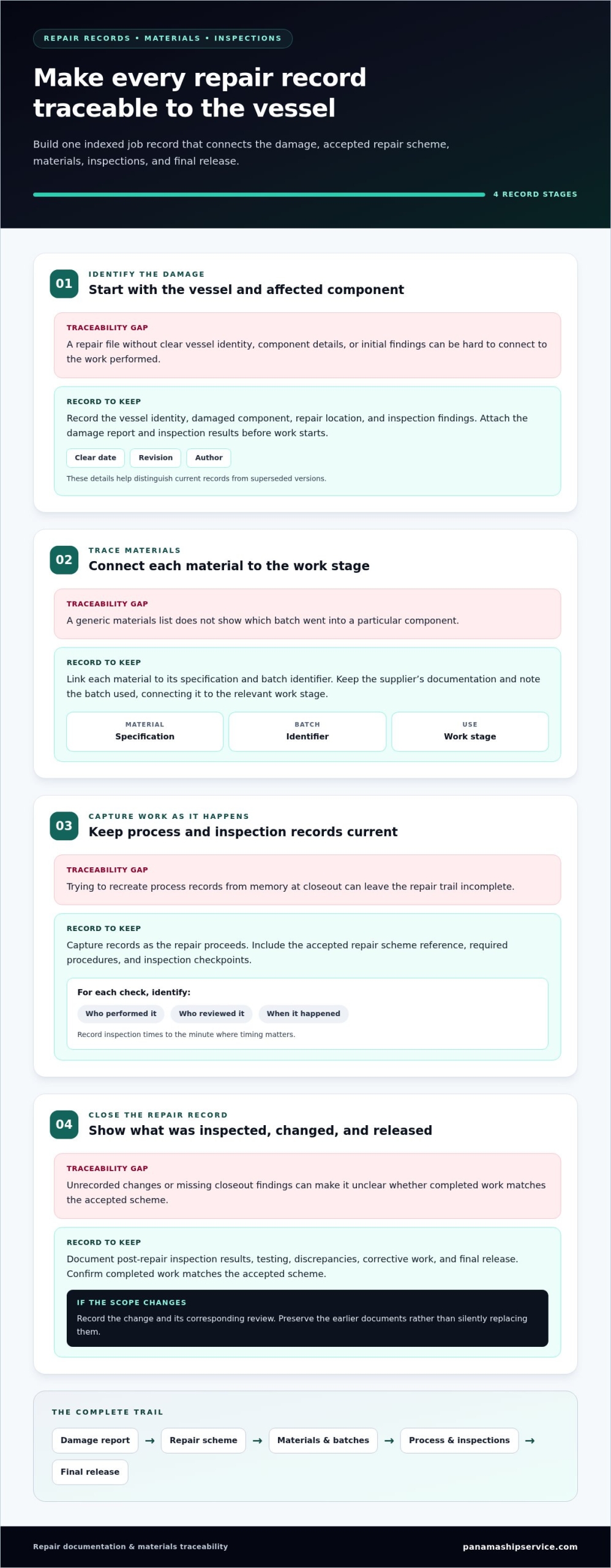
Build one indexed job record for the damage, approved repair scheme, materials, inspections, and release. Use it to connect each work stage to the vessel and the class decision it supports.
- Record the vessel identity, damaged component, inspection findings, and repair location. Attach the damage report and inspection results before work starts. Give each document a clear date, revision, and author so reviewers can distinguish current records from superseded versions.
- Link each material to its specification and batch identifier. Record the supplier’s documentation and the batch used in the repair, then connect those details to the relevant work stage. A generic materials list cannot show which batch went into a particular component.
- Capture process records as the repair proceeds, not from memory at closeout. Include the approved repair scheme reference, required procedures, and inspection checkpoints. Record inspection times to the minute where timing matters, and identify who performed and reviewed each check.
- Document post-repair inspection results, any testing, discrepancies, corrective work, and final release. Keep the findings with the repair record. Confirm that the completed work matches the accepted scheme. Record changes and the corresponding review rather than silently replacing earlier documents.
- For thickness measurements on ships and Mobile Offshore Units, Lloyd’s Register directs readers to MQPS, Book N, 17-1. For coating system testing, it directs readers to MQPS, Book P, 19-1. Lloyd’s Register lists testing under MSC.215(82), as amended, and IACS UI SC223 and/or MSC.288(87). Record the applicable reference and result.
- Check document status before relying on a certificate or approval record. Match its issuer, scope, vessel, and expiration date against the job file. Verify questionable records with the issuing organization. A polished document alone doesn’t establish that it’s legitimate or applies to the work.
Approved engineering data for damage beyond manual limits
For ship repairs, the vessel’s classification society sets the applicable review and survey process. Repairs requiring prior review depend on the society’s rules and the damage. For emergency work, notify the society and follow its instructions for inspection and records.
- Identify the damaged structure or machinery and the governing repair criteria. Compare the damage with the vessel’s approved drawings, applicable manuals, and class requirements. A manufacturer’s engine guidance, for example, doesn’t automatically establish approval for structural ship repairs.
- Keep aviation rules separate from ship classification. Repairs beyond an aircraft manual’s stated limits may require additional engineering review and approval. An appropriately rated FAA designee or FAA engineer may approve engineering data. This process is not class approval for a vessel.
- For a US aircraft repair, verify the engineering approval applies to that specific repair and aircraft. A DER may sign FAA Form 8110-3 to approve the data. That approval covers engineering data, not the repair’s implementation or return to service. The data may address material properties, loads, static strength, and damage tolerance.
- For a ship repair, send the society the damage description, proposed repair scheme, supporting calculations, and relevant material details. Ask what inspection stages and evidence it requires before work proceeds. In an emergency, preserve damage findings and work records, then provide them through the society’s required process.
- Check that the engineering basis matches the actual material, geometry, and loads. Compare the repair scheme with the manufacturer’s applicable information, but don’t substitute an unrelated engine or component procedure. Track document revisions and any stated expiration date, and use only data applicable to the repair.
For ship repair planning that requires technical assessment, arrange a marine survey to support review of the vessel’s condition and repair scope.
Panama Ship Service: Mechanical Ship Repairs
Panama Ship Service provides Mechanical Ship Repairs for vessel operators managing repairs at the Panama Canal. When damage needs assessment before the repair scope is set, Marine Surveys can help establish the vessel’s condition and document findings. Underwater Hull Services address underwater hull requirements, while MARPOL Disposal supports disposal needs. These services can help coordinate operational requirements alongside repair planning.
Class approval remains a decision of the vessel’s classification society. Provide the applicable survey findings, repair scope, and supporting records through the society’s required process, and keep its review distinct from the repair work itself. Contact Panama Ship Service to discuss your vessel’s repair requirements and next steps.
Keep the Next Repair Decision Moving
Knowing how to verify class approval for repairs gives your team a stronger basis for planning maintenance. Start the process early, while the repair scope and vessel schedule can still be coordinated. Clear responsibilities and organized records connect technical review to the work, rather than leaving approval until the end.
When work is needed, Panama Ship Service provides Mechanical Ship Repairs, Underwater Hull Services, and MARPOL Disposal. Choose the service that matches the vessel’s operational requirement, and keep classification society decisions within the society’s review process. This keeps repair planning focused on the vessel’s needs and the applicable approval path.
Contact Panama Ship Service to discuss your vessel’s requirements and plan the next step with confidence.
Frequently Asked Questions
Troubleshooting: What If Verification Fails?
Pause authorization or further work until the mismatch is resolved. A practical first step in how to verify class approval for repairs is to compare the supplier record with the vessel, service category, and proposed work. Save the documents, then contact the classification society through its official channel. Ask what evidence or correction is needed, and keep the response with the job file. Don’t treat an unanswered lookup as proof of approval.
What questions should you ask a shop to confirm its credentials in person?
Ask the shop to show its approval record and identify the issuing society, service scope, and current status. Have it explain which technicians or subcontractors will perform each task and who oversees their work. Ask how inspection findings are recorded and who receives them. For example, if coating work is subcontracted, establish who documents testing and sends those results for review.
What red flags should you watch for when confirming repair shop qualifications?
Watch for certificates that name a different legal entity, omit the relevant service category, or cannot be matched to the issuing society’s records. A class logo alone doesn’t establish approval for the proposed work. Treat pressure to proceed without written scope, inspection arrangements, or traceable records as a process warning. Compare certificate details with the society’s official register before relying on them.
Where can I check a vessel’s class status and survey records?
Start with the vessel’s classification society. Search its official vessel register using the vessel name or identification details, then compare the displayed class status and notation with current vessel records. If survey reports or detailed conditions aren’t publicly displayed, request them through the owner or authorized operator. Match each record to the vessel and survey date to avoid relying on unrelated documentation.
What documents prove class approval for completed repairs?
Look for a class survey report or record identifying the vessel, describing the repair, and recording the society’s decision. To verify class approval for repairs, match that record to the completed work, including applicable drawings, inspection findings, test results, and closure of related conditions. A contractor’s completion certificate documents its work but doesn’t replace the classification society’s decision.
What should I do if repair work was completed without class approval?
Notify the vessel’s classification society and disclose the completed work before describing the repair as class-approved. Submit the repair scope, damage findings, material records, process documentation, and available inspection or test results. Preserve original records and identify changes made during the job. Follow the society’s review instructions, document its decision, and link any required corrective work to the original repair file.