
Could a cleaner hull support your vessel’s CII performance without guaranteeing a better rating? Hull cleaning for improved CII rating starts with a practical link: fouling can increase resistance, which may raise fuel use and associated emissions. But cleaning alone cannot determine an annual CII outcome.
If you’re concerned that hull condition is adding drag, first assess whether the fouling is significant enough to justify cleaning and when the work could fit your schedule. The answer depends on the vessel’s condition, operating profile, coating condition, and requirements for the location where the work takes place.
This guide explains how hull condition relates to fuel consumption, emissions, and CII. It compares cleaning options and explains how underwater inspection can help inform the choice, alongside practical planning considerations such as vessel schedules and environmental controls. For vessels operating in the Panama Canal area, Panama Ship Service provides underwater hull cleaning and hull inspections. Confirm the work scope and applicable requirements before planning. Use the guidance to assess whether cleaning is appropriate, rather than treating it as an automatic CII fix.
Key Takeaways
- Learn how hull fouling can increase resistance and fuel demand, and why its effect on CII depends on vessel performance.
- See why hull cleaning for improved CII rating is a condition-led maintenance decision, not a guaranteed grade improvement.
- Use inspection findings, fouling severity, coating condition, and vessel access to assess which cleaning approach may be suitable.
- Plan work around the vessel’s schedule and applicable environmental requirements, then compare performance under similar operating conditions.
- Review how underwater hull cleaning, inspections, and propeller polishing available in the Panama Canal area can fit into a broader maintenance plan.
How Hull Condition Connects to Fuel Use and a Vessel’s CII Rating
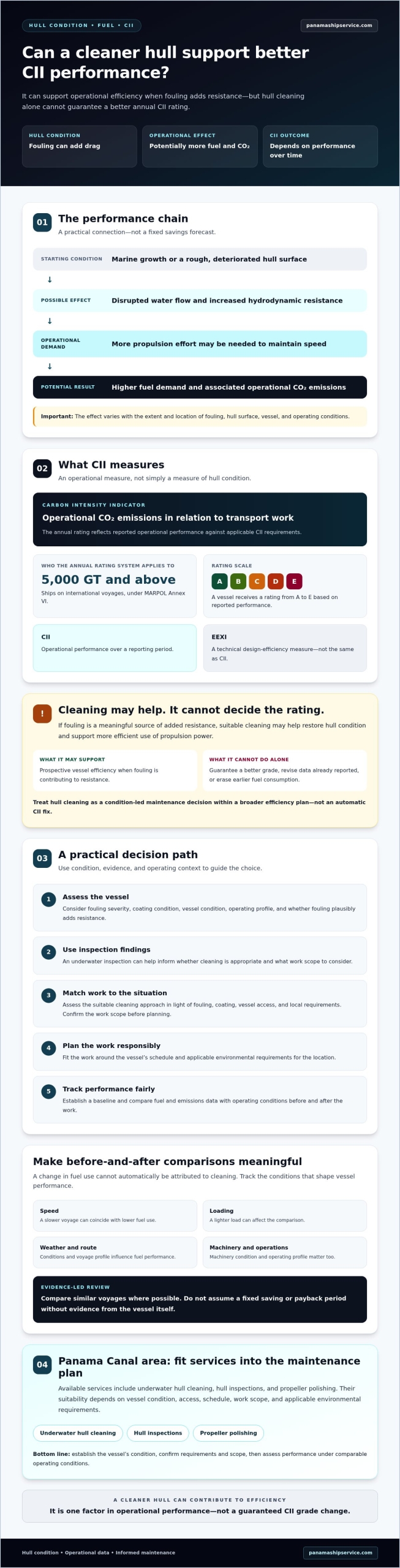
A fouled hull can affect more than maintenance records. Marine growth or a deteriorated, rough hull surface can increase hydrodynamic resistance, requiring more propulsion power to maintain speed. That can mean higher fuel consumption and, when fuel use rises, greater operational CO₂ emissions. The size of the effect varies by vessel and operating conditions, so hull condition is one factor to assess, not a complete explanation for fuel performance.
What does a CII rating measure?
The Carbon Intensity Indicator (CII) measures a vessel’s operational carbon intensity: the CO₂ emitted in relation to its transport work. Under MARPOL Annex VI, the annual rating system applies to ships of 5,000 gross tonnage and above on international voyages. A ship receives a rating from A to E based on its reported operational performance against applicable CII requirements. Check current IMO guidance for the rules and rating thresholds that apply to a particular vessel.
CII is not the same as a vessel’s technical design-efficiency measure. For example, the Energy Efficiency Existing Ship Index (EEXI) assesses technical efficiency, while CII is based on operational performance over a reporting period. Cleaning can change the hull’s condition, but the vessel’s annual rating reflects its wider activity and emissions over time.
How can hull fouling affect operational efficiency?
Biofouling is the accumulation of aquatic organisms on a vessel’s submerged surfaces. As growth builds up, it can disrupt water flow and increase drag. The biofouling process and its effect on hull drag help explain why hull condition matters. Greater resistance may require more propulsion effort and increase fuel demand. The actual outcome depends on the extent and location of fouling, the hull surface, and how the vessel is operated.
Hull condition is only one part of the performance picture. Speed, loading, weather, route, and machinery condition can also affect fuel consumption and emissions. A change after cleaning should not automatically be attributed to the work unless operating conditions are considered, too.
Hull cleaning is a contributing maintenance measure, not a guaranteed CII rating improvement. For operators considering hull cleaning for improved CII rating, start by establishing the vessel’s condition and reviewing operational data. This helps determine whether fouling is a credible source of added resistance and whether cleaning should be considered as part of a wider efficiency plan.
How Hull Cleaning Can Support CII Performance Without Guaranteeing a Better Grade
Cleaning can support vessel efficiency when biofouling is a meaningful source of added resistance. Removing marine growth may help restore the hull’s condition, allowing the vessel to make better use of its propulsion power. The International Maritime Organization discusses the relationship between speed, power performance and fuel consumption, but this general mechanism is not a vessel-specific savings forecast. Results depend on the hull’s condition before cleaning and how the ship operates afterward.
From reduced fouling to fuel and emissions data
To assess whether cleaning made a difference, establish a baseline before the work and compare it with performance afterward. Review fuel and emissions data alongside speed, route, loading, weather, and operating profile. If these conditions differ substantially, a simple before-and-after comparison may not show whether hull condition was responsible for the change.
For example, lower fuel use after cleaning may coincide with a slower voyage or lighter load. Conversely, a vessel operating faster or in more demanding conditions may consume more fuel despite a cleaner hull. Track relevant operating conditions with the performance data and, where possible, compare similar voyages. Do not assume a fixed saving or payback period without evidence from the vessel itself.
What hull cleaning cannot change on its own
CII reflects a vessel’s operational emissions in relation to its transport work over the reporting period. Cleaning cannot revise data already reported, erase earlier fuel consumption, or independently determine the vessel’s annual rating. Its contribution is prospective: if fouling was increasing resistance, suitable cleaning may support better operational performance on subsequent voyages.
Other factors continue to shape the outcome. Speed and utilization affect how the ship is operated; cargo and loading influence transport work and voyage conditions; weather and route can alter resistance and operating demands. Machinery condition and other maintenance decisions also matter. Hull work should therefore be part of a broader efficiency-management plan, not a replacement for it.
Hull cleaning may support CII performance by addressing fouling-related resistance, but the vessel’s operations and reported performance determine whether that contribution affects its rating. A condition-led decision is more useful than treating hull cleaning for improved CII rating as an automatic result: inspect the hull, assess whether cleaning is suitable, then monitor performance under comparable conditions. For vessels operating in the Panama Canal area, review underwater hull cleaning and inspection services as part of that assessment.
Hull Cleaning Options: Match the Method to Fouling, Coating, and Vessel Condition
Choose a cleaning approach based on inspection findings, not simply on a target CII rating. Fouling type and severity, coating system and condition, vessel access, and the ship’s operating schedule all affect whether in-water cleaning is suitable or another maintenance window should be considered. A method that is too aggressive for a coating can cause damage, while the handling of removed material can raise environmental concerns.
When in-water hull cleaning may be appropriate
An underwater inspection can help establish where fouling is present and assess visible hull condition before a method is selected. It may also identify areas that need closer evaluation. If the findings suggest cleaning is appropriate, confirm that the proposed method and equipment are compatible with the vessel’s coating and condition before work begins.
Schedule and access matter, too. In-water work may be worth assessing when the vessel’s location and operating plan allow it, but feasibility and requirements vary by vessel and port. If hull condition, coating suitability, access, or environmental controls are uncertain, clarify those points before committing to the work.
How to compare cleaning approaches responsibly
Use the comparison below as a planning framework, not a recommendation. Confirm available methods, operational implications, and applicable requirements for the vessel and location before selecting an option.
| Approach to assess | Potential suitability | Operational disruption | Coating and environmental considerations |
|---|---|---|---|
| In-water cleaning | May be considered when inspection confirms fouling and the hull is suitable for the proposed work. | Depends on access, vessel schedule, and local operating conditions. | Check coating compatibility, equipment suitability, debris management, and applicable environmental controls. |
| Cleaning during a planned dry-docking period | May be assessed when the vessel is already scheduled for this maintenance window or underwater work is not suitable. | Must be considered within the vessel’s planned out-of-service period. | Confirm the work scope, coating condition, and controls for the selected facility and method. |
| Defer cleaning and reassess | May be reasonable if inspection findings do not support cleaning or key suitability details remain unclear. | Avoids immediate intervention, but requires a plan to monitor condition. | Document the reason for deferral and determine when hull condition should be reviewed again. |
For a broader overview of vessel maintenance in the region, see this underwater hull services guide. A sound decision on hull cleaning for improved CII rating starts with verified condition and a method suited to the vessel, not an assumed fuel or rating outcome.
A Practical Decision Process for Scheduling Hull Cleaning and Tracking CII
A planned process helps operators decide whether hull cleaning is justified, coordinate the work with vessel operations, and evaluate what changes afterward. Treat cleaning as a maintenance decision supported by condition and performance evidence, not as a guaranteed way to change a CII result.
A step-by-step hull-cleaning decision checklist
Start with records and inspection findings, then confirm the work is suitable before committing. A marine surveys guide can provide broader context for inspection planning. Use this sequence:
- Review the evidence: Check fouling observations, hull inspection records, coating history, and relevant fuel, speed, and voyage data.
- Assess suitability: Consult technical personnel about hull condition, coating compatibility, and an appropriate cleaning approach.
- Confirm controls: Verify environmental controls and applicable local requirements for the vessel, location, and proposed work.
- Coordinate the plan: Align the work with the vessel’s operating schedule and confirm arrangements before making a commitment.
For a vessel operating in the Panama Canal area, include its transit and port schedule in the planning discussion. Confirm the proposed location, access, timing, and applicable requirements with the relevant parties. Do not assume a particular slot, duration, or authorization is available until arrangements have been verified.
How to assess results after cleaning
Record the cleaning date, inspection observations, vessel condition, and relevant operating variables. Afterward, compare fuel and emissions trends using consistent data, and document differences in speed, loading, route, weather, and utilization. If conditions are not comparable, note that limitation rather than treating the result as a direct measure of cleaning impact.
Interpret performance over time. Machinery condition, maintenance, and operating decisions may also influence fuel use and CII-related data, so avoid attributing every change to hull work. A clear record helps operators assess whether hull condition was a plausible contributor and informs future maintenance decisions.
For hull cleaning for improved CII rating, use an evidence-led sequence: review performance, inspect, confirm suitability and requirements, coordinate the work, then track outcomes. To discuss underwater hull cleaning and inspection in the Panama Canal area, contact Panama Ship Service about your vessel’s requirements.
Arrange Hull Cleaning in Panama as Part of a CII Improvement Plan
A sound CII improvement plan starts with evidence, not an assumed result. Confirm whether fouling is present, assess hull and coating condition, establish whether cleaning is suitable, and verify a method and environmental controls that fit the vessel and location. After the work, record the findings and track performance alongside operating conditions. Cleaning may support efficiency, but it cannot guarantee a particular CII outcome.
What to confirm before requesting underwater hull work
Provide clear vessel and scheduling information so the proposed scope can be assessed against actual conditions. Include:
- Vessel identity and current or planned location.
- Operational schedule and any relevant port or Canal transit plans.
- Observed fouling, available inspection findings, and known coating type or history.
- Any specific concerns about hull condition, access, or environmental controls.
Ask what inspection findings are needed, which cleaning methods may be suitable, and what environmental controls and local requirements apply. Confirm the provider’s current service scope, availability, and arrangements directly before committing. Requirements may vary by location and job, so verify them for the proposed work rather than assuming a method is approved or available.
Coordinate hull cleaning with wider vessel maintenance
Consider hull and propeller condition together when reviewing operational efficiency. Panama Ship Service provides underwater hull cleaning, hull inspections, and propeller polishing for vessels at the Panama Canal. Inspection findings can help clarify whether hull cleaning is appropriate and whether propeller condition should also be discussed. Where practical, coordinate underwater work with other planned vessel tasks, while confirming the work scope and schedule in advance.
For operators evaluating hull cleaning for improved CII rating, the practical objective is a well-supported maintenance decision and a clear record of subsequent performance, not a promised grade change. Share the vessel details, condition information, and timing requirements when discussing the work so the scope can be considered in context.
Discuss underwater hull cleaning in Panama with Panama Ship Service and confirm the requirements for your vessel and proposed work.
Make Hull Condition Part of Your CII Plan
Hull condition can influence resistance, fuel demand, and operational emissions, but cleaning is only one factor in annual CII performance. The practical approach is to confirm fouling through inspection, assess coating condition and suitability, then select work that fits the vessel’s schedule and applicable environmental requirements. Track performance afterward against comparable operating conditions to understand whether hull maintenance contributed to a change.
For operators considering hull cleaning for improved CII rating, treat it as a condition-led maintenance decision, not a guaranteed rating improvement. Panama Ship Service provides underwater hull cleaning and hull inspections for vessels in the Panama Canal area, along with propeller polishing. Confirm the current scope, scheduling, and requirements for your vessel before planning the work.
Discuss your vessel’s underwater hull cleaning requirements with Panama Ship Service. A clear assessment and practical plan can help you make an informed next move.
Frequently Asked Questions
Can hull cleaning improve a ship’s CII rating?
Hull cleaning may support a better CII outcome if fouling is increasing resistance and fuel use. However, CII reflects operational emissions and transport work over a reporting period, so one maintenance job cannot guarantee a higher rating. The effect depends on the hull’s condition, vessel operations, and other performance factors. Assess results using comparable operating data, and check current IMO requirements when evaluating your vessel’s CII performance.
How does hull fouling affect fuel consumption and CII?
Marine growth can increase a vessel’s resistance as it moves through water, potentially requiring more propulsion power and fuel. Higher fuel use may increase operational emissions and affect CII performance, but the effect varies by vessel and voyage. Speed, loading, weather, route, and machinery condition also influence consumption. Use inspection findings and vessel-specific operating data to determine whether fouling is a likely contributor to increased fuel demand.
How often should a vessel’s hull be cleaned to support CII?
There is no single cleaning interval that suits every vessel. Fouling rates, trading routes, operating profile, coating condition, inspection findings, and maintenance plans all affect timing. Use hull condition and performance trends to guide the decision rather than relying only on a generic schedule. Before planning work, check that the proposed method is suitable for the coating and vessel, and confirm applicable environmental requirements for the location.
Does hull cleaning guarantee a better CII grade?
No. Cleaning may address fouling-related resistance, but it cannot guarantee a better CII grade. The rating reflects operational emissions and transport work across the reporting period, including factors such as speed, utilization, and weather. Cleaning also cannot change data already reported. Treat it as one possible maintenance measure, then review subsequent performance using consistent operational data and account for changes in voyage and vessel conditions.
Is in-water hull cleaning suitable for every vessel?
No. Suitability depends on the fouling observed, hull coating and condition, access, the proposed method, and environmental controls. An underwater inspection can help establish the vessel’s condition before an intervention is selected. Confirm coating compatibility, the work scope, and applicable local requirements for the vessel and location. Do not assume the same cleaning method or schedule is appropriate for every ship.
What information should I provide when arranging hull cleaning in Panama?
Provide the vessel’s identity and location, expected schedule, observed fouling, available inspection or coating records, and relevant performance concerns. Ask the provider to confirm the proposed scope, inspection needs, method suitability, environmental controls, and current availability. Check applicable local requirements for the specific operation, too. Confirm all arrangements with the provider before relying on a planned service window.
How can I tell whether hull cleaning improved vessel performance?
Compare fuel and emissions trends before and after cleaning while accounting for speed, loading, weather, route, and other operating changes. Record inspection observations and the work performed so the comparison has context. A single voyage may not provide enough evidence to draw a reliable conclusion. Review consistent data over an appropriate period, and avoid attributing every change in fuel use or CII-related performance to cleaning alone.