
A layer of marine slime just 0.5 mm thick can trigger a 25% increase in fuel consumption and carbon emissions for a transoceanic vessel. In the high-stakes environment of the Panama Canal, where schedules are tight and environmental regulations like the IMO 2023 biofouling guidelines are strictly enforced, ignoring what lies beneath the waterline is a risk you can’t afford. You already know that maintaining vessel speed while minimizing drag is the only way to keep your operational costs under control. We’re experts in maritime efficiency so you don’t have to be.
This guide helps you master the technical requirements and strategic benefits of a professional hull coating inspection underwater. You’ll learn how to secure class-approved documentation and avoid the heavy penalties associated with invasive species during your transit. We’ll preview the specific inspection protocols used in Panamanian ports and demonstrate the clear ROI that proactive cleaning provides for your fleet’s bottom line. Put your transit in our hands and ensure your vessel remains compliant and cost-effective.
Key Takeaways
- Understand how maintaining anti-fouling and anti-corrosive layers minimizes drag and significantly reduces fuel consumption during your Panama Canal transit.
- Evaluate the technical advantages of diver-led visual surveys versus ROV technology to choose the most efficient inspection method for your specific vessel.
- Learn to identify various stages of coating failure, from initial slime and algae to severe physical damage caused by tug operations or grounding.
- Schedule a professional hull coating inspection underwater at strategic anchorages like Balboa or Cristobal to ensure compliance without disrupting your transit timeline.
- Leverage 20 years of local expertise and Class-approved standards to navigate the unique operational challenges of the Panama Canal environment efficiently.
The Critical Role of Hull Coating Inspections in Maritime Operations
A hull coating inspection underwater is a specialized technical survey designed to verify the integrity of a ship’s anti-fouling and anti-corrosive systems. Using highly trained divers or advanced Remote Operated Vehicles (ROVs), these inspections provide a clear picture of the vessel’s submerged condition without the need for expensive drydocking. For vessels preparing for Panama Canal transits, this data is vital. Timing is everything in the shipping industry. Efficiency is the priority. We are experts so you don’t have to be.
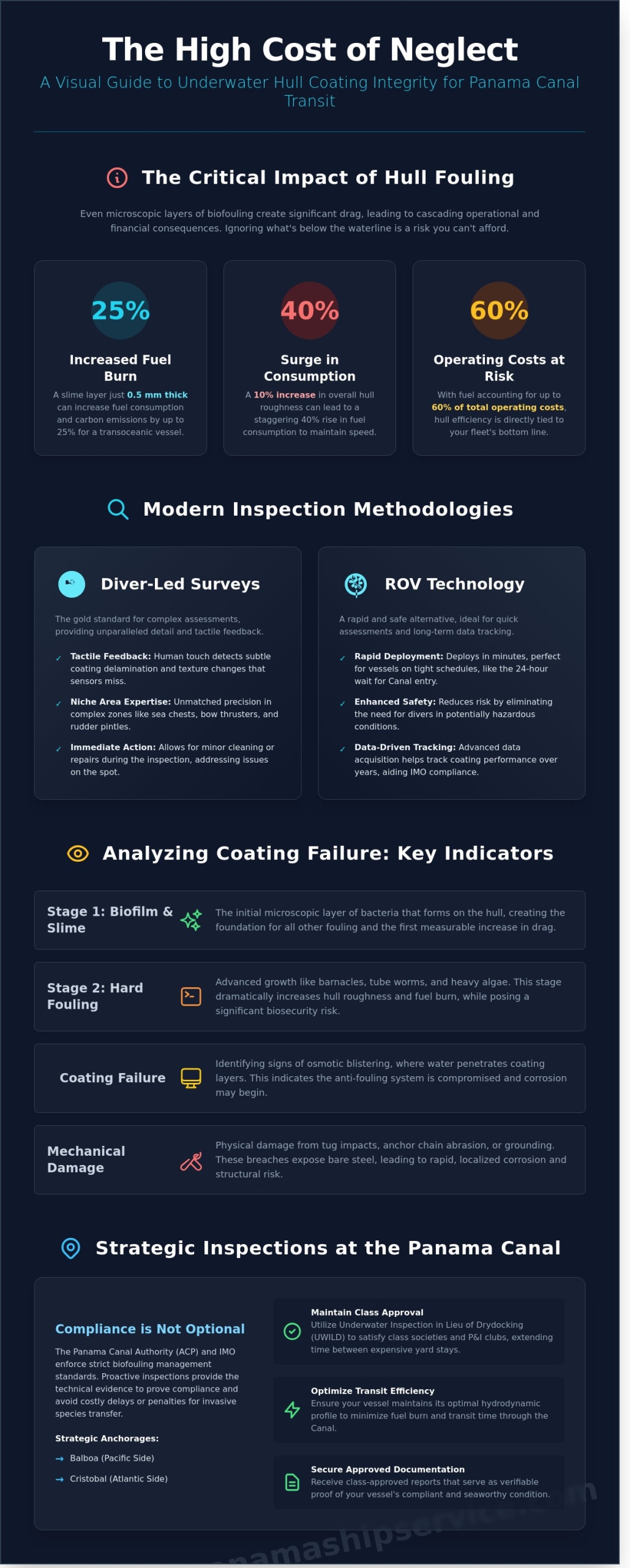
Small changes in hull condition lead to massive financial consequences. Industry data shows that a 10% increase in hull roughness can result in a 40% increase in fuel consumption. In an industry where fuel represents up to 60% of total operating costs, neglecting the hull is not an option. A rough hull creates drag, forcing the engine to work harder to maintain speed. This leads to higher emissions and increased wear on machinery. Regular inspections identify these issues before they impact your bottom line.
Compliance isn’t optional. The Panama Canal Authority (ACP) and international bodies like the IMO enforce strict biofouling management standards. These rules prevent the transfer of invasive species and ensure vessels maintain optimal hydrodynamic profiles. We provide the technical evidence needed to prove your vessel meets these rigorous environmental and operational benchmarks.
Biofouling and Coating Degradation
Biofouling begins the moment a vessel hits the water. It starts with a microscopic biofilm of bacteria and evolves into hard fouling like barnacles or tube worms. Modern anti-fouling paint technologies use biocides or foul-release mechanisms to interrupt this lifecycle. However, these coatings eventually fail. Our inspectors look for early signs of osmotic blistering, where water penetrates the coating layers, or mechanical damage from tug impacts and anchor chain abrasion. Early detection prevents localized corrosion from becoming a structural failure.
Class Approval and Insurance Requirements
Maintaining class status requires regular verification. An underwater inspection in lieu of drydocking (UWILD) allows operators to extend the time between expensive yard stays. Detailed reports satisfy P&I club requirements by proving the vessel is seaworthy and well maintained. Utilizing professional marine surveys in Panama ensures your vessel valuation remains high and your insurance coverage stays intact. Don’t leave your transit to chance; put your vessel in the hands of qualified professionals who understand the local regulatory environment.
Modern Methodologies for Underwater Hull Inspections
Effective hull maintenance starts with choosing the right diagnostic tool. A hull coating inspection underwater is no longer just a “look and see” operation; it’s a data-driven process. Owners must balance the need for high-resolution detail with the strict time constraints of a Panama Canal transit. We provide the expertise to navigate these choices so you don’t have to worry about the technical minutiae.
Diver-Led Surveys: Depth and Detail
Human intuition remains the gold standard for complex assessments. Divers provide tactile feedback that sensors often miss, such as the specific texture of calcareous growth or the subtle start of coating delamination. During these surveys, topside supervisors maintain constant verbal communication with the diver. This ensures every square meter of the niche areas, like sea chests and rudder pintles, is documented. This methodology allows for immediate action, combining a thorough inspection with minor underwater hull services to address localized fouling before it spreads across the flat bottom.
ROV Technology: Efficiency and Safety
Remotely Operated Vehicles (ROVs) offer a rapid alternative when safety or speed is the priority. These units deploy in minutes, making them ideal for vessels during the typical 24-hour waiting period for Canal entry. Modern ROVs use advanced data acquisition systems to track coating performance over multiple years. This data helps owners comply with IMO Biofouling Guidelines, which aim to reduce the transfer of invasive species and optimize fuel efficiency. However, ROVs face challenges in currents exceeding 1.5 knots or in cases of heavy macro-fouling where physical contact is required to verify the substrate condition.
Visual Documentation and Real-Time Feeds
Real-time CCTV feeds bridge the gap between the seabed and the office. Owners can watch the live stream from the bridge or a remote office, making instant decisions on whether to proceed with a full cleaning. This transparency eliminates guesswork and builds trust between the service provider and the vessel manager.
In high-traffic ports like Balboa, where turbidity often drops visibility to less than 0.5 meters, digital clear water photography is essential. This technology uses specialized lenses and enclosures to cut through suspended solids, providing crisp evidence of the hull’s condition. Precise documentation is vital for insurance claims and class renewals.
- CCTV: Instant visibility for stakeholders.
- Clear Water Tech: High-resolution imagery in murky port environments.
- Data Tracking: Longitudinal monitoring of coating degradation.
Protect your vessel’s efficiency by scheduling a professional hull assessment with our expert team today.
Analyzing Coating Failure: What the Inspector Looks For
During a professional hull coating inspection underwater, our divers categorize biological growth using standardized fouling scales. We look for everything from light slime and green algae to heavy calcareous growth like barnacles or tubeworms. These organisms don’t just sit on the surface; they chemically and physically bond to the substrate. Adhering to the IMO biofouling management guidelines is essential because even a 0.5 mm layer of slime can trigger a 25% increase in greenhouse gas emissions due to added drag.
Physical damage often results from operational stress. We document scrapes from tug contact, deep chafing from anchor chains, and distinct gouges from grounding incidents. Our inspectors also identify coating detachment issues such as peeling or flaking. We specifically hunt for “holidays,” which are small gaps or thin spots left during the original shipyard application. These vulnerable points become the first sites for localized pitting on the steel substrate.
Corrosion monitoring is a critical part of the survey. We evaluate anode depletion rates to determine if the cathodic protection system is functioning. If an anode shows 70% wastage within a single year, it indicates an electrical imbalance or a significant failure in the hull’s insulating coating. We record every instance of rust staining or bubbling to prevent long term structural degradation.
The Impact of Roughness on Hydrodynamics
Hull roughness serves as the primary driver of preventable carbon emissions. When a coating fails, the resulting “roughness penalty” forces the engine to work harder to maintain speed. A 10 micron increase in average hull roughness can lead to a 1% increase in fuel consumption. We pay special attention to niche areas like rudders, sea chests, and propellers. While these spots represent less than 10% of the total hull surface, they can contribute nearly 30% of the vessel’s total hydrodynamic drag if they aren’t kept smooth and clean.
NDT (Non-Destructive Testing) Integration
Visual checks aren’t enough for a complete assessment. We use Ultrasonic thickness (UT) gauging to measure the actual steel thickness beneath the paint without removing the coating. This ensures the hull maintains its structural integrity despite any surface corrosion. For vessels with suspected stress issues, eddy current testing allows us to check weld integrity for microscopic cracks. We finish by measuring the electrochemical potential of the hull. This data confirms that the cathodic protection system provides enough millivolts to stop corrosion in its tracks. We provide these technical insights so you don’t have to guess about your vessel’s condition.
Logistics of Hull Inspections at the Panama Canal
Panama is the world’s most critical maritime choke point. Managing a hull coating inspection underwater here requires precision timing to avoid costly delays. We schedule these operations at the Pacific (Balboa) or Atlantic (Cristobal) anchorages while your vessel waits for its transit slot. This strategy eliminates additional downtime by utilizing existing idle time. Since transit costs represent a major portion of a voyage’s budget, every hour saved at anchor improves your bottom line. Our team coordinates directly with your agent to ensure the dive boat is alongside as soon as the anchor drops.
Environmental factors in Panamanian waters demand local expertise. Visibility varies significantly between the two oceans. Tidal currents at the Balboa anchorage can reach speeds that make diving dangerous or ineffective. We track these conditions in real-time to select the optimal window for your inspection. This proactive management ensures that the data collected is clear and actionable, rather than obscured by silt or turbulence.
Balboa vs. Cristobal: Choosing the Right Location
Choosing between the two terminals depends on your route and the specific needs of the hull. Balboa offers proximity to major technical hubs but experiences higher traffic density. Cristobal often provides better visibility for detailed imaging of the bulbous bow and rudder. Our rapid-response technical teams are stationed at both ends to ensure immediate deployment. If an inspection reveals damage, mechanical ship repairs in Panama can begin immediately. This prevents a failed inspection from turning into a week-long delay.
Preparing the Vessel for Inspection
Preparation is vital for a successful hull coating inspection underwater. Divers need specific draft and trim adjustments to access the entire surface area safely. You must coordinate these movements with our dive supervisor to ensure stability during the operation. Safety protocols are non-negotiable in active transit zones where currents shift suddenly. Additionally, the Panama Canal Authority requires specific permits and documentation before any underwater work starts. We handle these administrative burdens so you don’t have to.
Charterers save money by consolidating services. Instead of hiring three different vendors for surveys, repairs, and disposals, a one-stop-shop approach reduces mobilization fees and administrative overhead. In 2023, vessels that consolidated services at the Canal saw an average 15% reduction in total port-stay costs. We are experts in this environment, providing a seamless transition from inspection to necessary maintenance.
Put your vessel in the hands of the local experts. Contact Panama Ship Service to book your integrated hull inspection today.
Panama Ship Service: Your Expert Partner for Hull Integrity
Operating in the Panama Canal is often a difficult and frustrating experience for ship owners who lack a seasoned local partner. Panama Ship Service brings 20 years of specialized expertise to this high-pressure environment. We utilize a combination of class-approved divers and state-of-the-art ROV equipment to ensure every hull coating inspection underwater is performed with surgical precision. Our team understands that timing is everything in the Canal. We provide the rapid response and technical accuracy required to keep your vessel compliant and efficient without missing your transit window.
If an inspection reveals structural issues or significant coating depletion, we facilitate a seamless transition to mechanical ship repairs. This integrated approach eliminates the need for multiple contractors and reduces the risk of operational delays. We don’t just find problems; we provide the qualified personnel and equipment to fix them immediately.
We Are Experts So You Don’t Have To Be
Managing a fleet involves constant pressure from rising costs and strict environmental regulations. We take the technical burden off your shoulders through a commitment to constant daily communication. You receive real-time updates throughout the survey process, ensuring you have the data needed to make informed decisions. Our cost-conscious approach is designed to protect your bottom line by identifying minor coating failures before they escalate into expensive structural repairs.
Our reporting standards are among the highest in the industry. Every hull coating inspection underwater includes:
- High-resolution imagery and video documentation of the vertical sides, flat bottom, and niche areas.
- Detailed analysis of antifouling condition and biofouling levels.
- Actionable recommendations for localized cleaning or touch-ups to prevent drag.
The financial impact of our expertise is measurable. In a 2023 case study, our inspectors identified early-stage coating detachment on a 180,000 DWT bulk carrier that was invisible from the surface. By performing targeted maintenance based on our report, the owner realized a 15% reduction in fuel consumption on the subsequent transoceanic voyage. This proactive catch saved the operator thousands in bunkers and prevented an unscheduled dry-docking.
Consolidated Maritime Solutions
Efficiency at the Canal requires a holistic approach to vessel husbandry. We provide consolidated maritime solutions by integrating hull inspections with MARPOL disposal, bunker surveys, and essential ship supplies. This “one-stop-shop” model minimizes port stays and reduces administrative friction. We operate with a “Put your transit in our hands” philosophy, acting as your eyes and ears in Panama.
Our team is ready to respond to your needs 24/7 with the professional, direct service that has defined our company for two decades. Don’t leave your vessel’s performance to chance in one of the world’s most demanding maritime hubs. Contact us today for a competitive quote on your next hull survey and secure the integrity of your fleet.
Optimize Your Vessel Performance for the Panama Canal
Maintaining hull integrity is vital for fuel efficiency and regulatory compliance. A routine hull coating inspection underwater identifies early signs of blistering or detachment before these issues lead to drag or structural corrosion. Our Class-approved underwater surveying and repair teams leverage 20+ years of maritime expertise at the Panama Canal to deliver precise, actionable results. We understand that timing is everything in this industry. Misjudging your maintenance schedule leads to delays and increased operational expenses that your bottom line doesn’t need.
Panama Ship Service provides the technical solutions required to keep your fleet moving. We offer rapid response capabilities at both Balboa and Cristobal ports, ensuring your vessel receives professional attention without disrupting its transit schedule. We are experts so you don’t have to be. Put your vessel in our hands and benefit from a partner dedicated to minimizing expenses through proactive care. It’s time to secure your ship’s performance with a team that understands the high-stakes environment of the canal.
GET A QUOTE for your Hull Coating Inspection in Panama
We’re ready to help you maintain a competitive edge on the water.
Frequently Asked Questions
How long does a typical underwater hull coating inspection take?
A typical hull coating inspection underwater takes between 2 and 6 hours depending on the vessel size. For a standard 200 meter Panamax bulk carrier, our divers usually complete the full survey in 4 hours. This timeframe includes the setup of high-definition video equipment and a detailed assessment of the vertical sides, flat bottom, and rudder.
Is an underwater inspection accepted by all major classification societies?
All major classification societies like ABS, DNV, and Lloyd’s Register accept underwater inspections in lieu of dry-docking. We hold certifications from 8 different class societies to ensure your reports meet every regulatory standard. Our team follows the specific IACS guidelines to provide the technical documentation your vessel needs for its intermediate or special survey.
Can hull cleaning be performed immediately after an inspection if fouling is found?
We can perform hull cleaning immediately after an inspection if the survey identifies fouling that doesn’t compromise the coating. Our teams often deploy cleaning equipment within 60 minutes of the diver surfacing to maximize your time at the anchorage. This rapid transition ensures your vessel recovers its fuel efficiency without causing any delays to your scheduled transit.
What is the cost difference between a diver inspection and an ROV survey?
Diver inspections involve higher operational costs than ROV surveys because of the specialized life-support equipment and personnel required. Industry data shows that ROV surveys can reduce mobilization costs by 15 percent since they don’t require the same safety protocols as human divers. While ROVs are efficient for flat surfaces, divers are better for complex areas like sea chests.
Does the Panama Canal Authority require specific hull condition reports for transit?
The Panama Canal Authority requires vessels to maintain clean hulls as specified in the OP Notice N-1-2024 regarding invasive species. Vessels found with heavy fouling or significant coating damage may be denied entry until they meet ACP standards. We provide the specific reports and high-resolution imagery required to prove your vessel is compliant and ready for transit.
What happens if the inspection reveals significant coating damage?
If the inspection reveals more than 10 percent coating depletion or localized corrosion, we provide an immediate repair strategy and photographic evidence. Our technicians can often apply underwater-curing epoxy resins to damaged areas while the ship is at anchor. This proactive maintenance prevents further steel oxidation and helps you avoid the high costs of an unscheduled dry-docking.
How often should a vessel undergo an underwater hull coating inspection?
A vessel should undergo a hull coating inspection underwater every 12 to 24 months to monitor anti-fouling performance. Ships operating in tropical regions like Panama often require 6-month checks to manage the rapid growth of barnacles and tubeworms. Maintaining a smooth hull through regular inspections can reduce your vessel’s total fuel consumption by 10 percent annually.
Can inspections be carried out at night at the Panama Canal anchorages?
We carry out inspections 24 hours a day at the Panama Canal anchorages in Balboa and Cristobal. Our dive teams use 500-watt underwater lighting systems to ensure crystal clear visibility during night operations. This 24/7 availability means you don’t have to wait for daylight to complete your surveys, keeping your vessel on its strict operational schedule.