
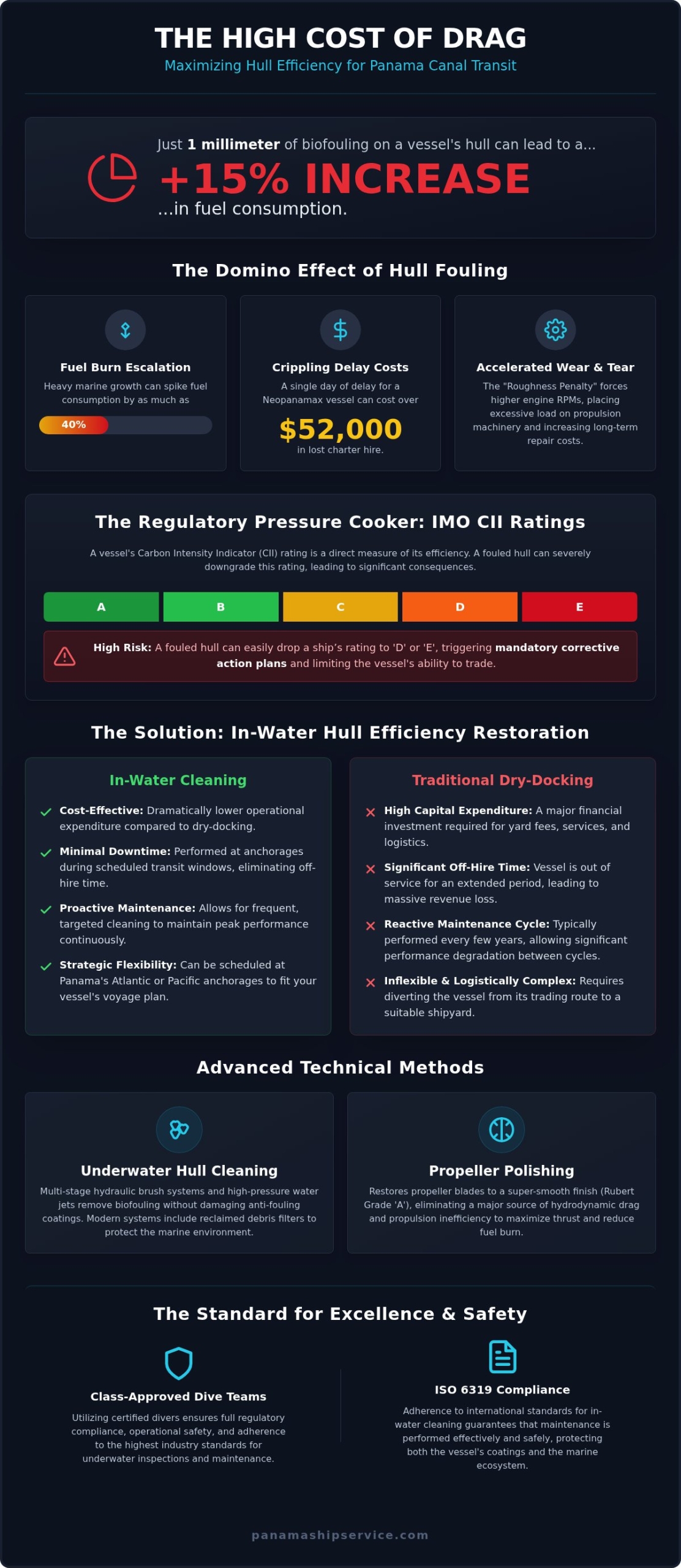
Did you know that just one millimeter of biofouling on your vessel’s hull can spike fuel consumption by 15%? In the high-stakes environment of the Panama Canal, where a single day of delay for a Neopanamax vessel can cost over $52,000 in lost charter hire, ignoring hydrodynamic drag is no longer an option. Professional hull efficiency restoration has shifted from a routine maintenance task to a critical financial intervention. You’re likely already feeling the pressure of rising fuel prices and the tightening grip of IMO CII and EEXI ratings on your operational margins.
We understand that maintaining a strict schedule while meeting stringent environmental standards is a complex balancing act. This article explores how specialized underwater cleaning and propeller polishing during your transit window can significantly reduce fuel burn and ensure compliance with the latest ISO 6319 standards. You’ll discover how to maximize your operational ROI and leverage the Green Vessel incentive program to secure tiered discounts on port dues. We’ll examine the technical requirements for in-water cleaning at Panama anchorages and how a proactive approach to hull performance protects your bottom line from heavy non-compliance fines.
Key Takeaways
- Understand how even light biofouling creates a significant fuel penalty and why proactive hull efficiency restoration is essential for maintaining voyage margins.
- Explore the technical advantages of using hydraulic brush systems and propeller polishing to eliminate hydrodynamic drag and propulsion inefficiency.
- Compare the strategic cost savings of in-water hull maintenance against the high capital expenditure and off-hire time required for traditional dry-docking cycles.
- Learn how to coordinate underwater services at Panama’s Atlantic or Pacific anchorages to optimize your vessel’s schedule during transit.
- Discover the importance of utilizing class-approved dive teams for underwater inspections to ensure full regulatory compliance and operational safety.
The Economics of Hull Efficiency Restoration in Commercial Shipping
Hull efficiency restoration is the systematic process of returning a vessel’s wetted surface to its original, smooth hydrodynamic state. For commercial ship operators, this isn’t a cosmetic concern; it’s a fundamental economic necessity. Marine growth creates significant turbulence along the hull. Even a thin layer of slime can disrupt laminar flow, forcing the propulsion system to work harder to maintain speed. This technical intervention ensures the ship glides through the water with minimal resistance, directly protecting your voyage margins.
Understanding what is biofouling is the first step in managing operational overhead. Research indicates that a single millimeter of biofouling can increase a vessel’s fuel consumption by 15%. For heavy growth, that figure can jump as high as 40%. On long-haul routes transiting the Panama Canal, where fuel represents the largest operational expense, these inefficiencies lead to massive fiscal leakage. You can’t afford to ignore the hidden costs of a fouled hull when transiting one of the world’s most expensive maritime corridors.
Identifying the Cost of Hydrodynamic Drag
Frictional resistance increases dramatically as the hull surface roughens. This drag requires higher engine RPMs to maintain transit schedules, which places a continuous, excessive load on the main engine and propulsion machinery. Over time, this leads to accelerated mechanical wear and higher long-term repair costs. In maritime engineering, the Roughness Penalty is defined as the measurable increase in power required to overcome the additional frictional resistance caused by hull surface degradation.
CII and EEXI Compliance: A Regulatory Driver
Under IMO 2026 standards, hull performance is no longer just about fuel costs; it’s about legal compliance. A vessel’s Carbon Intensity Indicator (CII) rating is a direct reflection of its operational efficiency. A fouled hull can easily drop a ship’s rating from a ‘C’ to a ‘D’ or ‘E’, triggering mandatory corrective action plans and potentially limiting your ability to trade in certain regions.
Proactive hull efficiency restoration is far more cost-effective than the alternative of slow steaming to meet emission targets. Reducing speed to lower carbon output results in fewer voyages per year and lost charter revenue. Maintaining a clean hull ensures you stay within the ‘A’ or ‘B’ rating tiers while keeping your vessel at full operational speed. Operators should utilize professional marine surveys in Panama to verify hull condition and document compliance before and after restoration work. This data-driven approach provides the evidence needed to satisfy port state control and environmental auditors without sacrificing commercial performance.
Technical Methods for Restoring Hull Performance
Modern hull efficiency restoration relies on a combination of high-precision equipment and specialized diving expertise. The goal is to remove biofouling without compromising the integrity of the underlying anti-fouling coatings. If the cleaning process is too aggressive, it can strip away the expensive protective layers, leading to even faster regrowth and potential hull corrosion. Expert teams evaluate the type and thickness of the fouling before selecting the specific tool for the job, ensuring the vessel’s wetted surface returns to its design specifications.
Maintaining a clean hull is a continuous requirement for vessels operating in tropical waters like those surrounding the Panama Canal. High water temperatures and extended idle times at anchorages accelerate the growth of calcium-based organisms and soft slime. Following IMO’s Biofouling Guidelines ensures that your maintenance schedule aligns with international best practices for both performance and environmental safety.
Advanced Underwater Hull Cleaning Techniques
Technical teams typically utilize multi-stage hydraulic brush systems for large-scale cleaning. These systems use rotating brushes with varying degrees of stiffness to lift growth away from the hull. For sensitive areas or light slime, high-pressure water jetting provides a gentler alternative that leaves the coating intact. Environmental regulations in Panama now mandate the use of reclaimed debris systems that filter discharge down to 5 microns. This prevents the spread of invasive species and ensures your vessel remains compliant with local environmental laws. Utilizing professional underwater hull services allows operators to perform these critical tasks during their scheduled transit wait time, turning idle hours into operational gains.
Propeller Polishing: The ‘Low-Hanging Fruit’ of Efficiency
Propeller performance is just as vital as hull smoothness. Divers use the Rubert Scale to measure the roughness of the blades, aiming for a Grade A or B finish. Even minor pitting or calcium deposits on the propeller can cause cavitation, which erodes the metal and reduces thrust. It’s a precise science; a 1% improvement in propeller efficiency often results in fuel savings that far exceed the cost of the service itself. Teams employ a multi-stage polishing process using progressively finer abrasive discs to achieve a mirror-like finish. This reduces the torque required to turn the shaft and minimizes engine stress. If you haven’t scheduled an inspection recently, it’s a good idea to consult with a technical partner to assess your propulsion efficiency before your next transit.
In-Water Restoration vs. Dry-Docking: A Strategic Comparison
Choosing between in-water maintenance and a full dry-dock cycle is a high-stakes decision for any fleet manager. Dry-docking represents a massive capital expenditure, often costing between $2 million and $5 million for Post-Panamax vessels according to 2026 industry estimates. Beyond the direct yard costs, the off-hire period is the most significant financial drain. Taking a ship out of service for weeks results in lost charter revenue and disrupted logistics chains. In contrast, in-water hull efficiency restoration allows for performance recovery without removing the vessel from its earning cycle.
Proactive in-water services effectively extend the interval between mandatory dry-docking periods. By maintaining the hull’s hydrodynamic profile through regular cleaning, you prevent the deep-seated fouling that eventually degrades the coating system. This strategy shifts maintenance from a reactive, crisis-managed event to a planned operational task. However, underwater work has limits. While divers can handle cleaning and inspections, major structural mechanical ship repairs require the controlled environment of a dry dock to ensure long-term integrity.
Cost-Benefit Analysis of In-Water Services
The primary advantage of in-water restoration is flexibility. Shipyard slots often require scheduling months or even years in advance, leaving little room for operational shifts. In a strategic hub like Panama, underwater teams can mobilize quickly after the required environmental clearance. This allows work to proceed at anchor while the vessel waits for its transit slot. For a typical bulk carrier, the fuel-saved versus service-cost ratio is highly favorable. When a clean hull prevents a 10% to 15% increase in fuel consumption, the service pays for itself within a single long-haul voyage. You’re essentially converting unavoidable idle time into a performance-enhancing window.
When Dry-Docking is Unavoidable
Yard intervention becomes mandatory when hull damage exceeds the scope of underwater capabilities. Deep structural fractures, significant plate thinning, or a complete failure of the anti-fouling system are clear thresholds for dry-docking. Class-approved surveys are the standard tool for making this determination. These inspections provide the objective data needed to justify the expense of a yard stay. To maximize the value of this downtime, operators should integrate necessary mechanical ship repairs in Panama to ensure all systems are restored simultaneously. This consolidated approach minimizes the frequency of future off-hire events and ensures the vessel returns to sea in peak condition.
Operational Logistics: Restoring Efficiency at the Panama Canal
The Panama Canal serves as a strategic bottleneck where vessels often spend 24 to 72 hours awaiting their transit slot. This waiting period presents a prime opportunity for hull efficiency restoration without adding a single hour of deviation to the voyage. By performing underwater maintenance at the Atlantic or Pacific anchorages, Cristobal or Balboa, operators can transform idle time into a performance-enhancing window. Efficient coordination ensures that the vessel enters the canal in peak hydrodynamic condition, ready to meet the strict operational requirements of the Panama Canal Authority (ACP).
Tropical waters create a unique biofouling challenge. High temperatures and nutrient-rich environments accelerate the growth of both soft slime and hard calcareous organisms like barnacles. While slime increases drag by roughly 10%, hard growth can cause a catastrophic fuel penalty of up to 40%. Addressing these issues while at anchor is a logical step that prepares the vessel for the next leg of its journey. Combining hull cleaning with MARPOL disposal in Panama further streamlines the transit process, ensuring all environmental obligations are met before entering the locks.
Scheduling Restoration During Canal Wait Times
Timing is everything in the Panama hub. Service teams must be ready to mobilize the moment a vessel reaches the anchorage to maximize the available window. Most professional teams operate 24/7 to accommodate the fluid nature of canal scheduling. To ensure a smooth operation, vessel masters should follow a standardized preparation protocol:
- Confirm the exact anchorage coordinates with the ACP and the transit agent.
- Verify that the 48-hour advance notice for environmental clearance has been filed.
- Ensure the vessel’s crew is ready to provide safe boarding access for the dive support team.
- Coordinate with the agent to ensure hull work doesn’t conflict with bunkering or cargo operations.
Environmental Regulations in the Panama Canal Watershed
The ACP enforces strict environmental protocols to protect the canal’s delicate ecosystem. In-water cleaning is only permitted for contractors holding a valid ACP license and utilizing approved debris capture systems. These regulations are designed to prevent the introduction of invasive species and the discharge of heavy metals from hull coatings into the watershed. It’s critical to work with certified contractors who understand these local nuances to avoid heavy fines or transit delays. Additionally, many operators utilize this time to restock via ship supplies in Panama Canal, ensuring the crew has the necessary equipment to support maintenance activities. To secure your transit schedule and optimize your vessel’s performance, you should contact a licensed service provider well in advance of your arrival.
Panama Ship Service: Professional Hull Restoration Excellence
Panama Ship Service stands as the authoritative partner for vessel operators requiring professional hull efficiency restoration at the Panama Canal. Our position as a seasoned veteran in this strategic hub is built on a foundation of technical proficiency and fiscal responsibility. We understand the high-stakes, time-sensitive nature of the maritime industry. Every hour spent at anchor is an opportunity to optimize your vessel’s performance. Our highly skilled dive teams utilize specialized equipment to deliver results that directly impact your bottom line, ensuring your ship operates at peak hydrodynamic efficiency for the remainder of its voyage.
Class-Approved Underwater Surveys and Inspections
Compliance is a critical component of modern fleet management. We provide specialized underwater surveys, including Underwater Inspection in Lieu of Dry-docking (UWILD), to help operators maintain class standing without the need for immediate yard stays. Our teams use high-definition CCTV and photography to provide comprehensive hull condition reports. These detailed visual records allow for precise assessment of biofouling levels and coating integrity. All our surveys meet the stringent requirements of major classification societies, providing you with the verified data needed for regulatory and insurance purposes. We handle the technical documentation so you don’t have to worry about compliance gaps during your transit.
Consolidating Services for Maximum Efficiency
Efficiency in the Panama Canal hub is not just about the quality of a single service; it’s about the orchestration of multiple operational needs. Panama Ship Service offers a comprehensive “One-Stop-Shop” approach that allows you to consolidate hull efficiency restoration with other essential tasks. While our divers are cleaning the hull or polishing the propeller, we can simultaneously coordinate mechanical ship repairs and the delivery of ship supplies. This integrated model minimizes the number of service vessels alongside and reduces the complexity of your port call. It’s a systematic way to handle overhead while your vessel is already idle.
By centralizing these services, you eliminate the logistical friction of managing multiple vendors in a complex environment. We prioritize proactive communication and quick turnaround times to ensure your vessel meets its transit window without delay. Our goal is to maximize your operational ROI by handling technical complexity on your behalf. You can delegate the intricate details of underwater maintenance and logistics to our experienced team, allowing you to focus on the broader objectives of your voyage. Our service is grounded and reliable, positioning us as the dependable partner you need in this critical geographical hub.
Secure Your Operational ROI with Strategic Hull Maintenance
Managing a commercial fleet requires a relentless focus on fuel efficiency and regulatory compliance. We’ve examined how even light biofouling creates a significant fuel penalty and why in-water maintenance is a more flexible, cost-effective alternative to frequent dry-docking. By utilizing transit wait times at the Panama Canal, you transform idle hours into a high-value window for performance optimization. Professional hull efficiency restoration ensures your vessel meets stringent IMO standards while protecting your bottom line from rising voyage costs.
Panama Ship Service provides the technical expertise needed to maintain your competitive edge. Our expert underwater teams are available 24/7 to provide class-approved surveys and inspections that satisfy major classification societies. Strategically located at the Panama Canal, we’re your reliable partner for consolidating repairs and surveys without disrupting your schedule. Don’t let hydrodynamic drag erode your profit margins during your next transit.
Optimize your vessel’s efficiency—Contact Panama Ship Service for a restoration quote. We’re ready to help you achieve a cleaner, faster, and more profitable voyage.
Frequently Asked Questions
What is the typical fuel saving after a hull efficiency restoration?
Vessel operators typically see fuel savings between 10% and 15% following a professional cleaning of light slime, with even greater returns when removing hard calcareous growth. This recovery of hydrodynamic performance directly improves the ship’s Carbon Intensity Indicator (CII) rating and overall voyage profitability. The exact ROI depends on the vessel’s initial speed-loss data and the quality of the cleaning performed on the wetted surface and propulsion gear before transit.
Can hull cleaning be performed while the vessel is at anchor in Panama?
Yes, hull cleaning is performed at the Atlantic or Pacific anchorages, such as Cristobal and Balboa, while vessels wait for their transit slot. This allows operators to utilize unavoidable idle time for hull efficiency restoration without adding deviation to the voyage. Our teams mobilize quickly to these strategic hubs, providing 24/7 support to ensure the work is completed before the vessel’s scheduled entry into the canal locks.
How does propeller polishing differ from standard hull cleaning?
Propeller polishing focuses on the propulsion gear specifically, while hull cleaning covers the entire wetted surface. Polishing uses progressively finer abrasive discs to achieve a Rubert Grade A finish, reducing cavitation and improving torque efficiency. Hull cleaning involves hydraulic brushes to remove biofouling from the plates. Both services are essential parts of hull efficiency restoration, working together to minimize hydrodynamic resistance and maximize fuel economy for the next leg of the voyage.
Does underwater cleaning damage the anti-fouling paint?
Professional underwater cleaning doesn’t damage anti-fouling paint when performed with the correct equipment and pressure settings. Skilled dive teams assess the coating’s condition and select brushes that lift biofouling without stripping the protective layers. Using high-pressure water jetting for sensitive areas further preserves the hull’s integrity. Preserving these coatings is a priority, as any damage would lead to faster regrowth and potential corrosion of the steel hull plates over time.
How often should a vessel transiting the Panama Canal undergo hull restoration?
The ideal frequency depends on water temperature, idle time, and the vessel’s specific trading pattern. Vessels frequently transiting tropical waters like the Panama Canal often require inspections every six months due to accelerated growth rates. A proactive approach to hull efficiency restoration is more cost-effective than waiting for a mandatory dry-docking cycle. Regular underwater surveys help determine the optimal timing based on actual fouling levels rather than relying on arbitrary calendar dates.
What classification approvals are required for underwater hull inspections?
Underwater inspections and surveys must be conducted by providers recognized by major classification societies like ABS, DNV, or Lloyd’s Register. These approvals ensure that the data collected during a UWILD (Underwater Inspection in Lieu of Dry-docking) is legally valid for compliance and insurance purposes. Panama Ship Service maintains these certifications, providing high-definition video and photographic evidence that meets the stringent safety and technical standards required by international maritime law and port state control.
Is hull restoration compliant with Panama Canal Authority environmental rules?
Yes, restoration services are compliant provided the contractor holds a valid Panama Canal Authority (ACP) license. Current regulations mandate the use of reclaimed debris systems that filter discharge to prevent the spread of invasive species and the release of heavy metals into the watershed. Using certified contractors ensures your vessel avoids heavy environmental fines and remains in good standing with local authorities throughout the transit process. This coordination is essential for a clean and legal transit.
How long does a typical underwater hull cleaning take for a Panamax vessel?
A standard underwater hull cleaning for a Panamax vessel typically takes between 24 and 48 hours. The exact duration depends on the level of biofouling, the sea state at the anchorage, and whether propeller polishing is performed simultaneously. Our teams work 24/7 to meet tight vessel schedules, ensuring the work is completed within the transit wait window to minimize any potential operational delays or disruptions to the scheduled canal entry time.