
What if a gradual rise in fuel use is partly coming from the hull, not just the voyage? The impact of hull roughness on fuel cost can be difficult to isolate because speed, weather, loading and operating patterns also affect consumption. Roughness from fouling or coating deterioration adds resistance, so the vessel needs more power to maintain performance. A 2022 study estimated that hull roughness could increase fuel consumption by around 20% over 10 years of operation in calm water.
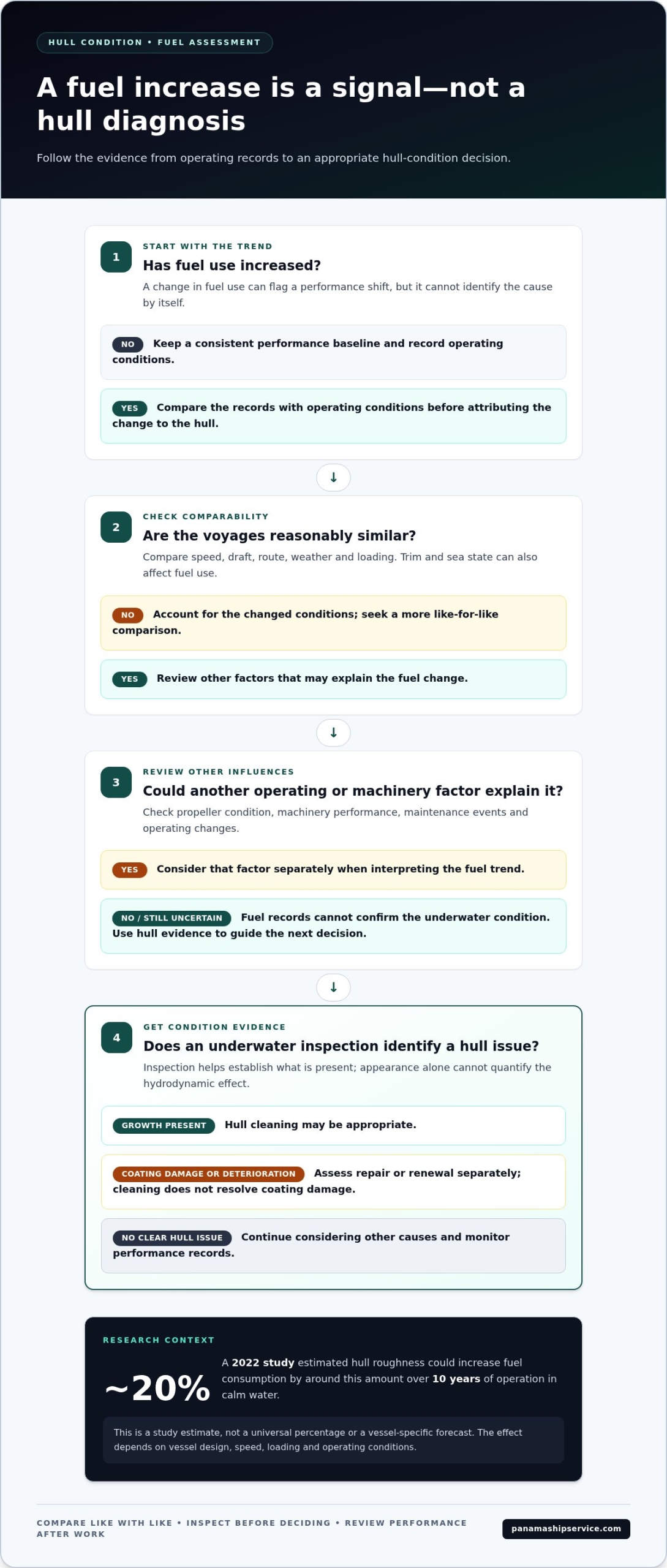
Fuel figures alone won’t show whether the hull is responsible. Compare them with operating conditions and hull-condition evidence to make a more informed decision about underwater work. This guide explains how roughness creates added resistance, what vessel data can reveal, and how to assess whether inspection or cleaning is a practical next step. It also covers how to plan hull work around Panama Canal operations.
Key Takeaways
- Understand how surface irregularities and fouling can increase resistance and require more propulsion power.
- Assess the impact of hull roughness on fuel cost alongside speed, weather, draft, trim and machinery condition.
- Build a useful comparison by recording operating conditions, fuel use and maintenance events against a consistent baseline.
- Use hull-condition evidence to decide whether monitoring, an underwater inspection, hull cleaning or propeller polishing is the appropriate next step.
- Plan hull-condition work around Panama Canal operations, then review vessel performance to assess the outcome.
How hull roughness affects ship fuel cost through added resistance
A vessel moving through water must overcome resistance from the water flowing around its hull. A smooth underwater surface helps maintain that flow, while irregularities can disturb it and increase the force opposing the vessel’s movement. The resulting fuel effect depends on the ship’s design, speed, loading and operating conditions. Hull condition is one factor to assess, not a complete explanation for every change in fuel use.
Hull roughness is underwater surface irregularity that can increase resistance, demand more propulsion power at a given speed, and potentially raise fuel consumption. Not every visible imperfection creates the same operational penalty. The extent and location of the roughness matter, as does the vessel’s operating profile.
What counts as hull roughness on an operating vessel?
Roughness can come from coating texture, deterioration such as cracking or peeling, physical damage, or marine growth. Biofouling develops as organisms accumulate on submerged surfaces. The process of biofouling can range from early biological films to larger growth. These conditions differ in extent and form, so a lightly affected area shouldn’t be treated as equivalent to widespread or heavier growth.
Appearance alone can’t quantify the hydrodynamic effect. The type, distribution and extent of surface change matter, as do vessel design and operating conditions. An underwater inspection helps establish what is present before deciding whether hull work is warranted.
Why added resistance can change fuel consumption
A rougher or fouled surface can make water movement along the hull less favorable, increasing the resistance the vessel faces as it moves. To hold the same speed against that added drag, the propulsion system may need to deliver more power, which can increase fuel use. This added drag is commonly discussed as increased frictional resistance.
The relationship isn’t a fixed conversion. Vessel design affects how the hull interacts with water, while speed and loading influence the power required to maintain a given operating condition. Weather and sea state can add resistance too, and machinery condition can affect how efficiently fuel becomes propulsion. These factors make the impact of hull roughness on fuel cost difficult to isolate from a single fuel figure.
There’s no universal percentage that applies to every vessel or voyage. Compare like with like, then consider hull-condition evidence alongside operating data. This helps distinguish a plausible hull-related contribution from other causes before selecting an intervention.
How hull condition, speed, and fouling combine to influence fuel use
Fuel consumption reflects the whole operating picture, not the hull alone. A rise in fuel use may coincide with hull roughness, but changes in speed, draft, trim, loading, route, weather, sea state, propeller condition or machinery performance can also affect the figures. To judge whether hull condition is contributing, compare periods with similar operating conditions wherever possible.
Fuel trends can flag a performance change, but they can’t diagnose hull condition or identify its cause. Operational records help narrow the possibilities, but they don’t show what is physically present on underwater surfaces. When the evidence points to a hull-related issue, an inspection can provide that condition information.
Hull roughness, marine growth, and coating condition
Coating texture and deterioration can change the hull’s wetted surface, as can attached marine growth. Fouling is one possible source of roughness, not the only one. The International Maritime Organization’s 2023 Biofouling Guidelines address biofouling management, including its relevance to energy efficiency and the spread of aquatic species.
Different conditions call for different decisions. Cleaning may be appropriate when surface growth is present, while damaged or deteriorated coating may warrant separate assessment for repair or renewal. Cleaning doesn’t resolve coating damage, and no coating or treatment should be assumed to guarantee a specific fuel result.
Operating factors that can mask the hull’s contribution
Even a modest speed change can complicate a comparison. A vessel operating faster may need a different level of power, so fuel figures from different speeds aren’t directly equivalent. Draft, trim and cargo loading also affect how the vessel moves through water. Rough weather or a changed route can shift fuel use without any change to the hull.
- Compare records from voyages with reasonably similar speed, draft, route, weather and loading.
- Review propeller condition and machinery performance as separate factors.
- Record maintenance events and operating changes that could explain a shift in fuel use.
These records make performance trends more useful, but they can’t confirm whether the hull is fouled, damaged or affected by coating deterioration. An underwater hull inspection provides condition evidence to guide the next step. For vessels operating at the Panama Canal, underwater hull inspections can support maintenance decisions based on the vessel’s condition and operating plan.
How to assess the fuel-cost impact of hull roughness
Use a step-by-step assessment rather than treating a change in fuel use as proof of a rough hull. Establish a vessel-specific baseline, review operating records for meaningful changes, inspect the underwater condition, then compare performance again after any work. This sequence separates observed evidence from assumptions and gives operators a clearer basis for deciding whether hull maintenance is justified.
Build a meaningful vessel-performance baseline
Choose a period with reliable records and, where possible, compare operating periods with similar conditions. Record speed, draft, route, weather, loading and fuel use, along with relevant maintenance events. Include machinery work and propeller maintenance so changes in propulsion performance aren’t mistakenly assigned to hull condition.
A useful fuel comparison needs fuel-use data alongside speed, draft, route, weather and loading context. If those conditions differ substantially, the comparison may still be informative, but its limitations should be clear. For example, a slower voyage shouldn’t be treated as directly equivalent to a faster one without accounting for the operating difference.
After maintenance, continue recording the same factors. If fuel use improves, note other changes that occurred during the period. A change following hull work is relevant evidence, but it doesn’t prove that hull work alone caused the improvement.
Use inspection findings to interpret fuel data
Compare the operating history with an underwater inspection. Findings can document visible hull condition and help identify whether marine growth, coating deterioration or physical damage may be relevant. Propeller condition also matters to overall propulsion performance, so assess it separately rather than assuming the hull explains every trend.
Match the observed condition to the vessel’s records before selecting an intervention. If the evidence indicates surface growth, hull cleaning may be appropriate. Other findings may call for a different maintenance decision. The aim is to match the work to the condition observed, rather than rely on a fuel estimate alone.
After work, reassess performance using comparable operating data and state the assumptions behind any estimate. Label measured changes as measured, and keep projections distinct from observed results. The Underwater Hull Services: The Complete Guide for Vessels in Panama offers further context on inspections and underwater maintenance. For the impact of hull roughness on fuel cost, this evidence-led process provides a practical way to move from a performance signal to a considered next step.
When hull cleaning or polishing may make operational sense
Choose the response that matches the evidence, rather than assuming every vessel needs immediate underwater work. A change in performance may justify closer attention, but fuel data alone can’t show whether the hull needs cleaning. An inspection establishes the condition below the waterline and helps distinguish surface growth from other findings before work is selected.
Inspection, cleaning, or continued monitoring?
Use the available evidence to guide the next step. If performance records are stable and there’s no indication of a hull-condition change, continued monitoring may be reasonable. If performance has shifted or the condition is uncertain, an underwater inspection can clarify what’s present. Where inspection findings show surface growth, hull cleaning may be appropriate. The result depends on the vessel’s initial condition and operating context, so don’t assume a standard fuel improvement.
Timing matters too. Weigh condition evidence against the vessel’s port-call schedule and operational priorities. Planning work around a Panama Canal call can help fit underwater services into maintenance planning while keeping the decision grounded in the vessel’s needs and schedule.
Why propeller condition deserves separate attention
The propeller converts the propulsion system’s power into thrust. Its condition can therefore affect propulsion performance, but it’s separate from roughness or growth on the hull. Hull cleaning addresses surface growth on the hull; propeller polishing addresses propeller condition. An inspection can help determine whether one or both areas merit attention.
Keep the decision practical: identify the condition, select the relevant work, and assess performance afterward using comparable operating data. For more context on underwater maintenance in Panama, see the published Underwater Hull Services: The Complete Guide for Vessels in Panama.
The impact of hull roughness on fuel cost is best assessed alongside vessel condition and operating evidence, rather than treated as a guaranteed result of cleaning or polishing. For vessels operating at the Panama Canal, plan underwater hull services around the vessel’s condition and port-call schedule.
Plan hull-condition work around Panama Canal operations
Hull work is easier to plan when it follows a clear sequence: review performance records, assess the vessel’s underwater condition, select work based on the findings, then evaluate performance afterward. This keeps maintenance decisions tied to evidence while accounting for operational priorities and port-call timing.
Coordinate the assessment with vessel schedules
Start with the vessel’s condition and the reason for considering underwater work. Review performance trends and maintenance history, then consider Panama Canal call timing alongside operational priorities. An inspection can help establish whether hull cleaning, propeller polishing or continued monitoring is the relevant response. The scope should follow the observed condition, not an assumption that every vessel needs the same work.
Where more than one underwater service is indicated, coordinating the work within a planned call may simplify arrangements and help avoid unnecessary separate movements or coordination. The practical plan still depends on the vessel’s requirements and schedule. Panama Ship Service provides underwater hull inspections, hull cleaning and propeller polishing for vessels operating at the Panama Canal.
Turn findings into a follow-up performance review
Record what the inspection found and what work was completed. Afterward, continue tracking fuel use alongside speed, draft, route, weather, loading and relevant maintenance changes. Compare later operating data with a suitable baseline, accounting for differences between voyages before estimating any fuel effect. Keep measured results distinct from projections.
This follow-up matters because completed work and a subsequent change in fuel use don’t, by themselves, establish a direct cause. A careful comparison helps operators understand whether the observed hull or propeller condition may have contributed, while keeping other operating factors in view. That’s a more dependable basis for future maintenance planning than relying on a promised outcome.
For vessel operators, the impact of hull roughness on fuel cost is best addressed through condition-based decisions that fit the operational plan. Share your underwater service requirements for a Panama Canal call with Panama Ship Service to discuss inspection, cleaning or propeller polishing in relation to the vessel’s needs.
Make hull decisions with better evidence
The impact of hull roughness on fuel cost depends on more than the hull alone. Speed, loading, weather, machinery and propeller condition all influence fuel use, so trends need to be compared with operating context. A consistent baseline and underwater inspection help distinguish possible hull effects from other performance changes.
Match the response to the findings. Monitoring may be appropriate when conditions remain stable; an inspection can clarify what’s happening below the waterline, hull cleaning addresses surface growth, and propeller polishing focuses on propeller condition. For vessels operating at the Panama Canal, factoring underwater work into port-call planning can help align maintenance with operational priorities.
Panama Ship Service provides underwater hull inspections, hull cleaning and propeller polishing as part of its operational and technical services at the Panama Canal. Discuss underwater hull services for your vessel in Panama and identify a practical next step based on its condition and schedule.
Frequently Asked Questions
How much can hull roughness increase a ship’s fuel consumption?
There’s no single increase that applies to every vessel. A study cited by the ULisboa Research Portal in December 2022 estimated that hull roughness could raise fuel consumption by around 20% over 10 years of operation in calm water. Treat this as a study estimate, not a forecast for an individual ship. Vessel design, speed, loading, operating conditions and the type and extent of roughness all affect the outcome.
What causes hull roughness on a vessel?
Hull roughness can result from coating texture, coating deterioration, physical damage or marine growth attached to underwater surfaces. Biofouling may range from a thin biological film to larger organisms, and its effect varies with the type and extent of growth. Roughness isn’t always obvious from above the waterline, and visual appearance alone can’t determine its hydrodynamic significance. An underwater inspection can help establish the actual hull condition.
How do you measure the impact of hull roughness on fuel cost?
Start with consistent fuel-use and vessel-performance records, then compare periods with reasonably similar operating conditions. Include speed, draft, route, weather, loading and relevant machinery or propeller maintenance. An underwater inspection can document hull condition for comparison with those records. Clearly separate measured changes after maintenance from projected savings, and account for other possible causes. Fuel trends alone can’t establish that roughness caused a change in fuel use.
Does hull cleaning reduce fuel consumption?
Hull cleaning may help reduce resistance when inspection findings show surface growth affecting the hull. The outcome depends on the vessel’s initial condition and operating context, so cleaning shouldn’t be treated as a guaranteed fuel-saving measure. Coating damage or deterioration may need separate assessment, while propeller condition is another factor to consider. Compare performance before and after work using operating data from suitably comparable conditions.
How often should a ship’s hull be inspected or cleaned?
There isn’t one inspection or cleaning interval that suits every vessel. Hull condition changes with operating history, coating condition, fouling exposure and other vessel-specific factors. Use performance records and maintenance history to identify when closer assessment may be useful, then base cleaning decisions on inspection findings rather than a fixed assumption. An underwater inspection helps determine whether cleaning is appropriate or whether monitoring or another maintenance response makes more sense.
Can hull roughness affect a vessel even when there is little visible marine growth?
Yes. Marine growth is only one possible cause of roughness. Coating texture, deterioration or physical damage may affect the underwater surface even when little growth is visible. Changes below the waterline may not be apparent from routine visual observation, and the visible amount of fouling alone can’t quantify the effect on performance. An underwater inspection can document hull and propeller condition and help operators interpret fuel trends alongside operating data.
Can underwater hull services be coordinated during a Panama Canal call?
Yes. Underwater hull services can be planned as part of a vessel’s Panama Canal call, with the vessel’s condition, operational priorities and port-call schedule informing the work. Panama Ship Service provides underwater hull inspections, hull cleaning and propeller polishing for vessels operating at the Panama Canal. Share the vessel’s requirements and schedule to plan appropriate underwater work.