
For ship owners and operators, managing vessel maintenance while minimizing downtime is a constant challenge. The traditional dry-docking process, while necessary for major repairs, is a significant source of expense and operational disruption. Fortunately, a modern, efficient alternative exists for mandatory hull inspections. This guide will help you understand the complete in-water survey process, its benefits over dry-docking, and how to ensure compliance while saving valuable time and money.
This focus on operational efficiency and leveraging modern tools to save money isn’t unique to the maritime industry. In the world of consumer finance, for example, lenders also seek out advanced platforms to streamline their processes; those in the field can discover CFS Software for comprehensive loan management.
What is an In-Water Survey (IWS)?
An In-Water Survey (IWS), often referred to by classification societies as an Underwater Inspection in Lieu of Dry-docking (UWILD), is a detailed examination of a ship’s hull and its appendages while the vessel remains afloat. The primary goal is to verify the structural and watertight integrity of the hull, rudder, propeller, and other underwater components. This inspection allows a vessel to continue its commercial operations without the costly and time-consuming process of entering a dry dock, providing a crucial tool for efficient fleet management.
In-Water Survey vs. Dry-Docking: A Comparison
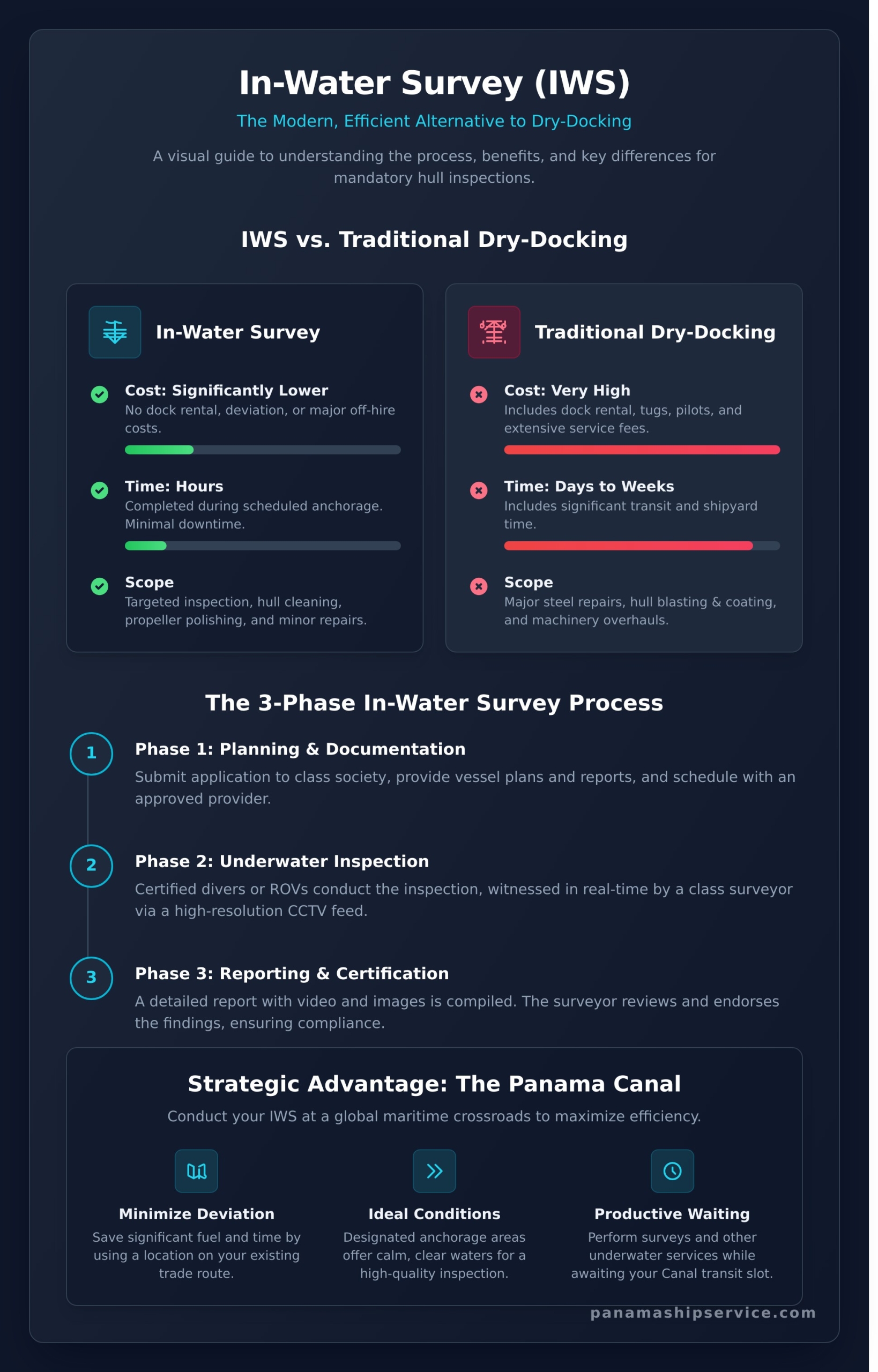
While both procedures aim to ensure a vessel’s seaworthiness, they serve different purposes and offer distinct advantages. An IWS is a targeted inspection designed to meet classification society requirements, significantly reducing expenses by eliminating dry dock rental, deviation, and off-hire time. Dry-docking, on the other hand, is a more intensive process required for major repairs, extensive maintenance, and statutory five-year special surveys. For intermediate inspections, the choice is clear.
| Factor | In-Water Survey (IWS) | Traditional Dry-Docking |
|---|---|---|
| Cost | Significantly lower; no dock fees or major deviation costs. | Very high, including dock rental, tugs, pilots, and service fees. |
| Time | Completed in hours, often during scheduled anchorage. Minimal downtime. | Takes days or weeks, including transit to/from the shipyard. |
| Scope | Inspection, cleaning, propeller polishing, and minor repairs. | Major steel repairs, hull blasting and coating, machinery overhauls. |
| Frequency | Can replace one of the two bottom surveys required in a 5-year period. | Required for two bottom surveys within a 5-year special survey cycle. |
When is an In-Water Survey Permitted by Class Societies?
Most major IACS (International Association of Classification Societies) members permit in-water surveys as an alternative to a dry-dock survey for intermediate bottom inspections. Generally, vessels must meet certain criteria to be eligible, such as being under 15 years of age, having a good hull coating condition, and a clean record from previous surveys. Final approval is always granted by the vessel’s specific classification society on a case-by-case basis. The IWS is a widely accepted practice that demonstrates a commitment to proactive maintenance while optimizing operational efficiency.
The In-Water Survey Process: Step-by-Step
A successful in-water survey depends on a well-defined process and seamless coordination between the vessel operator, the approved survey company, and the classification society surveyor. Following a structured approach ensures that all regulatory requirements are met and a comprehensive inspection is achieved.
Phase 1: Planning and Documentation
- The first step is to submit a formal application to the vessel’s classification society for approval to perform an IWS/UWILD.
- Necessary documentation, including vessel plans, previous survey reports, and a proposed survey location, must be provided.
- Once approved, the survey is scheduled with a class-approved service provider known for their expertise and reliability.
Phase 2: The Underwater Inspection
- The inspection is carried out by certified divers or, increasingly, by advanced Remotely Operated Vehicles (ROVs) for enhanced safety and data quality.
- A surveyor from the classification society must be present to witness the entire operation in real-time.
- A high-resolution CCTV system provides a live video feed from the underwater cameras directly to the surveyor, who can guide the inspection.
- Key areas of inspection include hull plating and welds, sea chests and gratings, bilge keels, rudder assembly, and propeller condition.
Phase 3: Reporting and Certification
- Upon completion, a detailed report is compiled, containing comprehensive notes, high-resolution video recordings, and still images of all inspected areas.
- The class surveyor reviews all findings and, if satisfied that the vessel’s condition is sound, endorses the report.
- This successful completion officially satisfies the classification society’s requirement for a bottom survey, allowing the vessel to continue trading without interruption. When your vessel’s compliance is on the line, you need a partner you can rely on. Trust our expert team for your class-approved survey in Panama.
Why Conduct Your In-Water Survey at the Panama Canal?
The Panama Canal is one of the world’s most critical maritime crossroads, making it a highly strategic location for essential vessel maintenance. Conducting an in-water survey here allows you to minimize deviation from your trade route, saving significant fuel and time. The designated anchorage areas in Panama offer calm, clear waters that are ideal for achieving a high-quality underwater inspection.
Choosing a Certified Provider in Panama
- When selecting a partner, ensure they hold approvals from major IACS member societies (e.g., DNV, ABS, Lloyd’s Register, ClassNK).
- Verify their experience with your specific vessel type and their track record for efficient, reliable service.
- Confirm that they utilize modern equipment, including high-spec ROVs and advanced camera systems, to ensure the best possible results.
- Panama Ship Service offers a fully coordinated, one-stop solution, managing the entire process on your behalf.
Streamlining Your Canal Transit
- An in-water survey can be efficiently conducted while your vessel is at anchor waiting for its scheduled transit slot, turning waiting time into productive time.
- This is the perfect opportunity to combine the inspection with other vital underwater services, such as hull cleaning to improve fuel efficiency or propeller polishing.
- Working with an experienced and efficient provider is critical to preventing any delays to your vessel’s transit and maintaining its schedule. Don’t let mandatory inspections disrupt your voyage. Optimize your vessel’s downtime at the Panama Canal. Get a quote.
Frequently Asked Questions About In-Water Surveys
What is the difference between an In-Water Survey and a UWILD?
The terms are often used interchangeably. “In-Water Survey” (IWS) is a general term, while “Underwater Inspection in Lieu of Dry-docking” (UWILD) is the more formal terminology used by classification societies to describe an IWS that replaces a mandatory dry-dock inspection.
Is an in-water survey accepted by all major classification societies?
Yes, all major members of IACS accept in-water surveys under specific conditions and with prior approval. The eligibility criteria, particularly regarding vessel age and type, can vary slightly between societies.
How long does a typical in-water survey take to complete?
The duration depends on the size and complexity of the vessel, but a standard IWS on a bulk carrier or tanker can typically be completed within 4 to 8 hours.
Can underwater repairs be performed during an in-water survey?
Yes, minor repairs can often be conducted. Services like propeller polishing, sea chest grating cleaning, or blanking of sea valves are commonly performed in conjunction with an IWS. Major structural repairs, however, still require a dry dock.
What water and weather conditions are required for an IWS?
Ideal conditions include calm seas (low current and swell) and good water visibility. The sheltered anchorages of the Panama Canal provide an excellent environment for conducting these surveys year-round.
What technology is used during an in-water survey?
Modern surveys rely on advanced technology, including high-definition underwater cameras with powerful lighting, surface-supplied air diving systems, and increasingly, maneuverable ROVs equipped with specialized tools like ultrasonic thickness gauges.
By leveraging in-water surveys, you can meet regulatory requirements, maintain vessel integrity, and achieve significant operational and financial advantages. Choosing the right location and the right partner is key to a successful outcome. At a strategic chokepoint like the Panama Canal, a well-executed IWS is the smartest way to keep your vessel compliant and profitable. Ready to streamline your next hull inspection? Request a Quote for Your In-Water Survey in Panama and let our experts handle the rest.