
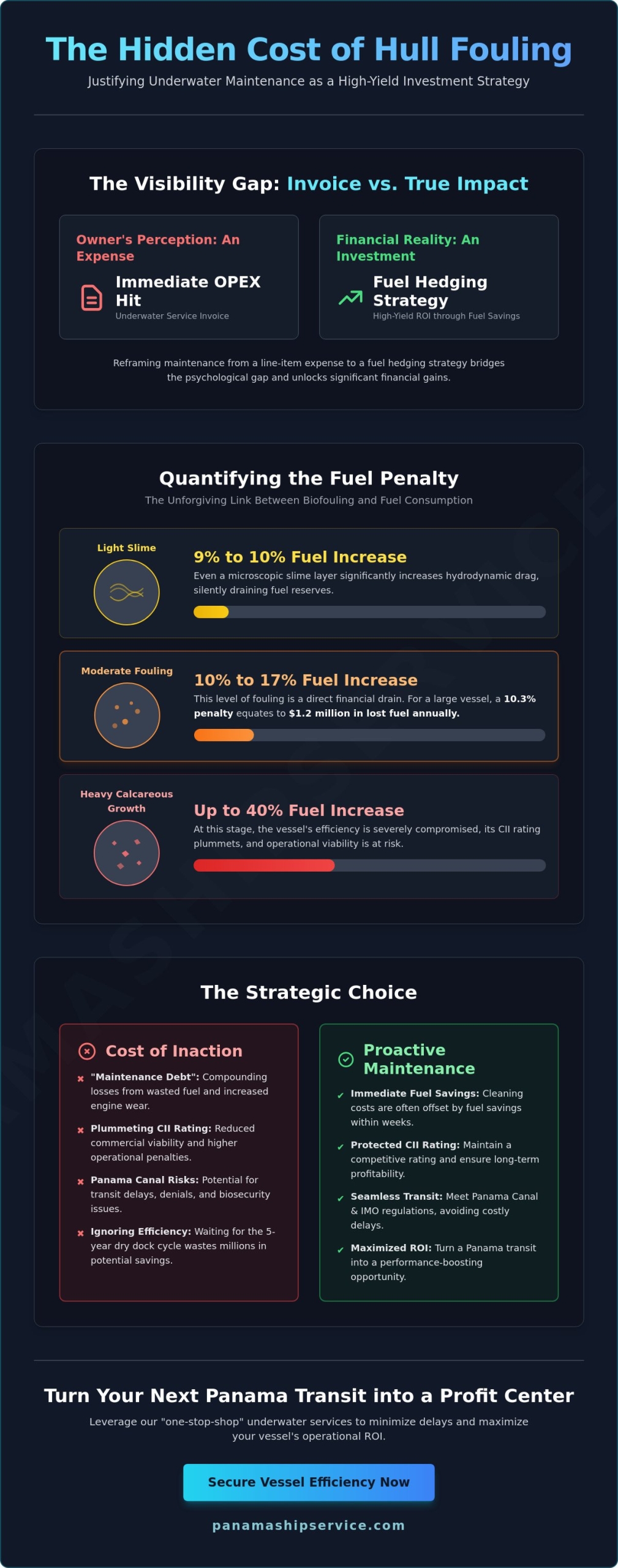
A single layer of moderate marine fouling can silently siphon 1.2 million dollars from a large vessel’s annual budget through a 10.3 percent increase in fuel consumption. We understand the frustration of staring at an underwater service invoice while under intense pressure to slash OPEX. It’s often difficult to see past the immediate cost when fuel savings aren’t visible on a daily spreadsheet. However, justifying hull cleaning costs to owner becomes simple when you stop treating maintenance as an expense and start treating it as a fuel hedging strategy.
At Panama Ship Service, we are experts so you don’t have to be. We’ve seen how regular cleaning reduces fuel consumption by up to 30 percent, providing a vital buffer against 2026 diesel prices that have reached 6.26 dollars per gallon in some regions. This guide provides a clear ROI framework and technical data to back up your maintenance requests. You’ll learn how to use the new ISO 6319 standards to secure approval for underwater services during your next Panama Canal transit. We’ll show you how to ensure your vessel remains efficient, profitable, and fully compliant with the latest IMO biofouling regulations.
Key Takeaways
- Bridge the “visibility gap” by reframing underwater hull maintenance as a high-yield financial investment rather than a simple line-item expense.
- Access the specific technical data and fuel penalty calculations required for justifying hull cleaning costs to owner based on current hydrodynamic drag studies.
- Navigate Panama Canal Authority regulations regarding biofouling to ensure seamless transit and avoid the operational risks associated with reduced maneuverability.
- Build a compelling business case using a “Cost of Inaction” framework that quantifies immediate fuel savings and protects your vessel’s CII rating.
- Leverage a professional “one-stop-shop” approach to minimize transit delays and maximize the ROI of your underwater services.
The Visibility Gap: Why Owners Resist Hull Cleaning Costs
Owners often view a ship’s hull as a static asset. Unlike a failing generator or a cracked liner, the underwater surface remains hidden from daily view. This “out of sight, out of mind” mentality creates a significant psychological barrier. When a superintendent presents a quote for underwater services, the owner typically sees a immediate hit to cash flow rather than a strategic move to protect the vessel’s performance. Bridging this gap requires a fundamental shift in perspective: hull maintenance is not an expense, it is a high-yield investment.
Superintendents often struggle when justifying hull cleaning costs to owner because technical reality and financial reporting speak different languages. To reconcile these, we must look at the science of drag. To understand the root cause of performance loss, it helps to review What is Biofouling? and how it alters the ship’s hydrodynamic profile. Even a light slime layer can trigger a 9 percent increase in fuel consumption. By the time barnacles are visible, that penalty can skyrocket to 40 percent. We are experts so you don’t have to be, and we know that waiting for a problem to become “obvious” is already too late.
Deferred maintenance creates what we call “maintenance debt.” Maintenance debt is the cumulative cost of neglected hull efficiency. Like high-interest financial debt, the longer you wait to “pay” for a cleaning, the more you lose in wasted fuel and engine wear. This debt compounds daily, eroding the vessel’s profitability and its Carbon Intensity Indicator (CII) rating.
The “Invoice vs. Impact” Conflict
Owners naturally focus on immediate OPEX. They see the invoice for divers or robotic cleaning and compare it to a zero-dollar baseline of doing nothing. However, the true baseline is the cost of the fuel penalty. A visual inspection from the deck or a quick look at the boot-top is a useless maintenance trigger. By the time fouling is visible at the waterline, the bottom is likely covered. The point where cleaning costs are officially offset by fuel savings usually occurs much sooner than owners realize, often within just a few weeks of operation in high-fouling environments.
The Hidden Cost of “Waiting for Dry Dock”
The traditional 5-year dry dock cycle is insufficient for modern efficiency targets. Relying solely on dry docking ignores the exponential growth of marine organisms in tropical regions. In the warm waters surrounding the Panama Canal, biofouling accumulates at a rapid pace. A vessel that waits three years for a scheduled dock can easily waste millions in excess fuel. Proactive underwater services during a Panama transit ensure the vessel operates at peak efficiency between major dockings, turning a potential bottleneck into a performance-boosting pit stop.
Quantifying the Fuel Penalty: The Financial Impact of Biofouling
When justifying hull cleaning costs to owner, the conversation must start with the physics of hydrodynamic drag. Every square centimeter of biofouling increases the wetted surface area and skin friction of the vessel. This isn’t merely a technical concern; it’s a direct financial drain. Even a microscopic slime layer, which often goes unnoticed during a deck inspection, can increase drag by as much as 10.3 percent. This small percentage translates to roughly 1.2 million dollars in additional annual fuel costs for a large commercial vessel according to U.S. Naval Academy data.
The relationship between hull roughness and fuel burn is linear and unforgiving. As the fouling severity increases, the vessel’s Carbon Intensity Indicator (CII) rating inevitably drops. A lower CII rating doesn’t just affect the environment; it limits the vessel’s commercial viability and increases operational costs. Consider these verified performance impacts based on fouling levels:
- Light Slime: 9 to 10 percent fuel consumption increase.
- Moderate Fouling: 10 to 17 percent fuel consumption increase.
- Heavy Calcareous Growth: Up to 40 percent fuel consumption increase.
Meeting the Panama Canal Authority (ACP) requirements for hull cleanliness is critical for maintaining transit schedules. A fouled hull isn’t just a fuel hog; it’s a biosecurity risk that can lead to transit denials or costly delays. We are experts so you don’t have to be, and we know that the cost of cleaning is always lower than the cost of a rejected transit.
The Silent Budget Destroyer: Slime and Algae
Soft fouling is the precursor to hard growth. This “slime penalty” hits the daily burn rate immediately, forcing the engine to work harder to maintain the same speed. If left untreated, soft algae provide the ideal substrate for hard calcareous organisms to attach. The financial difference between a proactive “light wipe” and a reactive “heavy scraping” is substantial. Soft cleaning is faster, preserves the integrity of the hull coating, and stops the maintenance debt from compounding.
Hard Fouling and Mechanical Stress
Hard fouling like barnacles creates extreme turbulence along the hull. This increases the load on the main engine, leading to higher exhaust gas temperatures and constant over-torque conditions. This mechanical stress accelerates component failure. Neglecting the hull often leads to the need for extensive mechanical ship repairs to address damaged bearings and overworked propulsion systems. Proactive maintenance from Panama Ship Service ensures your vessel avoids these costly mechanical breakdowns during your next transit.
Panama Canal Specifics: Risk Management and Transit Efficiency
The Panama Canal is a high-stakes environment where operational efficiency isn’t just a goal; it’s a requirement for survival. With Neopanamax transit tolls exceeding 840,000 dollars and auction fees for priority slots reaching as high as 4 million dollars in early 2026, any delay is a financial catastrophe. We are experts so you don’t have to be, and we recognize that a fouled hull is a primary driver of transit sluggishness. When you are justifying hull cleaning costs to owner, you must frame the service as a risk management tool that protects these massive transit investments. Between October 2025 and March 2026, the Canal recorded 6,288 transits. In such a crowded schedule, the Panama Canal Authority (ACP) has zero tolerance for vessels that cannot maintain their assigned speed or maneuverability due to excessive drag.
Cleaning at the Canal entrance provides a strategic advantage for the next leg of your voyage. It’s the ideal “pit stop” to reset your vessel’s performance. A clean hull ensures you don’t just pass through the Canal, but you do so with the lowest possible fuel burn and the highest degree of safety. Proactive maintenance here prevents mandatory cleaning orders from the ACP, which can cause missed windows and spiraling costs.
Maneuverability and Safety at the Locks
The narrow confines of the locks require precision. A hull covered in hard fouling creates turbulent flow that interferes with rudder effectiveness and bow thruster performance. Pilots rely on predictable vessel responsiveness. If a ship is sluggish, the risk of a lock strike or grounding increases significantly. Excessive drag also forces the main engine to operate at higher loads, increasing the risk of overheating or mechanical failure during critical maneuvers. Investing in professional underwater hull services before transit ensures your vessel handles exactly as the pilot expects, minimizing the chance of costly incidents.
Biofouling Regulations and Global Compliance
The regulatory landscape changed significantly in February 2026 when the IMO recommended a new legally binding instrument for biofouling management. This shift, combined with the March 2026 publication of the ISO 6319 standard, means that justifying hull cleaning costs to owner is now about legal compliance as much as fuel savings. A dirty hull is no longer just a technical issue; it’s a biosecurity threat. Many ports now refuse entry to vessels with visible fouling to prevent the spread of invasive species. The financial penalty of being turned away from a discharge port far outweighs the cost of a routine underwater cleaning in Panama.
Building the Business Case: A Framework for Owners
Moving from technical necessity to financial approval requires a structured argument. Owners don’t just want to know that the hull is dirty; they need to know how much that dirt costs them every day. We are experts so you don’t have to be, and we’ve found that the most successful superintendents use a data-driven approach. Start by gathering fuel logs from the last 90 days and comparing them to the vessel’s original speed-power curves. When the gap between intended and actual performance widens, you have the foundation for justifying hull cleaning costs to owner. Objective evidence is the only way to cut through budget resistance.
Perform a “Cost of Inaction” analysis. If a vessel is burning an extra 10.3 percent in fuel due to moderate fouling, and marine fuel is priced near 6.26 dollars per gallon, the daily loss is staggering. Presenting the payback period is your strongest move. In most cases, the fuel savings realized after a professional cleaning will cover the entire service invoice in less than six weeks. This isn’t a long-term gamble; it’s a short-term win for the vessel’s quarterly performance report.
The Data-Backed Pitch
Visual proof is often the final piece of the puzzle. Utilizing professional marine surveys in Panama provides high-definition photographic evidence of fouling severity. By calculating a 3-month fuel savings forecast based on current burn rates, you can demonstrate that the cleaning invoice is fully recovered before the next quarterly report. This shift from “we should clean” to “we are losing $X per day” changes the conversation from an expense to a recovery of lost profit. Secure your vessel’s efficiency by scheduling a marine survey in Panama to verify your ROI potential.
Addressing the “Dry Dock” Objection
Owners often suggest waiting for the next scheduled dry dock to save money. This is a false economy. Mid-cycle cleaning actually protects the owner’s long-term assets by preventing permanent damage to expensive anti-fouling coatings. Hard calcareous growth can “root” into the coating, requiring aggressive scraping that strips the hull to bare metal during dry dock. Proactive in-water cleaning is much gentler. Additionally, don’t overlook propeller polishing. It’s a high-ROI “quick win” that can be performed simultaneously, further reducing the payback period and engine load. Maintaining the hull in-water can also reduce dry dock duration by up to 2 days, as there is less heavy growth to remove before painting begins.
Panama Ship Service: Your Partner in Operational ROI
Maximizing vessel efficiency requires more than just data; it requires a partner who understands the high-pressure environment of the Panama Canal. We are experts so you don’t have to be. Our team specializes in turning maintenance challenges into competitive advantages. When you are tasked with justifying hull cleaning costs to owner, the reliability of the service provider is just as important as the ROI calculations. Choosing a seasoned partner ensures that the cleaning is performed safely, effectively, and without disrupting your transit schedule. We focus on tangible results that minimize vessel expenses and save time.
Our “One-Stop-Shop” approach is designed specifically for busy superintendents and owners. Instead of managing multiple vendors, you can consolidate your requirements through a single, trusted point of contact. This integration reduces administrative friction and ensures that all underwater services are coordinated with your arrival at Balboa or Cristobal. We provide the specialized equipment and qualified divers necessary to deliver a non-destructive clean that preserves your hull coating while restoring hydrodynamic performance.
Expertise at the Canal
With 20 years of experience at the Panama Canal, we’ve developed a deep understanding of local operational demands. We provide constant daily communication so you’re never in the dark regarding your vessel’s status. Our rapid response teams are strategically positioned to meet vessels at both the Pacific and Atlantic entrances. This geographical advantage allows us to execute hull cleanings during the natural waiting periods of a transit, effectively eliminating additional downtime. We prioritize efficiency because we know that in the shipping industry, timing is everything.
The Value of Integrated Services
Hull maintenance is often just one part of a larger technical requirement. Our expertise allows us to integrate cleaning with other essential tasks, such as mechanical ship repairs in Panama, MARPOL disposals, and detailed marine surveys. This holistic approach ensures your vessel leaves the Canal in peak condition. By handling the technical complexities, we allow owners to focus on their core business operations. Justifying hull cleaning costs to owner becomes effortless when the service is part of a comprehensive strategy to reduce overall OPEX and prevent future mechanical failures. Put your transit in our hands and experience the difference of a truly professional maritime partner.
Contact Panama Ship Service for a comprehensive underwater maintenance quote.
Secure Your Vessel’s Performance and Profitability
Transforming hull maintenance from an operational burden into a financial advantage is the key to modern fleet management. By addressing the visibility gap and utilizing data-driven fuel forecasts, you stop the drain on your vessel’s budget. Successfully justifying hull cleaning costs to owner requires shifting the focus from the immediate invoice to the long term fuel savings and essential compliance with the 2026 IMO biofouling standards. Proactive cleaning during a Panama transit isn’t just about speed; it’s about protecting your CII rating and ensuring your ship remains a competitive asset in a high-cost environment.
Panama Ship Service is your trusted partner at the Panama Canal. With 20 years of expertise, our Class-approved underwater teams provide the precision your fleet deserves. We offer a one-stop-shop for repairs, surveys, and MARPOL disposal; this allows you to focus on your cargo while we handle the technical details. Put your transit in our hands and reset your vessel’s efficiency for the voyage ahead. Get a Professional Quote for Hull Cleaning in Panama and start recovering your lost fuel ROI today. Your fleet’s peak performance is just one transit away.
Frequently Asked Questions
How quickly does fuel efficiency drop due to hull fouling?
Fuel efficiency begins to decline as soon as a biofilm forms, which can take less than 14 days in tropical environments. According to a U.S. Naval Academy study, even a light slime layer increases hydrodynamic drag by 10.3 percent. If left untreated, this soft fouling quickly evolves into hard growth, leading to fuel consumption penalties that can reach 40 percent within a few months of operation.
Is underwater hull cleaning safe for anti-fouling paint?
Modern underwater cleaning is safe for anti-fouling paint provided that specialized, non-destructive equipment is used. We utilize soft, rotating brushes and controlled water pressure to remove biofouling without stripping the expensive biocidal layers of your coating. Proactive cleaning actually extends the life of the paint by preventing hard calcareous organisms from rooting into and permanently damaging the hull’s surface.
What is the typical ROI period for a professional hull cleaning?
The typical ROI period for professional cleaning is between four and six weeks of active operation. This rapid payback is the most effective metric when justifying hull cleaning costs to owner. Because fuel savings often range from 10 to 30 percent, the reduction in bunker expenses quickly offsets the service invoice. In a high-cost fuel market, the “cost of inaction” far exceeds the price of the cleaning itself.
Can hull cleaning be performed during Panama Canal transit?
Cleaning is frequently performed during the mandatory waiting periods at the Pacific or Atlantic entrances of the Panama Canal. Our teams operate at the Balboa and Cristobal anchorages to ensure your vessel is serviced without adding a single hour of downtime to your schedule. This allows you to maximize the efficiency of your transit and arrive at your next port with a clean, high-performance hull.
How does hull cleaning affect a vessels CII (Carbon Intensity Indicator) rating?
Hull cleaning directly improves a vessel’s Carbon Intensity Indicator (CII) rating by reducing the fuel required to maintain transit speeds. Since the CII rating is based on CO2 emissions per cargo capacity and distance, lower fuel consumption leads to a more favorable grade. Maintaining a clean hull is one of the most cost-effective ways to ensure your vessel remains compliant with 2026 IMO carbon intensity regulations.
What happens if the Panama Canal Authority (ACP) finds excessive fouling on my vessel?
The Panama Canal Authority (ACP) may deny transit or impose mandatory cleaning orders if a vessel is deemed a biosecurity risk or an operational hazard. Heavy fouling can interfere with maneuverability in the locks, leading to safety concerns for pilots. A rejected transit can result in missed windows, auction fee losses, and significant daily demurrage costs that far outweigh the price of a proactive cleaning.
How often should a commercial vessel have its hull cleaned in tropical waters?
Commercial vessels operating in tropical waters should undergo hull inspections and cleaning every 4 to 6 months. High water temperatures in regions like Panama accelerate the growth rates of marine organisms. This proactive schedule simplifies the process of justifying hull cleaning costs to owner by avoiding the severe mechanical stress and 40 percent fuel penalties associated with heavy calcareous growth.
Is propeller polishing worth the cost if we are already cleaning the hull?
Propeller polishing is a high-value addition that often yields a 3 to 5 percent increase in fuel efficiency by itself. Because the propeller operates at high RPMs, even minor roughness causes significant cavitation and loss of thrust. Performing this service alongside a hull cleaning provides a combined “quick win” that further reduces the engine load and shortens the overall ROI period for the entire underwater maintenance package.