
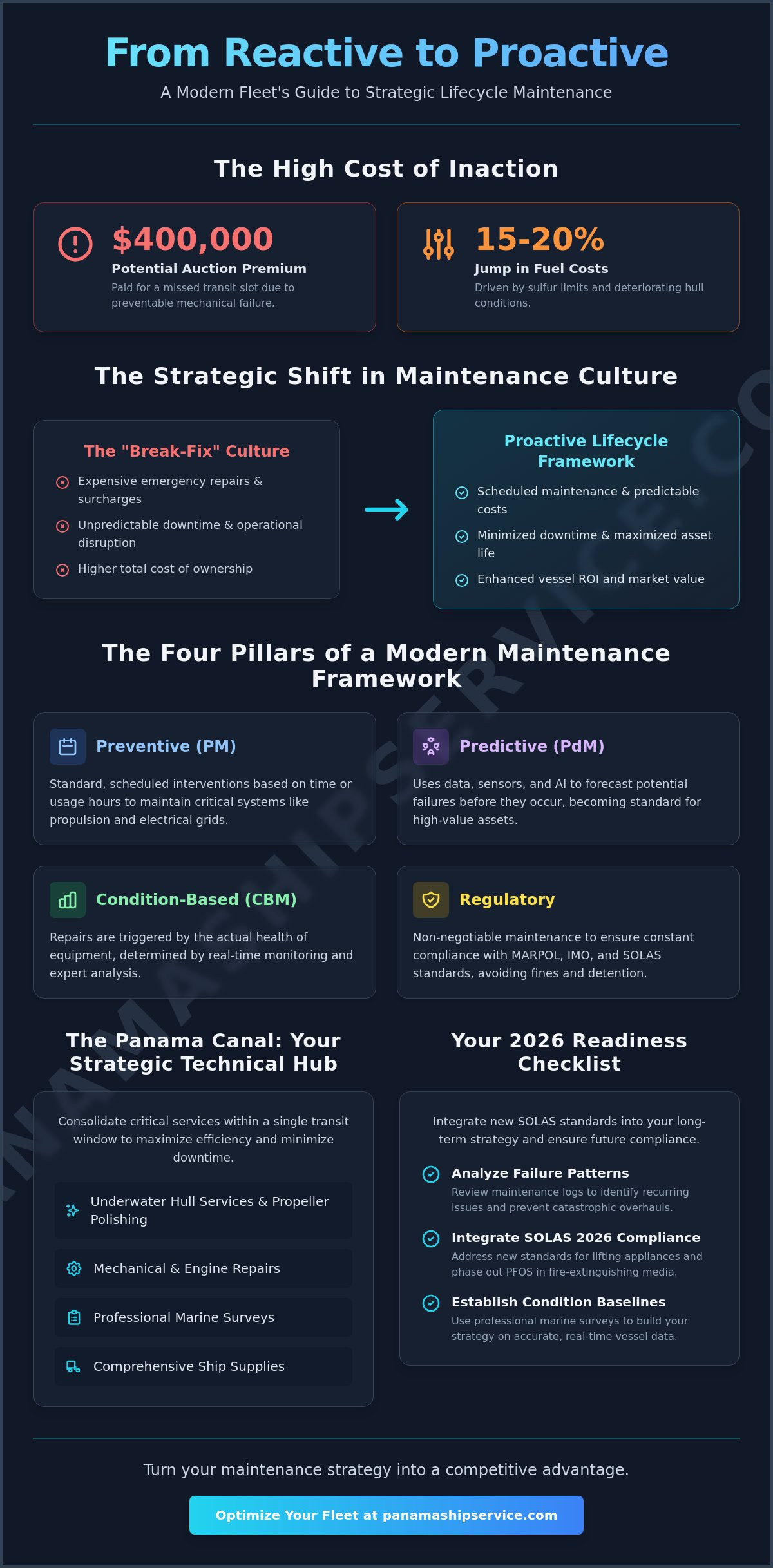
What if a $400,000 auction premium was the price your fleet paid simply because a preventable mechanical failure cost you a reserved transit slot? For fleet operators, the difference between a profitable voyage and a logistical nightmare often comes down to the maturity of your long-term ship maintenance strategy. You’re likely already feeling the pressure of rising fuel costs, which have jumped 15-20% for many due to sulfur emission limits and deteriorating hull conditions. It’s a constant challenge to manage a patchwork of vendors while struggling to keep your vessels compliant with the latest 2026 SOLAS standards for lifting appliances and fire-extinguishing media.
We understand that reactive repairs don’t just drain budgets; they disrupt your entire operational rhythm. This guide helps you move beyond emergency fixes toward a strategic lifecycle framework that turns the Panama Canal into a technical asset for your fleet. You’ll learn how to establish predictable maintenance windows that minimize downtime and significantly lower total ownership costs. We’ll examine how to coordinate underwater hull services and mechanical repairs at strategic hubs to guarantee regulatory compliance, streamline your vendor management, and maximize vessel ROI for years to come.
Key Takeaways
- Transition from a costly “break-fix” culture to a proactive lifecycle framework to prevent the compounding interest of deferred maintenance.
- Build a resilient long-term ship maintenance strategy by integrating scheduled preventive tasks with data-driven predictive maintenance technologies.
- Implement a Class Maintenance Plan (CMP) to systematically manage critical systems and guarantee compliance with 2026 maritime safety regulations.
- Optimize vessel ROI and fuel efficiency by prioritizing underwater hull services and propeller polishing to reduce hydrodynamic drag.
- Utilize the Panama Canal as a strategic technical hub to consolidate mechanical repairs, marine surveys, and ship supplies within a single transit window.
Defining the Strategic Shift: From Reactive Repairs to Lifecycle Management
Operating a fleet on a “break-fix” basis is an expensive gamble that modern maritime logistics can no longer afford. While reactive repairs might seem like a way to save immediate cash, they actually increase the total cost of ownership through lost time and emergency surcharges. A robust long-term ship maintenance strategy shifts the focus from emergency response to asset preservation. This transition represents a fundamental move toward financial asset management. By planning ahead, operators can avoid the “new work” surprises that often inflate dry-docking invoices. When you identify issues early, you control the schedule rather than letting the equipment dictate your downtime.
Comprehensive management involves more than just fixing broken engines. It encompasses the entire scope of ships husbandry, including the systematic upkeep of the hull, rigging, and specialized equipment. When maintenance is viewed as a lifecycle activity, every intervention serves to extend the vessel’s operational life and protect its market value. This approach is particularly critical at strategic hubs like the Panama Canal, where a single missed transit slot due to mechanical failure can result in massive auction premiums or reservation penalties.
The Anatomy of Lifecycle Cost Analysis (LCCA)
LCCA helps managers look beyond the initial purchase price or the cost of a single repair. It accounts for the long-term impact of maintenance decisions, such as how poor hull condition leads to significant fuel penalties. As IMO sulfur emission limits have already pushed fuel expenses up by 15-20% for many operators, maintaining a clean hull is a financial priority. Lifecycle Cost Analysis is the balance between preventive investment and operational savings.
Transitioning Your Fleet: The 2026 Readiness Checklist
To move toward a proactive model, start by evaluating your current maintenance logs for recurring failure patterns. You must identify “leverage points” where small mechanical repairs or part replacements prevent catastrophic engine overhauls. With new 2026 regulations now in effect, such as the SOLAS standards for lifting appliances and the prohibition of PFOS in fire-extinguishing media, compliance must be integrated into your long-term ship maintenance strategy. Establishing a baseline for vessel condition through professional marine surveys in Panama ensures that your strategy is built on accurate, real-time data. This allows you to address technical necessities before they become operational liabilities.
The Four Pillars of a Modern Maintenance Framework
A successful long-term ship maintenance strategy relies on a balanced application of four distinct methodologies. These pillars ensure that technical reliability and fiscal responsibility work in tandem to protect your fleet’s operational integrity. By diversifying your approach, you avoid the pitfalls of relying solely on one type of intervention. This framework allows for a more granular control over both scheduled downtime and unexpected repairs.
- Preventive Maintenance (PM): These are standard, scheduled interventions based on specific time intervals or equipment usage hours. It’s the baseline for keeping critical systems like propulsion and electrical grids running.
- Predictive Maintenance (PdM): This pillar uses data and sensors to forecast potential failures before they manifest. With AI investment in the maritime sector expected to double through 2026, PdM is becoming a standard for high-value assets.
- Condition-Based Maintenance (CBM): Repairs are executed based on the actual health of the equipment. This requires real-time monitoring and engineering expertise to determine if a component can continue in service or needs immediate attention.
- Regulatory Maintenance: This ensures constant compliance with MARPOL, IMO, and SOLAS standards. It’s a non-negotiable requirement to avoid fines and detention at strategic ports.
Condition-Based vs. Predictive Approaches
While often used interchangeably, these approaches differ in execution and technology. CBM typically relies on point-in-time assessments like vibration analysis or simple visual inspections by the crew. In contrast, PdM uses continuous monitoring to identify long-term trends. For example, utilizing underwater hull services allows operators to monitor biofouling levels with precision. This data helps determine the exact moment a hull cleaning is required to prevent the 15-20% fuel cost increase associated with poor hull condition. Balancing automated sensor data with manual engineering expertise ensures that technical decisions remain grounded in operational reality.
Integrating MARPOL Compliance into Your Strategy
Waste management is a core maintenance priority, not an afterthought. Inefficient sludge and bilge handling can lead to severe port delays and heavy fines that disrupt your entire schedule. By treating environmental compliance as a maintenance task, you streamline your operations and reduce overhead. Linking MARPOL disposal in Panama to your long-term environmental audit ensures that your fleet remains ready for inspection at any moment. This proactive approach avoids the logistical bottlenecks that occur when waste accumulates beyond storage capacity. If you’re looking to consolidate these pillars into a single operational window, you can schedule mechanical ship repairs during your next Canal transit to maximize uptime.
Engineering the Class Maintenance Plan (CMP)
A Class Maintenance Plan (CMP) serves as the technical manual for your vessel’s operational life. It’s often called the “bible” of maintenance because it translates the broad goals of a long-term ship maintenance strategy into specific, actionable tasks. Without a meticulously engineered CMP, your fleet is at the mercy of equipment failure and regulatory scrutiny. A strong plan moves beyond simple oil changes; it creates a predictable roadmap that aligns technical needs with commercial schedules.
Engineering this plan requires a systematic three step process:
- Step 1: Inventory of Critical Systems. You must catalog every system essential for propulsion, structural integrity, and electrical distribution. This includes everything from the main engine and auxiliary generators to the integrity of the steel hull itself.
- Step 2: Determining Frequency. Maintenance intervals aren’t arbitrary. You must balance Original Equipment Manufacturer (OEM) recommendations with the mandatory requirements of your Class Society, such as ABS or DNV.
- Step 3: Supply Chain Alignment. A maintenance schedule is only effective if the necessary parts and technicians are available. You must align your CMP with global supply chain realities to ensure that “maintenance day” doesn’t become “waiting for parts week.”
Integrating these steps into a long-term ship maintenance strategy ensures that every vessel in your fleet remains a productive asset rather than a liability. This proactive engineering allows you to manage multiple vendors across different ports without losing sight of the overall technical objective.
Mechanical and Steel Fabrication Priorities
Structural integrity is the foundation of vessel safety. You must plan for periodic steel thickness gauging to identify corrosion before it requires emergency plate replacement. By coordinating mechanical ship repairs during scheduled Canal transits, you address wear and tear on your own terms. Don’t overlook secondary systems like A/C and refrigeration. These are vital for crew welfare and cargo preservation, directly impacting the ship’s overall performance and safety culture.
Logistics and Spare Parts Management
Lead times for specialized marine components can often exceed six months. You can reduce these critical delays by pre-positioning essential spares at strategic hubs. Accessing reliable ship supplies in Panama ensures your CMP execution isn’t stalled by customs bottlenecks or international shipping lags. Accurate logistics data prevents “out-of-service” days by ensuring that the right parts arrive at the pier before the technician steps on board. This level of coordination is what separates profitable fleet operators from those constantly fighting fires.
Financial Optimization: Reducing OPEX and Minimizing Transit Downtime
Deferred maintenance behaves exactly like high-interest debt. When an operator ignores a minor mechanical issue to save immediate cash, they’re essentially borrowing against the vessel’s future reliability. This “compounding interest” manifests as emergency repair surcharges, expedited shipping fees for spares, and the devastating cost of missed transit windows. A long-term ship maintenance strategy eliminates these financial spikes by replacing emergency responses with predictable, budgeted interventions. It’s a shift from technical desperation to disciplined asset management.
Strategic planning is always more cost-effective than emergency reaction. When repairs are scheduled, you retain procurement leverage. You aren’t forced to accept the first available vendor’s price because your ship is dead in the water. Instead, you can utilize the competitive service market at the Panama Canal to secure the best value. This approach also protects you from the surging costs of last-minute transit auctions, which have recently reached premiums between $385,000 and $425,000 for vessels without reservations. A single mechanical failure that causes a missed slot can instantly wipe out a voyage’s entire profit margin.
Calculating the ROI of Preventive Hull Cleaning
Hull fouling is a silent profit killer that directly impacts your daily operating expenses. Research indicates that even moderate biofouling can increase fuel consumption by 10% to 15%. With IMO sulfur emission limits already driving fuel costs up by nearly 20% for many fleets, this penalty is financially unsustainable. Utilizing underwater hull services in Panama allows you to maintain optimal speed-over-ground without overworking the main engine. Regular in-water inspections and propeller polishing also extend the intervals between expensive dry-dockings, keeping your vessel in active service for longer periods.
Avoiding the “Emergency Repair” Trap
The “emergency repair” trap is a cycle of high-cost, short-term fixes. Emergency welding and specialized fabrication often carry a significant premium compared to scheduled work. By integrating mechanical ship repairs in Panama into your existing transit schedule, you turn necessary downtime into productive maintenance windows. This level of coordination ensures that technicians and materials are pier-side the moment your vessel arrives. To protect your bottom line, you can coordinate your next repair project with an experienced local partner to ensure your long-term ship maintenance strategy remains on track and within budget.
Executing Your Strategy at the Panama Canal Hub
The Panama Canal is more than a logistical shortcut; it’s the most strategic technical hub in the Americas. For a long-term ship maintenance strategy to be effective, it must leverage geographical bottlenecks where vessels are already required to pause. By consolidating mechanical repairs, marine surveys, and ship supplies into a single transit window, you eliminate the need for additional, dedicated downtime. This approach transforms a mandatory operational stop into a high-value maintenance opportunity that protects your schedule and your budget.
Executing maintenance at a central hub reduces the logistical friction of managing a global fleet. Instead of coordinating with different vendors in every port of call, operators can centralize their technical requirements in a location with established infrastructure and specialized expertise. This geographical focus allows for better quality control and more predictable service outcomes. It’s the most efficient way to ensure that every vessel remains compliant with evolving international standards without adding unnecessary days to the voyage.
The One-Stop-Shop Advantage
Managing multiple vendors across different time zones creates administrative overhead and increases the risk of schedule slippage. Panama Ship Service acts as your primary operational partner, allowing owners to delegate the complexity of technical coordination to a single, experienced entity. We synchronize mechanical ship repairs with underwater hull services and MARPOL disposal simultaneously. This integrated approach ensures that all technical work is completed within the transit window. Proactive communication with canal authorities further minimizes the risk of delays, ensuring that your long-term ship maintenance strategy remains an asset rather than a logistical burden.
Next Steps: Auditing Your Current Fleet Strategy
Refining your approach begins with a clear assessment of your fleet’s current status. We recommend scheduling a pre-transit condition survey to identify immediate technical needs before they escalate into costly emergencies. As you build your 2026 maintenance calendar, you should integrate Panama-based service windows to ensure your vessels remain compliant with the latest SOLAS and MARPOL requirements. This forward-looking planning prevents the “new work” surprises that often disrupt dry-docking budgets.
Contact Panama Ship Service today for a comprehensive technical consultation. Our team is ready to help you transition from reactive repairs to a strategic lifecycle framework. By partnering with a seasoned veteran in the field, you can simplify your operations, reduce your overhead, and guarantee the long-term reliability of your entire fleet.
Securing Your Fleet’s Operational Future
Transitioning from reactive repairs to a structured lifecycle framework is the most effective way to protect your vessel’s ROI. You’ve seen how proactive planning, supported by a rigorous Class Maintenance Plan and condition-based monitoring, prevents the compounding costs of technical neglect. By leveraging strategic hubs, you ensure that your fleet remains compliant with 2026 SOLAS and MARPOL standards without disrupting your commercial schedule.
Implementing a long-term ship maintenance strategy requires a partner who understands the high-stakes nature of canal transits. Panama Ship Service offers a comprehensive one-stop-shop for mechanical repairs, underwater hull services, and MARPOL disposal. Our team provides class-approved underwater inspections and surveys with a specific focus on minimizing transit delays at the Panama Canal. We handle the technical complexity so you can focus on your core operations.
Contact Panama Ship Service to optimize your vessel maintenance strategy today. We look forward to helping you achieve a more predictable and profitable operational lifecycle.
Frequently Asked Questions
What is the difference between preventive and predictive ship maintenance?
Preventive maintenance follows a fixed schedule based on running hours or calendar dates, regardless of the component’s actual health. Predictive maintenance uses real-time data and sensors to forecast exactly when a component will fail. This advanced approach allows for interventions only when necessary. It reduces unnecessary part replacements and labor costs while preventing catastrophic breakdowns that disrupt your operational schedule.
How often should a long-term ship maintenance strategy be reviewed?
You should review your long-term ship maintenance strategy at least once a year or following significant regulatory changes. This ensures the plan remains aligned with vessel performance data and changing international requirements, such as the 2026 SOLAS updates. A regular audit allows you to adjust for unexpected wear patterns or shifts in the global supply chain, keeping your fleet’s technical roadmap accurate and cost-effective.
Can underwater hull cleaning be performed during a Panama Canal transit?
Yes, underwater hull cleaning can be executed while a vessel is at anchorage in the Pacific or Atlantic entries of the Panama Canal. Coordinating these services during the transit window maximizes uptime and prevents the need for additional, dedicated stops. Our team synchronizes these technical interventions with your scheduled arrival to ensure there’s zero impact on your reserved transit slot or voyage timing.
What are the core components of a Class Maintenance Plan (CMP)?
A CMP consists of a comprehensive inventory of critical systems, a defined schedule of maintenance tasks, and a robust documentation system. It must align with both manufacturer recommendations and Class Society requirements. By engineering a precise CMP, you create a technical manual that guides your long-term ship maintenance strategy. This ensures constant seaworthiness and provides clear accountability for every mechanical intervention performed on the vessel.
How does a maintenance strategy impact MARPOL compliance?
A proactive strategy integrates waste management and emission control into daily operations to ensure constant compliance. Regular maintenance of oily water separators and incinerators ensures you meet MARPOL Annex I and VI standards. Treating environmental compliance as a maintenance task prevents port detentions. It also ensures efficient sludge and bilge disposal during your technical stops at major hubs, reducing the risk of environmental fines.
Is it more cost-effective to repair in-water or in a dry dock?
In-water repairs are generally more cost-effective for mechanical and hull tasks that don’t require structural dry-docking or major steel replacement. By performing class-approved underwater inspections and minor mechanical fixes at a strategic hub, you avoid the massive overhead and off-hire time associated with a shipyard. This preserves your operational cash flow while maintaining high asset integrity and safety standards throughout the vessel’s lifecycle.
How can ship owners reduce fuel consumption through maintenance?
Fuel consumption is primarily reduced through regular propeller polishing and hull cleaning to minimize hydrodynamic drag. Maintaining optimal engine performance through scheduled mechanical tuning also prevents efficiency losses. Given that poor hull condition can increase fuel costs by 15-20% for many operators, these technical interventions are essential. They directly impact your bottom line by reducing daily operating expenses and improving speed-over-ground performance.
What role does the Panama Canal play in global ship maintenance strategies?
The Panama Canal serves as a strategic technical hub where fleet operators can consolidate multiple services into a single operational window. Its unique location allows owners to execute repairs, surveys, and supplies without deviating from major trade routes. This geographic advantage is a cornerstone of an efficient global maintenance framework. It allows for complexity delegation to a single, reliable local partner, simplifying your fleet’s technical management.