
A main engine fault during a Panama Canal call can put crew safety, vessel condition, and the schedule under pressure at the same time. Effective main engine breakdown assistance starts with controlled onboard triage, not guesswork: follow vessel procedures, establish the engine’s status, and communicate the facts clearly.
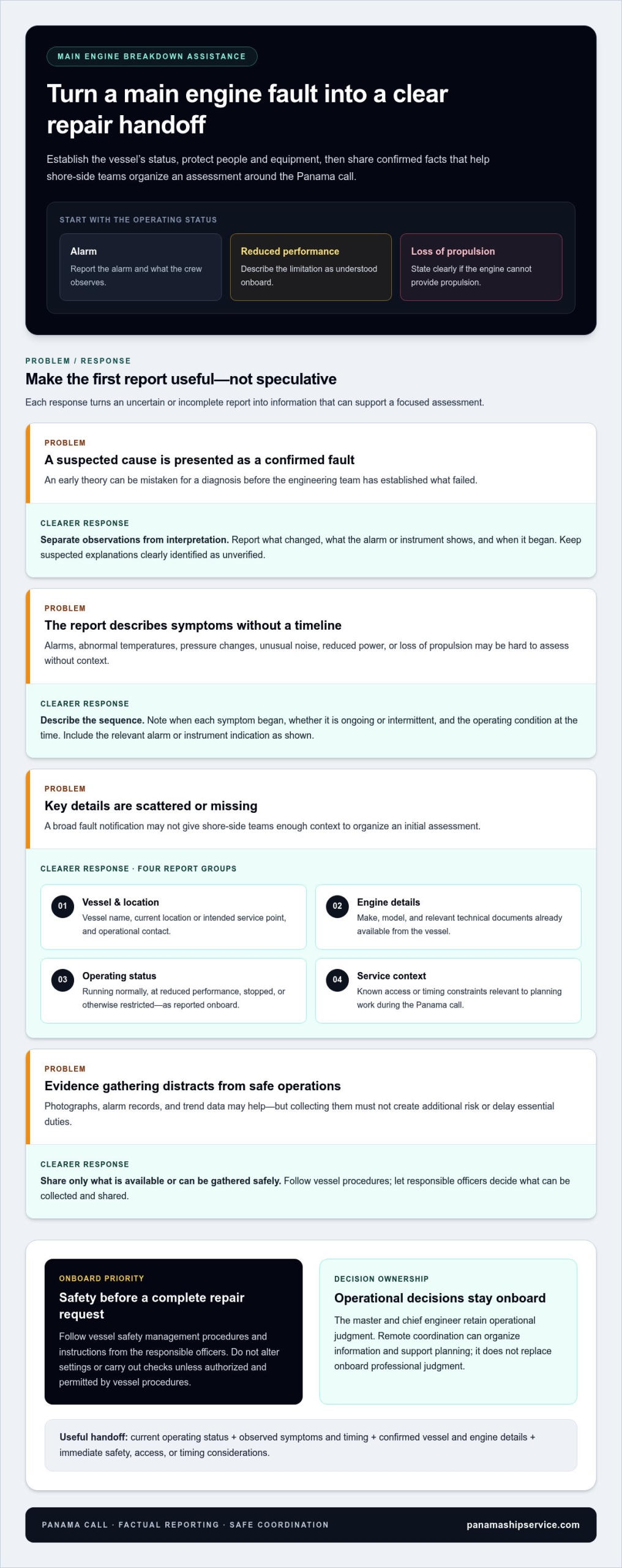
It’s understandable to be concerned about what the fault means and whether repair work will affect the call. A structured response helps the crew protect people and equipment while giving shore-side teams useful information for an initial assessment. This checklist covers immediate onboard priorities, the technical details to share, and how to coordinate local mechanical ship repair support around a vessel’s Panama call. The aim is to make the next decisions clearer and support practical repair planning without losing sight of safe operations.
Key Takeaways
- Distinguish an alarm, reduced engine performance, and loss of propulsion, then follow onboard procedures to assess the situation safely.
- Make main engine breakdown assistance more effective by preparing a concise report with vessel details, engine information, symptoms, and current operating status.
- Separate immediate assessment needs from the information required to define repair scope, access, and coordination requirements.
- Keep operational decisions with the master and chief engineer while organizing a clear request for mechanical repair support.
- Share accurate fault information with Panama Ship Service to discuss mechanical ship repairs and coordinate around the vessel’s Panama Canal call.
Main Engine Breakdown Assistance: Recognize the Situation and Set Priorities
A main engine fault can range from an alarm or reduced output to a complete loss of propulsion. The first priority is not to assign a cause. Establish what the vessel is experiencing, protect the crew and vessel, and follow the ship’s safety management procedures under the direction of the responsible officers.
Main engine breakdown assistance means coordinating support after a reported fault. It is not a diagnosis by itself. An initial report should distinguish observed symptoms from suspected explanations so shore-side teams can organize an assessment without treating an unverified theory as fact. For background on the systems involved, see this overview of marine propulsion systems.
Which main engine symptoms need prompt assessment?
Report changes that may affect engine operation, including alarms, abnormal temperatures, pressure changes, unusual noise, reduced power, or loss of propulsion. These are symptoms, not proof of a particular failure. A changed pressure indication and an alarm describe what the crew observes; they do not establish why it happened.
Under onboard procedures, record when each symptom began, what changed, and whether it is ongoing or intermittent. Note the relevant alarm or instrument indication as shown, along with the operating condition at the time. Avoid altering settings or carrying out checks unless authorized by the responsible officers and permitted by vessel procedures.
What should the vessel prioritize before arranging assistance?
Follow the vessel’s safety management procedures and instructions from the master, chief engineer, and other responsible officers. The chief engineer’s assessment is central to describing the engine’s current condition and determining what information can be gathered safely. Protecting personnel and maintaining vessel safety take priority over preparing a complete repair request.
Remote conversations can help organize information and coordination, but they don’t replace onboard professional judgment. Operational decisions, including how the vessel responds to the fault, remain with the vessel’s command and engineering team. Share only observations and information that can be provided safely and accurately.
Once the immediate situation is managed, a prompt, factual report gives shore-side support a clearer starting point. State whether the engine is operating normally, operating at reduced performance, or unable to provide propulsion. Describe the symptoms and when they began, and identify immediate safety or access considerations. Keep confirmed facts separate from suspected causes. This handoff helps frame the assessment, identify any further information needed, and organize mechanical repair support around the vessel’s call without making assumptions about the fault.
What Engine Information Helps Arrange Main Engine Breakdown Assistance?
A well-organized initial report turns a broad fault notification into a more focused repair assessment. For main engine breakdown assistance, group the information into four areas: vessel and location, engine details, observed symptoms, and current operating status. Share confirmed facts first, then identify information that is unavailable or still being assessed onboard.
Separate observed symptoms from suspected causes. For example, report “pressure reading changed at 14:20” rather than stating that a specific component has failed unless the engineering team has established that finding. This gives the receiving team a reliable starting point without turning an early assumption into a diagnosis.
Which vessel and engine details belong in the initial report?
Include the vessel’s name, current location or intended service point, and a reliable operational contact. Add the engine make and model as supplied by the vessel, along with relevant technical documents already available. The goal is to identify the equipment and call context, not to infer details that haven’t been provided.
- Vessel: name, location or intended service point, and operational contact.
- Engine: make, model, and available technical documentation supplied by the vessel.
- Operating status: whether it is running normally, at reduced performance, stopped, or otherwise restricted, as reported by the onboard engineering team.
- Service context: known access or timing constraints relevant to planning work during the Panama call.
Keep the status summary concise. If the engine is stopped, state that directly. If it remains in operation with a limitation, describe the limitation as the crew understands it and note who assessed it. This helps align the repair discussion with the vessel’s actual situation.
How should the crew describe symptoms and evidence?
List alarms, readings, and observed changes with their times when available. Include the units shown on instruments, and indicate whether a value was steady, rising, falling, or intermittent. A short sequence of events can be more useful than a long narrative, especially when several indications changed at different times.
Photographs, alarm records, and trend data can add context if they’re already available or can be gathered safely. Don’t delay essential duties or enter a hazardous area to collect evidence. Follow onboard procedures, and let responsible officers decide what can be shared. The International Maritime Organization (IMO) resources provide broader context on international shipping, while vessel-specific procedures guide the onboard response.
Before sending the report, separate direct observations from interpretation. Label a suspected cause as a suspicion, not a confirmed fault. This makes discussion of the repair scope clearer and can reduce unnecessary follow-up. For vessels planning mechanical ship repair support at the Panama Canal, Panama Ship Service’s mechanical ship repairs provide a local coordination point for discussing the reported needs.
How to Evaluate Breakdown Repair Coordination for a Panama Canal Call
A repair plan develops in stages. First, determine what assessment the reported fault requires. Then identify what information is needed to define the work, access, and resources. For a Panama Canal call, coordination must also account for the vessel’s location and operating schedule. A clear plan aligns these factors without assuming a repair method or promising a particular turnaround or transit outcome.
Which factors shape a practical repair plan?
The onboard engineering assessment and reported symptoms help frame the initial scope. Planning also considers where the vessel can be accessed, what work conditions are available, and how the schedule may change. Parts, personnel, and other work requirements depend on the repair scope, so treat them as planning inputs rather than assumptions.
| Planning factor | Immediate assessment | Defined repair scope |
|---|---|---|
| Fault urgency | Understand the reported operating condition and the onboard team’s assessment. | Clarify what work is proposed and what condition it addresses. |
| Access requirements | Identify the vessel’s current or intended service location and any known access limits. | Establish the access and work conditions needed for the defined scope. |
| Technical information | Use the facts and records available to support an initial review. | Identify any further details needed to plan the work and associated resources. |
| Coordination dependencies | Share the call schedule and immediate changes affecting the vessel. | Align work planning with location, access, schedule, and related vessel activities. |
These stages distinguish what needs prompt attention from what requires a more complete work definition. Gard discusses Panama Canal disruption charges for engine failure, underscoring why clear communication and coordinated planning matter when a mechanical issue affects a canal call.
How can repair coordination support vessel schedules?
Share schedule changes and access constraints as they arise. If the vessel’s service location, expected call sequence, or available work window changes, update the parties coordinating the repair. Early notice keeps planning based on current information rather than an outdated schedule.
Where appropriate, relevant mechanical work can be considered alongside other planned vessel services. This may help organize the call, but the work sequence depends on the defined scope, access, and operational needs. Panama Ship Service coordinates mechanical ship repairs at the Panama Canal. Its mechanical ship repair guide provides broader context for planning repair work.
Keep the plan adaptable. A change in the onboard assessment can affect scope, access, or resource requirements, so communicate revised information promptly. The goal is a practical repair plan that reflects the vessel’s needs and schedule, not a guaranteed transit result.
Main Engine Breakdown Assistance Checklist for the Vessel Team
A concise, current request helps organize main engine breakdown assistance without distracting the crew from onboard priorities. Use this sequence to prepare information and manage coordination. Safety actions come first, and the master and chief engineer retain operational decision-making authority under the vessel’s procedures.
What should the team prepare before requesting support?
Gather details as they become safely available. Don’t delay an onboard response to complete a report. Assign a vessel-side contact who can relay technical updates and coordinate practical arrangements while responsible officers manage the vessel’s response.
- Follow onboard procedures. The master and chief engineer direct the response and decide what information can be collected or shared safely.
- Identify the vessel and location. Provide the vessel name, current position or intended service point, and the best operational contact.
- Summarize the condition. State whether the engine is operating, restricted, stopped, or experiencing another status identified by the engineering team.
- Describe the symptoms. Report observed alarms, readings, changes, and when they occurred. Keep suspected causes separate from confirmed observations.
- Supply available engine details. Include the make and model as provided by the vessel, plus relevant technical documentation that’s readily available.
- Explain the call constraints. Share the service window, expected schedule, access arrangements, and known operational restrictions that may affect planning.
If a detail is not immediately available, identify it as pending rather than guessing. A clear partial report is more useful than an unverified answer.
How should the vessel manage updates during coordination?
Keep the report current as the situation changes. The assigned contact should relay material updates to symptoms, engine status, location, access, or schedule. For instance, if the vessel’s service point changes or the engineering team revises its assessment, communicate the update promptly so repair planning reflects current conditions.
Maintain a simple record of observations, communications, and agreed next steps. Note when information was reported, who received it, and any follow-up requested. This creates continuity across handoffs between vessel personnel and shore-side coordinators, especially when operational duties mean different people provide updates.
Before work is organized, ensure the proposed plan is understood by the responsible vessel officers and fits onboard responsibilities and procedures. Coordination supports the work, but it doesn’t replace the master’s or chief engineer’s judgment. Keep technical updates factual and make clear which details are confirmed, changed, or still being assessed.
To discuss mechanical ship repair coordination for a Panama call, contact Panama Ship Service about repair support.
Coordinate Mechanical Repair Support with Panama Ship Service
A clear onboard report gives repair coordination a practical starting point. Panama Ship Service provides mechanical ship repairs for vessels at the Panama Canal, supporting discussion of the reported issue, the vessel’s circumstances, and the work being requested. The report helps clarify what is known and what still needs assessment before a repair scope and service plan can be discussed.
Each vessel call has its own operating context. Location, intended call timing, access arrangements, and other planned work can affect how mechanical support is coordinated. Sharing these details early helps keep planning grounded in the vessel’s circumstances. The repair approach, required resources, and work sequence depend on the reported condition and the scope established through coordination.
What can vessel operators expect when coordinating mechanical repairs?
Expect a practical exchange focused on the vessel’s report and operating context. Share what the onboard team has observed, the current status, and the support being requested. Panama Ship Service uses that information to discuss mechanical repair needs and coordinate relevant work at the Panama Canal. Keep reported symptoms distinct from confirmed findings, without assuming a specific engine outcome, response time, or parts availability.
Mechanical repairs sit within a wider operational support context. If other services are relevant to the vessel’s call, such as supplies or underwater services, their timing may also matter to the overall plan. Include them only where they connect to the vessel’s requirements, and keep the main-engine issue and repair request clear.
What information should a repair request include?
Organize the request so the coordination team can understand who needs support, where the vessel is, and what is being reported. Include the engine details provided by the vessel, but don’t treat the make or model as proof of a particular repair capability. The master and chief engineer retain onboard decision-making authority and should guide what information is shared.
- Vessel and contact: vessel name and a responsible operational or engineering contact.
- Location and timing: current location, intended service point, and expected call timing or known schedule changes.
- Issue and status: observed symptoms, relevant alarms or readings, engine details supplied by the vessel, and the onboard engineering team’s assessment.
- Access and work context: known access constraints, operational limitations, and other work planned during the call that may affect coordination.
Keep updates consistent as the vessel’s position, schedule, or reported condition changes. A concise update that identifies what changed is easier to act on than a replacement report with no explanation. This supports coordinated planning while keeping decisions about vessel operations with the command and engineering team.
For main engine breakdown assistance during a Panama Canal call, share the vessel’s location, symptoms, schedule, and responsible contact with Panama Ship Service. Send your vessel details to discuss mechanical repair support and organize the next coordination steps.
Move from Fault Report to Coordinated Next Steps
A breakdown doesn’t have to leave the vessel team guessing about how to organize the next stage. Use the onboard assessment and current operating picture to begin a practical discussion about repair scope and coordination. Main engine breakdown assistance works best when the vessel’s technical needs and wider call requirements are considered together, with operational decisions remaining onboard.
Mechanical ship repairs are Panama Ship Service’s primary service, supported by a wider range of operational and technical services at the Panama Canal. This coordinated approach aims to consolidate vessel needs and help minimize transit delays, while planning remains specific to the vessel’s circumstances and defined work requirements.
Prepare the vessel’s location, reported symptoms, schedule, access constraints, and a responsible contact so the discussion can start with useful context. Start coordinating mechanical repair support with Panama Ship Service. A clear next step can help your team move forward with greater confidence.
Frequently Asked Questions
Can a vessel continue toward the Panama Canal after a main engine breakdown?
That decision depends on the vessel’s condition and must be made by the master and engineering team under onboard procedures. A fault does not automatically mean the vessel can safely continue, and repair coordination is not authorization to proceed. Assess propulsion and maneuvering capability, consider the risks of continued operation, and follow applicable Panama Canal instructions before entering Canal waters.
What is the difference between a main engine breakdown and reduced engine performance?
A breakdown generally describes a fault that prevents the engine from performing its required function, while reduced performance means it may still operate but cannot deliver expected output or operates with limitations. The distinction should reflect the vessel’s actual condition, not an assumed cause. Reduced power while the engine is running differs operationally from a complete loss of propulsion, even though both need assessment.
What information should a vessel send when requesting engine repair assistance?
Provide enough context for the receiving team to understand the vessel’s situation: its name and position, planned service location, call timing, and a responsible contact. Add the engine details available onboard, current operating condition, and a brief timeline of reported symptoms. Mention access restrictions or schedule changes that could affect planning. Mark uncertain information clearly rather than presenting it as a confirmed finding.
Can a main engine fault be diagnosed remotely?
Remote review can help organize reported symptoms and identify what additional information may be useful, but it cannot always establish the fault conclusively. The assessment depends on the evidence available, and some issues may require onboard inspection or testing by qualified personnel. Treat remote discussion as support for planning, not a replacement for the chief engineer’s assessment or the vessel’s established procedures.
How long does main engine breakdown assistance take in Panama?
There is no single duration that applies to every case. The time needed to organize assistance and complete work depends on the reported condition, repair scope, vessel location, access arrangements, and resources required for the defined work. A clear initial report helps frame the discussion, but it cannot establish a reliable completion time before the situation and scope are assessed.
Can mechanical repairs be coordinated during a Panama Canal vessel call?
Yes. Mechanical ship repairs can be coordinated around a vessel’s Panama Canal call, with planning shaped by the requested work, service location, access, and schedule. Panama Ship Service provides mechanical ship repairs alongside other operational and technical services for vessels at the Canal. Share schedule changes as they occur so coordination can reflect the vessel’s current circumstances without assuming a particular transit outcome.
What should the crew do if the main engine alarm clears but performance remains abnormal?
Don’t treat a cleared alarm as proof that the condition is resolved if performance still seems abnormal. The responsible engineering officers should reassess the engine under vessel procedures, note what remains different, and record when the alarm cleared and the performance concern continued. The master and chief engineer should determine operational next steps. Communicate the continuing symptom accurately when arranging main engine breakdown assistance.