
A single millimeter of biofouling can trigger a 15% increase in your vessel’s fuel consumption, while heavy growth can drive those costs up by as much as 40%. For operators managing thin profit margins, these aren’t just maintenance statistics; they’re direct hits to your bottom line. Managing biofouling for fuel efficiency has become a critical financial strategy rather than a routine chore. We recognize the operational strain caused by rising fuel prices and the mounting pressure of CII compliance. You shouldn’t have to choose between vessel performance and your delivery schedule.
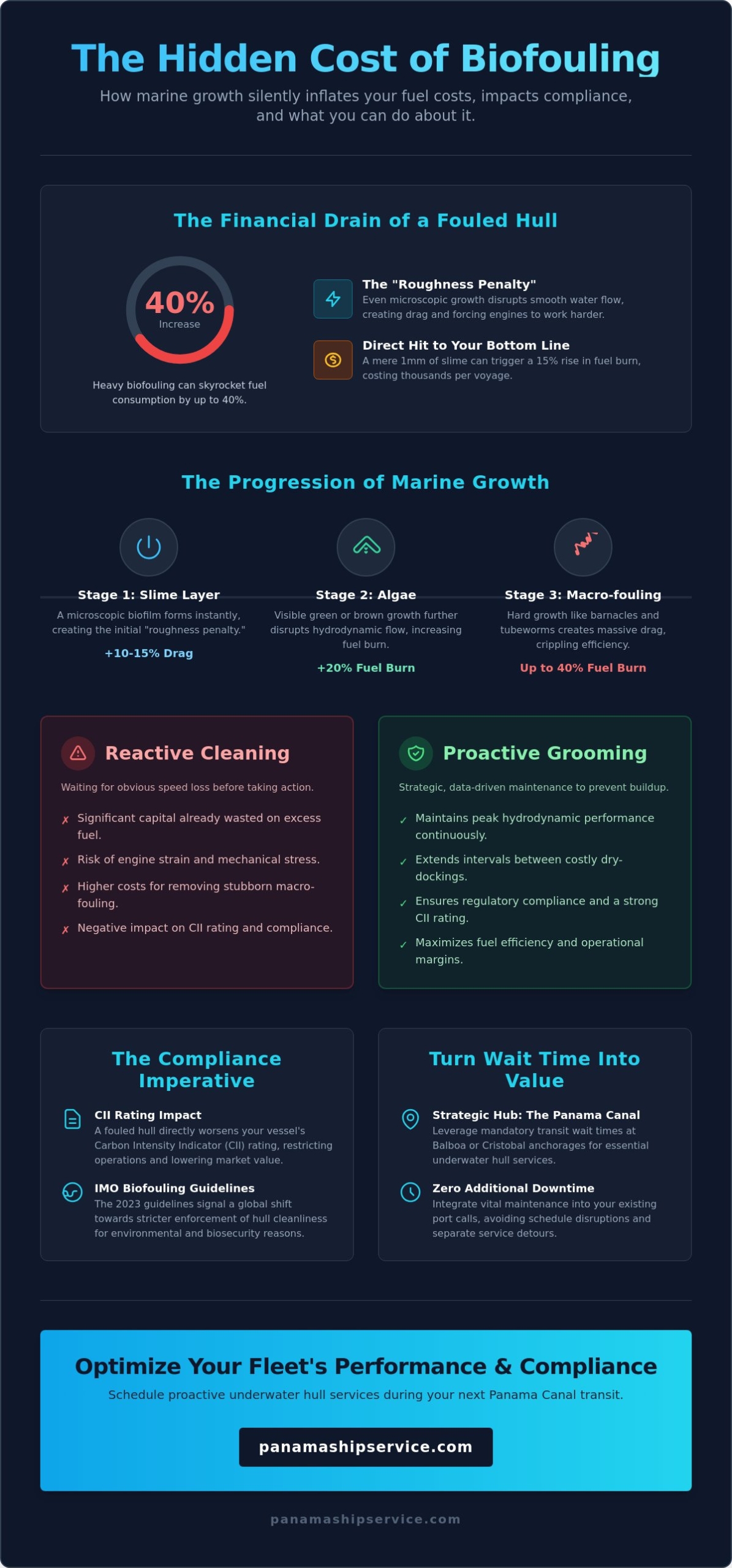
You’re about to discover how proactive biofouling management can slash your fuel spend and ensure total regulatory compliance during your next Panama Canal transit. This guide outlines the shift from reactive cleaning to strategic, data-driven maintenance. We’ll show you how to extend intervals between dry-dockings and integrate hull services into your existing port calls. By the end of this article, you’ll have a clear roadmap for reducing emissions and optimizing your fleet’s operational efficiency in a high-stakes environment.
Key Takeaways
- Quantify the “Roughness Penalty” to understand how early-stage biological settlement impacts vessel hydrodynamics and fuel costs.
- Evaluate the strategic shift from reactive cleaning to proactive hull grooming to prevent macro-fouling and maintain peak performance.
- Leverage mandatory Panama Canal transit wait times at Balboa or Cristobal anchorages to complete essential maintenance without incurring additional downtime.
- Implement a comprehensive plan for managing biofouling for fuel efficiency that ensures regulatory compliance and optimizes your fleet’s operational overhead.
The Financial Impact of Biofouling on Modern Shipping Operations
Biofouling is the unwanted accumulation of microorganisms, plants, and animals on submerged structures, and for vessel operators, it acts as a relentless biological tax on performance. This growth begins the moment a hull enters the water, starting with a microscopic biofilm that quickly evolves into a complex community of marine life. While it might seem like a minor aesthetic issue, the hydrodynamic consequences are severe. Managing biofouling for fuel efficiency is now a baseline requirement for any fleet attempting to maintain competitive operational margins.
The technical reality is that even a “light slime” layer, which is often difficult to see from the surface, can increase vessel drag by up to 10% to 15%. This resistance forces the propulsion system to work significantly harder to maintain design speeds. In financial terms, a mere 1% increase in drag translates to thousands of dollars in annual fuel waste for a single commercial vessel. When you consider that a heavily fouled hull can drive fuel consumption up by as much as 40%, the necessity of a proactive strategy becomes undeniable. These costs don’t just impact your current voyage; they directly influence your vessel’s Carbon Intensity Indicator (CII) rating, which is now a primary metric for global maritime compliance.
The Correlation Between Hull Roughness and Fuel Consumption
The physics of vessel movement relies on maintaining laminar flow, where water moves smoothly across the hull surface. Marine growth disrupts this flow, creating turbulence and increasing skin friction. This is often referred to as the “Roughness Penalty.” You can find more technical details on the Science of Drag: How Marine Growth Sabotages Vessel Hydrodynamics to understand how different species impact these coefficients. While micro-fouling like slime creates a baseline of resistance, macro-fouling, such as barnacles and tubeworms, creates massive drag coefficients that can Cripple a ship’s schedule. Early detection is critical. If you wait until speed loss is obvious, you’ve already wasted significant capital on excess fuel.
Regulatory Pressure: CII Ratings and IMO Biofouling Guidelines
The 2023 IMO Biofouling Guidelines have shifted the industry’s focus toward stricter global port entry requirements. Countries like Brazil and Australia are already enforcing hull cleanliness standards to prevent the spread of invasive species. Beyond environmental protection, these regulations tie directly to your CII rating. A poor rating can restrict your vessel’s operational flexibility and significantly lower its market value during chartering negotiations. Professional underwater hull services are the most effective tool for improving these ratings. By maintaining a clean hull, you ensure that managing biofouling for fuel efficiency remains a core part of your regulatory and financial success.
Science of Drag: How Marine Growth Sabotages Vessel Hydrodynamics
Marine growth doesn’t just add weight; it fundamentally alters the vessel’s hydrodynamic profile. This transformation begins with the “Roughness Penalty,” a mathematical increase in the power required to push the hull through water at a constant speed. Managing biofouling for fuel efficiency is essentially an exercise in surface management. Even microscopic changes in texture disrupt the boundary layer of water, leading to increased resistance. A detailed Reactive vs. Proactive Hull Cleaning: A Cost-Benefit Analysis shows that the energy required to overcome this drag scales exponentially as fouling progresses from a slime layer to hard growth.
Beyond the hull, biological accumulation impacts internal systems. Sea chests and heat exchangers are often overlooked niche areas where fouling restricts water flow. This restriction forces internal cooling systems to work harder, creating secondary mechanical stress and increasing the risk of engine overheating. Rudder hinges and thruster tunnels also suffer, as growth here interferes with maneuverability and increases the mechanical load on steering gear. If your vessel is approaching the Panama Canal, scheduling a quick underwater inspection is a pragmatic way to ensure your propulsion remains optimized before your transit.
From Slime to Barnacles: The Stages of Biofouling
The settlement process is a rapid, three-stage biological sequence that begins the moment a vessel is stationary:
- The first 24 hours: A biochemical conditioning film forms as the hull absorbs organic molecules from the water column.
- The first week: Bacteria and unicellular algae colonize the surface, creating a visible “slime” or micro-fouling layer.
- The long-term threat: Calcareous organisms like barnacles and tubeworms attach, causing permanent damage to the hull coating and massive drag coefficients.
Propeller Fouling: The Silent Efficiency Killer
While the hull represents the largest surface area, the propeller is often the most critical component for efficiency. Because propellers operate at high rotational speeds, even minor fouling here is more detrimental per square inch than on the hull. Rough surfaces trigger cavitation, which erodes the metal and reduces thrust. Focusing on managing biofouling for fuel efficiency specifically at the propeller can yield some of the highest returns on investment in underwater maintenance. Regular propeller polishing provides an immediate recovery of RPM and torque, often paying for itself within a single voyage.
Reactive vs. Proactive Hull Cleaning: A Cost-Benefit Analysis
Choosing between reactive and proactive maintenance is a decision that dictates your vessel’s long-term operational costs. Reactive cleaning occurs only after performance metrics drop, such as significant speed loss or a spike in fuel consumption. By this stage, macro-fouling like barnacles has often already taken hold. In contrast, proactive cleaning involves scheduled in-water grooming to remove the slime layer before it can evolve into hard growth. Adopting a proactive approach to managing biofouling for fuel efficiency ensures that your hull remains in peak hydrodynamic condition without the need for aggressive interventions.
The intensity of the cleaning method directly impacts the longevity of your anti-fouling coatings. Reactive cleaning often requires heavy-duty mechanical brushes to dislodge calcareous organisms. This process is abrasive and can strip expensive coatings down to the primer, shortening the interval between dry-dockings. Proactive grooming uses softer tools to maintain the hull surface, preserving the integrity of the paint. When you calculate the ROI, the cost of a single proactive cleaning service is typically recovered within weeks through fuel savings, often yielding a return that is five to ten times the initial investment over a six-month period.
The Hidden Risks of Reactive Maintenance
Waiting for visible performance loss introduces operational vulnerabilities. Heavy mechanical cleaning can compromise the hull’s protection, leading to corrosion and the eventual need for mechanical ship repairs due to the sustained engine strain of pushing a fouled hull. Additionally, cleaning a heavily fouled vessel in sensitive waters increases the risk of transferring invasive aquatic species. This is a primary concern addressed in the IMO’s Biofouling Guidelines, which emphasize that preventing settlement is far more effective than trying to manage it after the fact.
Calculating the ROI of Regular Underwater Inspections
Data-driven maintenance relies on accurate information. Regular marine surveys allow operators to monitor coating health and fouling levels in real-time. By using high-definition video and photography for class-approved UWILD surveys, you can identify niche areas that require attention before they impact performance. This level of oversight is essential for managing biofouling for fuel efficiency, as it allows you to schedule cleanings based on actual hull condition rather than arbitrary dates. This precision reduces overall dry-docking frequency and keeps your vessel in continuous, profitable operation.
Strategic Biofouling Management at the Panama Canal Hub
Panama is the world’s most strategic location for underwater services. Mandatory transit wait times provide a unique operational window that most other ports cannot match. By servicing a vessel at the Balboa or Cristobal anchorages, you eliminate the need for costly additional port calls or deviations. This efficiency is paramount for operators who need to maximize every hour of their schedule. Utilizing this “dead time” for maintenance turns a mandatory delay into a high-value performance gain.
The environmental conditions in Panama waters influence fouling rates heavily. Warm, nutrient-rich tropical waters act as a catalyst for rapid biological settlement, far exceeding the growth rates seen in temperate zones. Managing biofouling for fuel efficiency becomes a race against time in these conditions. Proactive intervention at the Canal ensures that your vessel enters the next long-haul leg in peak condition. The Panama Canal Authority (ACP) maintains strict regulations regarding in-water cleaning and discharge to protect these sensitive waters. Only specific, licensed contractors are permitted to operate within Canal waters to ensure that debris doesn’t impact the local ecosystem.
Local Regulations and Environmental Standards in Panama
Compliance with MARPOL disposal standards is a non-negotiable requirement for all underwater work in the region. Modern hull cleaning requires advanced debris capture and filtration systems to prevent the release of heavy metals or invasive species into the water column. You must use local, licensed contractors who possess a deep understanding of ACP protocols to avoid heavy fines or transit delays. Failure to follow these environmental standards can lead to vessel detention, which far outweighs the cost of professional compliance.
Optimising Maintenance During Canal Transit or Anchorage
Coordinating hull cleaning and propeller polishing with your transit schedule is the ultimate logistics win for any fleet manager. You can seamlessly combine these underwater services with the delivery of essential ship supplies and provisions. This consolidation minimizes the number of service craft alongside your vessel and keeps operations streamlined. A 12-hour cleaning window at anchorage can save 15% on the subsequent Pacific or Atlantic leg, providing a massive return on a short maintenance stop. To secure your slot and ensure a seamless transit, schedule your underwater hull services with Panama Ship Service today.
Professional Underwater Hull Services with Panama Ship Service
Panama Ship Service operates as your primary technical partner at the Panama Canal. We provide a comprehensive suite of services designed to address the complex operational pressures faced by modern vessel operators. Our team maintains constant readiness to handle high-stakes maintenance without disrupting your transit schedule. Managing biofouling for fuel efficiency requires a specialized approach, and we deliver this through a combination of technical expertise and local logistical dominance. We understand that time is your most valuable asset. That’s why our 24/7 operational model is built around speed, reliability, and precision.
Our hydraulic cleaning technology is engineered to be effective yet non-abrasive. Unlike traditional mechanical methods that can damage expensive anti-fouling systems, our equipment removes biological growth while preserving the underlying coating. This extends your dry-docking intervals and maintains the smooth hull profile necessary for peak performance. We integrate these underwater tasks with technical support and detailed surveys to provide a complete picture of your vessel’s health. By delegating these complexities to us, you ensure your vessel operates at its theoretical design efficiency throughout its journey.
Our Integrated Approach to Hull and Propeller Maintenance
Our integrated maintenance model covers everything from the vertical sides to the niche areas like sea chests and thrusters. We employ expert dive teams who utilize high-definition video and photography to provide real-time condition reports. This transparency allows you to make informed decisions about your fleet’s maintenance needs immediately. Propeller polishing is a key part of this process; we use multi-stage abrasive discs to achieve a Rubert Grade A finish. Every operation we conduct adheres to both international MARPOL standards and local ACP regulations. We ensure your vessel remains compliant and avoids environmental penalties while managing biofouling for fuel efficiency.
Minimising Delays with One-Stop Technical Solutions
Delegating your technical needs to a single, experienced provider simplifies your operations and reduces overhead. Our consolidated service model includes everything from marine surveys to ship supplies. We ensure that mechanical ship repairs are synchronized with your underwater maintenance to maximize vessel uptime. This holistic approach ensures that your ship leaves Panama in optimal condition for its next voyage. You don’t have to manage multiple contractors or coordinate conflicting schedules. We handle the logistics so you can focus on your core business.
Contact us today to establish a tailored maintenance plan that prioritizes your bottom line: Panama Ship Service.
Secure Your Fleet’s Performance at the Panama Hub
Effective hull maintenance is a financial necessity in today’s high-stakes maritime environment. By shifting to a proactive model, you eliminate the hydrodynamic drag that erodes profit margins and compromises CII ratings. Leveraging mandatory transit windows at the Panama Canal allows your vessel to undergo critical maintenance without adding a single day to its schedule. Managing biofouling for fuel efficiency ensures your fleet remains competitive and compliant across every global trade route.
We provide 24/7 operational support at both Balboa and Cristobal anchorages to meet your tightest schedules. Our expert teams utilize Class-approved underwater inspection and survey capabilities alongside specialized in-water equipment designed to protect your hull coatings. Optimize your vessel’s fuel efficiency with Panama Ship Service’s expert underwater cleaning. We’re ready to help you streamline your operations and maximize your vessel’s potential for the long haul.
Frequently Asked Questions
How much fuel can I realistically save by cleaning my ship’s hull?
You can realistically reduce fuel consumption by up to 40% if your vessel has heavy biological growth. Even a light slime layer increases drag enough to raise fuel costs by 10% to 15%. Managing biofouling for fuel efficiency is the most direct way to lower operational expenses without modifying engine hardware. These savings are immediate and measurable after the first voyage following a professional cleaning.
Is in-water hull cleaning allowed at the Panama Canal anchorages?
In-water hull cleaning is permitted at Panama Canal anchorages like Balboa and Cristobal, provided it’s performed by an ACP-licensed contractor. These operations must comply with strict environmental standards regarding the capture of debris and biological waste. We ensure all underwater services meet these local requirements, allowing you to utilize your transit wait time effectively without risking regulatory fines or delays.
How often should a commercial vessel undergo propeller polishing?
Commercial vessels should undergo propeller polishing every six months or whenever performance data indicates a drop in RPM efficiency. Because propellers rotate at high speeds, even minor roughness causes cavitation and significant thrust loss. Regular polishing to a Rubert Grade A finish restores torque and reduces engine strain. This maintenance is often the highest ROI task in any underwater service schedule.
Does mechanical hull cleaning damage the anti-fouling paint?
Mechanical hull cleaning doesn’t damage anti-fouling paint if performed with specialized hydraulic equipment and appropriate brush tensions. Proactive cleaning uses soft brushes to remove slime without compromising the coating’s integrity. In contrast, reactive cleaning of hard growth like barnacles requires aggressive force that can strip paint to the primer. Choosing the right equipment and timing is essential for preserving your vessel’s protective layers.
What is the difference between micro-fouling and macro-fouling?
Micro-fouling refers to the initial biofilm layer consisting of bacteria and unicellular algae, commonly known as slime. Macro-fouling involves the attachment of larger organisms like barnacles, mussels, and tubeworms. While micro-fouling increases drag by up to 15%, macro-fouling can increase fuel consumption by as much as 40% and cause permanent damage to the hull’s protective coatings.
Can hull cleaning help my vessel achieve a better CII rating?
Professional hull cleaning is a primary tool for achieving a better Carbon Intensity Indicator (CII) rating. Since the rating is based on the vessel’s efficiency and CO2 emissions, reducing drag directly lowers the fuel burned per mile. Managing biofouling for fuel efficiency helps keep your vessel in the higher rating categories, which preserves its market value and ensures operational flexibility in regulated waters.
How long does a typical underwater hull cleaning take for a Panamax vessel?
A typical underwater hull cleaning for a Panamax-sized vessel takes between 8 and 12 hours. This duration depends heavily on the extent of the fouling and the specific niche areas that require attention, such as sea chests and thruster tunnels. We coordinate these operations to fit within your scheduled anchorage window at the Panama Canal, ensuring no additional downtime is incurred during the process.
What happens if biofouling is not managed before a long ocean transit?
Neglecting biofouling before a long ocean transit leads to massive fuel waste and excessive engine wear due to sustained high-torque operation. You also risk being denied entry into ports with strict biofouling regulations, such as those in Australia or Brazil. The increased drag can also cause the vessel to miss its scheduled arrival times, leading to cascading logistical delays and lost charter hire fees.