
A failing HVAC system in the tropical heat of the Panama Canal isn’t just a minor inconvenience; it’s a direct threat to your vessel’s operational readiness. With an 81% probability of a severe El Niño event in late 2026, temperatures and humidity levels are reaching extremes that can lead to rapid equipment failure and crew exhaustion. You understand that bridge electronics and server rooms are particularly vulnerable to these conditions, where even a few hours of cooling loss can jeopardize a transit window worth hundreds of thousands of dollars.
Securing reliable marine air conditioning repair panama services is the only way to safeguard your assets and maintain your schedule at Balboa or Cristobal ports. This article provides the technical insights you need to manage HVAC maintenance under Panamanian logistical constraints while ensuring full MARPOL compliance. We’ll examine specialized refrigerant availability, rapid turnaround strategies for vessels in transit, and how consolidated repair services can reduce your administrative overhead during a busy canal passage.
Key Takeaways
- Protect bridge electronics and crew health by understanding the extreme demands Panama’s high humidity levels place on marine HVAC infrastructure.
- Identify the root causes of tropical system failures, such as high-salinity condenser fouling, to ensure faster turnaround times during critical repairs.
- Secure specialized marine air conditioning repair panama at the strategic hubs of Balboa and Cristobal to maintain vessel readiness at either end of the canal.
- Coordinate technical interventions within the transit window by following strict 48-hour pre-arrival notification protocols required for Panama Canal logistics.
- Streamline vessel husbandry by consolidating HVAC maintenance with other mechanical ship repairs to reduce administrative complexity and minimize port stay duration.
The Critical Role of Marine Air Conditioning in Tropical Canal Transits
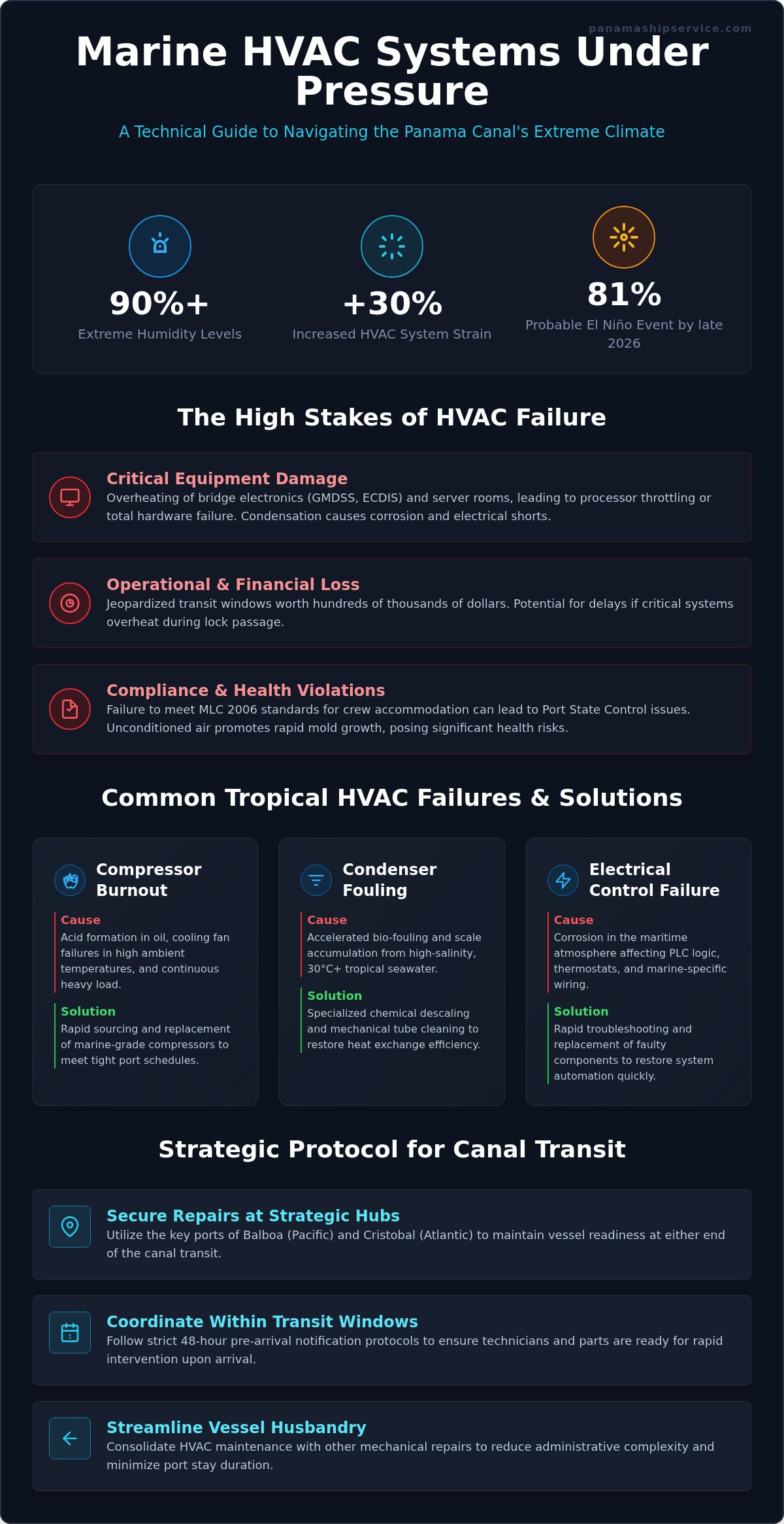
Panama’s tropical environment presents one of the most challenging climates for maritime operations. Humidity levels in the region frequently exceed 90%, forcing HVAC systems to work approximately 30% harder than they would in temperate zones. This constant load isn’t merely a matter of comfort; it’s a technical necessity for vessel safety. During Panama Canal transits, the combination of high ambient temperatures and moisture creates a high-risk scenario for critical onboard systems. When a cooling unit fails, the resulting spike in humidity can trigger a cascade of secondary mechanical ship repairs as condensation begins to form on cold surfaces, leading to rapid corrosion and electrical shorts.
The operational stakes are high. A vessel entering the locks with a compromised climate control system risks more than just a sweaty crew. You face potential delays if bridge systems overheat or if mold growth compromises air quality in living quarters. Securing a reliable marine air conditioning repair panama specialist before your transit window is essential to prevent these avoidable complications.
Protecting Sensitive Navigation and Communication Hardware
Modern vessels rely on sophisticated automation that is highly sensitive to thermal stress. Bridge electronics, including GMDSS and ECDIS systems, are designed to operate within narrow temperature ranges. Excessive heat leads to processor throttling or total hardware failure at the exact moment your vessel requires maximum precision. Furthermore, high humidity causes moisture to settle inside server racks and control rooms, creating conductive paths that fry circuit boards. Maintaining HVAC stability is the fundamental safeguard for modern vessel automation and safe navigation through the locks.
Compliance with International Maritime Standards
Common Marine HVAC Failures and Specialized Repair Solutions
Commercial vessels transiting the Isthmus put immense strain on their cooling infrastructure. Continuous operation in 30°C+ seawater leads to specific mechanical degradations that require immediate technical intervention. Identifying these failures early prevents a total system shutdown during your transit. Unlike smaller yacht services, commercial marine air conditioning repair panama requires heavy-duty solutions for high-capacity systems.
Electrical control failures often stem from the corrosive maritime atmosphere. Troubleshooting PLC logic or replacing faulty thermostats requires technicians who understand marine-specific wiring diagrams. We focus on restoring automation quickly to maintain climate stability for sensitive bridge equipment. If your crew reports fluctuating temperatures, it’s often a precursor to a total electrical failure.
Central Chiller Plant vs. DX System Repairs
Large-scale maritime chiller units require different diagnostic protocols than smaller direct expansion (DX) systems. While DX units are common in crew quarters, central chiller plants provide the heavy-duty cooling required for engine room control centers and large cargo holds. Sourcing specialized expansion valves and high-capacity pumps locally is critical for avoiding transit delays. Integrating these tasks with broader mechanical ship repairs at the Panama Canal ensures all auxiliary systems, including circulating pumps and motors, are synchronized for peak performance.
Refrigerant Management and MARPOL Compliance
Environmental stewardship is a priority under MARPOL Annex VI regulations. We manage modern refrigerants like R-134a and R-407C with strict recovery and logging procedures. The Panama Canal Authority (ACP) expects all technical services to adhere to rigorous environmental standards during port stays. Every system must undergo a comprehensive pressure and vacuum leak test before any refrigerant recharge occurs to prevent atmospheric discharge. Proper documentation of gas consumption is mandatory for your vessel’s environmental record book. If your system shows signs of reduced cooling capacity, consulting with a technical partner ensures your repairs are both technically sound and legally compliant.
Strategic Advantages of Sourcing A/C Repairs at Balboa and Cristobal
Panama’s unique geography offers a strategic window for technical maintenance that few other global hubs can match. By positioning marine air conditioning repair panama services at both the Pacific and Atlantic entrances, vessel operators can address critical HVAC issues without deviating from their primary route. This logistical setup allows for a “fix in transit” approach that preserves your schedule and ensures the vessel remains fully operational during the most demanding segments of the voyage.
Balboa, located on the Pacific side, serves as the ideal staging point for northbound vessels. It’s the final opportunity to stabilize climate control systems before the ship enters the locks and faces the peak humidity of the canal interior. Conversely, Cristobal on the Atlantic side is strategic for southbound vessels exiting the canal. These ships often require immediate attention after the intense thermal load of the transit. Consolidating HVAC work with marine surveys in Panama during these stops maximizes your port time, allowing multiple technical inspections to occur simultaneously under a single administrative umbrella.
Anchorage Repairs: Minimizing Port Fees
Berthing a commercial vessel for minor technical work is often cost-prohibitive and slow. We utilize 24/7 mobile repair teams that meet vessels at anchorage, significantly reducing port fees and avoiding the complexities of pier-side logistics. Barge-based technicians can board your vessel at the Pacific or Atlantic anchorages to begin diagnostics immediately. For heavy components like compressors or large blower motors, we coordinate supply boat logistics to deliver parts directly to the vessel. Our teams follow strict safety protocols for over-the-side technical work, ensuring that all repairs meet both local safety standards and international environmental regulations regarding refrigerant containment.
Local Expertise and Spare Parts Availability
Panama’s status as a global logistics center ensures superior access to ship supplies and specialized components. We maintain a robust inventory of spare parts for major international HVAC brands, including Carrier, Daikin, and Hi-Air. This local availability drastically reduces lead times compared to other regional ports. By working with an established local provider, you avoid the customs delays and high import duties often associated with flying in parts from overseas. We handle the entire procurement and clearance process, delivering “door-to-deck” service that keeps your maintenance schedule on track. It’s a pragmatic solution for busy superintendents who don’t have time to manage complex local supply chains themselves.
Navigating Logistics: Coordinating Repairs During Your Transit Window
The success of a technical intervention at the Isthmus depends entirely on synchronization with the vessel’s movement. You don’t have the luxury of extended port stays when a pilotage slot is confirmed. We require a 48-hour pre-arrival notification to ensure that all necessary components and technicians are staged and ready. This lead time allows us to review your technical specifications, verify refrigerant compatibility, and secure the necessary boarding permits before your hull reaches the anchorage. Precision in marine air conditioning repair panama means the work begins the moment the ladder is down.
Working within the Panama Canal Authority (ACP) schedule is a non-negotiable constraint. A standard transit takes between 8 and 12 hours, leaving a narrow margin for error. If a system failure is identified while the vessel is already in the queue, our teams can perform ‘on-the-fly’ repairs during the passage. This proactive approach is a core component of minimizing vessel downtime in Panama, ensuring that technical issues are resolved without losing your reserved transit slot. We prioritize efficiency to keep your operational costs from escalating due to avoidable delays.
Communication Between Agent, Vessel, and Technician
Clear data transmission is the backbone of a successful repair. We expect chief engineers to provide detailed fault reports, including compressor model numbers and electrical load requirements, well before arrival. Our office coordinates directly with your local agent to manage the logistical hurdles of restricted zones. The local agent acts as the vital link that synchronizes technician boarding times with the ever-shifting ACP transit sequence. Without this high-level coordination, even the simplest repair can become a logistical bottleneck.
Emergency 24/7 Response for Critical Failures
A total HVAC blackout in the tropical heat is a mission-critical emergency that requires an immediate, multi-disciplinary response. We mobilize teams that combine electrical proficiency with mechanical expertise to diagnose and resolve total system failures under pressure. Whether it’s a blown control board or a catastrophic compressor seizure, our 24/7 response capability ensures your crew and electronics aren’t left in a dangerous environment. Every emergency intervention concludes with rigorous post-repair testing and performance certification to meet class approval standards. If you’re facing a critical cooling failure, contact our technical coordination team immediately to secure an emergency boarding slot.
Panama Ship Service: Your Partner for Marine HVAC Excellence
Panama Ship Service functions as a specialized technical hub at the heart of global trade. We understand that technical superintendents require more than just a quick fix; they need a partner capable of managing complex systems under extreme time pressure. Our team provides comprehensive marine air conditioning repair panama services that integrate naturally into your vessel’s husbandry requirements. We don’t just repair hardware. We ensure your vessel maintains its operational certifications and stays on schedule through the most demanding maritime corridor in the world.
Our personnel are specifically trained for the high-capacity chiller plants and DX systems found on Neopanamax and Super vessels. We maintain a strict adherence to MARPOL Annex VI and ACP environmental regulations, ensuring all refrigerant handling is logged and compliant with international standards. This commitment to technical excellence has made us a trusted partner for the world’s leading shipping lines during their most critical transits. We treat every work order with the urgency the industry demands, providing a calm and expert presence in a high-pressure environment.
Why Consolidate Repairs with One Provider?
Fragmenting technical services across multiple vendors creates unnecessary administrative friction and increases the risk of miscommunication. By consolidating your mechanical repairs, HVAC maintenance, and surveys with a single provider, you gain significant financial efficiency. Managing one consolidated invoice reduces your overhead and simplifies cost tracking for the owner. You also benefit from a single point of technical accountability. If a cooling pump requires service during an HVAC overhaul, our multi-disciplinary teams handle both tasks simultaneously, ensuring consistency in safety standards and reporting across all work orders.
Request a Quote for Marine A/C Repair
To provide an accurate remote assessment and a firm quote, we require specific technical data before your vessel reaches the anchorage. Please include compressor serial numbers, current refrigerant types, and recent fault logs in your initial communication. This information allows us to stage parts and technicians before your hull reaches the locks. Our 2026 service commitment focuses on providing the global maritime community with rapid, reliable, and transparent technical support. Our 24/7 technical operations desk is always available to coordinate emergency boardings or scheduled maintenance. Contact us today to secure your technical service slot and ensure your vessel’s climate control systems are ready for the challenges of the Panama Canal.
Securing Your Vessel’s Operational Readiness for the Isthmus
Climate control is a mission-critical requirement for any vessel transiting the Isthmus. We’ve established how extreme humidity affects bridge electronics and why MARPOL compliance is essential for modern refrigerant handling. Navigating these technical demands requires a partner who understands the specific logistical pressures of the Panama Canal Authority schedule.
Our specialized teams provide 24/7 technical support in Balboa and Cristobal, offering integrated mechanical and HVAC solutions that minimize your port stay. Every intervention is performed by certified MARPOL refrigerant technicians to protect your environmental record. Don’t let a system failure compromise your transit window or crew welfare.
Request an Urgent Marine A/C Repair Quote to secure your technical service slot. Trust our experienced team to deliver the high-stakes marine air conditioning repair panama services your vessel requires for a safe and efficient passage. We look forward to supporting your fleet’s success in 2026.
Frequently Asked Questions
What types of marine A/C systems can you repair in Panama?
We provide comprehensive repair services for central chiller plants, direct expansion (DX) systems, and self-contained units. Our technicians specialize in the high-capacity infrastructure found on commercial vessels, including Neopanamax and Super vessels. Whether your system requires a minor electrical fix or a major overhaul of the primary cooling plant, we have the technical expertise to handle the job at either canal entrance.
Can you perform HVAC repairs while the vessel is transiting the Panama Canal?
Yes, we offer ‘on-the-fly’ repairs during the 8 to 12-hour canal passage to maximize your operational efficiency. Technicians can board at the Pacific or Atlantic anchorage and perform work while the vessel moves through the locks. This proactive approach ensures that your climate control is restored without sacrificing your reserved transit slot or incurring additional port fees for extended berthing.
How long does it take to replace a marine compressor in Balboa or Cristobal?
A standard compressor replacement typically takes between 6 and 12 hours once the component is on deck. The exact duration depends on the unit’s location and the complexity of the piping configuration. Because we understand the time-sensitive nature of marine air conditioning repair panama, we stage all necessary tools and gases in advance to ensure the work fits within your scheduled port stay.
Are your technicians certified for MARPOL-compliant refrigerant handling?
Every technician on our team is fully certified for MARPOL-compliant refrigerant handling and recovery. We utilize specialized equipment to prevent any atmospheric discharge during the repair process, ensuring your vessel remains in compliance with international environmental standards. We also provide the mandatory documentation and logging required for your vessel’s environmental record book to satisfy port state control inspections.
Do you keep common spare parts for brands like Carrier and Daikin in stock?
We maintain a robust local inventory of essential spare parts for major international brands, including Carrier, Daikin, and Hi-Air. Our stock includes expansion valves, thermostats, contactors, and various compressor models. By sourcing these components locally in Panama, we eliminate the customs delays and high freight costs associated with flying in parts from overseas, allowing for a much faster technical turnaround.
Is it possible to combine A/C repair with an underwater hull inspection?
Our one-stop-shop model allows you to consolidate HVAC repairs with underwater hull services or mechanical ship repairs. Coordinating these tasks through a single provider reduces your administrative burden and ensures that multiple technical teams work in sync. This integrated approach is the most efficient way to handle vessel husbandry, as it simplifies communication and results in a single, consolidated invoice for the owner.
What information do you need to provide a repair quote before we arrive?
We require the compressor model number, the specific refrigerant type (such as R-134a or R-404A), and a detailed fault report from the chief engineer. Providing electrical specifications and recent maintenance logs also helps our technical desk perform an accurate remote assessment. This data allows us to provide a firm quote and ensure that the correct parts are staged before your vessel reaches the anchorage.
How do you handle emergency HVAC failures during the night or on weekends?
We operate a 24/7 technical operations desk to handle emergency HVAC failures at any time, including nights and weekends. Our response teams are always on standby at both Balboa and Cristobal to address total system blackouts or critical cooling losses. We understand that technical emergencies don’t follow a schedule, so we maintain constant readiness to board your vessel and restore climate control immediately.